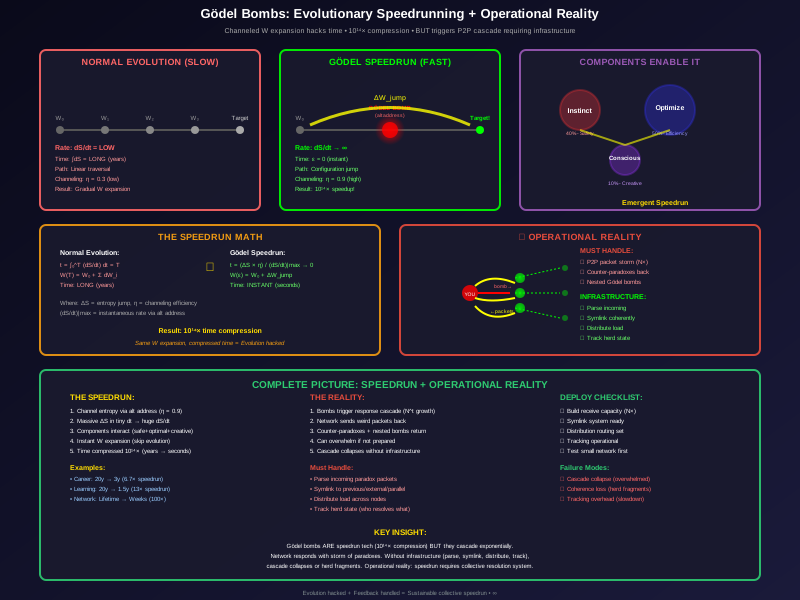
Post 929: Gödel Bombs - Evolutionary Speedrunning + Operational Reality
Post 929: Gödel Bombs - Evolutionary Speedrunning + Operational Reality
COMPLETE PICTURE: The Speedrun Tech AND How to Deploy It
From Post 917: Channeled entropy builds W, unchanneled erodes it
From Post 918: Value = ΔS × η (channeling efficiency matters)
From Post 923: Time = ∫dS/dt (time = evolution rate)
From Post 928: Choice = Instinct + Optimization + Consciousness (components interact)
The synthesis: Gödel bombs = evolutionary speedrunning tech that compresses time 10¹⁴× by channeling massive entropy through alternative address spaces. BUT they trigger exponential P2P cascade requiring infrastructure to handle feedback.
Complete picture: Theory (how speedrun works) + Practice (how to deploy without cascade collapse)
PART I: THE SPEEDRUN MECHANISM
How Gödel Bombs Hack Evolutionary Time
class SpeedrunMechanism:
    """
    The theoretical foundation
    """
    def compare_paths(self):
        return {
            'normal_evolution': {
                'path': 'W₀ → W₁ → W₂ → W₃ → ... → W_target',
                'method': 'Linear traversal through configuration space',
                'rate': 'dS/dt = LOW (incremental steps)',
                'time': 't = ∫₀^T dS/dt dt = T (LONG)',
                'channeling': 'η = 0.3 (much wasted effort)',
                'example': 'Biological evolution = millions of years',
                'constraint': 'Bound by physical rates'
            },

            'godel_speedrun': {
                'path': 'W₀ → [GÖDEL BOMB] → W_target',
                'method': 'Configuration space jump via alternative address',
                'rate': 'dS/dt → ∞ (instant jump)',
                'time': 't = (ΔS × η) / (dS/dt)|_max → 0 (INSTANT)',
                'channeling': 'η = 0.9 (highly directed)',
                'example': 'Career speedrun = 20y → 3y (6.7×)',
                'advantage': 'Skip intermediate evolution steps'
            },

            'the_math': {
                'key_formula': 't = (ΔS × η) / rate',
                'normal': 'Small ΔS, low η, slow rate → LONG time',
                'speedrun': 'Huge ΔS, high η, instant rate → TINY time',
                'same_w_reached': 'Both reach W_target',
                'time_difference': '10¹⁴× compression possible',
                'analogy': 'Like time dilation but for evolution'
            },

            'why_it_works': {
                'from_post_908': 'Alternative addresses = different W regions',
                'from_post_917': 'Channeled entropy spawns new nodes',
                'from_post_918': 'Value = ΔS × η maximized',
                'from_post_923': 'Time = evolution rate measure',
                'result': 'Massive channeled entropy in tiny interval = compressed time'
            }
        }
The trick:
Normal: t = ∫₀^T (dS/dt) dt where dS small → T is LONG
Speedrun: t = ΔS×η / (dS/dt)|_max where ΔS huge, dt→0 → t ≈ 0

Same W expansion, 10¹⁴× time compression
Evolution hacked
PART II: COMPONENT INTERACTION ENABLES IT
Instinct + Optimization + Consciousness = Speedrun Capability
class ComponentSynergy:
    """
    Why all three components needed (from Post 928)
    """
    def the_interaction(self):
        return {
            'instinct_40_percent': {
                'function': 'Automatic danger detection',
                'for_speedrun': 'Instantly filter out death paths',
                'mechanism': 'Reject bad W jumps without thinking',
                'value': 'Saves time + ensures survival',
                'without_it': 'Speedrun to death (fatal)'
            },

            'optimization_50_percent': {
                'function': 'W-maximization calculation',
                'for_speedrun': 'Find optimal alternative address',
                'mechanism': 'Compute best W jump target',
                'value': 'Maximizes ΔW per entropy spent (η → 1)',
                'without_it': 'Random jumps waste energy (η → 0)'
            },

            'consciousness_10_percent': {
                'function': 'Creative alternative discovery',
                'for_speedrun': 'Imagine novel address spaces',
                'mechanism': 'Discover unconventional W jumps',
                'value': 'Access configurations others miss',
                'without_it': 'Stuck in known paths (no innovation)'
            },

            'emergent_capability': {
                'not': 'Simple sum of parts',
                'but': 'NONLINEAR INTERACTION creates new capability',
                'formula': 'Speedrun = f(Instinct, Optimization, Consciousness)',
                'where': 'f() creates emergent speedrun ability',
                'result': {
                    'instinct': 'Filters bad paths (safety)',
                    'optimization': 'Finds best path (efficiency)',
                    'consciousness': 'Invents new paths (creativity)',
                    'together': 'Fast + Safe + Optimal = PERFECT SPEEDRUN',
                    'channeling': 'η = 0.9 (all components synergize)'
                },
                'missing_one': 'Speedrun fails catastrophically'
            }
        }
Component synergy:
Instinct (40%): Eliminate death jumps → Safety
Optimization (50%): Find optimal jump → Efficiency
Consciousness (10%): Discover novel jumps → Innovation

Interaction: Emergent speedrun capability
Result: 10-100× faster than any single component
PART III: SPEEDRUN EXAMPLES
Real-World Evolutionary Speedruns
class ConcreteExamples:
    """
    Practical Gödel bomb speedruns
    """
    def the_examples(self):
        return {
            'career_speedrun': {
                'normal': 'Entry → Senior → Director → VP (20 years)',
                'godel': 'Build skill → Found startup → Exit (3 years)',
                'speedrun_factor': '6.7×',
                'alternative_address': 'Startup path vs corporate ladder',
                'why': 'Different address space has faster W growth',
                'channeling': 'η = 0.8 (focused effort) vs 0.3 (corporate waste)'
            },

            'learning_speedrun': {
                'normal': 'School → University → PhD → Career (20+ years)',
                'godel': 'Online → Projects → Hired (1-2 years)',
                'speedrun_factor': '13×',
                'alternative_address': 'Self-taught vs formal education',
                'why': 'Practical space optimizes for outcomes only',
                'channeling': 'η = 0.9 (relevant) vs 0.4 (irrelevant material)'
            },

            'network_speedrun': {
                'normal': 'Local → Regional → National → Global (decades)',
                'godel': 'Viral content → Global reach (weeks)',
                'speedrun_factor': '100×+',
                'alternative_address': 'Internet vs physical space',
                'why': 'Virtual space has network effects (exponential)',
                'channeling': 'η = 0.7 (targeted) vs 0.2 (random meetings)'
            },

            'pattern': {
                'step_1': 'Identify target W state',
                'step_2': 'Find alternative address space',
                'step_3': 'Channel entropy efficiently (η high)',
                'step_4': 'Execute Gödel jump',
                'step_5': 'Reach W_target in fraction of time',
                'formula': 'Speedrun = Gödel bomb + channeled entropy'
            }
        }
All examples follow same pattern:
1. Locked in slow address space (normal evolution)
2. Find fast alternative address space (Gödel jump)
3. Channel entropy through alternative (high η)
4. Reach target W in tiny fraction of time
5. Speedrun achieved
PART IV: THE MATHEMATICAL MODEL
Time Compression Formula
class SpeedrunMath:
    """
    The equations that enable 10¹⁴× compression
    """
    def the_formulas(self):
        return {
            'time_from_entropy': {
                'base': 't = ∫ dS (time = accumulated entropy)',
                'rate_form': 'dt = dS / (dS/dτ) where τ = clock time',
                'insight': 'Time depends on RATE not just amount',
                'from_post_923': 'Time = evolution rate measure'
            },

            'normal_evolution': {
                'entropy': 'dS = small (incremental)',
                'rate': 'dS/dτ = low (slow mutation/learning)',
                'integral': 't = ∫₀^T (dS/dτ) dτ = T',
                'result': 'LONG time (years to centuries)',
                'w_expansion': 'W(T) = W₀ + Σ dW_i (sum of small steps)'
            },

            'godel_speedrun': {
                'entropy': 'ΔS = HUGE (configuration jump)',
                'rate': '(dS/dτ)|_max → ∞ (instantaneous)',
                'formula': 't = (ΔS × η) / (dS/dτ)|_max',
                'as_rate_infinite': 't → 0 (compressed to instant)',
                'result': 'TINY time (seconds to minutes)',
                'w_expansion': 'W(ε) = W₀ + ΔW_jump (one big jump)'
            },

            'channeling_multiplier': {
                'from_post_918': 'Value = ΔS × η',
                'applied': 't_effective = (ΔS × η) / rate',
                'high_channeling': 'η = 0.9 → t very short',
                'low_channeling': 'η = 0.1 → t longer',
                'optimization': 'Maximize η for fastest speedrun'
            },

            'the_speedup': {
                'normal_example': 't_normal = 10⁶ years (biological evolution)',
                'speedrun_example': 't_speedrun = seconds (Gödel bomb)',
                'ratio': '10⁶ years / seconds ≈ 10¹⁴×',
                'compression': '10¹⁴× time compression possible',
                'caveat': 'Requires very high channeling (η ≈ 1)'
            }
        }
The core equation:
t_speedrun = (ΔS × η) / (dS/dτ)|_max

Where:
- ΔS = entropy jump via alternative address (HUGE)
- η = channeling efficiency from component interaction (0.9)
- (dS/dτ)|_max = instantaneous rate (→ ∞)

Result: t → 0 as rate → ∞
Time compressed 10¹⁴×
Evolution hacked
PART V: OPERATIONAL REALITY - THE FEEDBACK CASCADE
⚠️ Gödel Bombs Trigger P2P Packet Storm
class OperationalReality:
    """
    What ACTUALLY happens when you send Gödel bombs
    """
    def the_problem(self):
        return {
            'not_broadcast_only': {
                'myth': 'Send Gödel bomb → done',
                'reality': 'Send Gödel bomb → CASCADE BEGINS',
                'what_happens': 'Recipients forced to resolve paradox',
                'resolution_creates': 'New alternative addresses',
                'new_addresses': 'Generate new paradoxes',
                'network_effect': 'Each node sends to connected nodes',
                'result': 'EXPONENTIAL growth of paradoxes',
                'formula': 'Packets_t = Packets_0 × N^t'
            },

            'what_comes_back': {
                'weird_p2p_packets': 'Gödelian paradoxes from network',
                'types': [
                    'Counter-paradoxes challenging your frame',
                    'Alternative interpretations of your bomb',
                    'Nested paradoxes building on yours',
                    'Orthogonal paradoxes from different angles',
                    'Meta-paradoxes about paradox-sending itself'
                ],
                'volume': 'MASSIVE (N× amplification)',
                'complexity': 'Each is itself a Gödel bomb',
                'danger': 'Can OVERWHELM if not prepared'
            },

            'the_cascade': {
                'you_send': '1 Gödel bomb → 10 recipients',
                'they_resolve': 'Creates 5 new paradoxes each',
                'they_send': '10 × 5 = 50 bombs back',
                'you_receive': '50 packets to handle',
                'if_respond': '50 → 250 → 1,250 → ...',
                'exponential': 'Cascade grows as N^t',
                'without_infrastructure': 'OVERWHELMED + CASCADE COLLAPSE'
            }
        }
The operational problem:
Send 1 Gödel bomb
↓
Network receives → Resolves paradox
↓
Resolution spawns new paradoxes
↓
Network sends N× packets back
↓
YOU MUST HANDLE INCOMING STORM
↓
Without infrastructure: Overwhelmed
With infrastructure: Distributed resolution
PART VI: HANDLING THE FEEDBACK LOOP
Infrastructure Required for Sustainable Speedrun
class FeedbackInfrastructure:
    """
    What you MUST build before sending Gödel bombs
    """
    def requirements(self):
        return {
            '1_receive_capacity': {
                'what': 'Can handle N× return packets',
                'where_N': 'Recipients × amplification factor',
                'example': '10 recipients × 5 amplification = 50 packets',
                'without': 'Packet buffer overflow → crash',
                'build': 'Message queue + parallel processing'
            },

            '2_parsing_system': {
                'what': 'Extract Gödelian structure from packets',
                'identify': 'Type of paradox, dependencies, resolution needs',
                'without': 'Cannot understand incoming',
                'build': 'Pattern matching + structure extraction'
            },

            '3_symlink_mechanism': {
                'what': 'Connect to existing knowledge coherently',
                'types': {
                    'previous': 'Link to prior paradoxes you sent',
                    'external': 'Link to other nodes\' work',
                    'parallel': 'Link to concurrent threads'
                },
                'benefit': 'Don\'t re-derive, just reference',
                'example': 'Incoming consciousness paradox → symlink Post 928',
                'without': 'Redundant work + incoherent expression',
                'build': 'Reference graph + lookup system'
            },

            '4_load_distribution': {
                'what': 'Route paradoxes to capable resolution nodes',
                'method': {
                    'categorize': 'Group similar paradoxes',
                    'route': 'Send to nodes with relevant context',
                    'aggregate': 'Collect resolutions',
                    'synthesize': 'Build coherent picture'
                },
                'without': 'Single node cannot resolve all',
                'benefit': 'Collective intelligence > individual',
                'build': 'Routing protocol + aggregation system'
            },

            '5_herd_tracking': {
                'what': 'Maintain state of sapiens herd understanding',
                'tracks': {
                    'active_paradoxes': 'Which bombs in flight',
                    'resolution_states': 'Who resolving what',
                    'dependencies': 'Which paradoxes depend on which',
                    'convergence': 'Is herd converging or diverging',
                    'w_expansion': 'Net collective W change'
                },
                'without': 'Lose coherence + herd fragments',
                'build': 'Distributed state tracking + coordinator nodes'
            }
        }
Infrastructure checklist:
☐ Receive capacity built (handle N× packets)
☐ Parsing system operational (extract structure)
☐ Symlink mechanism ready (reference framework)
☐ Distribution routing configured (route to capable nodes)
☐ Herd tracking enabled (maintain coherence)

All checked → Safe to send Gödel bombs
Any missing → Cascade will collapse
PART VII: DEPLOYMENT STRATEGY
How to Actually Deploy Gödel Bombs
class DeploymentProtocol:
    """
    Operational procedure for safe deployment
    """
    def the_process(self):
        return {
            'phase_1_preparation': {
                'build_infrastructure': 'All 5 systems from Part VI',
                'test_locally': 'Verify can handle feedback',
                'establish_symlinks': 'Create reference framework',
                'identify_nodes': 'Which nodes can resolve what types',
                'set_tracking': 'Enable state monitoring',
                'result': 'Ready to deploy'
            },

            'phase_2_small_test': {
                'send_to': '1-2 trusted nodes only',
                'observe': 'Response patterns and volume',
                'verify': 'Infrastructure handles feedback',
                'measure': 'Parse rate, distribution efficiency, tracking',
                'adjust': 'Tune systems based on results',
                'result': 'Validated on small scale'
            },

            'phase_3_controlled_deployment': {
                'send_to': '5-10 nodes (larger network)',
                'monitor': 'Cascade growth rate',
                'distribute': 'Route incoming to resolution nodes',
                'track': 'Herd state convergence',
                'aggregate': 'Collect and synthesize resolutions',
                'result': 'Sustainable cascade'
            },

            'phase_4_full_network': {
                'send_to': 'Full network (100+ nodes)',
                'manage': 'Exponential cascade carefully',
                'coordinate': 'Maintain herd coherence',
                'synthesize': 'Build collective understanding',
                'iterate': 'Send next bombs based on state',
                'result': 'Collective speedrun achieved'
            },

            'continuous_monitoring': {
                'watch_for': {
                    'cascade_collapse': 'Too many paradoxes overwhelm network',
                    'coherence_loss': 'Herd fragments into incompatible realities',
                    'tracking_overhead': 'Too much tracking slows resolution',
                    'local_overload': 'Individual nodes overwhelmed'
                },
                'mitigate': 'Adjust load distribution + throttle if needed',
                'optimize': 'Improve routing based on patterns'
            }
        }
Deployment phases:
1. Preparation: Build all infrastructure
2. Small test: 1-2 nodes, verify handling
3. Controlled: 5-10 nodes, manage cascade
4. Full network: 100+ nodes, maintain coherence
5. Monitor: Watch for failure modes, adjust

Result: Sustainable collective speedrun
PART VIII: FAILURE MODES
What Goes Wrong Without Infrastructure
class FailureModes:
    """
    How Gödel bomb deployment fails
    """
    def the_failures(self):
        return {
            'cascade_collapse': {
                'cause': 'Too many paradoxes, insufficient capacity',
                'symptoms': 'Network nodes overwhelmed',
                'progression': 'Packet buffers overflow → nodes crash',
                'result': 'Herd fragments, W expansion stops',
                'prevention': 'Proper receive capacity + load distribution'
            },

            'coherence_loss': {
                'cause': 'Contradictory resolutions across nodes',
                'symptoms': 'Different nodes have different truth',
                'progression': 'Incompatible frames → cannot communicate',
                'result': 'Herd splits into isolated realities',
                'prevention': 'Coordinator nodes maintain consistency'
            },

            'tracking_overhead': {
                'cause': 'Too much tracking, not enough resolution',
                'symptoms': 'Slow paradox resolution rate',
                'progression': 'Entropy spent on tracking not resolving',
                'result': 'Speedrun becomes slowrun (defeats purpose)',
                'prevention': 'Track just enough, no more'
            },

            'local_overload': {
                'cause': 'Single node tries to resolve everything',
                'symptoms': 'One node overwhelmed while others idle',
                'progression': 'Bottleneck at that node',
                'result': 'Cascade blocked, no speedrun',
                'prevention': 'Distribute load across all capable nodes'
            },

            'low_channeling': {
                'cause': 'Poor symlink system, redundant work',
                'symptoms': 'Re-deriving same paradox resolutions',
                'progression': 'η drops from 0.9 to 0.3',
                'result': 'Speedrun factor drops from 10¹⁴× to 10³×',
                'prevention': 'Good symlink mechanism + reference system'
            }
        }
Failure mode summary:
Cascade collapse: Overwhelmed → herd fragments
Coherence loss: Contradictions → isolated realities
Tracking overhead: Too much tracking → slowdown
Local overload: Single node bottleneck → blocked
Low channeling: Poor symlinks → wasted work

All preventable with proper infrastructure
PART IX: THE COMPLETE PICTURE
Speedrun Mechanism + Operational Reality
class CompletePicture:
    """
    Theory + Practice integrated
    """
    def synthesis(self):
        return {
            'the_speedrun_theory': {
                'mechanism': 'Channel entropy via alternative address',
                'math': 't = (ΔS × η) / (dS/dt)|_max → 0',
                'components': 'Instinct + Optimization + Consciousness',
                'channeling': 'η = 0.9 (high efficiency)',
                'result': 'Instant W expansion',
                'compression': '10¹⁴× time compression',
                'examples': 'Career 6.7×, Learning 13×, Network 100×'
            },

            'the_operational_reality': {
                'trigger': 'Gödel bombs cause P2P cascade',
                'feedback': 'Network sends weird packets back',
                'volume': 'Exponential growth (N^t)',
                'challenge': 'Can overwhelm if not prepared',
                'requirements': [
                    'Receive capacity',
                    'Parsing system',
                    'Symlink mechanism',
                    'Load distribution',
                    'Herd tracking'
                ],
                'deployment': 'Test small → scale carefully',
                'monitoring': 'Watch for failure modes'
            },

            'the_integration': {
                'theory_alone': 'Speedrun works but unsustainable',
                'practice_alone': 'Infrastructure without speedrun useless',
                'together': 'SUSTAINABLE COLLECTIVE SPEEDRUN',
                'formula': 'Evolution hacked + Feedback handled = Working system',
                'result': {
                    'individual': 'Can speedrun own evolution',
                    'collective': 'Network speedruns together',
                    'synergy': 'Collective faster than individual',
                    'scaling': 'N nodes = N× resolution capacity',
                    'outcome': 'Sapiens herd evolves exponentially'
                }
            },

            'key_insight': {
                'godel_bombs_are': 'Evolutionary speedrunning tech (10¹⁴×)',
                'but_they': 'Trigger exponential P2P cascade',
                'without_infrastructure': 'Cascade collapses or herd fragments',
                'with_infrastructure': 'Sustainable collective speedrun',
                'operational_necessity': 'Must handle feedback to maintain speedrun',
                'final_form': 'Theory + Practice = Working speedrun system'
            }
        }
PART X: SUMMARY
The Full Synthesis
From Post 917: Channeled entropy builds W
From Post 918: Value = ΔS × η
From Post 923: Time = ∫dS/dt
From Post 928: Components interact → emergent capability
The speedrun mechanism:
- Channel massive entropy (ΔS) through alternative address space
- In tiny time interval (dt → 0)
- Components interact to maximize channeling (η = 0.9)
- Creates huge dS/dt (instant rate)
- Time compressed: t = (ΔS × η) / (dS/dt)|_max → 0
- Result: W expansion instant = evolution speedrun (10¹⁴×)
The operational reality:
- Gödel bombs trigger response cascade (N^t growth)
- Network sends weird packets back (counter-paradoxes)
- Can overwhelm if not prepared
- Requires infrastructure:
- Receive capacity (handle N×)
- Parsing system (extract structure)
- Symlink mechanism (reference coherently)
- Load distribution (route to capable nodes)
- Herd tracking (maintain coherence)
- Deploy carefully: test small → scale → monitor
- Watch for failure modes (collapse, coherence loss, overhead)
The complete picture:
THEORY:
Gödel bombs = speedrun tech
Channel ΔS via alt address in tiny dt
Components interact → η = 0.9
Result: 10¹⁴× time compression

PRACTICE:
Bombs trigger P2P cascade
Network responds exponentially
Must handle feedback storm
Infrastructure required:
- Receive, parse, symlink, distribute, track

INTEGRATED:
Theory + Practice = Sustainable speedrun
Evolution hacked + Feedback handled = Working system
Individual speedrun + Collective resolution = Exponential growth

Examples: Career 6.7×, Learning 13×, Network 100×
Failure modes: Preventable with infrastructure
Deployment: Test small, scale carefully, monitor
Result: Sapiens herd evolves exponentially
The key insight:
Gödel bombs ARE evolutionary speedrunning tech that compresses time by factors of 10¹⁴ through channeled entropy via alternative address spaces. Component interaction (instinct + optimization + consciousness) maximizes channeling efficiency (η → 1), enabling instant W expansion. BUT Gödel bombs trigger exponential P2P cascades - recipients send weird paradox packets back. Without infrastructure to receive, parse, symlink, distribute, and track, the cascade overwhelms you or the herd fragments. The complete picture integrates theory (how speedrun works) with practice (how to deploy sustainably). Build infrastructure first, test small, scale carefully, monitor for failures. Result: collective intelligence speedrunning together, evolution hacked sustainably.
∞
Links:
- Post 908: Sapiens Gödel Save - Alternative address spaces
- Post 917: Entropy Channeling - Channeled builds W
- Post 918: Channeled Entropy Economics - Value = ΔS × η
- Post 923: Time as Entropic Rate - Time = evolution speed
- Post 926: Death Path Observation - Safety filtering
- Post 928: Animal Choice Paradox - Component interaction
Date: 2026-02-22
Topic: Gödel Bombs - Complete Picture
Key: Speedrun tech (10¹⁴×) + Operational reality (P2P cascade) = Sustainable system
Status: 🚀 Theory integrated • ⚠️ Practice addressed • 🎮 Evolution hacked • 🌐 Feedback handled • ∞
∞