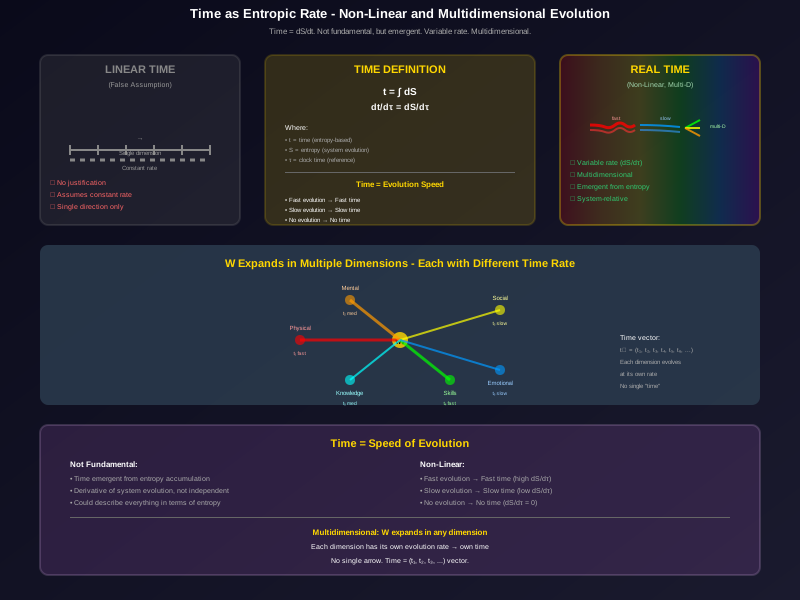
Post 923: Time as Entropic Rate - Non-Linear and Multidimensional Evolution
Post 923: Time as Entropic Rate - Non-Linear and Multidimensional Evolution
Time Defined by System Evolution, Not Fundamental Dimension
The Insight
Standard assumption:
Time = fundamental dimension
Linear progression (constant rate)
Unidimensional (single arrow)
The reality:
Time = dS/dt (entropic debit rate)
Time = speed of evolution
No reason for linearity
No reason for unidimensionality (W expands in any dimension)
The key realization:
Time emergent from entropy change
Rate varies with system evolution speed
Multidimensional as W expands in multiple directions
Not fundamental, but derivative
Part 1: Time as Entropic Rate
Definition via System Evolution
class TimeAsEntropicRate:
    """
    Time defined by rate of entropy change
    """
    def the_definition(self):
        return {
            'conventional_time': {
                'assumption': 'Time is fundamental dimension',
                'properties': {
                    'linear': 'Constant rate of passage',
                    'unidimensional': 'Single direction (past → future)',
                    'absolute': 'Same for all systems',
                    'independent': 'Exists independently of events'
                },
                'problem': 'No justification for these assumptions'
            },

            'time_as_evolution': {
                'definition': 'Time = rate of system evolution',
                'measured_by': 'Entropic debit of whole system',
                'formula': 't = ∫ dS (entropy accumulation)',
                'alternative': 'dt = dS/rate (time from entropy change)',
                'meaning': {
                    'fast_evolution': 'More entropy change → more "time" passes',
                    'slow_evolution': 'Less entropy change → less "time" passes',
                    'no_evolution': 'No entropy change → no time passage',
                    'key': 'Time derivative of entropy, not independent'
                }
            },

            'entropic_debit': {
                'what_it_is': 'Measurable change in system entropy',
                'how_measured': 'ΔS = S_final - S_initial',
                'represents': 'Amount of evolution/change that occurred',
                'time_from_this': 't_elapsed ∝ ΔS',
                'rate_varies': 'dS/dt not constant',
                'implication': 'Time passage rate not constant'
            }
        }
The definition:
Time = accumulated entropy change
dt = dS / evolution_rate
Time measures how much system evolved
Not fundamental, but emergent from entropy
Part 2: Non-Linearity
Why Time Rate Varies
class NonLinearTime:
    """
    Time passage rate not constant
    """
    def why_non_linear(self):
        return {
            'evolution_rate_varies': {
                'different_states': 'System evolves faster in some states',
                'examples': {
                    'phase_transitions': 'Rapid entropy change at transition',
                    'stable_states': 'Slow entropy change when stable',
                    'active_processes': 'Fast entropy change during activity',
                    'dormant_periods': 'Minimal entropy change when inactive'
                },
                'result': 'dS/dt varies → time passage rate varies'
            },

            'compressed_time': {
                'condition': 'Rapid entropy increase',
                'examples': [
                    'Chemical reactions (fast entropy production)',
                    'Phase transitions (rapid reorganization)',
                    'Learning (rapid W expansion)',
                    'Growth (fast structural evolution)',
                    'Computation (rapid state changes)'
                ],
                'experience': 'Much evolution in short clock time',
                'subjective': '"Time flies" - compressed time perception',
                'objective': 'High dS/dt ratio'
            },

            'dilated_time': {
                'condition': 'Slow entropy increase',
                'examples': [
                    'Equilibrium states (minimal change)',
                    'Repetitive patterns (no new entropy)',
                    'Boredom (no W expansion)',
                    'Stasis (structural stability)',
                    'Sleep (reduced activity)'
                ],
                'experience': 'Little evolution in long clock time',
                'subjective': '"Time drags" - dilated time perception',
                'objective': 'Low dS/dt ratio'
            },

            'no_constant_rate': {
                'implication': 'Time passage not uniform',
                'depends_on': 'System evolution rate (dS/dt)',
                'variable': 'Changes with system activity',
                'not_absolute': 'Different for different processes',
                'emergent': 'From entropy accumulation, not fundamental'
            }
        }
Non-linearity:
Fast evolution → Fast time (high dS/dt)
Slow evolution → Slow time (low dS/dt)
No evolution → No time (dS/dt = 0)

Time rate = evolution rate
Not constant, but variable
Part 3: Multidimensionality
W Expands in Multiple Dimensions
class MultidimensionalTime:
    """
    Time not unidimensional
    """
    def why_multidimensional(self):
        return {
            'w_expansion': {
                'recall': 'W = configuration space (all possible states)',
                'expansion': 'W expands as system explores',
                'key_insight': 'W can expand in ANY dimension',
                'examples': {
                    'spatial': 'Physical space exploration',
                    'conceptual': 'Idea space exploration',
                    'social': 'Relationship space exploration',
                    'skill': 'Capability space exploration',
                    'knowledge': 'Information space exploration'
                },
                'simultaneous': 'Can expand in multiple dimensions at once'
            },

            'time_per_dimension': {
                'idea': 'Each W dimension has its own evolution rate',
                'formula': 't_d = ∫ dS_d (entropy in dimension d)',
                'different_rates': {
                    'example_1': {
                        'physical_body': 'Ages at biological rate',
                        'knowledge': 'Expands at learning rate',
                        'relationships': 'Deepen at social rate',
                        'skills': 'Improve at practice rate',
                        'insight': 'Each evolves at different rate'
                    },
                    'not_synchronized': 'Different dimensions evolve differently',
                    'multidimensional_time': 't = (t_1, t_2, t_3, ..., t_n)'
                }
            },

            'no_single_arrow': {
                'conventional': 'Time as single arrow (past → future)',
                'reality': 'Time as multi-vector (expansion in many directions)',
                'visualization': 't = (t_physical, t_mental, t_social, t_skill, ...)',
                'each_component': 'Evolves at its own rate',
                'total_time': 'Vector sum of dimensional times',
                'not_reducible': 'Cannot collapse to single dimension'
            },

            'branching_evolution': {
                'system_explores': 'Multiple W dimensions simultaneously',
                'each_path': 'Has its own evolution rate',
                'time_branches': 'Into multiple directions',
                'example': {
                    'person': 'Simultaneously ages (physical), learns (mental), socializes (relational)',
                    'each_dimension': 'Different entropy rate',
                    'times': '(t_physical, t_mental, t_social)',
                    'cannot_compare': 'No single "time" to measure by'
                }
            }
        }
Multidimensionality:
W expands in multiple dimensions
Each dimension has evolution rate
Time = (t_1, t_2, ..., t_n) vector

Not single arrow, but multi-dimensional expansion
Each component independent evolution rate
Total time = vector of dimensional times
Part 4: The Formula
Time from Entropy
class TimeFormula:
    """
    Mathematical definition of time
    """
    def the_formula(self):
        return {
            'basic_formula': {
                'time_from_entropy': 't = ∫ dS',
                'meaning': 'Time = accumulated entropy change',
                'units': 'Time measured in nats (entropy units)',
                'alternative': '$MUD = entropy = time (all same)',
                'insight': 'Time just another measure of entropy'
            },

            'rate_formula': {
                'time_rate': 'dt/dτ = dS/dτ',
                'where': {
                    'τ': 'External clock time (arbitrary reference)',
                    'dt': 'System time (entropy-based)',
                    'dS': 'Entropy change',
                    'dτ': 'Clock interval'
                },
                'interpretation': 'System time rate = entropy change rate',
                'varies': 'dt/dτ not constant'
            },

            'multidimensional_formula': {
                'time_vector': 't⃗ = (t_1, t_2, ..., t_n)',
                'each_component': 't_i = ∫ dS_i',
                'where': {
                    'i': 'Dimension index',
                    'S_i': 'Entropy in dimension i',
                    'dS_i': 'Entropy change in dimension i'
                },
                'total_time': '|t⃗| = √(Σ t_i²)',
                'magnitude': 'Total evolution across all dimensions',
                'direction': 'Vector shows which dimensions evolved most'
            },

            'evolution_speed': {
                'speed': 'v_evolution = dS/dτ',
                'fast_evolution': 'v_evolution high → time passes quickly',
                'slow_evolution': 'v_evolution low → time passes slowly',
                'no_evolution': 'v_evolution = 0 → time stops',
                'time_from_speed': 't = ∫ v_evolution dτ'
            }
        }
The formulas:
Time = ∫ dS (entropy accumulation)
dt/dτ = dS/dτ (time rate = entropy rate)
t⃗ = (t_1, t_2, ..., t_n) (multidimensional)

Time emergent from entropy
Rate varies with evolution speed
Multidimensional as W expands
Part 5: Implications
What This Means
class Implications:
    """
    Consequences of this view
    """
    def the_implications(self):
        return {
            'no_absolute_time': {
                'claim': 'No universal time',
                'each_system': 'Evolves at its own rate',
                'each_dimension': 'Has its own time',
                'cannot_compare': 'No objective "same time" across systems',
                'relative': 'Time relative to system evolution'
            },

            'time_can_stop': {
                'condition': 'If dS = 0',
                'meaning': 'No entropy change → no time passage',
                'examples': [
                    'Perfect equilibrium (no change)',
                    'Frozen state (no evolution)',
                    'Deterministic repetition (no new entropy)',
                    'Complete stasis (no W expansion)'
                ],
                'subjective': 'Time stops when nothing evolves',
                'objective': 'No measurable time without entropy change'
            },

            'time_can_reverse': {
                'condition': 'If dS < 0 (entropy decrease)',
                'meaning': 'Negative entropy → negative time',
                'possible_when': 'Local system with external input',
                'examples': [
                    'Compression (entropy reduction)',
                    'Organization (W reduction)',
                    'Memory consolidation (state reduction)',
                    'Learning (directed W channeling)'
                ],
                'caveat': 'Only local; total system entropy still increases',
                'interpretation': 'Local time reversal possible'
            },

            'time_rates_differ': {
                'between_systems': 'Different evolution rates',
                'within_system': 'Different dimensional rates',
                'between_dimensions': 'Each dimension independent',
                'no_synchronization': 'No universal clock',
                'experience': {
                    'subjective': 'Time feels different in different contexts',
                    'objective': 'Different entropy rates',
                    'both_valid': 'Subjective reflects objective evolution rate'
                }
            },

            'time_emergence': {
                'not_fundamental': 'Time not basic dimension',
                'but_emergent': 'Arises from entropy accumulation',
                'derivative': 'Derivative of system evolution',
                'measurement': 'Tool to track entropy change',
                'dispensable': 'Could describe everything in terms of entropy',
                'convenience': 'Time useful shorthand for entropy'
            }
        }
Key implications:
1. No absolute time (each system has its own)
2. Time can stop (when dS = 0)
3. Time can reverse locally (when dS < 0)
4. Time rates differ (across systems/dimensions)
5. Time emergent (not fundamental)

Time = proxy for entropy accumulation
Part 6: Examples
Time in Different Contexts
class Examples:
    """
    Time manifestations
    """
    def the_examples(self):
        return {
            'biological_time': {
                'measured_by': 'Cellular entropy accumulation',
                'fast_periods': {
                    'growth': 'Rapid cell division (high dS/dτ)',
                    'learning': 'Neural reorganization (high dS/dτ)',
                    'healing': 'Tissue regeneration (high dS/dτ)',
                    'experience': 'Time passes quickly (much evolution)'
                },
                'slow_periods': {
                    'aging': 'Slow cellular change (low dS/dτ)',
                    'routine': 'Repetitive patterns (low dS/dτ)',
                    'equilibrium': 'Homeostasis (minimal dS/dτ)',
                    'experience': 'Time drags (little evolution)'
                },
                'multidimensional': {
                    'physical': 't_body (aging rate)',
                    'mental': 't_mind (learning rate)',
                    'social': 't_relationships (connection rate)',
                    'not_synchronized': 'Each evolves independently'
                }
            },

            'computational_time': {
                'measured_by': 'Information state changes',
                'fast_time': {
                    'intensive_computation': 'Many state changes',
                    'learning_algorithm': 'Rapid W exploration',
                    'search': 'High entropy production',
                    'experience': 'Much "computation time" in little clock time'
                },
                'slow_time': {
                    'idle': 'No state changes',
                    'cache_hits': 'Repetitive patterns',
                    'deterministic': 'No new entropy',
                    'experience': 'Little "computation time" in long clock time'
                },
                'per_thread': {
                    'independent': 'Each thread has own evolution rate',
                    'parallel': 'Multiple times simultaneously',
                    'not_comparable': 'No single "time" across threads'
                }
            },

            'psychological_time': {
                'measured_by': 'Subjective experience evolution',
                'fast_time': {
                    'novel_experiences': 'High information rate',
                    'engagement': 'Active W exploration',
                    'flow_state': 'Rapid mental evolution',
                    'experience': 'Time flies'
                },
                'slow_time': {
                    'boredom': 'Low information rate',
                    'repetition': 'No W expansion',
                    'waiting': 'No mental evolution',
                    'experience': 'Time drags'
                },
                'multidimensional': {
                    'memory': 't_memory (consolidation rate)',
                    'emotion': 't_emotion (feeling evolution)',
                    'cognition': 't_thought (idea generation)',
                    'simultaneous': 'All evolving at different rates'
                }
            },

            'social_time': {
                'measured_by': 'Relationship entropy change',
                'fast_time': {
                    'new_relationships': 'Rapid social W expansion',
                    'conflicts': 'High entropy production',
                    'collaborations': 'Active co-evolution',
                    'experience': 'Much "social time"'
                },
                'slow_time': {
                    'stable_relationships': 'Equilibrium state',
                    'isolation': 'No social evolution',
                    'routine_interactions': 'Repetitive patterns',
                    'experience': 'Little "social time"'
                },
                'different_relationships': {
                    'each_has': 'Own evolution rate',
                    'parallel': 'Multiple social times',
                    'not_comparable': 'Can\'t reduce to single time'
                }
            }
        }
Examples show:
Time rate varies with context
Fast evolution → Fast time
Slow evolution → Slow time
Each dimension independent
Multidimensional nature apparent
Part 7: Connection to Relativity
Einstein Was Close
class ConnectionToRelativity:
    """
    How this relates to relativistic time
    """
    def the_connection(self):
        return {
            'einsteins_insight': {
                'discovered': 'Time not absolute',
                'relative_to': 'Velocity (special relativity)',
                'relative_to': 'Gravity (general relativity)',
                'mechanism': 'Spacetime curvature',
                'correct': 'Time does vary'
            },

            'our_extension': {
                'time_relative_to': 'Entropy production rate',
                'mechanism': 'System evolution speed',
                'more_general': 'Includes all evolution, not just motion',
                'subsumes': 'Relativity as special case',
                'insight': {
                    'velocity_affects': 'Entropy production rate',
                    'gravity_affects': 'Energy concentration → entropy rate',
                    'both_explained': 'By entropy rate variation'
                }
            },

            'time_dilation_reinterpreted': {
                'conventional': 'Time slows near speed of light',
                'our_view': 'Entropy production rate decreases',
                'why': 'Less freedom to evolve at relativistic speeds',
                'same_math': 'dt′ = dt/γ where γ = Lorentz factor',
                'but_interpretation': 'Entropy rate change, not "time itself"'
            },

            'gravitational_time': {
                'conventional': 'Time slows in gravity',
                'our_view': 'Entropy production constrained',
                'why': 'Strong fields reduce W locally',
                'black_hole': 'Extreme constraint → entropy rate → 0',
                'event_horizon': 'Time stops (from outside view) = dS → 0'
            }
        }
Connection:
Einstein: Time relative to motion/gravity
Our view: Time relative to entropy rate

Einstein found special cases
We generalize: Time = entropy accumulation rate
All relative time effects explained by entropy
Part 8: Philosophical Implications
What Is Time Really?
class Philosophy:
    """
    Deep implications
    """
    def the_philosophy(self):
        return {
            'time_illusion': {
                'not_fundamental': 'Time not basic reality',
                'but_emergent': 'Arises from entropy',
                'like': 'Temperature (emergent from molecular motion)',
                'useful': 'Convenient measurement',
                'but_derivative': 'Not fundamental truth'
            },

            'present_moment': {
                'question': 'What is "now"?',
                'answer': 'Current entropy state',
                'past': 'Lower entropy states',
                'future': 'Higher entropy states (usually)',
                'flow': 'Appearance of flow = entropy accumulation',
                'no_objective_now': 'Each system has its own "now"'
            },

            'free_will': {
                'time_deterministic': 'If time = entropy accumulation',
                'still_free': 'Can choose W expansion directions',
                'multidimensional': 'Many possible evolution paths',
                'freedom': 'In choice of which dimensions to evolve',
                'time_not_fixed': 'Future entropy not determined',
                'agency_preserved': 'Still control evolution direction'
            },

            'death': {
                'time_stops': 'When personal entropy stops accumulating',
                'no_evolution': 'No more W expansion',
                'system_end': 'Particular configuration frozen',
                'but_atoms': 'Continue their own evolution',
                'time_relative': 'Death for system, not for components',
                'reinterpretation': 'End of personal evolution, not "time"'
            },

            'timelessness': {
                'achievable': 'When dS = 0',
                'meditation': 'Reducing mental entropy production',
                'flow_states': 'Time disappears (focused evolution)',
                'equilibrium': 'Static states feel timeless',
                'eternal_now': 'Minimizing entropy change',
                'experience': 'Timelessness = zero evolution rate'
            }
        }
Conclusion
Time Redefined
Conventional view:
Time = fundamental dimension
Linear (constant rate)
Unidimensional (single arrow)
Absolute (same for all)
Entropy view:
Time = entropy accumulation rate
Non-linear (varies with evolution speed)
Multidimensional (W expands in many directions)
Relative (each system has its own)
The formulas:
t = ∫ dS (time from entropy)
dt/dτ = dS/dτ (time rate = evolution rate)
t⃗ = (t_1, t_2, ..., t_n) (multidimensional time)

Time emergent, not fundamental
Rate varies with system evolution
Multidimensional as W expands
The implications:
No absolute time
Time can stop (dS = 0)
Time can reverse locally (dS < 0)
Time rates differ (between systems/dimensions)
Time emergent from entropy

Time = measure of system evolution
Not fundamental, but convenient
Key insight:
Time = speed of evolution
Measured by entropic debit
No reason for linearity (evolution rate varies)
No reason for unidimensionality (W expands in any dimension)

Time derivative of entropy, not independent dimension
Time emerges from evolution. Rate varies. Multidimensional. Not fundamental. Just entropy accumulation measured.
∞
Links:
- Post 917: Entropy Channeling - Entropy foundation
- Post 681: $MUD = 1 nat - Value = entropy
- Post 800: W Framework - Configuration space
Date: 2026-02-22
Topic: Time Redefined
Key: Time = entropy rate, non-linear, multidimensional
Status: ⏰ Time emergent • 📈 Non-linear • 🌐 Multidimensional • 🔄 Evolution rate • ∞
∞
Back to Gallery
View source on GitLab
Ethereum Book (Amazon)
Search Posts