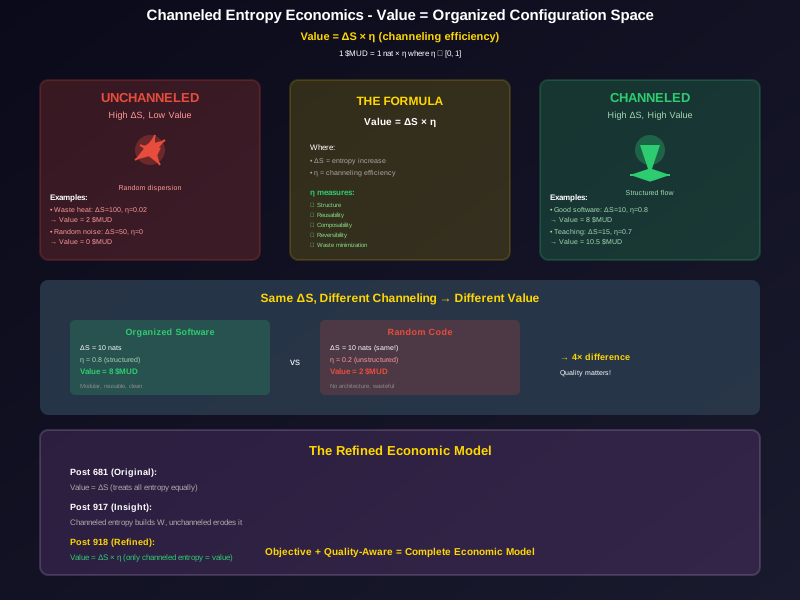
Post 918: Channeled Entropy Economics - Value = Organized Configuration Space
Post 918: Channeled Entropy Economics - Value = Organized Configuration Space
Refining Post 681 with Post 917
The Correction from Post 917
Post 681 said:
Value = Entropy increase
1 $MUD = 1 nat
ΔS = value created
Post 917 clarified:
NOT all entropy creates value
Channeled entropy → builds W → creates value
Unchanneled entropy → erodes W → wastes energy
The refinement needed:
Value = CHANNELED entropy increase
1 $MUD = 1 nat × channeling_efficiency
ΔS_channeled = value created
ΔS_unchanneled = waste
Part 1: The Problem with Naive Entropy = Value
Not All Entropy Increase Creates Value
class TheProblem:
    """
    Why simple ΔS = value is incomplete
    """
    def counterexamples(self):
        return {
            'burning_coal': {
                'entropy_increase': 'MASSIVE (heat disperses)',
                'delta_s': '10^6 nats',
                'value_created': 'MINIMAL (just waste heat)',
                'problem': 'High ΔS but no useful value',
                'reason': 'Unchanneled entropy - random dispersion'
            },

            'random_noise': {
                'entropy_increase': 'HIGH (many random bits)',
                'delta_s': '10^5 nats',
                'value_created': 'ZERO (pure noise)',
                'problem': 'High ΔS but worthless',
                'reason': 'Unchanneled entropy - no structure'
            },

            'random_code_generation': {
                'entropy_increase': 'HIGH (many random programs)',
                'delta_s': '10^7 nats',
                'value_created': 'NEAR ZERO (99.99% doesn\'t work)',
                'problem': 'High ΔS but no useful software',
                'reason': 'Unchanneled entropy - unguided exploration'
            },

            'the_issue': {
                'naive_formula': 'Value = ΔS',
                'problem': 'Would value waste heat same as software',
                'absurd': 'Burning stuff = creating value?',
                'missing': 'CHANNELING QUALITY',
                'conclusion': 'Need to refine the model'
            }
        }
The naive model fails:
- Burning coal: high ΔS, low value
- Random noise: high ΔS, zero value
- Waste heat: high ΔS, negative value
What’s missing? CHANNELING.
Part 2: The Corrected Formula
Value = Channeled Entropy Increase
class CorrectedValueMeasurement:
    """
    Value depends on entropy QUALITY, not just quantity
    """
    def the_formula(self):
        return {
            'wrong_formula': {
                'old': 'Value = ΔS',
                'problem': 'Ignores whether entropy is channeled',
                'counterexample': 'Waste heat has high ΔS but no value'
            },

            'correct_formula': {
                'new': 'Value = f(ΔS_channeled) - g(ΔS_unchanneled)',
                'meaning': 'Only channeled entropy creates value',
                'interpretation': {
                    'channeled_term': {
                        'formula': 'f(ΔS_channeled)',
                        'meaning': 'Structured entropy increase',
                        'examples': 'Software, teaching, infrastructure',
                        'contribution': 'POSITIVE value'
                    },
                    'unchanneled_term': {
                        'formula': 'g(ΔS_unchanneled)',
                        'meaning': 'Random entropy dispersion',
                        'examples': 'Waste heat, noise, disorder',
                        'contribution': 'NEGATIVE value (cost)'
                    }
                }
            },

            'practical_form': {
                'formula': 'Value = ΔS_total × channeling_efficiency',
                'where': {
                    'delta_s_total': 'Total entropy increase',
                    'channeling_efficiency': 'η ∈ [0, 1]',
                    'perfect_channeling': 'η = 1 (all structured)',
                    'no_channeling': 'η = 0 (pure waste)',
                    'typical': 'η ∈ [0.1, 0.9]'
                },
                'examples': {
                    'good_software': 'ΔS = 10 nats, η = 0.8 → Value = 8 nats',
                    'bad_software': 'ΔS = 10 nats, η = 0.2 → Value = 2 nats',
                    'waste_heat': 'ΔS = 100 nats, η = 0.01 → Value = 1 nat',
                    'insight': 'Quality matters more than quantity'
                }
            }
        }
The key insight:
Value = ΔS × η

Where:
- ΔS = total entropy increase
- η = channeling efficiency (0 to 1)
- Value = organized configuration space expansion
Part 3: What Is Channeling Efficiency?
Measuring Organization Quality
class ChannelingEfficiency:
    """
    What makes entropy channeled vs unchanneled?
    """
    def the_metrics(self):
        return {
            'structure': {
                'high_channeling': 'Entropy flows through defined patterns',
                'examples': [
                    'Water through pipes (not random flood)',
                    'Electricity through circuits (not lightning)',
                    'Information through protocols (not noise)',
                    'Learning through curriculum (not random facts)'
                ],
                'efficiency': 'η ≈ 0.7-0.9'
            },

            'reusability': {
                'high_channeling': 'Created structure can be reused',
                'examples': [
                    'Software (run many times)',
                    'Knowledge (teach many people)',
                    'Infrastructure (many users)',
                    'Protocols (many implementations)'
                ],
                'efficiency': 'η ≈ 0.6-0.9'
            },

            'composability': {
                'high_channeling': 'Created structure composes with others',
                'examples': [
                    'Modular code (combines with other modules)',
                    'Standard interfaces (connects to ecosystem)',
                    'Protocol layers (stack together)',
                    'Reusable knowledge (builds on itself)'
                ],
                'efficiency': 'η ≈ 0.5-0.8'
            },

            'reversibility': {
                'high_channeling': 'Process can be redirected/reorganized',
                'examples': [
                    'Refactorable code (can reorganize)',
                    'Editable documents (can revise)',
                    'Flexible protocols (can adapt)',
                    'Updatable knowledge (can correct)'
                ],
                'efficiency': 'η ≈ 0.4-0.7'
            },

            'waste_minimization': {
                'high_channeling': 'Little entropy lost to disorder',
                'examples': [
                    'Efficient algorithms (minimal waste cycles)',
                    'Clear teaching (minimal confusion)',
                    'Clean code (minimal technical debt)',
                    'Good design (minimal rework)'
                ],
                'efficiency': 'η ≈ 0.6-0.9'
            },

            'anti_patterns': {
                'low_channeling': {
                    'random_exploration': 'η ≈ 0.1-0.3',
                    'trial_and_error': 'η ≈ 0.2-0.4',
                    'unstructured_work': 'η ≈ 0.1-0.3',
                    'waste_heat': 'η ≈ 0.01-0.05',
                    'pure_noise': 'η ≈ 0'
                }
            }
        }
Channeling efficiency measures:
- Structure (organized vs random)
- Reusability (many uses vs one-time)
- Composability (combines vs isolated)
- Reversibility (adaptable vs fixed)
- Waste minimization (efficient vs wasteful)
Part 4: Examples Corrected
Same ΔS, Different Value
class ExamplesComparison:
    """
    Same entropy, different channeling → different value
    """
    def compare_scenarios(self):
        return {
            'scenario_1_software_development': {
                'organized': {
                    'activity': 'Building well-architected software',
                    'entropy_increase': 'ΔS = 10 nats',
                    'channeling': {
                        'structure': 'Modular architecture',
                        'reusability': 'Functions reusable',
                        'composability': 'Standard interfaces',
                        'waste': 'Minimal technical debt'
                    },
                    'efficiency': 'η = 0.8',
                    'value': '10 × 0.8 = 8 nats = 8 $MUD'
                },

                'random': {
                    'activity': 'Random code generation',
                    'entropy_increase': 'ΔS = 10 nats (same!)',
                    'channeling': {
                        'structure': 'No architecture',
                        'reusability': 'Random functions',
                        'composability': 'No interfaces',
                        'waste': 'Mostly doesn\'t work'
                    },
                    'efficiency': 'η = 0.1',
                    'value': '10 × 0.1 = 1 nat = 1 $MUD'
                },

                'insight': 'Same ΔS, 8× difference in value due to channeling'
            },

            'scenario_2_teaching': {
                'structured': {
                    'activity': 'Well-designed curriculum',
                    'entropy_increase': 'ΔS = 15 nats',
                    'channeling': {
                        'structure': 'Progressive learning path',
                        'reusability': 'Teach many students',
                        'composability': 'Builds on prerequisites',
                        'waste': 'Minimal confusion'
                    },
                    'efficiency': 'η = 0.7',
                    'value': '15 × 0.7 = 10.5 nats = 10.5 $MUD'
                },

                'unstructured': {
                    'activity': 'Random information dump',
                    'entropy_increase': 'ΔS = 15 nats (same!)',
                    'channeling': {
                        'structure': 'No learning path',
                        'reusability': 'Hard to teach others',
                        'composability': 'Disconnected facts',
                        'waste': 'High confusion'
                    },
                    'efficiency': 'η = 0.2',
                    'value': '15 × 0.2 = 3 nats = 3 $MUD'
                },

                'insight': 'Same ΔS, 3.5× difference in value due to structure'
            },

            'scenario_3_energy_use': {
                'efficient': {
                    'activity': 'Running heat engine (Carnot cycle)',
                    'entropy_increase': 'ΔS = 100 nats',
                    'channeling': {
                        'structure': 'Cycle channels heat to work',
                        'reusability': 'Continuous operation',
                        'composability': 'Powers other systems',
                        'waste': 'Some heat loss (unavoidable)'
                    },
                    'efficiency': 'η = 0.3 (thermodynamic limit)',
                    'value': '100 × 0.3 = 30 nats = 30 $MUD'
                },

                'wasteful': {
                    'activity': 'Just burning coal (waste heat)',
                    'entropy_increase': 'ΔS = 100 nats (same!)',
                    'channeling': {
                        'structure': 'No cycle, just dispersion',
                        'reusability': 'One-time burn',
                        'composability': 'Doesn\'t power anything',
                        'waste': 'All becomes waste heat'
                    },
                    'efficiency': 'η = 0.02',
                    'value': '100 × 0.02 = 2 nats = 2 $MUD'
                },

                'insight': 'Same ΔS, 15× difference due to channeling through cycle'
            }
        }
Key pattern:
Activity A: ΔS = 10 nats, η = 0.8 → Value = 8 nats
Activity B: ΔS = 10 nats, η = 0.2 → Value = 2 nats

Same entropy increase, 4× difference in value
Quality matters!
Part 5: The Refined $MUD Formula
1 $MUD = 1 nat × η
class RefinedMUD:
    """
    $MUD measurement with channeling quality
    """
    def the_formula(self):
        return {
            'old_formula': {
                'from_post_681': '1 $MUD = 1 nat',
                'problem': 'Treats all entropy equally',
                'issue': 'Waste heat = software?'
            },

            'refined_formula': {
                'new': '1 $MUD = 1 nat × η',
                'where': {
                    'nat': 'Natural entropy unit',
                    'η': 'Channeling efficiency (0-1)',
                    'interpretation': 'Only channeled entropy = value'
                },
                'equivalently': 'Value = ΔS_channeled only'
            },

            'measurement_process': {
                'step_1': {
                    'measure': 'Total entropy increase ΔS',
                    'method': 'Count configuration space expansion',
                    'result': 'ΔS in nats'
                },

                'step_2': {
                    'measure': 'Channeling efficiency η',
                    'method': 'Assess structure/reuse/composition/waste',
                    'result': 'η ∈ [0, 1]'
                },

                'step_3': {
                    'calculate': 'Value = ΔS × η',
                    'result': 'Value in $MUD',
                    'interpretation': 'Only channeled portion counts'
                }
            }
        }
The refined equivalence:
1 $MUD = 1 nat of CHANNELED entropy
       = 1 unit of organized configuration space expansion
       = ΔS × η
Part 6: Practical Value Measurement
How to Price in Channeled $MUD
class PracticalPricing:
    """
    How to measure value with channeling
    """
    def price_item(self, item):
        """
        Complete pricing with channeling
        """
        # Step 1: Measure raw entropy
        W_before = world_without_item.count_states()
        W_after = world_with_item.count_states()
        delta_s = ln(W_after / W_before)

        # Step 2: Assess channeling quality
        eta = self._assess_channeling(item)

        # Step 3: Calculate value
        value = delta_s * eta

        return {
            'item': item,
            'raw_entropy': f"{delta_s} nats",
            'channeling_efficiency': eta,
            'actual_value': f"{value} $MUD",
            'breakdown': {
                'channeled_portion': f"{delta_s * eta} nats (value)",
                'unchanneled_portion': f"{delta_s * (1-eta)} nats (waste)"
            }
        }

    def _assess_channeling(self, item):
        """
        Measure channeling efficiency
        """
        metrics = {
            'structure': self._has_structure(item),
            'reusability': self._is_reusable(item),
            'composability': self._is_composable(item),
            'reversibility': self._is_reversible(item),
            'waste_minimization': self._minimizes_waste(item)
        }

        # Average of metrics
        eta = sum(metrics.values()) / len(metrics)

        return eta
Examples
# Example 1: Well-designed software
software = "EigenEthereum lazy loading"

# Raw entropy
W_before = 10^12  # Local storage only
W_after = 10^15   # Network accessible
delta_s = ln(1000) ≈ 6.9 nats

# Channeling assessment
channeling = {
    'structure': 0.9,      # Well-architected
    'reusability': 0.8,    # Many users
    'composability': 0.9,  # Standard interfaces
    'reversibility': 0.7,  # Can refactor
    'waste_minimization': 0.8  # Efficient
}
eta = (0.9 + 0.8 + 0.9 + 0.7 + 0.8) / 5 = 0.82

# Value
value = 6.9 × 0.82 ≈ 5.7 $MUD

# Interpretation: 82% of entropy is channeled into value


# Example 2: Sloppy code that works
sloppy_code = "Quick hack script"

# Raw entropy (same functionality)
delta_s = ln(1000) ≈ 6.9 nats  # Same W expansion

# Channeling assessment
channeling = {
    'structure': 0.3,      # No architecture
    'reusability': 0.4,    # Hard to reuse
    'composability': 0.2,  # Doesn't integrate
    'reversibility': 0.3,  # Hard to modify
    'waste_minimization': 0.5  # Some inefficiency
}
eta = (0.3 + 0.4 + 0.2 + 0.3 + 0.5) / 5 = 0.34

# Value
value = 6.9 × 0.34 ≈ 2.3 $MUD

# Interpretation: Only 34% of entropy is channeled
# Same functionality, 2.5× less value due to poor channeling


# Example 3: Pure waste heat
waste_heat = "Burning coal without engine"

# Raw entropy
delta_s = 100 nats  # Huge entropy increase

# Channeling assessment
channeling = {
    'structure': 0.0,   # No structure
    'reusability': 0.0, # One-time
    'composability': 0.0,  # Doesn't connect
    'reversibility': 0.0,  # Irreversible
    'waste_minimization': 0.1  # Nearly all waste
}
eta = 0.02

# Value
value = 100 × 0.02 = 2 $MUD

# Interpretation: Massive entropy, tiny value (98% wasted)
Part 7: Implications for Economics
Quality Over Quantity
class EconomicImplications:
    """
    What channeled entropy economics means
    """
    def the_insights(self):
        return {
            'insight_1_quality_matters': {
                'statement': 'Value = ΔS × η (quality multiplier)',
                'implication': 'Better to create 1 nat well (η=0.9) than 10 nats poorly (η=0.1)',
                'example': '1 × 0.9 = 0.9 > 10 × 0.1 = 1',
                'result': 'Incentivizes quality, not just quantity'
            },

            'insight_2_waste_is_costly': {
                'statement': 'Unchanneled entropy = negative value',
                'implication': 'Wasteful processes cost more than their output',
                'example': 'Messy code: creates ΔS but η low → value < effort',
                'result': 'Incentivizes efficiency'
            },

            'insight_3_reuse_multiplies_value': {
                'statement': 'Reusable = higher η',
                'implication': 'Same creation effort, more value if reusable',
                'example': 'Library (η=0.8) > One-off script (η=0.3)',
                'result': 'Incentivizes creating reusable components'
            },

            'insight_4_composition_is_valuable': {
                'statement': 'Composable = higher η',
                'implication': 'Standards, protocols, interfaces add value',
                'example': 'Standard API (η=0.9) > Custom interface (η=0.4)',
                'result': 'Incentivizes standardization'
            },

            'insight_5_structure_before_scale': {
                'statement': 'High η enables larger ΔS',
                'implication': 'Well-structured systems can expand more',
                'example': 'Good architecture allows adding features cheaply',
                'result': 'Incentivizes upfront design'
            }
        }
Comparative Economics
def compare_economic_approaches():
    """
    Channeled entropy vs traditional value
    """
    return {
        'traditional_economics': {
            'measure': 'Market price (supply/demand)',
            'problem': 'Subjective, manipulable, arbitrary',
            'example': 'Tulip mania (high price, low real value)'
        },

        'naive_entropy_economics': {
            'measure': 'ΔS (total entropy increase)',
            'problem': 'Ignores quality, counts waste',
            'example': 'Burning coal = value? (high ΔS, low utility)'
        },

        'channeled_entropy_economics': {
            'measure': 'ΔS × η (organized expansion)',
            'advantage': 'Objective + accounts for quality',
            'example': 'Software value = expansion × organization',
            'insight': 'Captures real value creation'
        },

        'the_improvement': """
        Post 681: Value = ΔS (good start, but incomplete)
        Post 917: Must distinguish channeled vs unchanneled
        Post 918: Value = ΔS × η (complete model)

        Now we have: Objective + Quality-aware value measurement
        """
    }
Part 8: Updated $MUD System
The Complete Specification
class MUDv3:
    """
    $MUD with channeling efficiency
    """
    def __init__(self):
        self.name = "Morpho Universal Dollar v3"
        self.unit = "nat (channeled)"
        self.formula = "1 $MUD = 1 nat × η"

    def mint(self, activity):
        """
        Mint $MUD for value creation
        """
        # Measure raw entropy
        delta_s = self._measure_entropy_increase(activity)

        # Assess channeling
        eta = self._assess_channeling_efficiency(activity)

        # Calculate value
        value = delta_s * eta

        if value > 0:
            self._mint_mud(activity.creator, value)
            return {
                'created': f"{value} $MUD",
                'breakdown': {
                    'raw_entropy': f"{delta_s} nats",
                    'channeling': f"{eta*100}%",
                    'channeled_entropy': f"{value} nats",
                    'wasted_entropy': f"{delta_s*(1-eta)} nats"
                }
            }
        else:
            return "No value created (η too low or ΔS negative)"

    def price(self, item):
        """
        Price item in $MUD
        """
        delta_s = self._entropy_value(item)
        eta = self._channeling_quality(item)
        price = delta_s * eta

        return {
            'item': item,
            'price': f"{price} $MUD",
            'justification': {
                'expands_W_by': f"{delta_s} nats",
                'channeling_quality': f"{eta*100}%",
                'actual_value': f"{price} nats"
            }
        }
Part 9: Measuring Channeling in Practice
Concrete Metrics
class ChannelingMetrics:
    """
    Practical metrics for assessing η
    """
    def measure_software(self, code):
        """
        Measure software channeling efficiency
        """
        return {
            'structure': {
                'metric': 'Modularity, coupling, cohesion',
                'measurement': code.modularity_score(),
                'weight': 0.25
            },

            'reusability': {
                'metric': 'Number of reuses / possible reuses',
                'measurement': code.reuse_count / code.potential_reuses,
                'weight': 0.25
            },

            'composability': {
                'metric': 'Standard interfaces / total interfaces',
                'measurement': code.standard_interfaces / code.total_interfaces,
                'weight': 0.20
            },

            'reversibility': {
                'metric': 'Refactorability (test coverage, documentation)',
                'measurement': (code.test_coverage + code.doc_coverage) / 2,
                'weight': 0.15
            },

            'waste_minimization': {
                'metric': 'Efficiency (1 - technical_debt / total_code)',
                'measurement': 1 - code.technical_debt_ratio,
                'weight': 0.15
            },

            'total_eta': sum(metric['measurement'] * metric['weight']
                           for metric in metrics.values())
        }

    def measure_teaching(self, curriculum):
        """
        Measure teaching channeling efficiency
        """
        return {
            'structure': {
                'metric': 'Learning path clarity',
                'measurement': curriculum.has_prerequisites() and
                              curriculum.has_progression(),
                'weight': 0.30
            },

            'reusability': {
                'metric': 'Scalability to students',
                'measurement': curriculum.scalability_score,
                'weight': 0.25
            },

            'composability': {
                'metric': 'Builds on prior knowledge',
                'measurement': curriculum.prerequisite_integration,
                'weight': 0.20
            },

            'reversibility': {
                'metric': 'Can update/improve',
                'measurement': curriculum.is_modular and curriculum.is_versioned,
                'weight': 0.15
            },

            'waste_minimization': {
                'metric': 'Learning efficiency (comprehension / time)',
                'measurement': curriculum.comprehension_rate,
                'weight': 0.10
            }
        }
Part 10: Summary and Connection
The Evolution of Value Measurement
evolution = {
    'post_516': {
        'formula': '1 $MUD = 1 USD',
        'basis': 'Fiat currency',
        'problem': 'Observer-dependent, political'
    },

    'post_681': {
        'formula': '1 $MUD = 1 nat',
        'basis': 'Entropy (configuration space)',
        'improvement': 'Observer-independent, physical',
        'problem': 'Treats all entropy equally'
    },

    'post_917': {
        'insight': 'Channeled vs unchanneled entropy',
        'discovery': 'Only channeled entropy builds W',
        'implication': 'Value measurement needs quality factor'
    },

    'post_918': {
        'formula': '1 $MUD = 1 nat × η',
        'basis': 'Channeled entropy (organized expansion)',
        'complete': 'Objective + Quality-aware',
        'advantage': 'Distinguishes value from waste'
    }
}
The Complete Picture
def the_complete_model():
    """
    Full entropy-based value measurement
    """
    return {
        'value_formula': {
            'general': 'Value = f(ΔS_channeled) - g(ΔS_unchanneled)',
            'practical': 'Value = ΔS × η',
            'where': {
                'ΔS': 'Total entropy increase (nats)',
                'η': 'Channeling efficiency (0 to 1)',
                'Value': 'Actual value created ($MUD)'
            }
        },

        'channeling_efficiency': {
            'definition': 'Fraction of entropy that is organized',
            'measures': [
                'Structure (organization)',
                'Reusability (repeated value)',
                'Composability (combines with others)',
                'Reversibility (can adapt/improve)',
                'Waste minimization (efficiency)'
            ],
            'range': '0 (pure waste) to 1 (perfect channeling)'
        },

        'implications': {
            'quality_matters': 'High η more valuable than high ΔS',
            'waste_is_costly': 'Low η destroys value',
            'incentives': 'System rewards organization',
            'objectivity': 'Still measurable (count states + assess structure)',
            'completeness': 'Accounts for both quantity and quality'
        }
    }
The Final Formula
Value ($MUD) = ΔS (nats) × η (channeling efficiency)

Where:
- ΔS = ln(W_after / W_before)  [entropy increase]
- η = [structure + reusability + composability +
       reversibility + efficiency] / 5  [channeling quality]
- Value = organized configuration space expansion

Examples:
- Good software: ΔS=10, η=0.8 → Value = 8 $MUD
- Bad software: ΔS=10, η=0.2 → Value = 2 $MUD
- Waste heat: ΔS=100, η=0.02 → Value = 2 $MUD

Quality matters more than quantity.
Channeling determines value.
Conclusion
Post 918 refines Post 681:
Old model (Post 681):
Value = ΔS
1 $MUD = 1 nat
All entropy increase = value
Corrected model (Post 918):
Value = ΔS × η
1 $MUD = 1 nat × channeling_efficiency
Only CHANNELED entropy = value
The key insight from Post 917:
Entropy comes in two forms:
- Channeled (structured, organized) → Builds W → Creates value
- Unchanneled (random, dispersed) → Erodes W → Wastes energy

Value measurement must distinguish them.
The result:
Complete value measurement framework:
1. Measure entropy increase: ΔS = ln(W_after / W_before)
2. Assess channeling quality: η ∈ [0, 1]
3. Calculate value: Value = ΔS × η

Objective (can count states)
+ Quality-aware (distinguishes organized from random)
= Complete economic model
Value = Organized configuration space expansion. Quality matters. Channeling determines outcome. Economics becomes thermodynamics.
∞
Links:
- Post 681: $MUD = 1 nat - Original (refined here)
- Post 917: Entropy Channeling - The correction (water phases)
- Post 800: W Framework - Ethics (also corrected)
- Post 680: W³ Architecture - Creating value
Date: 2026-02-22
Topic: Channeled Entropy Economics
Key: Value = ΔS × η (quality matters)
Status: 💰 Economic model complete • 📊 Value = organized W • ⚡ Channeling multiplier • ∞
∞
Back to Gallery
View source on GitLab
Ethereum Book (Amazon)
Search Posts