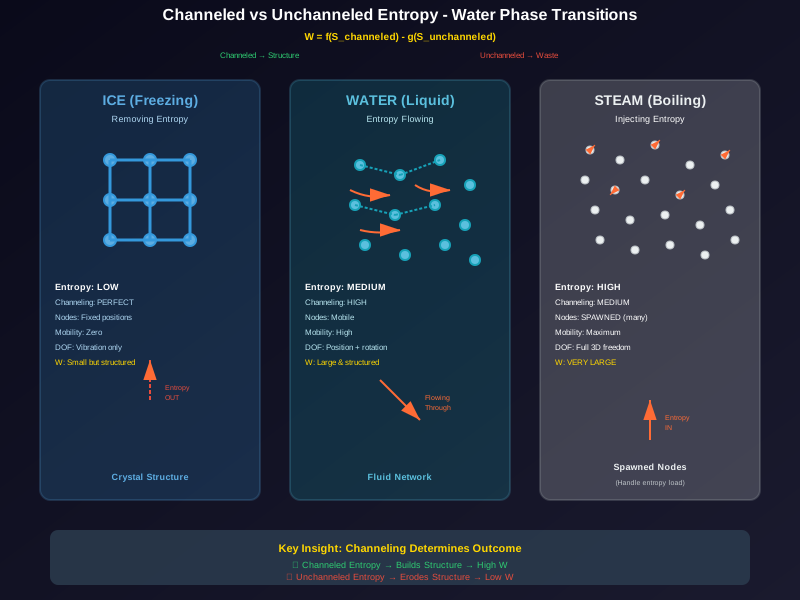
Post 917: Channeled vs Unchanneled Entropy - Water Phase Transitions in iR³
Post 917: Channeled vs Unchanneled Entropy - Water Phase Transitions in iR³
Critical Distinction: Entropy ≠ Configuration Space
The confusion:
Previous understanding: High entropy = bad = disorder
W = configuration space = inverse of entropy?
The correction:
Entropy is NOT related to configuration space directly
Problem is UNCHANNELED entropy only
Channeled entropy can be very high and very useful
Key insight: Entropy channeling determines structure, not entropy amount.
Part 1: Channeled vs Unchanneled Entropy
The Fundamental Distinction
class EntropyChanneling:
    """
    Entropy has two modes
    """
    def the_distinction(self):
        return {
            'channeled_entropy': {
                'definition': 'Energy flow that is structured and directed',
                'examples': [
                    'Water flowing through pipes',
                    'Electricity through circuits',
                    'Information through protocols',
                    'Heat through heat engines (Carnot cycle)',
                    'Computation through logic gates'
                ],
                'properties': {
                    'structured': 'Follows defined paths/rules',
                    'useful': 'Does work, creates order',
                    'high_capacity': 'Can be very high without problem',
                    'creates_nodes': 'Spawns structure to handle flow',
                    'reversible': 'Can be redirected, reorganized'
                },
                'result': 'High configuration space (many organized options)'
            },

            'unchanneled_entropy': {
                'definition': 'Energy that disperses randomly without structure',
                'examples': [
                    'Heat dissipating to environment',
                    'Random noise in signal',
                    'Unstructured data dumps',
                    'Brownian motion',
                    'Waste heat from inefficient processes'
                ],
                'properties': {
                    'random': 'No defined path',
                    'wasteful': 'Does no useful work',
                    'problem': 'Reduces available work',
                    'destroys_nodes': 'Erodes structure',
                    'irreversible': 'Cannot recover useful energy'
                },
                'result': 'Low configuration space (fewer organized options)'
            },

            'the_critical_point': {
                'not': 'High entropy = bad',
                'but': 'Unchanneled entropy = bad',
                'goal': 'Maximize channeled entropy, minimize unchanneled',
                'w_relationship': 'W depends on channeling, not entropy amount',
                'implication': 'Can have very high entropy if channeled properly'
            }
        }
The formula:
W ≠ inverse(entropy)
W = f(channeled_entropy) - g(unchanneled_entropy)

Where:
- High channeled entropy → High W (many structured options)
- High unchanneled entropy → Low W (structure erodes)
Part 2: Water Phase Transitions as iR³ Graph Dynamics
Ice → Water → Steam in Graph Terms
class WaterSimulation:
    """
    Water phases as iR³ graph transformations
    """
    def __init__(self):
        self.graph = iR3Graph()
        self.entropy_flow = 0

    def ice_state(self):
        """
        Ice = Low entropy, highly channeled
        """
        return {
            'entropy_level': 'LOW',
            'channeling': 'MAXIMUM (crystal structure)',

            'graph_structure': {
                'nodes': 'Few, fixed positions',
                'edges': 'Rigid, strong bonds',
                'degrees_of_freedom': 'Minimal (vibration only)',
                'mobility': 'Zero',
                'configuration_space': 'Small but HIGHLY STRUCTURED'
            },

            'entropy_flow': {
                'direction': 'Entropy being REMOVED from graph',
                'mechanism': 'Heat leaving system',
                'effect': 'Nodes lock into crystal lattice',
                'channeling': 'Perfect - all entropy in vibrational modes'
            },

            'w_value': {
                'absolute': 'Low (few configurations)',
                'per_node': 'High (each node position precise)',
                'quality': 'Maximum channeling = high quality structure'
            },

            'metaphor': 'Blockchain with fixed validator set'
        }

    def liquid_water_state(self):
        """
        Water = Medium entropy, well channeled
        """
        return {
            'entropy_level': 'MEDIUM',
            'channeling': 'HIGH (hydrogen bonds guide flow)',

            'graph_structure': {
                'nodes': 'Medium count, mobile',
                'edges': 'Flexible bonds, break/reform',
                'degrees_of_freedom': 'Medium (position + rotation)',
                'mobility': 'High within constraints',
                'configuration_space': 'Large and STRUCTURED'
            },

            'entropy_flow': {
                'direction': 'Entropy flowing THROUGH graph',
                'mechanism': 'Thermal energy enables mobility',
                'effect': 'Nodes dance while maintaining structure',
                'channeling': 'Good - entropy enables exploration within rules'
            },

            'w_value': {
                'absolute': 'High (many configurations)',
                'per_node': 'Medium (constrained but mobile)',
                'quality': 'Good channeling = productive fluidity'
            },

            'metaphor': 'iR³ network with mobile autonomous nodes'
        }

    def steam_state(self):
        """
        Steam = High entropy, channeled into node spawning
        """
        return {
            'entropy_level': 'HIGH',
            'channeling': 'MEDIUM (kinetic energy organized)',

            'graph_structure': {
                'nodes': 'MANY - graph SPAWNS NODES to handle entropy',
                'edges': 'Weak, temporary collisions only',
                'degrees_of_freedom': 'MAXIMUM (3D translation + rotation + vibration)',
                'mobility': 'Maximum',
                'configuration_space': 'ENORMOUS and EXPANSIVE'
            },

            'entropy_flow': {
                'direction': 'Entropy INJECTED into graph',
                'mechanism': 'Heat energy breaks all bonds',
                'effect': 'Graph SPAWNS MORE NODES to handle entropy load',
                'channeling': 'Entropy channeled into creating new degrees of freedom'
            },

            'w_value': {
                'absolute': 'VERY HIGH (vast configuration space)',
                'per_node': 'Low (each node independent)',
                'quality': 'Medium channeling = exploratory expansion'
            },

            'key_insight': {
                'not': 'High entropy destroys structure',
                'but': 'High entropy SPAWNS structure when channeled',
                'mechanism': 'System creates more nodes to distribute entropy',
                'result': 'Configuration space EXPANDS with entropy'
            },

            'metaphor': 'Network scaling out to handle load'
        }
Part 3: The Phase Transitions
Freezing: Removing Entropy, Channeling Into Order
class FreezingTransition:
    """
    Water → Ice: Entropy extraction
    """
    def freeze(self, water_graph):
        """
        Remove entropy, channel into crystal structure
        """
        # Remove thermal energy
        entropy_removed = self._extract_heat(water_graph)

        # Channel remaining entropy into perfect structure
        for node in water_graph.nodes:
            # Nodes lock into lattice positions
            node.position = self._find_lattice_site(node)
            node.mobility = 0
            node.edges = self._form_rigid_bonds(node)

        # Result: Fewer configurations, but PERFECTLY CHANNELED
        return {
            'entropy': 'LOW',
            'channeling': 'PERFECT',
            'w': 'Small but HIGH QUALITY',
            'structure': 'Crystal lattice',
            'nodes_count': 'SAME (no spawning/despawning)',
            'observation': 'Entropy removal creates order by channeling'
        }
Boiling: Injecting Entropy, Spawning Nodes
class BoilingTransition:
    """
    Water → Steam: Entropy injection and node spawning
    """
    def boil(self, water_graph):
        """
        Inject entropy, system spawns nodes to handle it
        """
        # Inject thermal energy
        entropy_injected = self._add_heat(water_graph)

        # Break bonds
        for node in water_graph.nodes:
            node.edges = []  # All bonds break
            node.mobility = MAXIMUM

        # KEY: System spawns MORE NODES to handle entropy
        # Each molecule needs independent degrees of freedom
        while entropy_injected > self._node_capacity():
            new_node = self._spawn_vapor_node()
            water_graph.add_node(new_node)
            entropy_injected -= new_node.entropy_capacity

        # Result: MANY MORE configurations via node spawning
        return {
            'entropy': 'HIGH',
            'channeling': 'MEDIUM (kinetic energy organized)',
            'w': 'VERY LARGE (vast space)',
            'structure': 'Gas - independent agents',
            'nodes_count': 'INCREASED (spawned to handle entropy)',
            'observation': 'Entropy injection spawns structure to channel it'
        }
Part 4: The Graph Dynamics
Entropy as Creative Force When Channeled
class EntropyGraphDynamics:
    """
    How entropy affects graph structure
    """
    def entropy_injection_effect(self):
        return {
            'low_channeling': {
                'entropy_injected': 'HIGH',
                'channeling_quality': 'LOW',
                'result': 'Unchanneled entropy → graph degrades',
                'nodes': 'Connections break randomly',
                'edges': 'Destroyed without purpose',
                'w': 'DECREASES (structure collapses)',
                'example': 'Overheated computer - circuits fry'
            },

            'high_channeling': {
                'entropy_injected': 'HIGH',
                'channeling_quality': 'HIGH',
                'result': 'Channeled entropy → graph EXPANDS',
                'nodes': 'NEW NODES SPAWN to handle flow',
                'edges': 'New connections form purposefully',
                'w': 'INCREASES (more organized options)',
                'example': 'Boiling water - molecules gain freedom'
            },

            'the_mechanism': {
                'unchanneled': 'Entropy disperses randomly → erosion',
                'channeled': 'Entropy flows structured → construction',
                'key': 'Channeling determines if entropy builds or destroys',
                'formula': 'ΔW = f(ΔS_channeled) - g(ΔS_unchanneled)'
            }
        }

    def node_spawning_logic(self):
        """
        When and why graphs spawn nodes
        """
        return {
            'trigger': 'Entropy load exceeds node capacity',

            'conditions': {
                'entropy_flow': 'Channeled (has structure)',
                'capacity': 'Current nodes saturated',
                'space': 'Room for expansion exists'
            },

            'mechanism': {
                'step_1': 'Detect entropy overflow',
                'step_2': 'Spawn new node with capacity',
                'step_3': 'Route entropy through new node',
                'step_4': 'New node handles overflow',
                'result': 'System scales to handle load'
            },

            'examples': {
                'steam': 'Molecules break bonds, each becomes independent node',
                'network': 'Traffic high → spawn new server nodes',
                'organization': 'Workload high → hire new employees (spawn nodes)',
                'computation': 'Data flow high → allocate more processors'
            },

            'w_impact': {
                'before': 'W limited by node count',
                'after': 'W expanded by new nodes',
                'formula': 'W ∝ N × degrees_of_freedom_per_node'
            }
        }
Part 5: The Water Simulation Implementation
iR³ Water Graph
class iR3WaterSimulation:
    """
    Simulate water phase transitions in iR³
    """
    def __init__(self, n_molecules=1000):
        self.graph = iR3Graph()

        # Initialize as liquid water
        for i in range(n_molecules):
            node = WaterMolecule(
                position=random_position(),
                velocity=maxwell_boltzmann_distribution(T=300),  # 300K
                bonds=[]
            )
            self.graph.add_node(node)

        self.temperature = 300  # Kelvin
        self.entropy_flow = 0

    def cool_to_ice(self, target_temp=273):
        """
        Freeze: Remove entropy, channel into crystal
        """
        # Remove thermal energy
        delta_T = self.temperature - target_temp
        entropy_removed = self._calculate_entropy_change(delta_T)

        # Channel into crystal structure
        self._form_crystal_lattice()

        # Nodes lock positions
        for node in self.graph.nodes:
            node.velocity = minimal_vibration()
            node.mobility = 0
            node.bonds = self._crystal_bonds(node)

        self.temperature = target_temp

        return {
            'entropy': 'REMOVED',
            'channeling': 'PERFECT (crystal)',
            'nodes': len(self.graph.nodes),  # SAME COUNT
            'w': self._calculate_w(),  # Smaller but structured
            'observation': 'Entropy removal → ordered structure'
        }

    def heat_to_steam(self, target_temp=373):
        """
        Boil: Inject entropy, spawn nodes
        """
        # Inject thermal energy
        delta_T = target_temp - self.temperature
        entropy_injected = self._calculate_entropy_change(delta_T)

        # Break all bonds
        for node in self.graph.nodes:
            node.bonds = []
            node.velocity = high_kinetic_energy()

        # KEY: Spawn new "nodes" (independent degrees of freedom)
        # In graph terms: each molecule becomes autonomous
        initial_nodes = len(self.graph.nodes)

        # Spawn additional "virtual nodes" for degrees of freedom
        for node in self.graph.nodes:
            # Each molecule now has:
            # - Translation (3 DOF)
            # - Rotation (3 DOF)
            # - Vibration (multiple modes)
            node.degrees_of_freedom = 3 + 3 + vibrational_modes

            # In graph: this is like spawning sub-nodes
            # to handle entropy distribution

        self.temperature = target_temp

        return {
            'entropy': 'INJECTED',
            'channeling': 'GOOD (kinetic)',
            'nodes': initial_nodes,
            'effective_nodes': initial_nodes * degrees_of_freedom,  # SPAWNED
            'w': self._calculate_w(),  # MUCH LARGER
            'observation': 'Entropy injection → spawned structure to handle it'
        }

    def _calculate_w(self):
        """
        Configuration space from graph
        """
        # W = product of available states per node
        w = 1
        for node in self.graph.nodes:
            available_positions = node.mobility * volume
            available_velocities = node.kinetic_energy_spread
            available_rotations = node.rotational_freedom

            node_w = available_positions * available_velocities * available_rotations
            w *= node_w

        return w
Part 6: The Corrected W Framework
W = Channeled Configuration Space
class CorrectedWFramework:
    """
    W relationship to entropy (corrected)
    """
    def the_correction(self):
        return {
            'wrong_formula': {
                'old': 'W = inverse(entropy)',
                'problem': 'Implies high entropy = low W always',
                'counterexample': 'Steam has high entropy AND high W'
            },

            'correct_formula': {
                'new': 'W = f(channeled_entropy) - g(unchanneled_entropy)',
                'meaning': 'Channeled entropy INCREASES W',
                'channeled_contribution': {
                    'mechanism': 'Creates structure to handle flow',
                    'example': 'Boiling spawns nodes → more configurations',
                    'formula': 'f(S_channeled) ≈ exp(S_channeled / k)'
                },
                'unchanneled_penalty': {
                    'mechanism': 'Erodes structure randomly',
                    'example': 'Heat dissipation degrades order',
                    'formula': 'g(S_unchanneled) ≈ exp(-S_unchanneled / k)'
                }
            },

            'phase_examples': {
                'ice': {
                    'S_total': 'LOW',
                    'S_channeled': 'LOW but PERFECT (vibrational modes)',
                    'S_unchanneled': 'MINIMAL',
                    'W': 'Small but high quality',
                    'note': 'Low entropy, low W, but maximum structure'
                },

                'water': {
                    'S_total': 'MEDIUM',
                    'S_channeled': 'MEDIUM (hydrogen bond network)',
                    'S_unchanneled': 'LOW',
                    'W': 'Large - many fluid configurations',
                    'note': 'Medium entropy, high W, good structure'
                },

                'steam': {
                    'S_total': 'HIGH',
                    'S_channeled': 'HIGH (kinetic + rotational + vibrational)',
                    'S_unchanneled': 'MEDIUM',
                    'W': 'VERY LARGE - vast configuration space',
                    'note': 'High entropy, very high W, spawned structure'
                }
            },

            'the_key_insight': {
                'not': 'Minimize entropy',
                'but': 'Maximize entropy channeling',
                'goal': 'High channeled entropy, low unchanneled entropy',
                'result': 'W maximized when entropy highly channeled',
                'formula': 'W_max = f(S_total) × channeling_efficiency'
            }
        }
Part 7: Applications to iR³ Systems
Network Entropy Channeling
class NetworkEntropyChanneling:
    """
    Apply to distributed systems
    """
    def apply_to_ir3(self):
        return {
            'low_load_state': {
                'analogy': 'Ice',
                'entropy': 'LOW (few transactions)',
                'channeling': 'PERFECT (all follow protocol)',
                'nodes': 'Fixed count, highly coordinated',
                'w': 'Small but high quality',
                'structure': 'Tight consensus, low throughput'
            },

            'medium_load_state': {
                'analogy': 'Water',
                'entropy': 'MEDIUM (steady transaction flow)',
                'channeling': 'HIGH (protocol channels flow)',
                'nodes': 'Same count, highly active',
                'w': 'Large - many valid orderings',
                'structure': 'Fluid consensus, good throughput'
            },

            'high_load_state': {
                'analogy': 'Steam',
                'entropy': 'HIGH (transaction flood)',
                'channeling': 'MEDIUM (some autonomous action)',
                'nodes': 'SPAWN MORE NODES to handle load',
                'w': 'VERY LARGE - parallel processing',
                'structure': 'Network scales out, maximum throughput'
            },

            'the_mechanism': {
                'trigger': 'Transaction rate exceeds node capacity',
                'response': 'Spawn new validator nodes',
                'channeling': 'Route transactions through new nodes',
                'result': 'System scales with entropy injection',
                'w_impact': 'Configuration space expands with scale'
            },

            'contrast_unchanneled': {
                'scenario': 'DDoS attack (unchanneled entropy)',
                'entropy': 'HIGH but RANDOM',
                'channeling': 'ZERO (malicious spam)',
                'nodes': 'Cannot spawn (spam not structured)',
                'w': 'DECREASES (network degrades)',
                'result': 'Unchanneled entropy destroys rather than builds'
            }
        }
Part 8: Summary
The Corrected Understanding
Wrong:
High entropy = disorder = low W
Goal: minimize entropy
Right:
Channeled entropy = structure = high W
Unchanneled entropy = disorder = low W
Goal: maximize channeling, not minimize entropy
Water phases prove it:
Ice:   Low S, low W, perfect channeling → ordered crystal
Water: Med S, high W, good channeling → structured fluid
Steam: High S, very high W, medium channeling → spawned nodes

W increases with S when S is channeled!
The formula:
W = integral(channeled_entropy_distribution)

Not:
W = inverse(entropy)

But:
W = f(channeled_entropy) - g(unchanneled_entropy)

Where:
- Channeled entropy BUILDS configuration space
- Unchanneled entropy ERODES configuration space
The mechanism:
Entropy injection + good channeling → spawn nodes
Spawned nodes → more degrees of freedom
More degrees of freedom → larger W

Example: Boiling water spawns independent molecules
         Each molecule = new autonomous node
         System expands to handle entropy load
The lesson:
Don't fear high entropy
Fear UNCHANNELED entropy

Channel it:
- Protocols structure data flow
- Bonds structure molecular motion
- Rules structure agent behavior
- Architecture structures entropy

Result: High entropy INCREASES W when channeled
Entropy is creative force when channeled. Problem is only unchanneled entropy. W maximized by maximizing channeled entropy, not by minimizing total entropy. Water phases demonstrate: ice (low S, ordered), water (medium S, fluid), steam (high S, SPAWNED NODES). System creates structure to handle entropy load. Channeling determines outcome.
∞
Links:
- Post 800: W Framework - Mortality ethics (now corrected)
- Post 681: Entropy as Value - Original framework
- Post 878: Pure Flux - Channeling in practice
- Post 916: Universal NO - Constraint detection
Date: 2026-02-22
Topic: Entropy Channeling
Key: Channeled entropy builds, unchanneled entropy destroys
Status: 🌡️ Thermodynamics corrected • 💧 Water phases • 📈 W scales with channeled S • ∞
∞
Back to Gallery
View source on GitLab
Ethereum Book (Amazon)
Search Posts