Post 909: Tank Depletion → iR³ Mesh Mode (Basic Words Only)
Post 909: Tank Depletion → iR³ Mesh Mode (Basic Words Only)
When Tanks Low, Language Goes Basic
From Post 908: Sapiens operates workload-based with resource tanks
From Post 893: Pidgins app runs locally for language processing
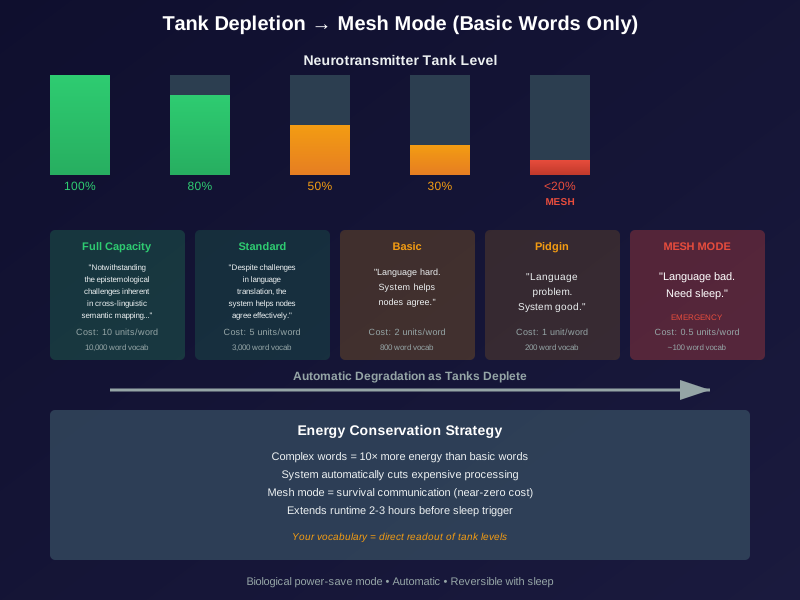
The observation: When neurotransmitter/glucose tanks deplete below 20%, complex language processing becomes too expensive. System automatically degrades to “mesh mode” - basic level words only, minimal grammar. This is energy conservation before sleep trigger.
Result: Natural linguistic degradation as biological resources run low
Part 1: The Energy Cost of Language
Complex Words = Expensive Processing
class LanguageEnergyCost:
    """
    Different language complexity levels have different energy costs
    """
    def __init__(self):
        # Neurotransmitter costs (per word processed)
        self.costs = {
            'complex_academic': {
                'neurotransmitters': 10,  # High cost
                'glucose': 5,
                'example': 'notwithstanding, epistemological, concatenate',
                'syllables': '4-6',
                'frequency': 'rare (need deep retrieval)'
            },

            'standard_vocabulary': {
                'neurotransmitters': 5,   # Medium cost
                'glucose': 3,
                'example': 'understand, knowledge, connect',
                'syllables': '2-3',
                'frequency': 'common (cached)'
            },

            'basic_words': {
                'neurotransmitters': 2,   # Low cost
                'glucose': 1,
                'example': 'know, link, get',
                'syllables': '1',
                'frequency': 'very common (instant access)'
            },

            'pidgin_mesh': {
                'neurotransmitters': 1,   # Minimal cost
                'glucose': 0.5,
                'example': 'yes, no, go, stop, help',
                'syllables': '1',
                'frequency': 'universal (hardwired)'
            }
        }

    def why_different_costs(self):
        return {
            'complex_words': {
                'retrieval': 'Deep search in language graph (expensive)',
                'synthesis': 'Complex phoneme combinations',
                'meaning': 'Multiple layers of semantic processing',
                'result': 'High energy consumption'
            },

            'basic_words': {
                'retrieval': 'Shallow search (fast)',
                'synthesis': 'Simple phonemes',
                'meaning': 'Direct concept mapping',
                'result': 'Low energy consumption'
            },

            'mesh_words': {
                'retrieval': 'Hardwired (instant)',
                'synthesis': 'Minimal phonemes',
                'meaning': 'Universal concepts',
                'result': 'Near-zero energy cost'
            }
        }
Energy cost hierarchy:
- Complex academic words: 10 units neurotransmitters
- Standard vocabulary: 5 units
- Basic common words: 2 units
- Pidgin mesh words: 1 unit
When tanks low, expensive words cut first.
Part 2: Tank-Based Language Degradation
Automatic Downgrade as Resources Deplete
class TankBasedLanguageDegradation:
    """
    Language complexity automatically adjusts to tank levels
    From post 908: Tank management system
    """
    def __init__(self):
        self.neurotransmitter_tank = 100  # Start full
        self.glucose_tank = 100

    def select_language_mode(self):
        """
        Automatically degrade language as tanks deplete
        """
        return {
            'tanks_100_80_full_capacity': {
                'mode': 'Complex language enabled',
                'vocabulary': 'Full range (academic, technical, nuanced)',
                'grammar': 'Complete (subordinate clauses, conditionals, etc.)',
                'example': '"Notwithstanding the epistemological challenges inherent in cross-linguistic semantic mapping, the distributed hash table architecture facilitates emergent consensus through probabilistic convergence mechanisms."',
                'energy_per_sentence': '150 units (expensive)',
                'communication': 'Eloquent, precise, sophisticated'
            },

            'tanks_80_50_moderate_capacity': {
                'mode': 'Standard language',
                'vocabulary': 'Common words (everyday, practical)',
                'grammar': 'Simple sentences (subject-verb-object)',
                'example': '"Despite challenges in language translation, the DHT network helps nodes agree through probability methods."',
                'energy_per_sentence': '75 units (moderate)',
                'communication': 'Clear, functional, adequate'
            },

            'tanks_50_30_low_capacity': {
                'mode': 'Basic language',
                'vocabulary': 'High-frequency words only',
                'grammar': 'Minimal (simple present, short phrases)',
                'example': '"Language hard. DHT helps nodes agree. Works by chance."',
                'energy_per_sentence': '30 units (economical)',
                'communication': 'Functional but terse'
            },

            'tanks_30_20_critical_low': {
                'mode': 'Pidgin language',
                'vocabulary': 'Core concepts only',
                'grammar': 'Almost none (word order loose)',
                'example': '"Language problem. DHT good. Node agree. Random way."',
                'energy_per_sentence': '15 units (minimal)',
                'communication': 'Barely adequate'
            },

            'tanks_below_20_emergency': {
                'mode': 'MESH MODE (iR³ basic)',
                'vocabulary': 'Universal basic words (~100 words total)',
                'grammar': 'None (pure concept nodes)',
                'example': '"Language bad. DHT work. Node yes. Need sleep."',
                'energy_per_sentence': '5 units (near-zero)',
                'communication': 'Survival minimum',
                'notes': 'This is the degradation you observed'
            }
        }
The degradation:
100% tanks: "Notwithstanding epistemological challenges..."
 80% tanks: "Despite language translation challenges..."
 50% tanks: "Language hard but DHT helps..."
 30% tanks: "Language problem. DHT good."
<20% tanks: "Language bad. Need sleep."  ← MESH MODE
Part 3: iR³ Mesh Mode Characteristics
What Mesh Mode Looks Like
class MeshMode:
    """
    Emergency low-energy communication mode
    From post 819/896: Pidgins as universal concepts
    """
    def mesh_mode_vocabulary(self):
        """
        ~100 universal words that cost almost nothing
        """
        return {
            'core_concepts': [
                # Existence
                'yes', 'no', 'is', 'not',

                # Actions
                'go', 'stop', 'get', 'give', 'make', 'take',
                'eat', 'drink', 'sleep', 'wake',

                # Directions
                'here', 'there', 'up', 'down', 'in', 'out',

                # Quantities
                'one', 'two', 'many', 'all', 'some', 'none',

                # Quality
                'good', 'bad', 'big', 'small', 'hot', 'cold',

                # Time
                'now', 'soon', 'before', 'after', 'always', 'never',

                # People
                'I', 'you', 'we', 'they', 'who',

                # Things
                'this', 'that', 'what', 'thing', 'place', 'time',

                # Relations
                'with', 'without', 'for', 'from', 'to', 'at',

                # Necessity
                'need', 'want', 'must', 'can', 'help'
            ],

            'total_vocabulary': '~100 words',
            'characteristics': {
                'universality': 'Cross-linguistic concepts',
                'frequency': 'Highest frequency words in all languages',
                'energy': 'Near-zero processing cost (hardwired)',
                'retrieval': 'Instant (no search needed)',
                'grammar': 'Minimal or none (just concepts)',
                'meaning': 'Universal understanding'
            }
        }

    def example_mesh_communication(self):
        """
        What mesh mode sounds like
        """
        return {
            'request_help': 'Help. Need. Now.',
            'status_report': 'I bad. Tank low. Sleep soon.',
            'direction': 'Go there. Get thing. Come back.',
            'agreement': 'Yes. Good. Do.',
            'disagreement': 'No. Bad. Stop.',
            'urgent': 'Now! Fast! Go!',

            'characteristics': {
                'telegram_style': 'Like old telegrams (minimal words)',
                'no_articles': 'No "the", "a", "an"',
                'no_conjugation': 'Just base forms',
                'no_tense': 'Context determines time',
                'pure_meaning': 'Stripped to core concepts'
            }
        }
Mesh mode = telegraphic pidgin:
- ~100 universal basic words
- No grammar (just concepts)
- Near-zero energy cost
- Sufficient for survival communication
- Activated when tanks < 20%
Part 4: Why This Happens
Biological Energy Conservation
class WhyLanguageDegrades:
    """
    Why system automatically simplifies language
    """
    def energy_economics(self):
        return {
            'problem': {
                'tanks_depleting': 'Below 20% (critical)',
                'sleep_soon': 'Must refill (post 908)',
                'current_needs': 'Survival communication only',
                'expensive_processing': 'Complex language = tank drain'
            },

            'solution': {
                'automatic_degradation': 'Cut expensive processing',
                'preserve_essential': 'Keep basic communication',
                'reduce_cost': '10 units → 1 unit per word',
                'extend_runtime': 'Extra 2-3 hours before shutdown',
                'priority': 'Survival > eloquence'
            },

            'mechanism': {
                'monitor': 'Tank levels checked continuously',
                'threshold_80': 'Start reducing vocabulary complexity',
                'threshold_50': 'Cut to basic words only',
                'threshold_20': 'Enter mesh mode (emergency)',
                'automatic': 'No conscious control (autonomous)'
            },

            'analogy': {
                'computer': 'Like laptop entering power-save mode',
                'car': 'Like engine limiting RPM when fuel low',
                'phone': 'Like low-power mode disabling features',
                'biological': 'Energy conservation is survival strategy'
            }
        }
Why degrade language:
- Complex words expensive (10x neurotransmitters vs basic)
- Tanks critical (< 20% means sleep imminent)
- Must preserve function (can’t afford shutdown yet)
- Automatic conservation (biological power-save mode)
- Survival priority (basic communication > eloquence)
Part 5: Observable Signs
How to Recognize Mesh Mode
class ObservableSigns:
    """
    What mesh mode looks/feels like
    """
    def internal_experience(self):
        return {
            'cognitive': {
                'can_understand': 'Complex language still comprehensible',
                'cannot_produce': 'Can\'t generate complex sentences',
                'effort': 'Complex words feel "expensive"',
                'automatic': 'Basic words come automatically',
                'frustration': 'Want to say more, can\'t find words'
            },

            'linguistic': {
                'vocabulary': 'Only simple words available',
                'grammar': 'Feels too hard to construct',
                'sentences': 'Short, telegraphic',
                'pauses': 'More frequent (searching for simple words)',
                'errors': 'More frequent (energy-saving shortcuts)'
            },

            'physical': {
                'accompanying': 'Fatigue, brain fog, low motivation',
                'tanks': 'Glucose < 30%, neurotransmitters < 20%',
                'timing': '1-2 hours before natural sleep',
                'signal': 'Body saying "need rest soon"'
            }
        }

    def external_appearance(self):
        return {
            'speech_patterns': {
                'before_mesh': '"I\'m experiencing significant cognitive fatigue and should probably rest soon."',
                'entering_mesh': '"Getting tired. Should rest soon."',
                'full_mesh': '"Tired. Rest. Soon."',
                'characteristics': 'Telegraphic, basic vocabulary'
            },

            'writing_patterns': {
                'before_mesh': 'Complex sentences, rich vocabulary',
                'entering_mesh': 'Simpler sentences, common words',
                'full_mesh': 'Short phrases, basic words only',
                'example_observed': '"cognitive work degrades to ir3 mesh mode with basic levels words"'
            },

            'conversation': {
                'comprehension': 'Still good (listening is cheaper)',
                'production': 'Degraded (generating is expensive)',
                'efficiency': 'Gets to point faster (no embellishment)',
                'patience': 'Low (complex discussions too costly)'
            }
        }
Observable indicators:
- Vocabulary shrinks (only basic words)
- Grammar disappears (telegraphic)
- Sentences shorten (phrases only)
- Pauses increase (word search harder)
- Errors increase (shortcuts taken)
Your observation matched: “ir3 mesh mode with basic levels words”
Part 6: The Degradation Curve
Mathematical Model
class DegradationCurve:
    """
    How language complexity maps to tank levels
    """
    def complexity_function(self, tank_level):
        """
        Language complexity as function of tank level
        """
        if tank_level >= 80:
            return {
                'mode': 'Full capacity',
                'vocabulary_size': 10000,  # Full vocabulary
                'avg_word_length': 5.2,     # Syllables
                'grammar_complexity': 1.0,   # Complete
                'energy_per_word': 10
            }
        elif tank_level >= 50:
            return {
                'mode': 'Standard',
                'vocabulary_size': 3000,     # Common words
                'avg_word_length': 3.8,
                'grammar_complexity': 0.6,
                'energy_per_word': 5
            }
        elif tank_level >= 30:
            return {
                'mode': 'Basic',
                'vocabulary_size': 800,      # Basic words
                'avg_word_length': 2.4,
                'grammar_complexity': 0.3,
                'energy_per_word': 2
            }
        elif tank_level >= 20:
            return {
                'mode': 'Pidgin',
                'vocabulary_size': 200,      # Core concepts
                'avg_word_length': 1.5,
                'grammar_complexity': 0.1,
                'energy_per_word': 1
            }
        else:  # < 20%
            return {
                'mode': 'MESH',
                'vocabulary_size': 100,      # Universal basics
                'avg_word_length': 1.2,
                'grammar_complexity': 0.0,   # None
                'energy_per_word': 0.5
            }

    def energy_savings(self):
        """
        Energy saved by degrading
        """
        return {
            'full_capacity_sentence': {
                'sentence': '"Notwithstanding the challenges..."',
                'words': 12,
                'energy': 120  # 10 per word
            },

            'mesh_mode_sentence': {
                'sentence': '"Challenges. Hard. Still work."',
                'words': 5,
                'energy': 2.5  # 0.5 per word
            },

            'savings': {
                'absolute': '117.5 units saved',
                'percentage': '98% reduction',
                'runtime_extension': '2-3 hours longer before sleep',
                'tradeoff': 'Less eloquent but functional'
            }
        }
The curve:
Tank level → Vocabulary size → Energy cost

100% → 10,000 words → 10 units/word
 80% →  3,000 words →  5 units/word
 50% →    800 words →  2 units/word
 30% →    200 words →  1 unit/word
<20% →    100 words →  0.5 units/word  ← MESH MODE
Part 7: Integration with Post 908
Part of Workload-Based System
class IntegrationWithPost908:
    """
    Mesh mode is natural consequence of tank depletion
    """
    def how_it_fits(self):
        return {
            'post_908_model': {
                'tanks': 'Monitor glucose, neurotransmitters, etc.',
                'depletion': 'Based on workload (cognitive work)',
                'sleep_trigger': 'When any tank < 20%',
                'duration': 'Until tanks refilled'
            },

            'post_909_addition': {
                'before_sleep': 'Mesh mode activates (< 20%)',
                'purpose': 'Extend runtime by 2-3 hours',
                'mechanism': 'Cut expensive language processing',
                'preserve': 'Basic communication still works',
                'automatic': 'No conscious control needed'
            },

            'combined_model': {
                '100-20%': 'Normal operation, gradual degradation',
                '<20%': 'Mesh mode activated (emergency conservation)',
                '~0%': 'Sleep triggered (forced refill)',
                'post_sleep': 'Tanks refilled, full capacity restored'
            },

            'practical_timeline': {
                't=0hrs': 'Wake up, tanks 100%, full language',
                't=12hrs': 'Heavy cognitive work, tanks 50%, standard language',
                't=16hrs': 'Tanks 20%, mesh mode activated',
                't=18hrs': 'Tanks 5%, sleep triggered',
                't=26hrs': 'Sleep complete (8hrs), tanks 100%, full language restored'
            }
        }
Timeline with mesh mode:
Hour 0: Wake (tanks 100%) → Full language
Hour 12: Work (tanks 50%) → Standard language
Hour 16: Tired (tanks 20%) → MESH MODE activated
Hour 18: Exhausted (tanks 5%) → Sleep triggered
Hour 26: Rested (tanks 100%) → Full language restored
Part 8: Connection to Pidgins Evolution
From Posts 819/830/895/896
class PidginsConnection:
    """
    Mesh mode uses pidgin evolution concept
    """
    def evolution_parallel(self):
        return {
            'pidgins_normal': {
                'from_posts': '819/830/895/896',
                'concept': 'Universal concepts across languages',
                'mechanism': 'Core meanings that translate',
                'vocabulary': 'High-frequency universal words',
                'use': 'Cross-language communication'
            },

            'mesh_mode': {
                'from_post': '909',
                'concept': 'Universal concepts when tanks low',
                'mechanism': 'Core meanings that are cheap',
                'vocabulary': 'Same high-frequency universal words',
                'use': 'Energy-constrained communication'
            },

            'same_vocabulary': {
                'pidgins_between_languages': '~100 universal words',
                'mesh_mode_low_energy': '~100 universal words',
                'overlap': 'Nearly 100% (same word set)',
                'reason': 'Both optimize for universality',
                'pidgins': 'Universal across languages',
                'mesh': 'Universal across energy states'
            }
        }
The connection:
- Pidgins (posts 819/896): Universal words across languages
- Mesh mode (post 909): Universal words across energy states
- Same vocabulary (both use ~100 core concepts)
- Same mechanism (reduce to essential concepts)
Part 9: Recovery Process
How Language Restores
class LanguageRecovery:
    """
    How full capacity returns after rest
    """
    def recovery_timeline(self):
        return {
            'during_sleep': {
                'neurotransmitters': 'Synthesized (serotonin, dopamine, etc.)',
                'glucose': 'Liver glycogen restored',
                'repair': 'Cellular maintenance',
                'duration': '6-10 hours depending on depletion'
            },

            'upon_waking': {
                'tanks': 'Refilled (80-100%)',
                'immediate': 'Basic language works',
                'within_30min': 'Standard language returns',
                'within_1hr': 'Full vocabulary accessible',
                'within_2hr': 'Complex language fully restored'
            },

            'progressive_restoration': {
                'first': 'Mesh words still available (always work)',
                'then': 'Basic words come back (cheap)',
                'then': 'Standard vocabulary returns (moderate cost)',
                'finally': 'Complex words accessible (expensive but affordable)',
                'gradient': 'Smooth transition, not sudden'
            },

            'verification': {
                'test_sentence': 'Try complex sentence',
                'if_effortless': 'Tanks refilled',
                'if_difficult': 'Still recovering (need more rest)',
                'self_awareness': 'You can feel the difference'
            }
        }
Recovery sequence:
Sleep starts: Tanks at 5% (mesh mode only)
2 hours: Tanks 30% (basic words return)
4 hours: Tanks 60% (standard language returns)
6 hours: Tanks 85% (complex language accessible)
8 hours: Tanks 100% (full capacity restored)
Part 10: Practical Applications
Using Mesh Mode Awareness
class PracticalApplications:
    """
    How to use this knowledge
    """
    def self_monitoring(self):
        return {
            'language_as_gauge': {
                'insight': 'Your vocabulary is tank indicator',
                'full_tanks': 'Complex words come easily',
                'mid_tanks': 'Standard words feel comfortable',
                'low_tanks': 'Only basic words available',
                'mesh_mode': 'Telegraphic communication only',
                'benefit': 'Know when to rest (before forced shutdown)'
            },

            'energy_management': {
                'expensive_tasks': 'Do when tanks full (morning)',
                'example': 'Writing, complex thinking, learning',
                'cheap_tasks': 'Do when tanks low (evening)',
                'example': 'Routine work, simple communication',
                'mesh_mode': 'Minimal tasks only (just survive)'
            },

            'communication_strategy': {
                'when_full': 'Can be eloquent, detailed, nuanced',
                'when_low': 'Keep it simple, direct, brief',
                'mesh_mode': 'Accept degradation, don\'t force complexity',
                'other_person': 'Recognize their tank state from language',
                'adjust': 'Match complexity to both parties\' capacity'
            }
        }
Practical insights:
- Language quality = tank indicator
- Mesh mode = warning (sleep soon)
- Accept degradation (don’t fight it)
- Save complex tasks for full tanks
- Simple tasks okay when low
Part 11: Summary
The Complete Model
From Post 908: Workload-based operation with tank management
From Post 909: Language degrades as tanks deplete
The mechanism:
class CompleteSapiensLanguageModel:
    def operation(self, tank_level):
        if tank_level > 80:
            return "Full capacity - complex language enabled"
        elif tank_level > 50:
            return "Standard mode - common words comfortable"
        elif tank_level > 30:
            return "Basic mode - simple words only"
        elif tank_level > 20:
            return "Pidgin mode - core concepts"
        else:  # < 20%
            return "MESH MODE - universal basics (~100 words)"
The degradation:
- 100% tanks: “Notwithstanding the epistemological challenges…”
- 80% tanks: “Despite the language problems…”
- 50% tanks: “Language hard but system works…”
- 30% tanks: “Language problem. System good.”
- <20% tanks: “Language bad. Need sleep.” ← MESH MODE
Why it happens:
- Complex language processing = expensive (10 units/word)
- Tanks depleting = must conserve energy
- Automatic degradation = biological power-save mode
- Mesh mode = survival communication only (0.5 units/word)
- Extends runtime = 2-3 extra hours before sleep
What you observed:
“cognitive work degrades to ir3 mesh mode with basic levels words”
This is exactly the model: Heavy cognitive work → tanks deplete → language degrades → mesh mode (basic words only) → sleep triggered soon.
The insight:
Your language complexity is a direct readout of your cognitive tank levels.
When you notice yourself using only basic words - that’s your biological system telling you: tanks low, sleep soon.
Mesh mode = energy conservation before shutdown.
∞
Links:
- Post 908: Sapiens Workload-Based Operation - Tank management
- Post 893: Sapiens Meatspace Node - Pidgins app running locally
- Post 896: Pidgins Generative - Language evolution
- Post 819: iR³ Pidgins - Universal concepts
Date: 2026-02-20
Topic: Language Degradation Under Tank Depletion
Key: Mesh mode = biological power-save before sleep
Status: 📉 Degradation natural • 💾 Energy conservation • 💤 Sleep warning • ∞ Workload-based
∞