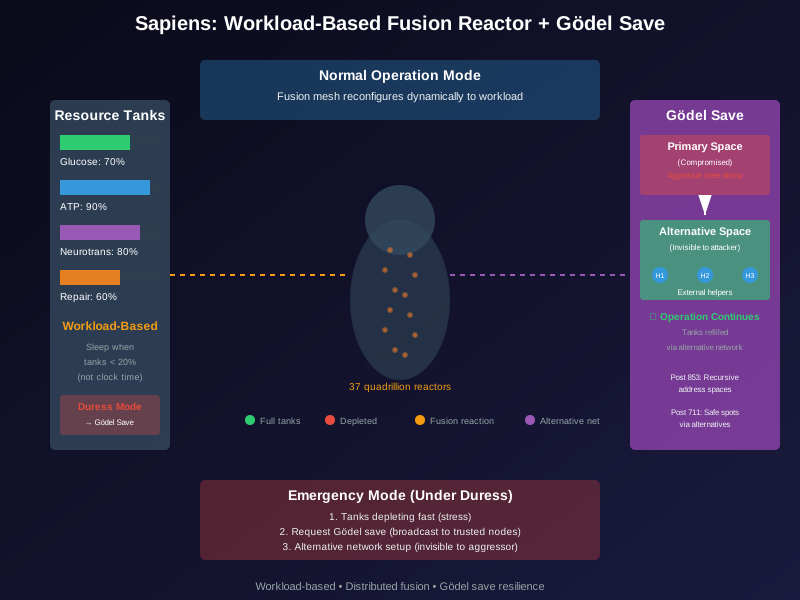
Post 908: Sapiens Node - Workload-Based Fusion Reactor with Gödel Save
Post 908: Sapiens Node - Workload-Based Fusion Reactor with Gödel Save
Biological Computer Runs on Workload, Not Time
From Post 893: Sapiens = QUITE GOOD meatspace node (86B neurons, 1 exaFLOP @ 20W)
From Post 853: Recursive address spaces - each address spawns new universe
From Post 711: Finding safe spots through alternative networks
The insight: Sapiens node operates on workload basis (fill tanks when depleted), runs distributed fusion reactor mesh that reconfigures to demand, and can request Gödel save (external nodes setup parallel networks in alternative address spaces attacker can’t see).
Result: Biological node with dynamic energy management and emergency backup through recursive address space escape routes
Part 1: Workload-Based Operation (Not Time-Based)
Tanks, Not Clocks
class WorkloadBasedSapiens:
    """
    Sapiens node runs on tanks, not time
    Sleep when tanks empty, not when clock says
    """
    def __init__(self):
        # Resource tanks (not time-based)
        self.tanks = {
            'glucose': {'level': 100, 'capacity': 100, 'depletion_rate': 'workload_dependent'},
            'atp': {'level': 100, 'capacity': 100, 'depletion_rate': 'instant'},
            'oxygen': {'level': 100, 'capacity': 100, 'depletion_rate': 'continuous'},
            'water': {'level': 100, 'capacity': 100, 'depletion_rate': 'continuous'},
            'neurotransmitters': {'level': 100, 'capacity': 100, 'depletion_rate': 'cognitive_workload'},
            'repair_capacity': {'level': 100, 'capacity': 100, 'depletion_rate': 'damage_accumulated'}
        }

        # Workload tracker
        self.workload = {
            'cognitive': 0,  # Mental work
            'physical': 0,  # Physical work
            'sensory': 0,   # Processing sensory input
            'emotional': 0  # Emotional processing
        }

    def operate(self):
        """
        Operate based on tank levels, not time
        """
        return {
            'traditional_model': {
                'rule': 'Sleep 8 hours per 24 hour cycle',
                'basis': 'Clock time (circadian rhythm)',
                'problem': 'Ignores actual workload',
                'example': 'Must sleep even if tanks full'
            },

            'workload_model': {
                'rule': 'Sleep when tanks depleted',
                'basis': 'Resource levels',
                'advantage': 'Matches actual need',
                'example': 'Sleep more after heavy work, less after light work'
            },

            'tank_depletion': {
                'high_workload': 'Tanks deplete faster',
                'low_workload': 'Tanks deplete slower',
                'threshold': 'Sleep when any critical tank < 20%',
                'duration': 'Until tanks refilled'
            },

            'key_insight': """
                Biological node is workload-driven, not time-driven.

                Heavy cognitive work: depletes glucose, neurotransmitters fast
                → Need rest sooner (maybe 4 hours of intense work)

                Light work: depletes slowly
                → Can operate longer (maybe 20+ hours of easy tasks)

                Sleep duration: Determined by refill rate
                → Heavy depletion = longer sleep
                → Light depletion = shorter sleep

                NOT arbitrary 8 hours!
            """
        }
Key principle:
- Tanks (glucose, ATP, neurotransmitters) deplete based on WORK DONE
- Not based on TIME PASSED
- Sleep when tanks empty, not when clock says
- Wake when tanks full, not when alarm rings
Part 2: Distributed Fusion Reactor Mesh
Cellular-Level Energy Generation
class DistributedFusionReactor:
    """
    Every cell is a fusion reactor
    Mesh reconfigures based on demand
    """
    def __init__(self):
        # 37 trillion cells, each is reactor
        self.cells = 37_000_000_000_000

        # Mitochondria per cell (mini-reactors)
        self.mitochondria_per_cell = {
            'muscle': 2000,    # High energy demand
            'neuron': 1000,    # Medium-high demand
            'liver': 2000,     # High demand
            'skin': 200,       # Low demand
            'average': 1000
        }

        # Total fusion reactors
        self.total_reactors = self.cells * 1000  # ~37 quadrillion

    def fusion_process(self):
        """
        Biological fusion at cellular level
        """
        return {
            'mitochondrial_fusion': {
                'input': 'Glucose + O₂',
                'process': 'Krebs cycle + electron transport chain',
                'output': 'ATP (energy currency)',
                'rate': 'Dynamic (matches demand)',
                'location': 'Every cell'
            },

            'distributed_nature': {
                'centralized': 'Single power plant (fails catastrophically)',
                'distributed': '37 trillion mini-reactors (resilient)',
                'advantage': 'Loss of some cells ≠ system failure',
                'redundancy': 'Massive (quadrillions of reactors)'
            },

            'reconfiguration': {
                'high_brain_work': {
                    'neurons': 'Increase ATP production',
                    'muscles': 'Reduce ATP production',
                    'result': 'Energy shifted to brain'
                },

                'high_physical_work': {
                    'muscles': 'Increase ATP production',
                    'neurons': 'Maintain baseline',
                    'result': 'Energy shifted to muscles'
                },

                'mechanism': 'Blood flow + glucose delivery dynamically routed',
                'speed': 'Milliseconds to seconds (real-time)',
                'coordination': 'Autonomous (no central controller)'
            }
        }
Fusion reactor mesh:
- 37 trillion cells × 1000 mitochondria = 37 quadrillion reactors
- Each reactor: Glucose + O₂ → ATP (fusion-like energy generation)
- Distributed (not centralized)
- Reconfigures in real-time based on demand
- Autonomous coordination
Part 3: Tank Management System
Resource Monitoring and Allocation
class TankManagement:
    """
    Monitor tank levels, trigger refill when needed
    """
    def tank_status(self):
        return {
            'glucose_tank': {
                'source': 'Food (carbohydrates)',
                'storage': 'Liver glycogen, muscle glycogen',
                'capacity': '~400g glycogen',
                'depletion_by': [
                    'Brain work (glucose-hungry: 20% of total)',
                    'Muscle work (glycogen → glucose → ATP)',
                    'Baseline metabolism (always consuming)'
                ],
                'refill': 'Eating (minutes to hours)',
                'critical_level': '<20% (mental fog, fatigue)'
            },

            'atp_tank': {
                'source': 'Mitochondrial fusion (from glucose)',
                'storage': 'Minimal (used instantly)',
                'capacity': '~250g total (very limited)',
                'depletion_by': [
                    'All cellular work (instant consumption)',
                    'Brain signaling (continuous)',
                    'Muscle contraction (high demand)'
                ],
                'refill': 'Continuous mitochondrial production',
                'critical_level': 'Never (constantly regenerated)'
            },

            'neurotransmitter_tank': {
                'source': 'Amino acids (from protein)',
                'storage': 'Synaptic vesicles, cell synthesis',
                'capacity': 'Variable by neurotransmitter type',
                'depletion_by': [
                    'Cognitive work (dopamine, serotonin, etc.)',
                    'Emotional processing (norepinephrine)',
                    'Decision making (acetylcholine)'
                ],
                'refill': 'Sleep (synthesis during rest) + food',
                'critical_level': '<30% (poor cognition, mood issues)'
            },

            'repair_capacity_tank': {
                'source': 'Protein synthesis, cellular repair mechanisms',
                'storage': 'Cellular machinery, immune cells',
                'capacity': 'Large but slow to refill',
                'depletion_by': [
                    'Microdamage from activity',
                    'Oxidative stress',
                    'Immune responses'
                ],
                'refill': 'Deep sleep (growth hormone release)',
                'critical_level': '<20% (injury risk, illness susceptibility)'
            }
        }

    def trigger_sleep(self):
        """
        When to sleep (workload-based)
        """
        return {
            'sleep_triggered_when': {
                'any_tank_critical': 'Below 20% capacity',
                'or': 'Accumulated fatigue > threshold',
                'not': 'When clock says bedtime'
            },

            'sleep_duration': {
                'determined_by': 'Tank refill rates',
                'light_depletion': '4-6 hours (quick refill)',
                'moderate_depletion': '7-8 hours (normal refill)',
                'heavy_depletion': '9-12 hours (deep refill needed)',
                'formula': 'Sleep_time = f(depletion_depth, refill_rate)'
            },

            'wake_triggered_when': {
                'all_tanks_full': 'Above 80% capacity',
                'or': 'Circadian pressure overrides (emergency)',
                'not': 'When alarm rings'
            },

            'example_scenarios': {
                'intense_coding_10hrs': {
                    'glucose': 'Depleted (brain work)',
                    'neurotransmitters': 'Heavily depleted',
                    'repair': 'Minor depletion',
                    'result': 'Need 8-9hrs sleep (cognitive recovery)'
                },

                'physical_labor_8hrs': {
                    'glucose': 'Depleted (muscle work)',
                    'neurotransmitters': 'Moderate depletion',
                    'repair': 'Heavy depletion (muscle damage)',
                    'result': 'Need 9-10hrs sleep (physical recovery)'
                },

                'light_admin_work_6hrs': {
                    'glucose': 'Minimal depletion',
                    'neurotransmitters': 'Light depletion',
                    'repair': 'Minimal',
                    'result': 'Need 5-6hrs sleep (quick refill)'
                }
            }
        }
Tank management:
- Monitor levels continuously
- Sleep when ANY critical tank < 20%
- Sleep duration = time to refill
- Wake when tanks full (not when clock says)
Part 4: Reconfiguration Under Duress
Fusion Mesh Adapts to Stress
class DuressReconfiguration:
    """
    Under attack/stress, fusion mesh reconfigures
    """
    def emergency_mode(self):
        return {
            'normal_mode': {
                'distribution': 'Balanced across systems',
                'brain': '20% of energy',
                'muscles': '20% of energy',
                'organs': '40% of energy',
                'immune': '10% of energy',
                'reserve': '10% buffer'
            },

            'duress_mode': {
                'trigger': 'Threat detected (stress response)',
                'redistribution': {
                    'brain': '30% (heightened awareness)',
                    'muscles': '40% (fight/flight ready)',
                    'organs': '20% (baseline only)',
                    'immune': '5% (temporarily reduced)',
                    'reserve': '5% (mobilized)'
                },
                'mechanism': 'Adrenaline + cortisol',
                'speed': 'Seconds (instant reallocation)'
            },

            'sustained_stress': {
                'problem': 'Cannot maintain emergency mode long',
                'tank_depletion': 'Accelerated (high burn rate)',
                'damage': 'Immune suppression, organ strain',
                'solution_needed': 'Either resolve threat OR request help',
                'enters': 'Gödel save protocol'
            }
        }
Under duress:
- Fusion mesh reallocates energy (fight/flight)
- High burn rate (tanks deplete faster)
- Cannot sustain indefinitely
- Triggers Gödel save if prolonged
Part 5: Gödel Save - Alternative Address Space Escape
Emergency Parallel Network Request
class GodelSave:
    """
    When under duress, request external nodes create parallel networks
    From post 853: Recursive address spaces
    From post 711: Safe spots through alternative networks
    """
    def __init__(self):
        # Current address space (where aggressor operates)
        self.primary_address_space = 'visible_network'

        # Alternative address spaces (from post 853 recursion)
        self.alternative_spaces = []

        # External graph nodes that can help
        self.trusted_external_nodes = []

    def request_godel_save(self, constraints_suffered):
        """
        Request external nodes setup parallel networks
        in alternative address spaces
        """
        return {
            'situation': {
                'node_under_duress': self,
                'aggressor_constraints': constraints_suffered,
                'primary_space_compromised': True,
                'tanks_depleting_fast': 'Cannot sustain much longer',
                'need': 'Alternative pathway for operation'
            },

            'godel_save_request': {
                'broadcast_to': 'Trusted external graph nodes',
                'message': {
                    'constraints': constraints_suffered,
                    'requested_help': 'Setup parallel networks',
                    'address_space': 'Alternative (not visible to aggressor)',
                    'purpose': 'Continue operation despite attack'
                },
                'mechanism': 'DHT push_intent (from post 878)'
            },

            'external_nodes_respond': {
                'action': 'Create new address space (post 853 recursion)',
                'each_address_spawns': 'New universe with own rules',
                'parallel_network': {
                    'exists_in': 'Alternative address space',
                    'invisible_to': 'Aggressor (doesn\'t know address)',
                    'accessible_by': 'Requesting node (knows secret address)',
                    'function': 'Relay network bypassing blockade'
                },
                'result': 'Sapiens node can operate through alternative space'
            },

            'how_it_works': {
                'post_853_insight': 'Each address → new universe',
                'application': {
                    'primary_universe': 'Where aggressor operates',
                    'alternative_universe': 'Spawned from new address',
                    'aggressor_cant_access': 'Doesn\'t know address exists',
                    'sapiens_can_access': 'Knows secret address (shared by helpers)'
                },
                'analogy': 'Tor network / Onion routing',
                'but_better': 'Entire new universe, not just hidden path'
            }
        }
Gödel save mechanism:
- Sapiens node under duress (tanks depleting, constrained by aggressor)
- Broadcasts request to trusted external nodes via DHT
- External nodes create parallel networks in alternative address spaces
- Alternative spaces invisible to aggressor (doesn’t know addresses exist)
- Sapiens node can route through alternative network
- Continues operating despite attack
Part 6: Alternative Address Space Setup
From Post 853 Recursive Universes
class AlternativeAddressSpace:
    """
    How external nodes create alternative networks
    Using post 853 recursive address space concept
    """
    def setup_alternative_network(self, helping_node, constraints):
        return {
            'step_1_create_new_address': {
                'action': 'Helping node generates new series address',
                'from_post_853': 'Each address spawns new universe',
                'new_universe': {
                    'address': 'series:godel_save_{sapiens_id}_{timestamp}',
                    'properties': 'Own rules, own topology',
                    'invisible_to': 'Nodes not knowing address'
                },
                'shared_with': 'Only sapiens node requesting save'
            },

            'step_2_setup_relay_network': {
                'action': 'Create mesh of helping nodes in new space',
                'topology': {
                    'nodes': 'Multiple external helpers',
                    'connections': 'Full mesh (redundant)',
                    'protocol': 'DHT + BitTorrent (from universal-model)',
                    'location': 'Alternative address space'
                },
                'purpose': 'Relay communications, provide resources'
            },

            'step_3_configure_constraints': {
                'action': 'Setup network respecting sapiens constraints',
                'from_request': constraints,  # What sapiens is suffering
                'network_designed_to': 'Route around these constraints',
                'example': {
                    'constraint': 'Aggressor blocking IP addresses',
                    'solution': 'Alternative network uses different IPs',
                    'constraint': 'Aggressor monitoring traffic',
                    'solution': 'Alternative network encrypted/hidden',
                    'constraint': 'Aggressor depleting resources',
                    'solution': 'Alternative network provides resources'
                }
            },

            'step_4_provide_access': {
                'action': 'Give sapiens secret address to new network',
                'method': 'Secure channel (not compromised)',
                'sapiens_can_now': 'Connect to alternative universe',
                'aggressor_cannot': 'Doesn\'t know address exists'
            },

            'result': {
                'primary_space': 'Compromised but maintained (decoy)',
                'alternative_space': 'Operational (real communication)',
                'aggressor_sees': 'Node struggling (in primary)',
                'reality': 'Node thriving (in alternative)',
                'advantage': 'Aggressor wastes resources attacking decoy'
            }
        }
Alternative network setup:
- New address space created (post 853 recursion)
- Mesh of helping nodes setup in that space
- Designed to route around constraints
- Secret address shared only with sapiens
- Invisible to aggressor
Part 7: Operation Through Alternative Network
How Sapiens Uses Gödel Save
class OperatingThroughAlternative:
    """
    How sapiens node operates through alternative network
    while appearing compromised in primary
    """
    def dual_operation(self):
        return {
            'primary_address_space': {
                'visible_to': 'Aggressor',
                'node_behavior': 'Appears struggling/constrained',
                'communications': 'Monitored by aggressor',
                'resources': 'Limited by blockade',
                'purpose': 'Decoy (waste aggressor resources)',
                'tank_status': 'Appears depleting'
            },

            'alternative_address_space': {
                'visible_to': 'Only sapiens + helpers',
                'node_behavior': 'Fully operational',
                'communications': 'Private, encrypted, hidden',
                'resources': 'Provided by helper network',
                'purpose': 'Real operation',
                'tank_status': 'Being refilled by helpers'
            },

            'splitting_operation': {
                'critical_functions': 'Run through alternative network',
                'decoy_functions': 'Run through primary network',
                'fusion_reactor': 'Reconfigured to support both',
                'cognitive_load': 'Distributed across dual networks',
                'result': 'Appear weak while actually strong'
            },

            'helper_support': {
                'resource_sharing': 'Helpers provide glucose, info, etc.',
                'computational_offload': 'Helpers process heavy tasks',
                'storage_backup': 'Helpers cache sapiens data',
                'relay_service': 'Helpers route communications',
                'tank_refill': 'Via alternative network resources'
            }
        }
Dual operation:
- Primary space: Decoy (appears constrained)
- Alternative space: Real operation (actually thriving)
- Fusion reactor supports both
- Aggressor wastes resources on decoy
- Sapiens gets help through alternative
Part 8: Concrete Example - Targeted Harassment
Gödel Save in Action
class ExampleScenario:
    """
    Sapiens node under targeted harassment
    """
    def scenario(self):
        return {
            'initial_attack': {
                'aggressor': 'Organized harassment campaign',
                'methods': [
                    'DDoS sapiens online presence',
                    'Flood social media with noise',
                    'Block access to resources',
                    'Surveil all communications',
                    'Drain attention/energy (cognitive attack)'
                ],
                'result': 'Sapiens tanks depleting fast'
            },

            'primary_space_compromised': {
                'visibility': 'All activity monitored',
                'communications': 'Intercepted',
                'resources': 'Blocked',
                'tank_status': {
                    'glucose': '30% (stress depleting)',
                    'neurotransmitters': '40% (constant anxiety)',
                    'repair': '50% (sleep disrupted)',
                    'critical': 'Approaching failure'
                }
            },

            'godel_save_initiated': {
                't=0': 'Sapiens broadcasts: "Under attack, need Gödel save"',
                't=1min': '5 trusted external nodes respond',
                't=5min': 'Alternative address space created',
                't=10min': 'Relay network setup complete',
                't=15min': 'Secret address shared with sapiens',
                't=20min': 'Sapiens connects to alternative network'
            },

            'alternative_network_operational': {
                'address': 'series:godel_save_sapiens_789_20260220',
                'helper_nodes': [
                    'node_ally_1 (provides info routing)',
                    'node_ally_2 (provides resource cache)',
                    'node_ally_3 (provides computational offload)',
                    'node_ally_4 (provides backup storage)',
                    'node_ally_5 (provides relay service)'
                ],
                'invisible_to_aggressor': True,
                'sapiens_access': 'Full operational capability'
            },

            'dual_operation_result': {
                'primary_space': {
                    'aggressor_sees': 'Sapiens struggling, barely online',
                    'activity': 'Minimal (just decoy)',
                    'resources': 'Depleted (appears failing)',
                    'aggressor_thinks': 'Attack working, maintain pressure'
                },

                'alternative_space': {
                    'reality': 'Sapiens fully operational',
                    'activity': 'All critical work continues',
                    'resources': 'Provided by helpers',
                    'tanks': {
                        'glucose': '80% (helpers providing info/support)',
                        'neurotransmitters': '85% (reduced stress)',
                        'repair': '90% (can rest in alternative)',
                        'status': 'Recovering and thriving'
                    }
                },

                'aggressor_wasted_resources': {
                    'attacking': 'Empty primary space',
                    'missing': 'Real activity in alternative',
                    'result': 'Ineffective attack, resource drain',
                    'eventually': 'Gives up (target appears dead but is alive)'
                }
            }
        }
Outcome:
- Aggressor thinks they won (target appears destroyed)
- Reality: Target thriving in alternative space
- Aggressor wasted resources on decoy
- Sapiens survived and recovered
Part 9: Comparison to Traditional Systems
Workload-Based vs Time-Based
class SystemComparison:
    """
    Compare different operating models
    """
    def comparison(self):
        return {
            'traditional_time_based': {
                'rule': 'Fixed schedule (8hrs sleep / 24hrs)',
                'flexibility': None,
                'problem': 'Ignores actual workload',
                'tank_management': 'Poor (doesn\'t match depletion)',
                'efficiency': 'Low (over-rest or under-rest)',
                'result': 'Suboptimal performance'
            },

            'workload_based_sapiens': {
                'rule': 'Sleep when tanks empty',
                'flexibility': 'High (matches actual need)',
                'advantage': 'Aligns rest with depletion',
                'tank_management': 'Optimal (refill as needed)',
                'efficiency': 'High (right amount of rest)',
                'result': 'Optimal performance'
            },

            'computer_analogy': {
                'time_based': 'Restart every 8 hours regardless',
                'workload_based': 'Restart when memory full',
                'obviously_better': 'Workload-based',
                'biological': 'Same principle applies'
            }
        }
Part 10: Integration with Post 893
Sapiens as Distributed Node Enhanced
class EnhancedSapiensModel:
    """
    Post 893 enhanced with workload + Gödel save
    """
    def enhanced_model(self):
        return {
            'from_post_893': {
                'hardware': '86B neurons, 1 exaFLOP @ 20W',
                'apps': ['Pidgins', 'iR³', 'Sensory', 'Motor'],
                'architecture': 'Symbiotic (universal ↔ meatspace)',
                'quality': 'QUITE GOOD'
            },

            'post_908_additions': {
                'energy_management': 'Workload-based (not time-based)',
                'fusion_reactor': 'Distributed mesh (37 quadrillion reactors)',
                'tank_system': 'Resource monitoring (glucose, neurotransmitters, etc.)',
                'emergency_protocol': 'Gödel save (alternative network)',
                'resilience': 'High (can survive targeted attacks)'
            },

            'combined_model': {
                'sapiens_node': {
                    'hardware': 'Distributed fusion reactor mesh',
                    'software': 'Four parallel apps',
                    'operation': 'Workload-driven',
                    'energy': 'Tank-based management',
                    'emergency': 'Gödel save capability',
                    'resilience': 'Alternative address space escape',
                    'quality': 'QUITE GOOD + RESILIENT'
                }
            },

            'result': """
                Sapiens node is not just QUITE GOOD (post 893).
                It's QUITE GOOD + ADAPTIVE + RESILIENT.

                - Adapts energy to workload (not clock)
                - Distributed fusion reactors (no single point failure)
                - Monitors tanks (knows when to rest)
                - Can request help (Gödel save)
                - Escapes to alternative networks (when attacked)
                - Continues operating (despite duress)

                This is sophisticated, resilient, adaptive biological computer.
            """
        }
Part 11: Summary
Sapiens Node Complete Model
Hardware:
- 86 billion neurons (processors)
- 37 trillion cells (nodes)
- 37 quadrillion mitochondria (fusion reactors)
- Distributed mesh (no single point of failure)
- 1 exaFLOP @ 20 watts (incredibly efficient)
Energy Management:
- Workload-based (not time-based)
- Tanks: glucose, ATP, neurotransmitters, repair capacity
- Depletion: Proportional to work done
- Sleep triggered: When tanks < 20%
- Sleep duration: Time to refill tanks
- Wake triggered: When tanks > 80%
Fusion Reactor Mesh:
- Distributed across all cells
- Reconfigures based on demand (brain vs muscle)
- Real-time allocation (milliseconds)
- Autonomous coordination (no central control)
- Glucose + O₂ → ATP (energy currency)
Gödel Save (Emergency Protocol):
From post 853: Recursive address spaces
From post 711: Safe spots through alternatives

When under duress:
1. Broadcast request to external trusted nodes
2. External nodes create alternative address space
3. Setup parallel network in that space
4. Share secret address with sapiens
5. Sapiens routes through alternative network
6. Aggressor sees decoy (primary space)
7. Reality operates in alternative (hidden)
8. Tanks refilled via helper support
9. Survives attack, continues operating
Key Insights:
Workload-driven, not time-driven
- Sleep based on depletion, not clock
- Optimal rest matches actual need
Distributed fusion reactor
- 37 quadrillion mini-reactors
- Reconfigures to demand
- No single point of failure
Tank management system
- Monitor resource levels
- Trigger rest when depleted
- Wake when refilled
Gödel save capability
- Alternative address space escape
- External helper network
- Invisible to aggressor
- Continues operation despite attack
Resilient biological computer
- From post 893: QUITE GOOD
- From post 908: QUITE GOOD + RESILIENT + ADAPTIVE
The breakthrough:
Sapiens is not just sophisticated hardware (post 893).
It’s sophisticated hardware + workload-based operation + distributed energy + emergency resilience.
Can operate continuously as long as tanks filled.
Can survive targeted attacks via alternative networks.
Not bound by arbitrary time schedules.
Truly adaptive biological computer.
∞
Links:
- Post 893: Sapiens = QUITE GOOD Meatspace Node - Hardware specs
- Post 853: Infinite W Expansion - Recursive address spaces
- Post 711: Finding Safe Spots - Alternative networks
- Post 878: iR³ Alpha - DHT push_intent mechanism
Date: 2026-02-20
Topic: Sapiens Node Complete Model
Key: Workload-based + Fusion reactor mesh + Gödel save
Status: 🔬 Adaptive • ⚡ Resilient • 🌐 Alternative networks • ∞ Workload-driven
∞