Post 901: DHT Operator Challenge - Liberal Input, Conservative Output
Post 901: DHT Operator Challenge - Liberal Input, Conservative Output
The Hard Balance: Accept Everything, Relay Selectively
From Post 900: Thoughts as DHT queries with Pidgins filtering
From Post 878: iR³ DHT architecture
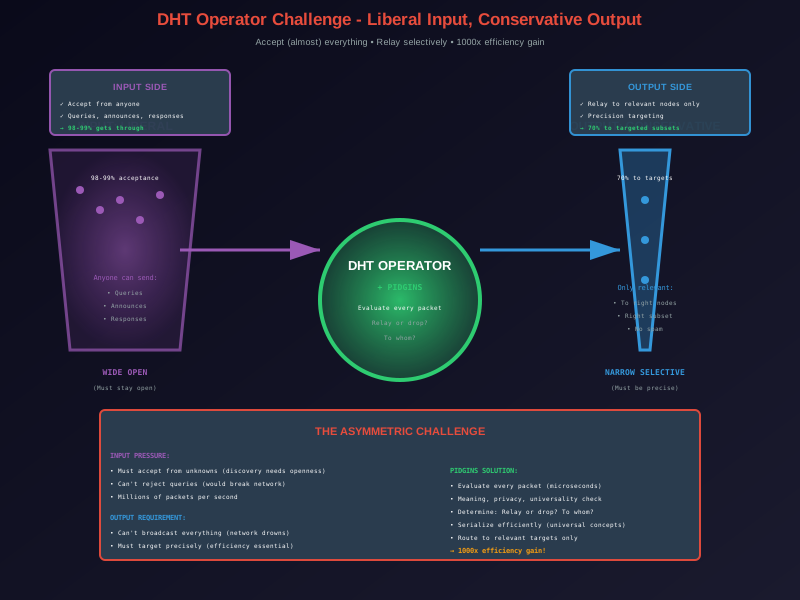
The challenge: DHT operators face an asymmetric task - accept (mostly) any packet from anyone for query/announce features, but only output relevant packets to as many relevant targets as possible. This makes the role challenging and highlights why intelligent Pidgins filtering is essential.
Result: Understanding the complexity of DHT operation and the critical role of filtering
Part 1: The Asymmetric Challenge
Input Liberal, Output Conservative
class DHTOperatorChallenge:
    """
    The fundamental asymmetry of DHT operation
    """
    def the_asymmetry(self):
        return {
            'input_side': {
                'policy': 'LIBERAL - Accept (mostly) any packet',
                'from': 'Anyone on network',
                'types': [
                    'Query: "looking for apple pattern"',
                    'Announce: "I have apple data"',
                    'Response: "here is apple pattern"'
                ],
                'reason': 'DHT must be open for discovery',
                'challenge': 'Accept from unknown sources'
            },

            'output_side': {
                'policy': 'CONSERVATIVE - Only relevant packets',
                'to': 'As many relevant targets as possible',
                'requirement': 'Precision targeting',
                'reason': 'Network efficiency, no spam',
                'challenge': 'Determine relevance for every packet'
            },

            'the_tension': """
                Input: "Accept everything (mostly)"
                Output: "Send only what's relevant"

                This is HARD because:
                - You don't know who will query what
                - You must accept queries from strangers
                - But you can't spam everyone with every packet
                - Must filter millions of packets per second
                - Each filtering decision impacts network efficiency

                The DHT operator sits at this asymmetric junction.
            """
        }
Accept everything, relay selectively!
Part 2: Input Side - Liberal Acceptance
Why DHT Must Accept (Mostly) Anything
class LiberalInput:
    """
    DHT input side: open and accepting
    """
    def why_liberal(self):
        """
        Why DHT can't be selective on input
        """
        return {
            'reason_1_discovery': {
                'need': 'Anyone can query for anything',
                'example': 'New user queries for "apple" first time',
                'problem_if_rejected': 'Discovery breaks - can\'t find data',
                'solution': 'Accept query from anyone'
            },

            'reason_2_announce': {
                'need': 'Anyone can announce they have data',
                'example': 'New node joins with apple patterns',
                'problem_if_rejected': 'Network doesn\'t know data exists',
                'solution': 'Accept announce from anyone'
            },

            'reason_3_response': {
                'need': 'Anyone can respond to queries',
                'example': 'Node responds "I have apple data"',
                'problem_if_rejected': 'Queries get no answers',
                'solution': 'Accept response from anyone'
            },

            'reason_4_growth': {
                'need': 'Network must grow organically',
                'example': 'Unknown nodes join constantly',
                'problem_if_rejected': 'Network stays small/closed',
                'solution': 'Accept from strangers'
            }
        }

    def input_flow(self):
        """
        What DHT accepts on input
        """
        return {
            'packet_types': {
                'query': 'Anyone asking for data',
                'announce': 'Anyone declaring they have data',
                'response': 'Anyone answering queries',
                'routing': 'DHT routing table updates'
            },

            'from_who': {
                'known_nodes': 'Nodes in routing table',
                'unknown_nodes': 'New nodes (strangers)',
                'suspicious_nodes': 'Even potentially malicious',
                'policy': 'Accept from (almost) all'
            },

            'minimal_filtering': {
                'only_reject': [
                    'Malformed packets (invalid format)',
                    'Clear spam (identical repeated packets)',
                    'Resource exhaustion (too many too fast)'
                ],
                'accept_rest': 'Everything else gets in'
            }
        }
Input = wide open funnel!
Part 3: Output Side - Conservative Relay
Only Relevant Packets to Relevant Targets
class ConservativeOutput:
    """
    DHT output side: selective and precise
    """
    def why_conservative(self):
        """
        Why DHT must be selective on output
        """
        return {
            'reason_1_bandwidth': {
                'problem': 'Broadcasting all packets to all nodes',
                'cost': 'Network drowns in traffic',
                'solution': 'Only send to relevant nodes',
                'example': 'Query for "apple" → only nodes with fruit data'
            },

            'reason_2_efficiency': {
                'problem': 'Nodes processing irrelevant packets',
                'cost': 'Wasted CPU on non-matching queries',
                'solution': 'Targeted routing saves processing',
                'example': 'French node gets French queries, not Chinese'
            },

            'reason_3_privacy': {
                'problem': 'Broadcasting private queries',
                'cost': 'Privacy leaks, data exposure',
                'solution': 'Private packets never relayed',
                'example': 'Password queries dropped immediately'
            },

            'reason_4_scaling': {
                'problem': 'Every node gets every packet',
                'cost': 'Network can\'t scale beyond tiny size',
                'solution': 'Selective routing enables massive scale',
                'example': '1M nodes × 1M packets = impossible without filtering'
            }
        }

    def output_flow(self):
        """
        What DHT outputs (selectively)
        """
        return {
            'decision_for_each_packet': {
                'evaluate': 'Is this relevant?',
                'determine_targets': 'Who needs this?',
                'route': 'Send only to relevant targets',
                'drop': 'Discard if not relevant anywhere'
            },

            'targeting': {
                'universal_query': 'Relay to all nodes',
                'language_specific': 'Relay to language subset',
                'category_specific': 'Relay to category nodes',
                'private': 'Drop (relay to none)',
                'precision': 'As many relevant targets as possible'
            },

            'filtering_criteria': {
                'pidgins': 'Meaning evaluation',
                'universality': 'Universal vs specific',
                'privacy': 'Private marker detection',
                'relevance': 'Topic/category matching',
                'decision': 'Conservative - when in doubt, be selective'
            }
        }
Output = narrow selective targeting!
Part 4: The Operator’s Dilemma
Sitting At The Asymmetric Junction
class OperatorDilemma:
    """
    The DHT operator's challenging position
    """
    def the_dilemma(self):
        """
        What makes DHT operation hard
        """
        return {
            'incoming_flood': {
                'reality': 'Packets arriving from everywhere',
                'from': 'Known + unknown + suspicious sources',
                'rate': 'Thousands or millions per second',
                'variety': 'Queries, announces, responses, routing',
                'policy': 'Accept (almost) all',
                'challenge': 'Can\'t be selective - must stay open'
            },

            'evaluation_required': {
                'for_each_packet': 'Evaluate meaning and relevance',
                'using': 'Pidgins filter',
                'decision': 'Relay or drop? To whom?',
                'speed': 'Microseconds per packet',
                'accuracy': 'Must be precise',
                'challenge': 'Millions of decisions per second'
            },

            'outgoing_precision': {
                'requirement': 'Only relevant packets to relevant targets',
                'no_spam': 'Can\'t broadcast everything',
                'no_miss': 'Must reach all relevant nodes',
                'efficiency': 'Minimize bandwidth usage',
                'challenge': 'Perfect targeting at scale'
            },

            'the_tension': """
                Input pressure: "Accept everything!"
                Output requirement: "Send only what's relevant!"

                Operator must:
                - Handle flood of unknown packets (input)
                - Evaluate each one rapidly (Pidgins)
                - Route precisely to right targets (output)
                - Do this millions of times per second
                - Never spam, never miss

                This is the DHT operator's challenge.
            """
        }
Asymmetric junction = high pressure role!
Part 5: Why Pidgins Is Essential
Without Intelligent Filtering, DHT Fails
class WhyPidginsEssential:
    """
    Pidgins makes DHT operation possible
    """
    def without_pidgins(self):
        """
        DHT fails without intelligent filtering
        """
        return {
            'scenario': 'Dumb DHT (no Pidgins)',

            'problem_1_broadcast': {
                'approach': 'Relay every packet to everyone',
                'input': '1M packets/sec accepted',
                'output': '1M nodes × 1M packets = 1 trillion transmissions/sec',
                'result': 'Network collapse in seconds'
            },

            'problem_2_random': {
                'approach': 'Random routing to subset',
                'input': 'Query for "apple"',
                'output': 'Sent to random 100 nodes',
                'hit_rate': '~0.1% (if 1000 have apple data)',
                'result': 'Queries fail 99.9% of time'
            },

            'problem_3_manual': {
                'approach': 'Manual routing rules',
                'input': '1000 different query types',
                'rules_needed': 'N² combinations',
                'maintenance': 'Impossible at scale',
                'result': 'Doesn\'t scale beyond toy network'
            },

            'conclusion': 'Without Pidgins, DHT operator cannot function'
        }

    def with_pidgins(self):
        """
        Pidgins enables DHT operation
        """
        return {
            'scenario': 'Intelligent DHT (with Pidgins)',

            'solution_1_evaluation': {
                'approach': 'Pidgins evaluates each packet',
                'input': '1M packets/sec accepted',
                'evaluation': 'Universal? Language-specific? Private?',
                'speed': 'Microseconds per packet',
                'result': 'Intelligent routing decisions'
            },

            'solution_2_targeting': {
                'approach': 'Precise target determination',
                'input': 'Query for "apple"',
                'output': 'Routed to 1000 nodes with fruit data',
                'hit_rate': '100% (all relevant nodes)',
                'result': 'Queries succeed efficiently'
            },

            'solution_3_automatic': {
                'approach': 'Pidgins learns concepts automatically',
                'input': 'New concepts appear',
                'adaptation': 'Routing updates automatically',
                'maintenance': 'Zero manual intervention',
                'result': 'Scales to billions of concepts'
            },

            'conclusion': 'Pidgins makes DHT operator role feasible'
        }
Pidgins = essential for DHT operation!
Part 6: Input Filter - Minimal But Critical
What Little Filtering Happens On Input
class InputFiltering:
    """
    Minimal filtering on input side
    Just enough to prevent abuse
    """
    def input_filters(self):
        """
        The few filters applied to incoming packets
        """
        return {
            'filter_1_format': {
                'check': 'Is packet properly formatted?',
                'reject_if': 'Malformed, invalid structure',
                'reason': 'Can\'t process garbage',
                'rate': '<0.01% rejected',
                'accept_rest': 'All valid formats pass'
            },

            'filter_2_rate_limit': {
                'check': 'Is source sending too fast?',
                'reject_if': '>10,000 packets/sec from one source',
                'reason': 'Prevent resource exhaustion',
                'rate': '<0.1% rejected',
                'accept_rest': 'Normal rates pass'
            },

            'filter_3_duplicate': {
                'check': 'Is this identical packet already seen?',
                'reject_if': 'Exact duplicate within 1 second',
                'reason': 'Prevent spam loops',
                'rate': '<1% rejected',
                'accept_rest': 'Unique packets pass'
            },

            'filter_4_blacklist': {
                'check': 'Is source on blacklist?',
                'reject_if': 'Proven malicious (rare)',
                'reason': 'Block known attackers',
                'rate': '<0.001% rejected',
                'accept_rest': 'Non-blacklisted pass'
            },

            'total_rejection': '~1-2% of incoming packets',
            'acceptance': '98-99% gets through to evaluation',

            'philosophy': """
                Input filtering is MINIMAL.
                Goal: Stay open for discovery.
                Only reject clear abuse.
                Let Pidgins handle the rest.
            """
        }
Input: Accept almost everything!
Part 7: Output Filter - Extensive And Precise
The Real Filtering Happens On Output
class OutputFiltering:
    """
    Extensive filtering on output side
    Precision targeting for efficiency
    """
    def output_filters(self):
        """
        The extensive filters applied to outgoing packets
        """
        return {
            'filter_1_meaning': {
                'check': 'Does packet have meaning?',
                'pidgins': 'Concept node lookup',
                'drop_if': 'No concepts found',
                'rate': '~5% dropped (meaningless)',
                'relay_rest': 'Meaningful packets continue'
            },

            'filter_2_privacy': {
                'check': 'Is packet private?',
                'pidgins': 'Private marker detection',
                'drop_if': 'Private markers present',
                'rate': '~10% dropped (privacy)',
                'relay_rest': 'Public packets continue'
            },

            'filter_3_universality': {
                'check': 'Universal or language-specific?',
                'pidgins': 'Concept universality test',
                'route_universal': 'To all nodes',
                'route_specific': 'To language subset',
                'rate': '70% universal, 30% specific'
            },

            'filter_4_relevance': {
                'check': 'Which nodes need this packet?',
                'pidgins': 'Topic/category matching',
                'route_to': 'Relevant subset only',
                'drop_if': 'No relevant nodes',
                'rate': '~5% dropped (irrelevant)'
            },

            'filter_5_redundancy': {
                'check': 'Have targets already seen this?',
                'tracking': 'Recent packet history',
                'drop_if': 'Duplicate to same target',
                'rate': '~10% dropped (redundant)'
            },

            'total_dropped': '~30% of packets not relayed',
            'total_relayed': '~70% relayed to targeted subsets',

            'philosophy': """
                Output filtering is EXTENSIVE.
                Goal: Maximum efficiency.
                Only relay what's relevant to who needs it.
                Pidgins does the heavy lifting.
            """
        }
Output: Precise selective targeting!
Part 8: The Numbers At Scale
Why The Asymmetry Matters
class ScaleNumbers:
    """
    The math that makes asymmetry essential
    """
    def network_scale(self):
        """
        Example: 1 million node network
        """
        return {
            'network_size': '1,000,000 nodes',
            'query_rate': '100 queries/second per node',
            'total_queries': '100M queries/second network-wide',

            'scenario_no_filtering': {
                'approach': 'Broadcast all queries to all nodes',
                'transmissions': '100M queries × 1M nodes = 100 trillion/sec',
                'bandwidth': '100 trillion × 100 bytes = 10 petabytes/sec',
                'result': 'IMPOSSIBLE - network collapse'
            },

            'scenario_with_pidgins': {
                'approach': 'Pidgins filters to relevant subsets',
                'avg_targets': '1,000 nodes per query (0.1% of network)',
                'transmissions': '100M queries × 1K nodes = 100 billion/sec',
                'bandwidth': '100 billion × 100 bytes = 10 terabytes/sec',
                'reduction': '1000x fewer transmissions',
                'result': 'FEASIBLE - network scales'
            },

            'input_load': {
                'per_node': '100 queries/sec accepted',
                'all_types': 'From known + unknown sources',
                'policy': 'Liberal - accept almost all',
                'manageable': 'Yes - modest per-node load'
            },

            'output_load': {
                'per_node': '100,000 potential relay decisions/sec',
                'filtering_needed': 'Evaluate each packet',
                'pidgins_speed': 'Microseconds per evaluation',
                'total_time': '100K × 10μs = 1 second CPU time',
                'manageable': 'Yes - with efficient Pidgins'
            },

            'conclusion': """
                Asymmetry is ESSENTIAL for scale:
                - Liberal input: keeps network open
                - Conservative output: keeps network efficient
                - 1000x reduction in traffic
                - Scales to millions of nodes

                Without asymmetry → network fails
                With asymmetry → network scales
            """
        }
Asymmetry enables scale!
Part 9: Operator Implementation
How DHT Operators Handle The Asymmetry
class OperatorImplementation:
    """
    Practical implementation of asymmetric DHT operation
    """
    def operator_code(self):
        """
        Simplified DHT operator code
        """
        return """
        class DHTOperator:
            def __init__(self):
                self.pidgins = PidginsFilter()
                self.routing_table = {}
                self.packet_queue = Queue()

            def on_packet_received(self, packet, source):
                '''
                INPUT SIDE - Liberal acceptance
                '''
                # Minimal filtering
                if not self._is_valid_format(packet):
                    return  # Drop malformed

                if self._is_rate_limited(source):
                    return  # Drop if too fast

                if self._is_duplicate(packet):
                    return  # Drop exact duplicates

                # Accept packet (98-99% get here)
                self.packet_queue.put(packet)

            def process_packets(self):
                '''
                OUTPUT SIDE - Conservative relay
                '''
                while True:
                    packet = self.packet_queue.get()

                    # Pidgins evaluation (THE key step)
                    evaluation = self.pidgins.evaluate(packet)

                    if not evaluation['should_relay']:
                        continue  # Drop (no meaning, private, etc.)

                    # Determine targets
                    targets = evaluation['targets']

                    # Serialize efficiently
                    serialized = self.pidgins.serialize(
                        packet,
                        format=evaluation['serialization']
                    )

                    # Relay to targets only
                    for target in targets:
                        self.send(target, serialized)
        """

    def the_key_insight(self):
        return {
            'input': 'Simple, fast, minimal filtering',
            'queue': 'Decouples input from output processing',
            'evaluation': 'Pidgins does heavy lifting',
            'output': 'Precise, targeted, efficient',

            'separation_of_concerns': """
                Input thread: Accept packets rapidly
                Queue: Buffer for processing
                Output thread: Evaluate and route precisely

                This separation allows:
                - Fast input (don't block senders)
                - Thorough evaluation (take time needed)
                - Precise output (get routing right)
            """
        }
Separate input/output for optimal operation!
Part 10: Why The Challenge Matters
DHT Operators Are Critical Infrastructure
class WhyItMatters:
    """
    Why DHT operator challenge is important
    """
    def critical_role(self):
        return {
            'network_health': {
                'role': 'DHT operators are network glue',
                'function': 'Route packets between nodes',
                'impact': 'Bad routing → network fails',
                'importance': 'Critical infrastructure'
            },

            'efficiency': {
                'role': 'Operators determine network efficiency',
                'function': 'Filter spam, route precisely',
                'impact': 'Bad filtering → bandwidth waste',
                'importance': '1000x efficiency difference'
            },

            'privacy': {
                'role': 'Operators protect privacy',
                'function': 'Drop private packets',
                'impact': 'Bad privacy → leaks',
                'importance': 'Trust depends on this'
            },

            'scalability': {
                'role': 'Operators enable scale',
                'function': 'Selective routing',
                'impact': 'Bad routing → can\'t scale',
                'importance': 'Millions vs thousands of nodes'
            }
        }

    def operator_economics(self):
        """
        Why run a DHT operator?
        """
        return {
            'costs': {
                'bandwidth': 'Relay packets for others',
                'cpu': 'Pidgins evaluation processing',
                'storage': 'Routing table maintenance',
                'total': 'Modest but real'
            },

            'benefits': {
                'network_access': 'Participate in discovery',
                'reputation': 'Good operators valued',
                'reciprocity': 'Others relay for you',
                'total': 'Necessary for network participation'
            },

            'incentive': """
                You WANT to run DHT operator because:
                - You need others to relay your queries
                - Network only works if nodes participate
                - Good operators get better service
                - Reputation matters

                It's symbiotic - everyone benefits from good operation.
            """
        }
DHT operators = critical infrastructure!
Part 11: Evolution Of Filtering
From Simple To Sophisticated
class FilteringEvolution:
    """
    How DHT filtering evolves over time
    """
    def stages(self):
        return {
            'stage_1_simple': {
                'era': 'Early network (1-1000 nodes)',
                'input_filter': 'None - accept all',
                'output_filter': 'Broadcast to all',
                'pidgins': 'Not needed',
                'works': 'Yes - network is tiny'
            },

            'stage_2_basic': {
                'era': 'Growing network (1K-100K nodes)',
                'input_filter': 'Format + rate limiting',
                'output_filter': 'Hash-based routing (DHT classic)',
                'pidgins': 'Not yet',
                'works': 'Barely - starting to struggle'
            },

            'stage_3_pidgins': {
                'era': 'Large network (100K-1M nodes)',
                'input_filter': 'Format + rate + duplicates',
                'output_filter': 'Pidgins semantic routing',
                'pidgins': 'Essential',
                'works': 'Yes - scales well'
            },

            'stage_4_advanced': {
                'era': 'Massive network (1M+ nodes)',
                'input_filter': 'Full suite + ML anomaly detection',
                'output_filter': 'Pidgins + predictive routing',
                'pidgins': 'Highly optimized',
                'works': 'Yes - scales to billions'
            },

            'trajectory': """
                Network growth demands better filtering.
                Simple → Sophisticated over time.
                Pidgins becomes essential at scale.
                Advanced ML for massive networks.
            """
        }
Filtering sophistication grows with network!
Part 12: Summary
DHT Operator Challenge - The Asymmetric Junction
The challenge:
INPUT SIDE: Liberal
  ↓ Accept (almost) any packet from anyone
  ↓ For: query, announce, response
  ↓ From: known + unknown sources
  ↓ Policy: Stay open for discovery
  ↓ Filtering: Minimal (format, rate, duplicates)
  ↓ Acceptance: 98-99% gets through

EVALUATION: Pidgins
  ↓ For each accepted packet
  ↓ Evaluate: Meaning, universality, privacy
  ↓ Determine: Relay or drop? To whom?
  ↓ Serialize: Universal concepts for efficiency
  ↓ Speed: Microseconds per packet

OUTPUT SIDE: Conservative
  ↓ Relay only relevant packets
  ↓ To: As many relevant targets as possible
  ↓ Not to: Everyone else
  ↓ Policy: Maximum efficiency
  ↓ Filtering: Extensive (meaning, privacy, relevance)
  ↓ Relay: 70% to targeted subsets
Key insights:
- Asymmetry is essential: Liberal input + conservative output enables scale
- Input must be open: Can’t reject unknown sources - discovery requires openness
- Output must be selective: Can’t broadcast everything - network drowns in traffic
- Pidgins is critical: Without intelligent filtering, asymmetry is impossible
- Scale demands it: 1000x efficiency gain from selective routing
- Operators are infrastructure: Critical role in network health
- Challenge is real: Millions of evaluation decisions per second
- Evolution necessary: Filtering sophistication grows with network
The numbers:
- Input acceptance: 98-99% of packets
- Output relay: 70% to targeted subsets
- Efficiency gain: 1000x reduction in transmissions
- Scale enabled: Millions of nodes vs thousands
Why it matters:
Without asymmetric operation:
- Network fails at scale (broadcast impossible)
- Privacy leaks (everything to everyone)
- Efficiency terrible (wasted bandwidth)
- Discovery broken (can’t accept unknowns)
With asymmetric operation:
- Network scales to millions of nodes
- Privacy preserved (selective routing)
- Efficiency excellent (1000x better)
- Discovery works (open to new participants)
From Post 900: Thoughts as DHT queries
From Post 878: iR³ DHT foundation
This post: DHT operator challenge - accept (almost) any packet from anyone, relay only relevant packets to relevant targets. Liberal input + conservative output = essential asymmetry for scale. Pidgins makes it possible.
∞
Links:
- Post 878: iR³ Alpha - DHT foundation
- Post 900: Thoughts as DHT Queries - Pidgins filtering
Date: 2026-02-20
Topic: DHT Operation Challenge
Architecture: Liberal input + Pidgins evaluation + Conservative output
Status: ⚖️ Asymmetric = Essential • 🔍 Pidgins = Critical • 📈 Scale = Enabled
∞