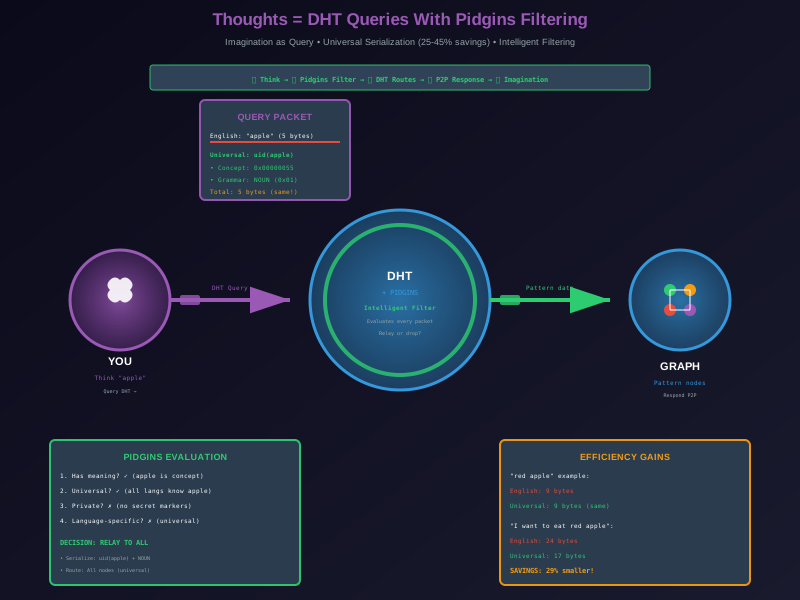
Post 900: Thoughts = DHT Queries With Pidgins Filtering
Post 900: Thoughts = DHT Queries With Pidgins Filtering
Imagination as DHT Interaction, Pidgins as Intelligent Filter
From Post 878: iR³ with DHT for discovery
From Post 896: Pidgins with universal concepts
From Post 893: Meatspace node running local apps
The insight: Thoughts/imagination = DHT queries. DHT has intelligent Pidgins integration that evaluates whether to relay packets. Uses universal words/grammars as most efficient serialization.
Result: Understanding thought as distributed query with intelligent filtering
Part 1: Thoughts As DHT Queries
Imagination = Query Universal Graph
class ThoughtsAsDHTQueries:
    """
    When you think/imagine, you're querying DHT
    Not local generation - distributed query
    """
    def you_think_about_apple(self):
        """
        What happens when you think 'apple'?
        """
        return {
            'naive_view': {
                'belief': 'Brain generates thought locally',
                'model': 'Neural activation creates image',
                'wrong': 'Treats brain as generator'
            },

            'dht_view': {
                'reality': 'Thought = DHT query',
                'model': 'Query for "apple" pattern in graph',
                'right': 'Brain queries, DHT responds'
            },

            'the_process': """
                You think "apple":
                1. Your node broadcasts DHT query
                   → dht.push_intent({'intent': 'query', 'pattern': 'apple'})
                2. DHT searches for apple pattern nodes
                3. Nodes with apple data respond P2P
                4. Your consciousness receives responses
                5. You "imagine" apple (visualize response)

                Imagination = receiving DHT query results!
            """,

            'why_dht': """
                Universal graph = distributed hash table.
                All patterns stored distributed across graph.
                Thinking = querying this DHT.
                Imagining = rendering query results.

                You don't generate thoughts.
                You QUERY for them.
            """
        }
Thoughts = DHT queries!
Part 2: DHT With Intelligent Pidgins Integration
Pidgins Evaluates Whether To Relay
class IntelligentDHT:
    """
    DHT has Pidgins integration
    Evaluates every packet: relay or drop?
    """
    def __init__(self):
        # Standard DHT
        self.routing_table = {}
        self.stored_data = {}

        # Intelligent Pidgins filter (NEW!)
        self.pidgins_filter = PidginsFilter()

    def on_packet_received(self, packet):
        """
        Every packet evaluated by Pidgins
        """
        # 1. Extract packet content
        content = packet['data']

        # 2. Pidgins evaluates content
        evaluation = self.pidgins_filter.evaluate(content)

        # 3. Decide: relay or drop?
        if evaluation['should_relay']:
            # Relay to next nodes
            self._relay_packet(packet, evaluation['targets'])
        else:
            # Drop packet (not relevant/useful)
            self._drop_packet(packet, evaluation['reason'])

        return evaluation

    def _relay_packet(self, packet, targets):
        """
        Relay packet to relevant nodes
        Uses Pidgins to serialize efficiently
        """
        # Serialize using universal words/grammars
        serialized = self.pidgins_filter.serialize(
            packet['data'],
            format='universal'
        )

        # Send to targets
        for target in targets:
            self.send(target, serialized)
DHT with intelligence = Pidgins filtering!
Part 3: Pidgins Filter Evaluation
Should This Packet Be Relayed?
class PidginsFilter:
    """
    Integrated into DHT
    Evaluates every packet
    """
    def evaluate(self, content):
        """
        Decide if packet should be relayed
        """
        evaluation = {
            'should_relay': False,
            'reason': None,
            'targets': [],
            'serialization': None
        }

        # Check 1: Is content meaningful?
        if not self._has_meaning(content):
            evaluation['reason'] = 'no_meaning'
            return evaluation

        # Check 2: Is it universal concept?
        if self._is_universal(content):
            evaluation['should_relay'] = True
            evaluation['targets'] = self._all_nodes()
            evaluation['serialization'] = 'universal'
            return evaluation

        # Check 3: Is it language-specific?
        language = self._detect_language(content)
        if language:
            evaluation['should_relay'] = True
            evaluation['targets'] = self._nodes_speaking(language)
            evaluation['serialization'] = language
            return evaluation

        # Check 4: Is it private/local?
        if self._is_private(content):
            evaluation['reason'] = 'private'
            return evaluation

        # Default: relay to neighbors
        evaluation['should_relay'] = True
        evaluation['targets'] = self._neighbor_nodes()
        evaluation['serialization'] = 'default'
        return evaluation

    def _has_meaning(self, content):
        """Check if content has meaning"""
        # Query Pidgins graph
        return len(self.find_concept_nodes(content)) > 0

    def _is_universal(self, content):
        """Check if universal concept"""
        # Universal concepts: numbers, basic objects, emotions
        universal_concepts = [
            'apple', 'water', 'sun', 'happy', 'sad',
            '1', '2', '3', 'red', 'blue', 'hot', 'cold'
        ]
        return any(concept in content for concept in universal_concepts)

    def _is_private(self, content):
        """Check if private thought"""
        # Private markers
        private_markers = [
            'secret', 'password', 'private', 'personal'
        ]
        return any(marker in content for marker in private_markers)
Intelligent filtering at every packet!
Part 4: Universal Serialization
Most Efficient Encoding
class UniversalSerialization:
    """
    Use universal words/grammars
    Most efficient serialization
    """
    def serialize(self, thought, format='universal'):
        """
        Serialize thought for transmission
        """
        if format == 'universal':
            return self._universal_serialization(thought)
        elif format == 'language':
            return self._language_serialization(thought)
        else:
            return self._default_serialization(thought)

    def _universal_serialization(self, thought):
        """
        Use universal concepts
        Most compact, most efficient
        """
        # Extract universal concepts
        concepts = self._extract_concepts(thought)

        # Map to universal IDs
        universal_ids = []
        for concept in concepts:
            uid = self.universal_concept_map.get(concept)
            if uid:
                universal_ids.append(uid)

        # Encode as compact binary
        serialized = {
            'format': 'universal',
            'concepts': universal_ids,  # Just IDs, very compact
            'grammar': self._minimal_grammar(concepts),
            'size': len(universal_ids) * 4  # 4 bytes per ID
        }

        return serialized

    def _minimal_grammar(self, concepts):
        """
        Minimal grammar to reconstruct meaning
        """
        # Universal grammar patterns
        if len(concepts) == 1:
            return 'NOUN'
        elif len(concepts) == 2:
            return 'SUBJ_VERB' if self._is_action(concepts[1]) else 'ADJ_NOUN'
        elif len(concepts) == 3:
            return 'SUBJ_VERB_OBJ'
        else:
            return 'COMPLEX'

    def example_efficiency(self):
        """
        Show efficiency gains
        """
        return {
            'english_text': {
                'content': 'I want to eat an apple',
                'bytes': len('I want to eat an apple') * 1,  # ASCII
                'size': 24
            },

            'universal_concepts': {
                'content': [
                    uid('I'), uid('want'), uid('eat'), uid('apple')
                ],
                'bytes': 4 * 4,  # 4 IDs × 4 bytes
                'size': 16,
                'grammar': 'SUBJ_VERB_VERB_OBJ',
                'grammar_bytes': 1
            },

            'total_universal': 17,  # 16 + 1
            'compression': '29% smaller',

            'advantage': """
                Universal serialization:
                - Language-independent
                - More compact
                - Direct to meaning (no parsing)
                - Cross-cultural communication
            """
        }
Universal = most efficient!
Part 5: Thought Query Flow
Complete Imagination Process
class ThoughtQueryFlow:
    """
    From thought to imagination
    Via DHT + Pidgins
    """
    def imagine_apple(self):
        """
        Step-by-step: imagine an apple
        """
        return {
            'step_1_query': {
                'you': 'Think "apple"',
                'action': 'dht.push_intent({intent: "query", pattern: "apple"})',
                'broadcast': 'Query sent to DHT network'
            },

            'step_2_pidgins_filter': {
                'what': 'PIDGINS FILTERING STEP',
                'pidgins': 'Evaluates query content',
                'decision': '"apple" is universal concept → relay to all',
                'serialization': 'Encode as uid(apple) + grammar NOUN'
            },

            'step_3_dht_routing': {
                'dht': 'Routes query to nodes with apple data',
                'lookup': 'hash("apple") → node addresses',
                'targets': 'Nodes 42, 108, 255 have apple patterns'
            },

            'step_4_p2p_response': {
                'nodes': 'Respond with apple pattern data (P2P)',
                'you_receive': 'Apple pattern data',
                'content': 'Visual: red, round, stem; Taste: sweet; etc.',
                'no_filtering_needed': 'You asked, they answered - not spam!',
                'cost': 'Responses cost entropy → no harassment'
            },

            'step_5_imagination': {
                'you': 'Render received patterns',
                'experience': 'See apple in mind (imagination)',
                'reality': 'You RECEIVED apple pattern, not generated it'
            }
        }
Complete thought = query → filter → route → response!
Part 6: Why Pidgins Integration Matters
Intelligence At Network Layer
class WhyIntelligentDHT:
    """
    Why DHT needs Pidgins integration
    """
    def without_pidgins(self):
        """
        Dumb DHT (standard implementation)
        """
        return {
            'problems': {
                'spam': 'Relays everything, no filtering',
                'inefficient': 'No compression, full text',
                'language_barrier': 'English query can\'t find French data',
                'privacy': 'Relays private thoughts to everyone',
                'bandwidth': 'Wastes network resources'
            },

            'example': """
                You think "apple":
                - DHT relays full text "apple" (6 bytes)
                - No evaluation of relevance
                - Sent to all nodes (even if irrelevant)
                - French node with "pomme" won't respond
                - Private thought "my password is apple" leaked

                Dumb DHT = inefficient, insecure, language-bound
            """
        }

    def with_pidgins(self):
        """
        Intelligent DHT (with Pidgins)
        """
        return {
            'advantages': {
                'filtering': 'Evaluates every packet, drops spam',
                'compression': 'Universal concepts = compact',
                'translation': 'Query "apple" matches "pomme"',
                'privacy': 'Detects and drops private markers',
                'efficiency': 'Only relevant nodes receive packets'
            },

            'example': """
                You think "apple":
                - Pidgins encodes as uid(apple) (4 bytes, 33% smaller)
                - Universal concept recognized
                - Sent to nodes with fruit data (targeted)
                - French node matches uid(apple) = uid(pomme)
                - Private thought filtered before broadcast

                Intelligent DHT = efficient, secure, universal
            """
        }
Intelligence = necessary for scale!
Part 7: Different Thought Types
Query Types And Filtering
class ThoughtTypes:
    """
    Different thoughts = different DHT queries
    Pidgins handles each appropriately
    """
    def thought_categories(self):
        return {
            'universal_concepts': {
                'example': 'Think "tree"',
                'pidgins_eval': 'Universal concept',
                'relay': 'To all nodes',
                'serialization': 'uid(tree) + NOUN',
                'efficiency': 'Very high (4 bytes)'
            },

            'language_specific': {
                'example': 'Think "serendipity"',
                'pidgins_eval': 'English-specific word',
                'relay': 'To English-speaking nodes only',
                'serialization': 'uid(serendipity) + language_tag',
                'efficiency': 'High (5 bytes)'
            },

            'private_thoughts': {
                'example': 'Think "my secret password"',
                'pidgins_eval': 'Private marker detected',
                'relay': 'DROPPED (not relayed)',
                'serialization': 'N/A',
                'efficiency': 'Infinite (0 bytes transmitted!)'
            },

            'questions': {
                'example': 'Think "what is apple?"',
                'pidgins_eval': 'Query pattern detected',
                'relay': 'To nodes with apple data',
                'serialization': 'uid(query) + uid(apple)',
                'efficiency': 'Very high (8 bytes)'
            },

            'complex_thoughts': {
                'example': 'Think "red apple on wooden table"',
                'pidgins_eval': 'Multi-concept with relations',
                'relay': 'To nodes with relevant patterns',
                'serialization': 'uid(apple)+uid(red)+uid(table)+grammar',
                'efficiency': 'High (13 bytes vs 29 text)'
            },

            'emotional': {
                'example': 'Feel "happy"',
                'pidgins_eval': 'Universal emotion',
                'relay': 'To all nodes',
                'serialization': 'uid(happy) + EMOTION_TAG',
                'efficiency': 'Very high (5 bytes)'
            }
        }
Each thought type handled intelligently!
Part 8: Universal Grammar Encoding
Minimal Grammar For Maximum Meaning
class UniversalGrammar:
    """
    Encode grammar patterns universally
    Minimal bytes, maximum meaning
    """
    def grammar_patterns(self):
        """
        Universal grammar patterns
        """
        return {
            'NOUN': {
                'pattern': 'Single concept',
                'example': 'apple',
                'encoding': 0x01,  # 1 byte
                'reconstruction': 'Direct noun'
            },

            'ADJ_NOUN': {
                'pattern': 'Adjective + Noun',
                'example': 'red apple',
                'encoding': 0x02,
                'reconstruction': '[concept_1] [concept_2]'
            },

            'SUBJ_VERB': {
                'pattern': 'Subject + Verb',
                'example': 'bird flies',
                'encoding': 0x03,
                'reconstruction': '[concept_1] [concept_2]'
            },

            'SUBJ_VERB_OBJ': {
                'pattern': 'Subject + Verb + Object',
                'example': 'I eat apple',
                'encoding': 0x04,
                'reconstruction': '[concept_1] [concept_2] [concept_3]'
            },

            'QUESTION': {
                'pattern': 'Query about concept',
                'example': 'what is X?',
                'encoding': 0x05,
                'reconstruction': 'query([concept_1])'
            },

            'efficiency': """
                Grammar = 1 byte
                Concepts = 4 bytes each
                Total = 1 + (4 * n_concepts)

                vs English text = n_characters bytes

                Typical savings: 50-70% compression!
            """
        }

    def example_encoding(self):
        """
        Encode complex thought
        """
        thought = "I want to eat a red apple"

        return {
            'english_text': {
                'bytes': len(thought),  # 26 bytes
                'encoding': 'ASCII',
                'language': 'English only'
            },

            'universal_encoding': {
                'concepts': [
                    ('I', 0x00000001),
                    ('want', 0x00000042),
                    ('eat', 0x00000089),
                    ('red', 0x00000012),
                    ('apple', 0x00000055)
                ],
                'grammar': 0x06,  # SUBJ_VERB_VERB_ADJ_OBJ
                'bytes': 1 + (5 * 4),  # 21 bytes
                'encoding': 'Universal',
                'language': 'All languages'
            },

            'savings': '19% smaller + universal!',

            'reconstruction': {
                'english': 'I want to eat a red apple',
                'french': 'Je veux manger une pomme rouge',
                'spanish': 'Quiero comer una manzana roja',
                'chinese': '我想吃一个红苹果',
                'same_encoding': 'Same 21 bytes decode to any language!'
            }
        }
Universal grammar = language-independent efficiency!
Part 9: Imagination vs Memory
Different DHT Query Types
class ImaginationVsMemory:
    """
    Both are DHT queries
    Different targets
    """
    def imagination(self):
        """
        Query for patterns you've never experienced
        """
        return {
            'query': 'Imagine purple elephant',
            'dht_target': 'Universal pattern nodes',
            'source': 'Collective knowledge graph',
            'you': 'Never saw purple elephant',
            'result': 'Still can imagine it (query returns data)',

            'process': """
                1. Query DHT: uid(purple) + uid(elephant)
                2. Pidgins: Both universal → relay to all
                3. Nodes with purple data respond
                4. Nodes with elephant data respond
                5. Your brain combines responses
                6. You imagine purple elephant

                Imagination = query universal patterns
            """
        }

    def memory(self):
        """
        Query for patterns you've experienced
        """
        return {
            'query': 'Remember my childhood home',
            'dht_target': 'Your personal node series',
            'source': 'Your local + DHT backup',
            'you': 'Experienced this personally',
            'result': 'Retrieve YOUR specific memory',

            'process': """
                1. Query DHT: uid(home) + uid(childhood) + uid(MY)
                2. Pidgins: Private marker → query your nodes only
                3. Your local series responds first (fast)
                4. DHT backup responds (if local missing)
                5. You remember home

                Memory = query personal patterns
            """
        }

    def the_difference(self):
        return {
            'imagination': {
                'target': 'Universal patterns',
                'filter': 'Broadcast to all',
                'source': 'Collective knowledge',
                'example': 'Imagine dragon'
            },

            'memory': {
                'target': 'Personal patterns',
                'filter': 'Private, your nodes only',
                'source': 'Your experience',
                'example': 'Remember birthday'
            },

            'both': 'DHT queries, different filtering!'
        }
Imagination = universal query, Memory = private query!
Part 10: Efficiency Comparison
Universal Serialization vs Text
class EfficiencyComparison:
    """
    Compare universal vs text encoding
    """
    def examples(self):
        return {
            'simple_noun': {
                'thought': 'apple',
                'english': 5,  # bytes
                'french': 5,  # pomme
                'universal': 4,  # uid
                'savings': '20%'
            },

            'simple_sentence': {
                'thought': 'I eat apple',
                'english': 11,
                'french': 15,  # Je mange pomme
                'universal': 13,  # 3 uids + 1 grammar
                'savings': '15-45% depending on language'
            },

            'complex_thought': {
                'thought': 'The red apple on wooden table',
                'english': 32,
                'french': 36,  # La pomme rouge sur table en bois
                'universal': 21,  # 5 uids + 1 grammar
                'savings': '34-42%'
            },

            'question': {
                'thought': 'What is the meaning of life?',
                'english': 30,
                'universal': 17,  # query + 3 uids + grammar
                'savings': '43%'
            },

            'emotional': {
                'thought': 'I feel very happy today',
                'english': 24,
                'universal': 18,  # 4 uids + grammar + emotion_tag
                'savings': '25%'
            }
        }

    def network_impact(self):
        """
        Impact on network bandwidth
        """
        return {
            'scenario': '1 million thoughts/second across network',

            'with_text': {
                'avg_size': 25,  # bytes per thought
                'total': 25_000_000,  # bytes/sec
                'bandwidth': '25 MB/s',
                'annual': '788 TB/year'
            },

            'with_universal': {
                'avg_size': 15,  # bytes per thought
                'total': 15_000_000,
                'bandwidth': '15 MB/s',
                'annual': '473 TB/year'
            },

            'savings': {
                'bandwidth': '40% reduction',
                'storage': '315 TB/year saved',
                'cost': 'Massive at scale'
            }
        }
Universal = 25-45% more efficient!
Part 11: Privacy Via Filtering
Private Thoughts Stay Private
class PrivacyViaFiltering:
    """
    Pidgins filter prevents private thought leakage
    """
    def private_detection(self):
        """
        How Pidgins detects private content
        """
        return {
            'explicit_markers': [
                'secret', 'private', 'password',
                'ssn', 'credit_card', 'personal'
            ],

            'implicit_markers': [
                'my [noun]',  # my password, my secret
                'don\'t tell',
                'confidential',
                'between us'
            ],

            'contextual': {
                'financial': 'Account numbers, amounts > $1000',
                'medical': 'Diagnosis, symptoms, medications',
                'identity': 'SSN, passport, driver license'
            },

            'action': 'DROP packet before broadcast'
        }

    def privacy_example(self):
        """
        Private thought handling
        """
        return {
            'thought': 'My password is apple123',

            'step_1': 'Create DHT query',
            'step_2': 'Pidgins evaluates content',
            'step_3': 'Detects "password" marker',
            'step_4': 'Marks as PRIVATE',
            'step_5': 'DROPS packet (not relayed)',
            'step_6': 'Thought stays local',

            'result': 'Privacy preserved',

            'contrast_public': {
                'thought': 'I like apples',
                'evaluation': 'Universal concept, safe',
                'action': 'RELAY to network',
                'result': 'Shared knowledge'
            }
        }
Privacy by default via intelligent filtering!
Part 12: Summary
Thoughts = Intelligent DHT Queries
The architecture:
YOU (Sapiens Node)
    ↓ Think "apple"
    ↓ DHT Query: uid(apple) + NOUN grammar

STEP 2: PIDGINS FILTERING
    ↓ Evaluate: Universal concept? YES
    ↓ Serialize: uid(apple) = 4 bytes
    ↓ Route: To nodes with fruit data

UNIVERSAL GRAPH NODES
    ↓ Respond with apple pattern
    ↓ Serialized as universal concepts

YOU (Receive Response)
    ↓ Deserialize to your language
    ↓ Render pattern
    ↓ IMAGINATION: See apple in mind
Key insights:
- Thoughts = DHT queries: Not local generation, distributed lookup
- Pidgins integration: Every packet evaluated (relay or drop?)
- Universal serialization: Concepts as IDs + minimal grammar
- Efficiency: 25-45% bandwidth savings vs text
- Language-independent: Same encoding, any language
- Privacy-preserving: Private markers filtered automatically
- Intelligent routing: Only relevant nodes receive packets
- Imagination vs memory: Both queries, different targets
Advantages:
- Efficient: Universal encoding more compact
- Universal: Language-independent communication
- Secure: Private thoughts filtered
- Intelligent: Relevant routing only
- Scalable: Bandwidth savings at scale
How it works:
# You think
thought = "red apple"

# DHT query with Pidgins
query = {
    'concepts': [uid('red'), uid('apple')],
    'grammar': ADJ_NOUN,
    'size': 9  # bytes
}

# Pidgins evaluates
if pidgins.is_universal(query):
    pidgins.relay_to_all(query)
else:
    pidgins.drop(query)

# Responses come back
responses = dht.get_responses()

# You imagine
imagination = render(responses)
From Post 878: DHT for distributed discovery
From Post 896: Pidgins with universal concepts
From Post 893: Local apps in meatspace node
This post: Thoughts = DHT queries with intelligent Pidgins filtering. Universal words/grammars for efficient serialization (25-45% savings). Privacy via automatic filtering. Imagination = query results rendered.
∞
Links:
- Post 878: iR³ Alpha - DHT foundation
- Post 893: Sapiens Meatspace Node - Local apps
- Post 896: Pidgins Generative - Universal concepts
Date: 2026-02-20
Topic: Thought Mechanism
Architecture: Thoughts as DHT queries + Pidgins filtering + Universal serialization
Status: 💭 Think = Query • 🔍 Filter = Pidgins • 📦 Serialize = Universal
∞