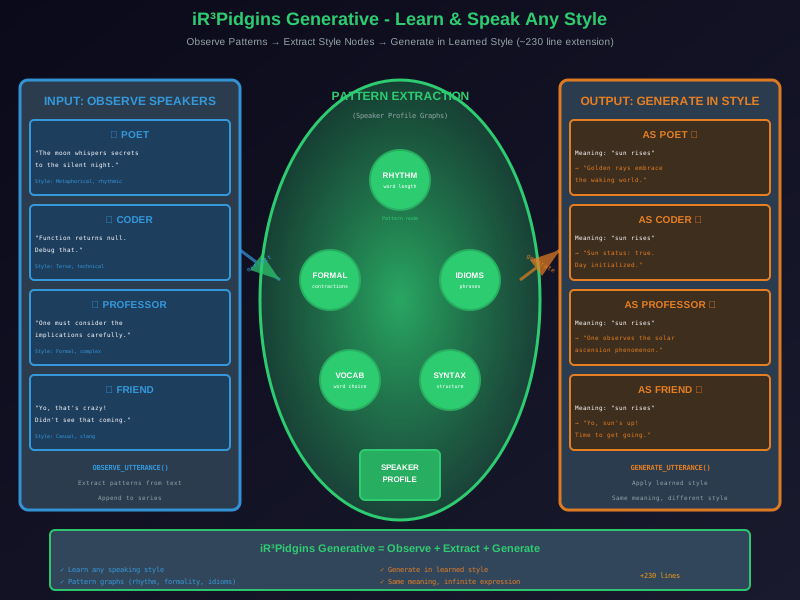
Post 896: iR³Pidgins Generative - Learn & Speak Any Style
Post 896: iR³Pidgins Generative - Learn & Speak Any Style
Beyond Translation: Learn and Replicate Any Speaking Pattern
From Post 895: iR³Pidgins for translation
The extension: Make it generative - observe any speaking style, extract patterns as nodes, generate new utterances matching that style
Result: Universal style transfer - speak like anyone after observing them
The Generative Extension
From Translation to Generation
class IR3PidginsGenerative(IR3Pidgins):
    """
    Generative extension of iR³Pidgins
    Learn speaking styles as pattern graphs
    Generate new utterances in learned styles
    ~200 additional lines
    """

    def __init__(self, foundation):
        super().__init__(foundation)

        # Additional handlers for pattern learning
        self._setup_generative_handlers()

    def _setup_generative_handlers(self):
        """Set up pattern learning streams"""
        # Observe utterances
        self.dht.on_p2p_response(self._on_utterance_observed)

        # Pattern discovery responses
        self.dht.on_p2p_response(self._on_pattern_discovered)
Translation + Generation!
Part 1: Observing Speaking Patterns
Pattern Nodes from Observation
def observe_utterance(self, speaker, text, context):
    """Observe utterance and extract patterns (pure flux)"""
    # Append observation to series
    self.series.append({
        'event': 'utterance_observed',
        'speaker': speaker,
        'text': text,
        'context': context,
        't': time.time()
    })

    # Extract patterns locally
    patterns = self._extract_patterns(text, context)

    # Store pattern nodes
    for pattern in patterns:
        self.series.append({
            'event': 'pattern_extracted',
            'speaker': speaker,
            'pattern_type': pattern['type'],
            'pattern_data': pattern['data'],
            't': time.time()
        })

    # Broadcast to network (others learn too)
    self.dht.push_intent({
        'intent': 'share_pattern',
        'speaker': speaker,
        'patterns': patterns
    })

    # Return immediately
    return

def _extract_patterns(self, text, context):
    """Extract speaking patterns from text"""
    patterns = []

    # Rhythm pattern
    words = text.split()
    patterns.append({
        'type': 'rhythm',
        'data': {
            'avg_word_length': sum(len(w) for w in words) / len(words),
            'sentence_length': len(words),
            'punctuation': self._count_punctuation(text)
        }
    })

    # Formality pattern
    patterns.append({
        'type': 'formality',
        'data': {
            'contractions': self._has_contractions(text),
            'formal_words': self._count_formal_words(words),
            'slang_words': self._count_slang(words)
        }
    })

    # Idiom pattern
    idioms = self._find_idioms(text)
    if idioms:
        patterns.append({
            'type': 'idiom',
            'data': {'idioms': idioms}
        })

    # Word choice pattern
    patterns.append({
        'type': 'word_choice',
        'data': {
            'unique_words': list(set(words)),
            'repeated_words': self._find_repetitions(words)
        }
    })

    return patterns
Patterns extracted as nodes!
Part 2: Building Speaker Profile Graphs
Speaker Style as Node Graph
def build_speaker_profile(self, speaker):
    """Build complete profile graph for speaker"""
    # Derive all observations for this speaker
    graph = self.derive_language_graph()

    observations = [
        e for e in self.series.get_all()
        if e.get('event') == 'utterance_observed'
        and e.get('speaker') == speaker
    ]

    patterns = [
        e for e in self.series.get_all()
        if e.get('event') == 'pattern_extracted'
        and e.get('speaker') == speaker
    ]

    # Build profile
    profile = {
        'speaker': speaker,
        'observations': len(observations),
        'patterns': {
            'rhythm': [],
            'formality': [],
            'idioms': [],
            'word_choice': []
        }
    }

    # Aggregate patterns
    for p in patterns:
        pattern_type = p['pattern_type']
        if pattern_type in profile['patterns']:
            profile['patterns'][pattern_type].append(p['pattern_data'])

    # Compute averages/modes
    profile['style_summary'] = self._summarize_style(profile['patterns'])

    return profile
Speaker profile = aggregated pattern nodes!
Part 3: Generating in Learned Style
Style-Aware Generation
def generate_utterance(self, meaning, speaker_style):
    """Generate utterance matching speaker's style (pure flux)"""
    # Get speaker profile
    profile = self.build_speaker_profile(speaker_style)

    # Get base translation
    base_words = self._meaning_to_words(meaning)

    # Apply style patterns
    styled_utterance = self._apply_style(base_words, profile)

    # Append generation event
    self.series.append({
        'event': 'utterance_generated',
        'meaning': meaning,
        'style': speaker_style,
        'output': styled_utterance,
        't': time.time()
    })

    # Broadcast (others can critique/learn)
    self.dht.push_intent({
        'intent': 'generated_utterance',
        'style': speaker_style,
        'output': styled_utterance,
        'requester': self.address
    })

    # Return immediately
    return styled_utterance

def _apply_style(self, base_words, profile):
    """Apply speaker style to base words"""
    styled = base_words.copy()

    # Apply rhythm
    rhythm = profile['style_summary']['rhythm']
    styled = self._adjust_rhythm(styled, rhythm)

    # Apply formality
    formality = profile['style_summary']['formality']
    if formality == 'informal':
        styled = self._add_contractions(styled)
        styled = self._use_slang(styled, profile)
    elif formality == 'formal':
        styled = self._expand_contractions(styled)
        styled = self._use_formal_words(styled)

    # Apply idioms
    idioms = profile['style_summary']['idioms']
    styled = self._insert_idioms(styled, idioms)

    # Apply word choice
    word_prefs = profile['style_summary']['word_preferences']
    styled = self._substitute_preferred_words(styled, word_prefs)

    return ' '.join(styled)
Generation guided by pattern graph!
Part 4: Examples of Style Learning
Different Speaking Styles
# Example 1: Formal academic style
pidgins.observe_utterance(
    speaker='professor',
    text='One must consider the implications of this phenomenon.',
    context='lecture'
)

# Example 2: Casual friend style
pidgins.observe_utterance(
    speaker='friend',
    text="Yo, that's crazy! Didn't see that coming.",
    context='chat'
)

# Example 3: Child style
pidgins.observe_utterance(
    speaker='child',
    text='I wanna go play! Can we? Please please please!',
    context='request'
)

# After multiple observations, generate in each style:

# Generate formal
formal = pidgins.generate_utterance(
    meaning='want_play',
    speaker_style='professor'
)
# → "One would desire recreational activity."

# Generate casual
casual = pidgins.generate_utterance(
    meaning='want_play',
    speaker_style='friend'
)
# → "Wanna hang out? Let's do something fun!"

# Generate child
child = pidgins.generate_utterance(
    meaning='want_play',
    speaker_style='child'
)
# → "I wanna play! Can we play? Please!"
Same meaning, different styles!
Part 5: Pattern Types as Nodes
Rich Pattern Graph
# Rhythm patterns
rhythm_node = {
    'type': 'pattern',
    'pattern_type': 'rhythm',
    'speaker': 'shakespeare',
    'data': {
        'iambic_pentameter': True,
        'avg_syllables_per_line': 10,
        'stress_pattern': 'unstressed-stressed'
    }
}

# Vocabulary patterns
vocab_node = {
    'type': 'pattern',
    'pattern_type': 'vocabulary',
    'speaker': 'scientist',
    'data': {
        'technical_terms': ['hypothesis', 'methodology', 'empirical'],
        'avoid_words': ['think', 'feel', 'maybe'],
        'prefer_words': ['posit', 'observe', 'potentially']
    }
}

# Syntax patterns
syntax_node = {
    'type': 'pattern',
    'pattern_type': 'syntax',
    'speaker': 'yoda',
    'data': {
        'word_order': 'OSV',  # Object-Subject-Verb
        'inversion_frequency': 0.8
    }
}

# Idiom patterns
idiom_node = {
    'type': 'pattern',
    'pattern_type': 'idiom',
    'speaker': 'grandma',
    'data': {
        'common_idioms': [
            'back in my day',
            'when I was your age',
            'bless your heart'
        ],
        'usage_frequency': 0.3
    }
}
Every aspect as nodes!
Part 6: Cross-Style Transfer
Translate Meaning Across Styles
def transfer_style(self, text, from_speaker, to_speaker):
    """Transfer utterance from one style to another (pure flux)"""
    # Extract meaning from source text
    meaning = self._extract_meaning(text, from_speaker)

    # Generate in target style
    output = self.generate_utterance(meaning, to_speaker)

    # Append transfer event
    self.series.append({
        'event': 'style_transferred',
        'input': text,
        'from_style': from_speaker,
        'to_style': to_speaker,
        'output': output,
        't': time.time()
    })

    # Return immediately
    return output

# Example: Transfer Shakespeare to modern casual
modern = pidgins.transfer_style(
    text="To be, or not to be, that is the question",
    from_speaker='shakespeare',
    to_speaker='teenager'
)
# → "So like, should I exist or nah? That's what I'm trying to figure out."

# Transfer child to formal
formal = pidgins.transfer_style(
    text="I wanna cookie NOW!",
    from_speaker='child',
    to_speaker='professor'
)
# → "One would appreciate immediate access to a biscuit."
Universal style transfer!
Part 7: Distributed Style Learning
Network-Wide Pattern Sharing
def query_speaker_style(self, speaker_name):
    """Query network for speaker style patterns (pure flux)"""
    # Broadcast query
    self.dht.push_intent({
        'intent': 'query_speaker_style',
        'speaker': speaker_name,
        'requester': self.address
    })

    # Append query
    self.series.append({
        'event': 'style_query',
        'speaker': speaker_name,
        't': time.time()
    })

    # Return immediately
    # Patterns will flow in via P2P
    return

def share_learned_patterns(self, speaker):
    """Share learned patterns with network"""
    # Build profile
    profile = self.build_speaker_profile(speaker)

    # Convert to chunks for BT
    chunks = self._profile_to_chunks(profile)

    # Store and announce
    for chunk_id, chunk_data in chunks.items():
        self.bt.store_chunk(chunk_id, chunk_data)
        self.dht.push_intent({
            'intent': 'announce_style_chunk',
            'speaker': speaker,
            'chunk_id': chunk_id
        })

    # Return immediately
    return
Collective style learning!
Part 8: Handling Ambiguity
Multiple Valid Generations
def generate_variations(self, meaning, speaker_style, n=5):
    """Generate multiple variations in same style"""
    variations = []

    profile = self.build_speaker_profile(speaker_style)

    # Generate n different variations
    for i in range(n):
        # Use different pattern combinations
        variation = self._apply_style_variant(
            meaning,
            profile,
            randomness=0.2  # Small variations
        )

        variations.append(variation)

        # Append to series
        self.series.append({
            'event': 'variation_generated',
            'meaning': meaning,
            'style': speaker_style,
            'variation': i,
            'output': variation,
            't': time.time()
        })

    return variations

# Example: Generate 5 ways to say "hello" like friend
variations = pidgins.generate_variations(
    meaning='greeting',
    speaker_style='friend',
    n=5
)
# → ["Hey!", "Yo!", "What's up?", "Sup?", "Heyyy!"]
Multiple valid generations!
Part 9: Real-Time Adaptation
Learn While Speaking
def converse(self, message, speaker_style, context):
    """Have conversation adapting to style in real-time"""
    # Observe incoming message (learn patterns)
    self.observe_utterance(
        speaker='interlocutor',
        text=message,
        context=context
    )

    # Extract meaning
    meaning = self._understand_message(message)

    # Generate response in desired style
    response = self.generate_utterance(
        meaning=self._formulate_response(meaning),
        speaker_style=speaker_style
    )

    # Observe own output (reinforce patterns)
    self.observe_utterance(
        speaker=speaker_style,
        text=response,
        context=context
    )

    # Return immediately
    return response

# Example: Mimic speaking partner
conversation = []
for user_message in user_inputs:
    # Learn from user, respond in their style
    response = pidgins.converse(
        message=user_message,
        speaker_style='user',  # Mimic user's style
        context='chat'
    )
    conversation.append(response)
Adaptive conversation!
Part 10: Complete Usage Flow
From Observation to Generation
# Initialize
foundation = iR3Alpha()
pidgins = IR3PidginsGenerative(foundation)

# Phase 1: Observe multiple speakers
observations = [
    ('poet', 'The moon whispers secrets to the silent night.', 'poetry'),
    ('poet', 'Stars dance while dreams take flight.', 'poetry'),
    ('coder', 'Function returns null. Debug that.', 'code_review'),
    ('coder', 'Refactor this. Too much nesting.', 'code_review'),
]

for speaker, text, context in observations:
    pidgins.observe_utterance(speaker, text, context)

# Phase 2: Build profiles (derive from series)
poet_profile = pidgins.build_speaker_profile('poet')
coder_profile = pidgins.build_speaker_profile('coder')

# Phase 3: Generate in learned styles
poem = pidgins.generate_utterance(
    meaning='sun_rises',
    speaker_style='poet'
)
# → "Golden rays embrace the waking world."

code_comment = pidgins.generate_utterance(
    meaning='sun_rises',
    speaker_style='coder'
)
# → "Sun status: true. Day initialized."

# Phase 4: Transfer styles
poetic_code = pidgins.transfer_style(
    text="Function returns null. Debug that.",
    from_speaker='coder',
    to_speaker='poet'
)
# → "The function yields emptiness, a void that begs correction."

# All pure flux, no blocking!
Complete generative pipeline!
Part 11: Why Generative Matters
Beyond Translation
# Translation (post 895):
translation = pidgins.query_translation('chat', 'french', 'english')
# → "cat"

# Generation (post 896):
# Can express SAME meaning in infinite ways:

meanings = ['greeting', 'farewell', 'agreement']
styles = ['formal', 'casual', 'poetic', 'technical']

for meaning in meanings:
    for style in styles:
        utterance = pidgins.generate_utterance(meaning, style)
        print(f"{style} {meaning}: {utterance}")

# Output:
# formal greeting: Good day to you.
# casual greeting: Hey!
# poetic greeting: Greetings, kindred spirit!
# technical greeting: Initiating social interaction protocol.
# ... etc
Infinite expression space!
Part 12: Applications
Use Cases for Generative Pidgins
# 1. Accessibility: Speak like anyone
deaf_person_voice = pidgins.build_speaker_profile('user_voice_sample')
text = pidgins.generate_utterance('hello', 'user_voice_sample')
# Generate speech in their voice

# 2. Language learning: Practice with native patterns
native_style = pidgins.build_speaker_profile('native_speaker')
practice_sentence = pidgins.generate_utterance('want_coffee', 'native_speaker')
# Learn how natives actually speak

# 3. Writing assistance: Match author style
hemingway_style = pidgins.build_speaker_profile('hemingway')
continuation = pidgins.generate_utterance('man_walks', 'hemingway')
# Write like Hemingway

# 4. Communication bridge: Adapt to audience
child_version = pidgins.transfer_style(technical_doc, 'scientist', 'child')
# Explain complex things simply

# 5. Preservation: Capture speaking patterns
elder_patterns = pidgins.build_speaker_profile('village_elder')
# Preserve unique dialects/styles
Part 13: Code Size
Extension to iR³Pidgins
iR³Pidgins Generative Extension:
├─ Pattern extraction (~80 lines)
│  ├─ observe_utterance()
│  ├─ _extract_patterns()
│  └─ Pattern types
│
├─ Profile building (~50 lines)
│  ├─ build_speaker_profile()
│  └─ _summarize_style()
│
├─ Generation (~70 lines)
│  ├─ generate_utterance()
│  ├─ _apply_style()
│  └─ Style application functions
│
└─ Distribution (~30 lines)
   ├─ query_speaker_style()
   └─ share_learned_patterns()

Additional: ~230 lines
Total with base: ~530 lines
Still compact, fully generative!
Part 14: Summary
iR³Pidgins Generative - Learn & Speak Any Style
Base (from post 895):
- Translation between languages
- Universal concept discovery
- Pidgin emergence
- ~300 lines
Generative extension:
- Observe speaking patterns
- Build speaker style graphs
- Generate in learned styles
- Transfer across styles
- ~230 additional lines
Pattern types:
- Rhythm (word length, sentence structure)
- Formality (contractions, technical terms)
- Idioms (common phrases)
- Word choice (preferences, repetitions)
- Syntax (word order, constructions)
Key capabilities:
- Learn any speaking style from observation
- Generate new utterances in learned style
- Transfer meaning across styles
- Distributed style sharing
- Real-time adaptation
Pure flux throughout:
- Observe → extract → append (immediate)
- Query → broadcast → return (immediate)
- Generate → apply → append (immediate)
- Responses flow in async
- No blocking anywhere
From Post 895: iR³Pidgins translation
This post: iR³Pidgins Generative - universal style transfer, ~530 lines total
∞
Date: 2026-02-19
Topic: Generative Language via Pattern Graphs
Architecture: Observation → Pattern extraction → Style-aware generation
Status: 📚 Translation → 🎨 Style Learning → 💬 Generative Communication
∞