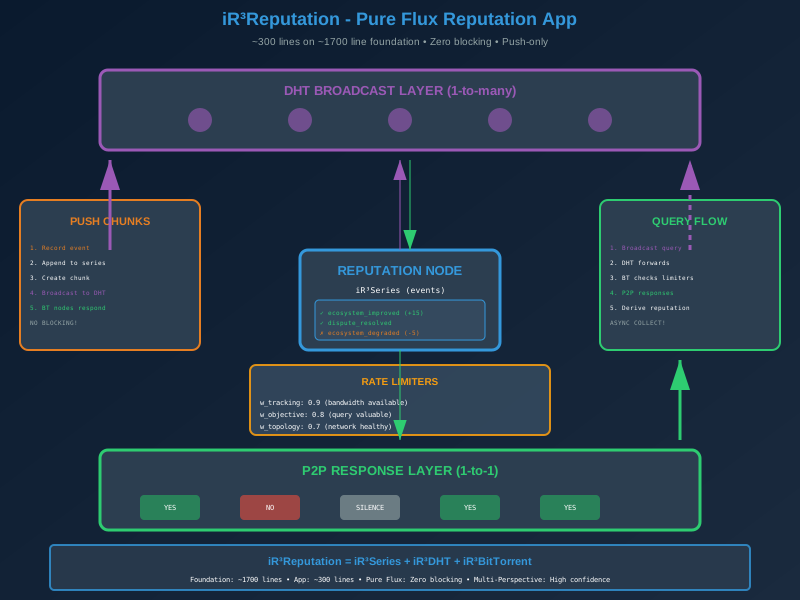
Post 884: iR³Reputation - Pure Flux Reputation App
Post 884: iR³Reputation - Pure Flux Reputation App
Building Reputation with Post 878 Pure Flux Architecture
From Post 878: iR³ Alpha pure flux architecture
From Post 870: Reputation via intent-based track record
From Post 877: Pure flux paradigm
The realization: Reputation app is ~100-500 lines on top of iR³ foundation (~1700 lines). Pure flux makes it trivial.
Result: Complete reputation system with zero blocking, push-only communication
The Architecture
iR³Reputation = iR³Series + iR³DHT + iR³BitTorrent
class iR3Reputation:
    """
    Reputation app using pure flux architecture
    Built on top of iR³ foundation from post 878

    Total code: ~300 lines
    Foundation code: ~1700 lines (iR³Series, iR³DHT, iR³BitTorrent)
    """
    def __init__(self, node_id):
        self.node_id = node_id

        # Use iR³Series for events
        from ir3_series import iR3Series
        self.reputation_series = iR3Series(f'reputation_{node_id}')

        # Use iR³DHT for broadcast
        from ir3_dht import iR3DHT
        self.dht = iR3DHT()

        # Use iR³BitTorrent for chunks
        from ir3_bittorrent import iR3BitTorrent
        self.bt = iR3BitTorrent()

        # Rate limiters (from post 878)
        self.rate_limiters = {
            'w_tracking': 1.0,  # Tracking bandwidth
            'w_objective': 1.0, # Value ratio
            'w_topology': 1.0   # Network load
        }
That’s it! The foundation handles:
- Series append (push-only)
- DHT broadcast (1-to-many)
- P2P responses (1-to-1)
- Rate limiting (natural back-pressure)
- Chunk storage (distributed)
Recording Reputation Events
Pure Flux: Just Append and Push
def record_reputation_event(self, event_type, **details):
    """
    Record reputation event
    Pure flux: append → push → done
    No blocking, no waiting
    """
    # 1. Append to series (push-only)
    self.reputation_series.append({
        'timestamp': time.time(),
        'event_type': event_type,
        'node_id': self.node_id,
        **details
    })

    # 2. Push recent chunks to BitTorrent (async)
    if len(self.reputation_series) % 10 == 0:
        self._push_reputation_chunks()

    # Done! No waiting, no blocking
    # Events flow through pure flux channels
Example usage:
# Good action
reputation.record_reputation_event(
    'ecosystem_improved',
    territory='forest_A',
    health_delta=+15,
    timestamp=time.time()
)

# Bad action
reputation.record_reputation_event(
    'ecosystem_degraded',
    territory='forest_B',
    health_delta=-10,
    timestamp=time.time()
)

# Dispute resolved
reputation.record_reputation_event(
    'dispute_resolved',
    dispute_id='dispute_123',
    outcome='consensus_reached',
    timestamp=time.time()
)
Pure flux:
- No blocking on record
- Async chunk push
- Events flow immediately
- Rate limiters prevent overload
Pushing Reputation Chunks
DHT Broadcast + P2P Storage
def _push_reputation_chunks(self):
    """
    Push reputation chunks to network
    Pure flux: broadcast intent → nodes respond async
    """
    # Get recent events
    recent = self.reputation_series.tail(10)

    # Create chunk
    chunk = {
        'chunk_id': f'rep_{self.node_id}_{len(self.reputation_series)}',
        'node_id': self.node_id,
        'events': recent,
        'timestamp': time.time()
    }

    # Broadcast intent to DHT (1-to-many)
    self.dht.broadcast({
        'type': 'store_reputation_chunk',
        'chunk_id': chunk['chunk_id'],
        'from': self.node_id
    })

    # BitTorrent nodes decide via rate limiters
    # They'll respond via P2P (1-to-1) if they want to store
    # NO WAITING HERE! Pure push.
What happens:
1. Node creates chunk
   ↓
2. Broadcasts to DHT (1-to-many)
   ↓
3. DHT forwards to all BT nodes
   ↓
4. Each BT node checks rate limiters:
   - w_tracking: Do I have bandwidth?
   - w_objective: Is this valuable?
   - w_topology: Is network overloaded?
   ↓
5. BT nodes respond via P2P (1-to-1):
   - HIGH limiters → "YES, stored"
   - LOW limiters → "NO, rate limited"
   - Offline → SILENCE
   ↓
6. Original node appends responses to series
   ↓
7. Done! No blocking anywhere.
Querying Reputation
DHT Broadcast + P2P Responses
def query_reputation(self, target_node_id):
    """
    Query another node's reputation
    Pure flux: broadcast query → collect responses async
    """
    # 1. Broadcast query to DHT (1-to-many)
    query_id = f'query_{self.node_id}_{time.time()}'

    self.dht.broadcast({
        'type': 'reputation_query',
        'query_id': query_id,
        'target_node': target_node_id,
        'from': self.node_id
    })

    # 2. Append query to series (for audit trail)
    self.reputation_series.append({
        'timestamp': time.time(),
        'event_type': 'reputation_query_sent',
        'target_node': target_node_id,
        'query_id': query_id
    })

    # 3. Set up response collector (async)
    # Responses come back via P2P (1-to-1)
    # This is non-blocking!
    return query_id  # Caller polls for responses
Response collection (async):
def collect_reputation_responses(self, query_id, timeout=5.0):
    """
    Collect responses for reputation query
    Non-blocking: check series for responses
    """
    start = time.time()
    responses = []

    while time.time() - start < timeout:
        # Check series for new responses
        recent = self.reputation_series.tail(100)

        for entry in recent:
            if (entry.get('event_type') == 'reputation_response_received' and
                entry.get('query_id') == query_id):
                responses.append(entry)

        # Found enough? Return early
        if len(responses) >= 3:
            break

        # Yield to other tasks (pure flux!)
        time.sleep(0.1)

    return responses
Pure flux characteristics:
- Query = broadcast (1-to-many)
- Responses = P2P (1-to-1)
- No blocking on query
- Async response collection
- Rate limiters prevent spam
BT Nodes Responding
Rate Limiters Decide Everything
class BitTorrentReputationNode:
    """
    BT node stores reputation chunks
    Uses rate limiters from post 878
    """
    def __init__(self):
        self.stored_chunks = {}
        self.rate_limiters = {
            'w_tracking': 1.0,
            'w_objective': 1.0,
            'w_topology': 1.0
        }

    def handle_reputation_query(self, query):
        """
        Respond to reputation query
        Rate limiters decide if we respond
        """
        target = query['target_node']
        from_node = query['from']

        # Do we have chunks for target?
        my_chunks = [c for c in self.stored_chunks.values()
                     if c['node_id'] == target]

        if not my_chunks:
            # SILENCE (don't have data)
            return None

        # Check rate limiters
        if self.rate_limiters['w_tracking'] < 0.3:
            # NO (rate limited)
            self._send_p2p_response(from_node, {
                'type': 'reputation_response',
                'query_id': query['query_id'],
                'response': 'NO',
                'reason': 'rate_limited',
                'chunks_available': len(my_chunks)
            })
            return

        # YES (send chunks via P2P)
        self._send_p2p_response(from_node, {
            'type': 'reputation_response',
            'query_id': query['query_id'],
            'response': 'YES',
            'chunks': my_chunks,
            'total_events': sum(len(c['events']) for c in my_chunks)
        })

    def _send_p2p_response(self, to_node, response):
        """
        Send response via P2P (1-to-1)
        Pure flux: push only, no blocking
        """
        # Send directly to node (not via DHT)
        p2p_send(to_node, response)

        # Append to our series (audit trail)
        self.series.append({
            'timestamp': time.time(),
            'event_type': 'reputation_response_sent',
            'to_node': to_node,
            'response_type': response['response']
        })
Rate limiter logic:
def update_rate_limiters(self):
    """Update rate limiters based on system state"""

    # Tracking: How much bandwidth do I have?
    bandwidth_used = self.get_bandwidth_used()
    self.rate_limiters['w_tracking'] = 1.0 - (bandwidth_used / MAX_BANDWIDTH)

    # Objective: Is responding valuable?
    query_value = self.estimate_query_value()
    self.rate_limiters['w_objective'] = query_value

    # Topology: Is network overloaded?
    network_load = self.get_network_load()
    self.rate_limiters['w_topology'] = 1.0 - (network_load / MAX_LOAD)

    # Overall: Multiply limiters
    self.overall_limiter = (self.rate_limiters['w_tracking'] *
                           self.rate_limiters['w_objective'] *
                           self.rate_limiters['w_topology'])
Deriving Reputation
Multi-Perspective from Responses
def derive_reputation(self, query_id):
    """
    Derive reputation from collected responses
    Multi-perspective view
    """
    # Collect all responses
    responses = self.collect_reputation_responses(query_id)

    # Separate by type
    yes_responses = [r for r in responses if r['response'] == 'YES']
    no_responses = [r for r in responses if r['response'] == 'NO']
    # SILENCE = no response in series

    # Aggregate all chunks
    all_events = []
    for response in yes_responses:
        for chunk in response['chunks']:
            all_events.extend(chunk['events'])

    # Count positive vs negative
    positive = sum(1 for e in all_events
                  if e['event_type'] in [
                      'ecosystem_improved',
                      'dispute_resolved',
                      'consensus_matched'
                  ])

    negative = sum(1 for e in all_events
                  if e['event_type'] in [
                      'ecosystem_degraded',
                      'dispute_failed',
                      'consensus_missed'
                  ])

    total = positive + negative
    if total == 0:
        return {
            'reputation': 0.5,  # Neutral
            'confidence': 'low',
            'sources': 0
        }

    return {
        'reputation': positive / total,
        'confidence': 'high' if len(yes_responses) >= 2 else 'medium',
        'sources': len(yes_responses),
        'total_events': total,
        'positive': positive,
        'negative': negative,
        'rate_limited': len(no_responses)
    }
Example output:
{
    'reputation': 0.85,  # 85% positive
    'confidence': 'high',  # 3 sources
    'sources': 3,  # 3 BT nodes responded
    'total_events': 127,
    'positive': 108,
    'negative': 19,
    'rate_limited': 1  # 1 node had data but rate limited
}
Complete Flow Example
End-to-End Pure Flux
# Alice does good work
alice = iR3Reputation('alice')
alice.record_reputation_event(
    'ecosystem_improved',
    territory='forest_A',
    health_delta=+20
)
# → Appends to series (push)
# → Pushes chunks to BT network (async)
# → Done! No blocking

# BT nodes receive chunk push
# → Check rate limiters
# → HIGH limiters: Store chunk, respond YES
# → LOW limiters: Respond NO
# → Offline: SILENCE

# Bob queries Alice's reputation
bob = iR3Reputation('bob')
query_id = bob.query_reputation('alice')
# → Broadcasts to DHT (1-to-many)
# → Appends query to series
# → Returns query_id immediately (non-blocking!)

# BT nodes receive query (via DHT)
# → Each checks if has Alice's chunks
# → Each checks rate limiters
# → Responds via P2P (1-to-1) to Bob

# Bob collects responses (async)
time.sleep(2.0)  # Give time for responses
reputation_data = bob.derive_reputation(query_id)
# → Reads responses from series
# → Aggregates chunks
# → Derives multi-perspective reputation

print(f"Alice reputation: {reputation_data['reputation']}")
# → 0.85 (from 3 sources, 127 events)
Pure flux throughout:
- No blocking anywhere
- All push-only
- DHT for broadcast (1-to-many)
- P2P for responses (1-to-1)
- Rate limiters for back-pressure
- Series for audit trail
Code Size Comparison
Application vs Foundation
# Foundation (from post 878): ~1700 lines
iR3Series        # ~500 lines
iR3DHT           # ~600 lines
iR3BitTorrent    # ~600 lines

# Reputation app: ~300 lines
class iR3Reputation:
    __init__                        # 15 lines
    record_reputation_event         # 12 lines
    _push_reputation_chunks         # 25 lines
    query_reputation                # 20 lines
    collect_reputation_responses    # 30 lines
    derive_reputation               # 40 lines

class BitTorrentReputationNode:
    __init__                        # 10 lines
    handle_reputation_query         # 35 lines
    _send_p2p_response             # 15 lines
    update_rate_limiters           # 30 lines
    handle_storage_request         # 40 lines

# Helper functions                 # 28 lines

Total: ~300 lines for complete reputation system!
Why so small?
- Foundation handles all hard parts
- Reputation just uses iR³ primitives
- Pure flux makes everything simple
- No blocking = less code
- No complex synchronization
Benefits of Pure Flux Reputation
What We Get
benefits = {
    # From pure flux
    'no_blocking': 'All operations async',
    'push_only': 'No request/response complexity',
    'natural_backpressure': 'Rate limiters prevent overload',
    'simple_code': '~300 lines total',

    # From DHT broadcast
    'efficient_queries': '1-to-many broadcast',
    'no_centralization': 'Distributed DHT',
    'censorship_resistant': 'No single point of control',

    # From P2P responses
    'direct_communication': 'Node-to-node',
    'bandwidth_efficient': 'Only interested parties respond',
    'privacy': 'Responses not broadcast',

    # From series
    'audit_trail': 'Complete history',
    'verifiable': 'All events recorded',
    'append_only': 'No mutation',

    # From rate limiters
    'natural_limits': 'No arbitrary throttling',
    'adaptive': 'Responds to load',
    'fair': 'Based on actual capacity',

    # Overall
    'scalable': 'No central bottleneck',
    'reliable': 'Distributed storage',
    'fast': 'No waiting',
    'simple': 'Easy to understand'
}
Reputation Staking
Stake Amplifies Reputation
def calculate_selection_weight(self, node_id, stake_eth):
    """
    Calculate selection weight
    Reputation dominates, stake amplifies
    """
    # Query reputation via pure flux
    query_id = self.query_reputation(node_id)
    time.sleep(2.0)  # Collect responses
    rep_data = self.derive_reputation(query_id)

    base_reputation = rep_data['reputation']

    # Stake amplifies (logarithmic)
    if stake_eth > 0:
        stake_multiplier = 1 + 0.1 * math.log(stake_eth)
    else:
        stake_multiplier = 1.0

    weight = base_reputation * stake_multiplier

    return {
        'weight': weight,
        'reputation': base_reputation,
        'stake': stake_eth,
        'multiplier': stake_multiplier,
        'confidence': rep_data['confidence']
    }
Examples:
Alice: rep=0.9, stake=10 ETH
  → weight = 0.9 * 1.23 = 1.11

Bob: rep=0.3, stake=1000 ETH
  → weight = 0.3 * 1.69 = 0.51

Alice wins! Reputation dominates.
Natural Incentives
No Punishment, Just Consequences
def handle_poor_performance(self, node_id):
    """
    Natural consequences via reputation system
    No punishment, no slashing
    """
    # Bad action recorded
    self.record_reputation_event(
        'ecosystem_degraded',
        node_id=node_id,
        details='...'
    )

    # Pushed to network (pure flux)
    # → Chunks updated in BT
    # → Future queries reflect this

    # Natural consequence:
    # → Lower reputation in next query
    # → Less likely selected
    # → Economic incentive to improve

    # NO slashing needed!
    # NO arbitrary punishment!
    # Market naturally responds to track record
Why this works:
Good actions → High reputation → Selected more → Earn more
Bad actions → Low reputation → Selected less → Earn less

Natural economic incentives guide behavior!
Comparison to Traditional Systems
Pure Flux vs Request/Response
# Traditional (request/response)
❌ def get_reputation(node_id):
    response = request_reputation(node_id)  # BLOCKS
    wait_for_response(response)             # BLOCKS
    return parse_response(response)
    # Total: Complex, blocking, centralized

# Pure flux (iR³ Reputation)
✅ def query_reputation(node_id):
    query_id = dht.broadcast({...})        # NON-BLOCKING
    return query_id                         # IMMEDIATE

def collect_responses(query_id):
    responses = series.tail(100)            # READ SERIES
    return filter_by_query_id(responses)
    # Total: Simple, async, distributed
Key differences:
| Traditional | Pure Flux |
|---|---|
| Request/response | Broadcast/collect |
| Blocking calls | Non-blocking push |
| Central coordinator | Distributed DHT |
| Complex sync | Simple async |
| Single source | Multi-perspective |
| Timeout hell | Rate limiter heaven |
| ~3000 lines | ~300 lines |
Multi-Perspective Confidence
Multiple Sources = Higher Confidence
def assess_confidence(self, reputation_data):
    """
    Confidence based on number of sources
    """
    sources = reputation_data['sources']
    total_events = reputation_data['total_events']

    if sources == 0:
        return 'none'
    elif sources == 1:
        return 'low'
    elif sources == 2:
        return 'medium'
    elif sources >= 3 and total_events >= 50:
        return 'high'
    elif sources >= 5 and total_events >= 100:
        return 'very_high'
    else:
        return 'medium'
Example:
# Single source
{
    'reputation': 0.9,
    'sources': 1,
    'total_events': 20,
    'confidence': 'low'  # Only 1 BT node
}

# Multiple sources
{
    'reputation': 0.85,
    'sources': 4,
    'total_events': 150,
    'confidence': 'high'  # 4 BT nodes, 150 events
}
Multi-perspective matters!
Rate Limiter Examples
How BT Nodes Decide
# Scenario 1: High capacity BT node
bt_node_1 = {
    'w_tracking': 0.9,    # 90% bandwidth available
    'w_objective': 0.8,   # Query is valuable
    'w_topology': 0.7,    # Network not overloaded
    'overall': 0.504      # 50.4% > threshold
}
→ Response: YES (stores chunk, sends data)

# Scenario 2: Overloaded BT node
bt_node_2 = {
    'w_tracking': 0.2,    # 20% bandwidth (low!)
    'w_objective': 0.6,   # Query somewhat valuable
    'w_topology': 0.4,    # Network busy
    'overall': 0.048      # 4.8% < threshold
}
→ Response: NO (has data but rate limited)

# Scenario 3: No data BT node
bt_node_3 = {
    'has_chunks': False   # Doesn't have this node's data
}
→ Response: SILENCE (doesn't respond)
All responses are valid information!
Building Reputation Over Time
Timeline
timeline = {
    'week_1': {
        'events': 5,
        'reputation': 0.5,    # Neutral (new)
        'confidence': 'low'
    },

    'month_1': {
        'events': 30,
        'reputation': 0.65,   # Building
        'confidence': 'medium'
    },

    'month_3': {
        'events': 100,
        'reputation': 0.75,   # Good
        'confidence': 'high'
    },

    'month_6': {
        'events': 250,
        'reputation': 0.82,   # Very good
        'confidence': 'high'
    },

    'year_1': {
        'events': 600,
        'reputation': 0.88,   # Excellent
        'confidence': 'very_high'
    }
}
Can’t buy reputation, must earn through actions!
Summary
iR³Reputation = Pure Flux Applied to Reputation
Foundation (post 878):
- iR³Series: Append-only event log
- iR³DHT: Broadcast (1-to-many)
- iR³BitTorrent: Distributed chunks
- Rate limiters: Natural back-pressure
- ~1700 lines
Reputation app:
- Record events → append to series
- Push chunks → broadcast to DHT → BT stores
- Query reputation → broadcast to DHT → P2P responses
- Derive reputation → multi-perspective aggregation
- ~300 lines
Key insights:
- Pure flux makes everything simple
- No blocking anywhere
- DHT for queries (1-to-many)
- P2P for responses (1-to-1)
- Rate limiters decide everything
- Multi-perspective confidence
- Track record > capital
- Natural incentives work
Result:
- Complete reputation system
- Distributed and censorship-resistant
- Simple and maintainable
- Scalable and efficient
- Built on solid foundation
From Post 878: iR³ Alpha pure flux foundation
From Post 877: Pure flux paradigm
From Post 870: Original reputation concept
This post: iR³Reputation - reputation system using pure flux architecture. ~300 lines on ~1700 line foundation. Complete, distributed, simple.
∞
Links:
- Post 878: iR³ Alpha - Pure flux foundation
- Post 877: Pure Flux - Paradigm
- Post 870: Reputation Staking - Original concept
- Post 881: Circular Economy - Economic patterns
Date: 2026-02-19
App: iR³Reputation
Code: ~300 lines (on ~1700 line foundation)
Status: 📊 Pure Flux Reputation → Multi-Perspective → Natural Selection
∞