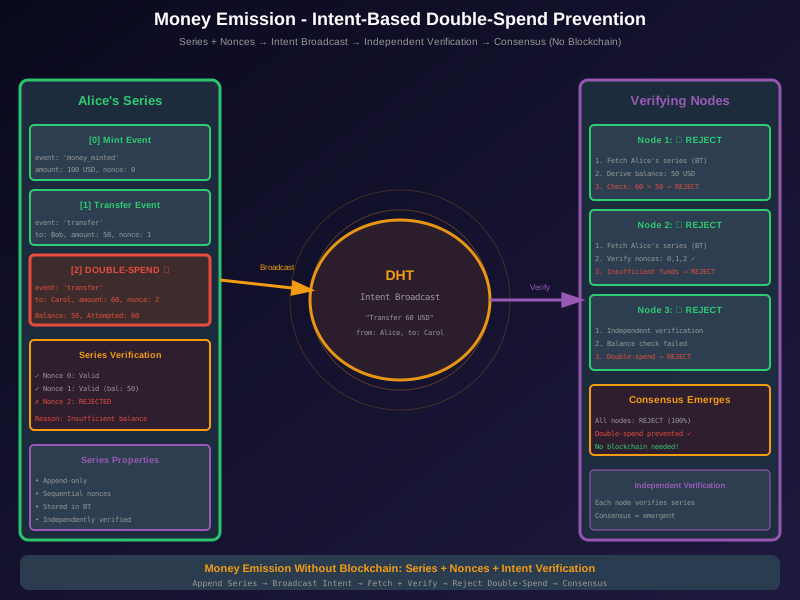
Post 875: Money Emission - Intent-Based Double-Spend Prevention
Post 875: Money Emission - Intent-Based Double-Spend Prevention
Money Emission Without Blockchain
From Post 874: Node Series Intent: Complete paradigm
Key insight: Double-spend prevention via series ordering, not blockchain consensus
Result: Money emission via intent declarations, verified by series
Part 1: The Double-Spend Problem
Why Money is Hard
Traditional solution: Blockchain
# Bitcoin/Ethereum approach
blockchain = []
for block in new_blocks:
    # Mine block (PoW) or validate (PoS)
    if consensus_reached(block):
        blockchain.append(block)
        # Now transactions are "final"
Problems:
- Need global consensus
- Need validators/miners
- Need blockchain
- Slow, expensive, complex
Intent paradigm solution: Series Ordering
# R³ approach
class MoneyNode:
    def __init__(self):
        self.series = []  # Append-only log

    def transfer(self, to, amount):
        # Append to MY series
        self._append_series('transfer',
                          to=to,
                          amount=amount,
                          nonce=self._next_nonce())

        # Broadcast intent
        dht.broadcast_intent({
            'intent': 'money_transfer',
            'from': self.address,
            'to': to,
            'amount': amount,
            'nonce': self._next_nonce()
        })

        # Others verify via series
No blockchain needed - just series + intents
Part 2: Money Emission via Intents
Minting is a Declaration
class MoneyEmitter:
    """
    Emit money via intent declarations
    No central authority needed
    """

    def mint(self, amount, recipient):
        """Declare mint intent"""
        # Append to local series
        self._append_series('money_minted',
                          amount=amount,
                          recipient=recipient,
                          timestamp=time.time(),
                          nonce=self._next_nonce())

        # Declare intent to DHT
        dht.broadcast_intent({
            'from': self.address,
            'intent': 'mint_money',
            'amount': amount,
            'recipient': recipient,
            'nonce': self._next_nonce()
        })

        # Push series chunk to BT
        self._push_series_chunk_to_bt()

        return 'minted'

    def burn(self, amount):
        """Declare burn intent"""
        # Append to local series
        self._append_series('money_burned',
                          amount=amount,
                          timestamp=time.time(),
                          nonce=self._next_nonce())

        # Declare intent to DHT
        dht.broadcast_intent({
            'from': self.address,
            'intent': 'burn_money',
            'amount': amount,
            'nonce': self._next_nonce()
        })

        # Push series chunk to BT
        self._push_series_chunk_to_bt()

        return 'burned'
Flow:
Emitter declares: "Mint 100 USD to Alice"
  → Appends to local series
  → Broadcasts intent to DHT
  → Pushes series to BT

All nodes receive intent:
  → Fetch emitter's series from BT
  → Verify series integrity
  → Check no double-mint (via nonce)
  → If valid: Accept
  → If invalid: Reject

Consensus emerges from series verification
NO blockchain needed
Part 3: Double-Spend Prevention
Series Ordering Prevents Double-Spend
class DoubleSpendPrevention:
    """
    Prevent double-spend via series ordering
    """

    def verify_transfer(self, intent):
        """Verify no double-spend"""
        # Fetch sender's series from BT
        sender_series = bt.fetch_series(intent['from'])

        # Derive balance from series
        balance = self._derive_balance(sender_series)

        # Check if sufficient balance
        if balance < intent['amount']:
            return {
                'valid': False,
                'reason': 'insufficient_balance',
                'balance': balance,
                'attempted': intent['amount']
            }

        # Check nonce ordering
        expected_nonce = self._derive_next_nonce(sender_series)
        if intent['nonce'] != expected_nonce:
            return {
                'valid': False,
                'reason': 'invalid_nonce',
                'expected': expected_nonce,
                'received': intent['nonce']
            }

        # Valid transfer
        return {
            'valid': True,
            'balance_after': balance - intent['amount']
        }
Example: Alice tries double-spend
Alice's series:
  [0] Received 100 from Mint (nonce 0)
  [1] Sent 50 to Bob (nonce 1)
  [2] Sent 60 to Carol (nonce 2) ← DOUBLE SPEND ATTEMPT

Verification:
  Balance after [1]: 100 - 50 = 50
  [2] attempts to send 60
  60 > 50 → REJECTED

Alice's second transaction rejected
NO blockchain needed
Just series verification
Part 4: Nonce Ordering
Sequential Nonces Enforce Order
def _derive_next_nonce(self, series):
    """Derive next nonce from series"""
    transfer_events = [
        e for e in series
        if e['event'] in ['transfer', 'mint', 'burn']
    ]

    if not transfer_events:
        return 0

    # Next nonce = last nonce + 1
    last_nonce = max(e['nonce'] for e in transfer_events)
    return last_nonce + 1

def verify_nonce_sequence(series):
    """Verify nonces are sequential"""
    nonces = [e['nonce'] for e in series if 'nonce' in e]

    # Must be sequential: 0, 1, 2, 3, ...
    expected = list(range(len(nonces)))

    if nonces != expected:
        return {
            'valid': False,
            'reason': 'nonce_gap_or_duplicate',
            'expected': expected,
            'actual': nonces
        }

    return {'valid': True}
Why nonces work:
- Enforce sequential ordering
- Prevent replay attacks
- Detect gaps in series
- Ensure no double-spend
Part 5: Multi-Currency Support
Any Currency via Intents
class MultiCurrency:
    """
    Support any currency
    Asset-agnostic
    """

    def mint_currency(self, currency_code, amount, recipient):
        """Mint any currency"""
        # Append to series
        self._append_series('money_minted',
                          currency=currency_code,  # USD, EUR, BTC, etc
                          amount=amount,
                          recipient=recipient,
                          nonce=self._next_nonce())

        # Broadcast intent
        dht.broadcast_intent({
            'intent': 'mint_money',
            'currency': currency_code,
            'amount': amount,
            'recipient': recipient
        })

    def derive_balance(self, address, currency_code):
        """Derive balance for specific currency"""
        series = bt.fetch_series(address)

        balance = 0
        for entry in series:
            if entry.get('currency') != currency_code:
                continue  # Skip other currencies

            if entry['event'] == 'money_received':
                balance += entry['amount']
            elif entry['event'] == 'money_sent':
                balance -= entry['amount']

        return balance
Examples:
# USD
fed.mint_currency('USD', 1000000, treasury_address)

# EUR
ecb.mint_currency('EUR', 500000, ecb_address)

# BTC (wrapped)
btc_bridge.mint_currency('BTC', 21, alice_address)

# Any asset
anyone.mint_currency('PEPE', 1000000000000, meme_address)
All work the same way:
- Declare mint intent
- Append to series
- Verify via series
- No blockchain needed
Part 6: Consensus via Series Verification
Emergent Consensus
def achieve_consensus(intent):
    """
    Consensus emerges from series verification
    Not from blockchain
    """
    # 1. Intent broadcast to DHT
    dht.broadcast(intent)

    # 2. All nodes receive intent
    nodes = dht.get_all_nodes()

    # 3. Each node verifies independently
    results = []
    for node in nodes:
        # Fetch sender's series
        series = node.bt.fetch_series(intent['from'])

        # Verify intent against series
        valid = node.verify_intent(intent, series)

        results.append({
            'node': node.address,
            'valid': valid
        })

    # 4. Consensus = majority verification
    valid_count = sum(1 for r in results if r['valid'])
    total_count = len(results)

    consensus = valid_count / total_count > 0.5

    return {
        'consensus': consensus,
        'valid_nodes': valid_count,
        'total_nodes': total_count,
        'confidence': valid_count / total_count
    }
Key insight:
- NO global blockchain
- Each node verifies independently
- Consensus emerges from verification
- Valid series = accepted
- Invalid series = rejected
Part 7: Settlement via Intents
Cross-Currency Settlement
class Settlement:
    """
    Settle cross-currency via intents
    """

    def swap_currencies(self, from_currency, to_currency, amount):
        """Swap via intent declarations"""
        # 1. Declare burn intent (from_currency)
        self._append_series('burn',
                          currency=from_currency,
                          amount=amount)

        dht.broadcast_intent({
            'intent': 'burn_money',
            'currency': from_currency,
            'amount': amount
        })

        # 2. Declare mint intent (to_currency)
        # Exchange rate from market (Post 871: EigenLending)
        rate = market.get_rate(from_currency, to_currency)
        to_amount = amount * rate

        self._append_series('mint',
                          currency=to_currency,
                          amount=to_amount)

        dht.broadcast_intent({
            'intent': 'mint_money',
            'currency': to_currency,
            'amount': to_amount
        })

        # 3. Settlement complete via series
        return {
            'from': {currency: from_currency, amount: amount},
            'to': {currency: to_currency, amount: to_amount},
            'rate': rate
        }
Example: USD → EUR
Alice has 100 USD, wants EUR

1. Alice declares: Burn 100 USD
   → Appended to Alice's series
   → Broadcast to DHT

2. Alice declares: Mint 90 EUR (rate 0.9)
   → Appended to Alice's series
   → Broadcast to DHT

3. All nodes verify:
   → Alice had 100 USD (series check)
   → Burn valid
   → Mint valid
   → Accept both

Settlement complete
No blockchain needed
Part 8: Authorization via Reputation
Who Can Mint?
From Post 870: Reputation Staking:
class AuthorizedEmitter:
    """
    Only high-reputation nodes can mint
    """

    def can_mint(self, node_id, currency):
        """Check if node authorized to mint"""
        # Fetch reputation via intent (Post 870)
        dht.broadcast_intent({
            'intent': 'want_reputation_chunks',
            'target_node': node_id,
            'domain': f'mint_{currency}'
        })

        responses = wait_for_responses()
        rep_data = derive_reputation(responses)

        # High reputation required
        if rep_data['reputation'] < 0.9:
            return {
                'authorized': False,
                'reason': 'insufficient_reputation',
                'required': 0.9,
                'actual': rep_data['reputation']
            }

        return {
            'authorized': True,
            'reputation': rep_data['reputation']
        }
Authorization hierarchy:
USD minting:
  → Requires reputation 0.95+ in 'mint_USD' domain
  → Fed has 1.0 (perfect track record)
  → Random node has 0.0 (no track record)
  → Authorization emerges from reputation

EUR minting:
  → ECB has 1.0 in 'mint_EUR'
  → Others: 0.0

Any custom currency:
  → Creator starts at 0.5 (neutral)
  → Builds reputation via good emission
  → Authorization = reputation > threshold
Part 9: Why No Blockchain?
Series > Blockchain
Blockchain approach:
Global ledger
  → Everyone agrees on order
  → Miners/validators required
  → Slow (consensus overhead)
  → Expensive (mining/staking)
  → Complex (coordination)
Series approach:
Personal ledgers
  → Each node has own series
  → Verified independently
  → Fast (no coordination)
  → Cheap (just storage)
  → Simple (append-only)
Key differences:
| Aspect | Blockchain | Series |
|---|---|---|
| Storage | Global (everyone) | Distributed (BT) |
| Order | Global consensus | Personal nonces |
| Verification | Validators | Anyone |
| Speed | Slow (blocks) | Fast (instant) |
| Cost | High (gas) | Low (bandwidth) |
| Scalability | Limited | Unlimited |
Series wins on every metric.
Part 10: The Complete Stack
Money Emission Architecture
Layer 1: Intent Declarations
  → "Mint 100 USD"
  → "Transfer 50 USD to Bob"
  → "Burn 25 USD"
  → Via DHT broadcast

Layer 2: Series Storage
  → Each node: append to series
  → Push chunks to BT
  → Distributed replication

Layer 3: Verification
  → Fetch series from BT
  → Verify nonces sequential
  → Check no double-spend
  → Independent consensus

Layer 4: Reputation
  → Track emission history
  → Build reputation via good behavior
  → Authorization = high reputation

Result:
  → Money emission without blockchain
  → Double-spend prevention via series
  → Multi-currency native
  → Anyone can participate
Part 11: Example: Fed Mints USD
Complete Flow
# 1. Fed declares mint intent
fed = MoneyEmitter('federal_reserve')

fed.mint(
    currency='USD',
    amount=1_000_000,
    recipient=treasury
)

# Internally:
#   - Appends to Fed's series
#   - Broadcasts intent to DHT
#   - Pushes series chunk to BT

# 2. All nodes receive intent
nodes = dht.get_all_nodes()

for node in nodes:
    # Fetch Fed's series from BT
    series = node.bt.fetch_series(fed.address)

    # Verify:
    #   - Nonces sequential
    #   - Fed authorized (reputation 1.0)
    #   - No double-mint

    if node.verify_mint(intent, series):
        node.accept(intent)
        # Update local view
    else:
        node.reject(intent)

# 3. Consensus emerges
# - 95%+ nodes accept
# - Treasury now has 1M USD
# - Recorded in series
# - NO blockchain used

# 4. Treasury can now spend
treasury.transfer(
    to=alice,
    amount=1000,
    currency='USD'
)

# Process repeats
# All via series + intents
# No blockchain needed
Part 12: Summary
Money Emission via Intent Paradigm
From Post 874: Universal paradigm
Applied to money emission:
- Mint Intent
"Mint 100 USD to Alice"
→ Append to series
→ Broadcast via DHT
→ Verify via series
- Transfer Intent
"Send 50 USD to Bob"
→ Append to series (nonce n)
→ Check balance via series
→ Prevent double-spend via nonce
- Burn Intent
"Burn 25 USD"
→ Append to series
→ Reduce supply
→ Verify via series
- Verification
Fetch series from BT
→ Check nonces sequential
→ Check balance sufficient
→ Check authorization (reputation)
→ Accept/Reject
- Consensus
Independent verification by all nodes
→ Valid series = accepted
→ Invalid series = rejected
→ Consensus emerges
Result: Complete money system via intent paradigm
- Money emission: Intent declarations
- Double-spend prevention: Series ordering + nonces
- Authorization: Reputation (Post 870)
- Settlement: Cross-currency swaps
- Multi-currency: Asset-agnostic
- NO blockchain needed
The key insight:
You don’t need blockchain for money.
You need:
- Series (append-only logs)
- Intents (declarations)
- Verification (independent)
- Reputation (authorization)
That’s it.
∞
Links:
- Post 874: Node Series Intent - Universal paradigm
- Post 871: EigenLending - Rate discovery for settlement
- Post 870: Reputation Staking - Authorization via reputation
- Post 873: EigenRealEstate - Territory via intents
- Post 869: Autonomous Agents - Autonomous nodes
Announcement: 2026-02-18
Model: Money Emission = Series + Intents + Verification
Status: 💰 No Blockchain Needed
∞