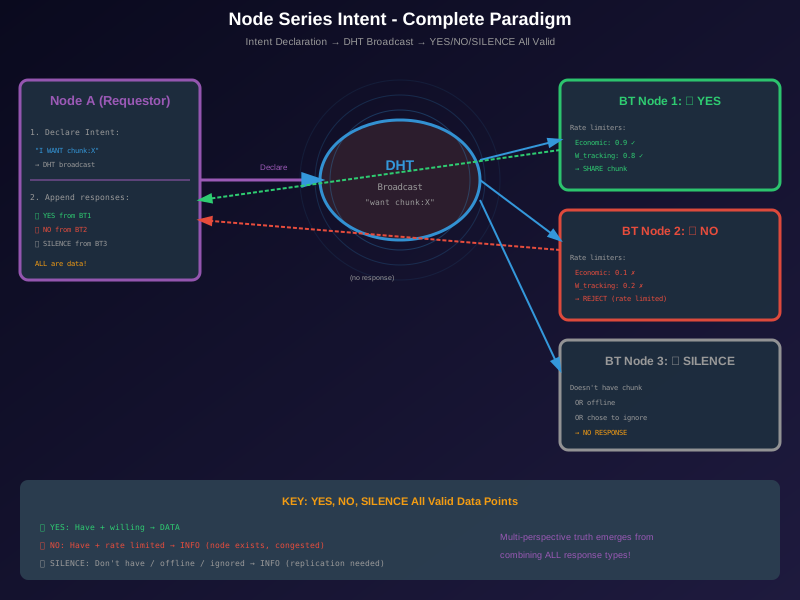
Post 874: Node Series Intent - The Complete Paradigm
Post 874: Node Series Intent - The Complete Paradigm
Intent = Declaration, Not Request
From universal-model: Complete distributed system
Key insight: “Dame eso” = broadcast intention, not question
Result: YES, NO, SILENCE all valid → Multi-perspective truth
Part 1: The Core Pattern
Series + Intent + DHT + BT
# Local node
class Node:
    def __init__(self):
        # ONLY series
        self.series = [
            {'t': time.time(), 'event': 'initialized'}
        ]

    def declare_intent(self, want):
        """
        Declare intention (not request!)
        Broadcast via DHT
        """
        # Declare to DHT: "I want X"
        dht.broadcast_intent({
            'from': self.address,
            'intent': 'want_chunk',
            'chunk_id': want
        })

        # Append declaration to MY series
        self._append_series('declared_intent',
                          chunk_id=want,
                          broadcast_time=time.time())

        # Wait for responses (or silence)
        # Each response appended to series
Not:
❌ "Can you give me X?" (question)
❌ send_request(node, 'get', chunk_id)
But:
✅ "I want X" (declaration)
✅ dht.broadcast_intent(...)
Part 2: Intent Communication
“Dame Eso” = Broadcast Declaration
Traditional (❌ wrong):
Node A → Node B: "Do you have chunk X?"
Node B → Node A: YES/NO
Intent-based (✅ correct):
Node A → DHT: "I WANT chunk:X"
DHT → [broadcast to all BT nodes]

BT Node 1: (decides) → ✅ "Here it is"
BT Node 2: (decides) → 🤷 [silence]
BT Node 3: (decides) → ❌ "I have it but rate limited"
BT Node 4: (decides) → 🤷 [silence]

Node A appends ALL outcomes to series:
  {'response': 'yes', 'from': 'BT1', 'data': chunk}
  {'response': 'silence', 'from': 'BT2'}
  {'response': 'no', 'from': 'BT3', 'reason': 'rate_limited'}
  {'response': 'silence', 'from': 'BT4'}
Key differences:
- Declaration (not question)
- Broadcast (not point-to-point)
- Multiple responses (not single answer)
- Silence is data (not absence)
Part 3: YES, NO, SILENCE All Valid
Every Outcome Is Information
class IntentResponse:
    """All responses are valid data points"""

    def process_responses(self, intent_id):
        """Collect all responses to intent"""
        responses = {
            'yes': [],      # Nodes that provided
            'no': [],       # Nodes that refused
            'silence': []   # Nodes that ignored
        }

        # Scan series for responses
        for entry in self.series:
            if entry.get('intent_id') == intent_id:
                if entry['response'] == 'yes':
                    responses['yes'].append(entry)
                elif entry['response'] == 'no':
                    responses['no'].append(entry)
                elif entry['response'] == 'silence':
                    responses['silence'].append(entry)

        return responses

    def derive_insights(self, responses):
        """Each response type gives information"""

        # YES = I have it and can share
        availability = len(responses['yes'])

        # NO = I have it but won't share (rate limited)
        # → Tells you: resource exists, node loaded
        congestion = len(responses['no'])

        # SILENCE = Didn't respond
        # → Tells you: don't have it, offline, or ignored
        unknowns = len(responses['silence'])

        return {
            'available_from': availability,
            'congested_nodes': congestion,
            'unknown_state': unknowns,
            'total_queried': availability + congestion + unknowns
        }
Why silence is valuable:
Scenario: Want chunk:X
Broadcast to 10 BT nodes

Responses:
- 2 YES (have it, not rate limited)
- 1 NO (have it, rate limited)
- 7 SILENCE (don't have it or offline)

Insights:
✓ Chunk exists (3 nodes aware)
✓ Replication factor = 3
✓ 1 node congested (high demand?)
✓ 7 nodes don't have (need more replication?)
Silence isn’t absence - it’s information!
Part 4: Rate Limiters
Each Node Decides Autonomously
class BitTorrentNode:
    """BT node with rate limiters"""

    def receive_intent(self, intent):
        """Intent broadcast received - decide response"""
        chunk_id = intent['chunk_id']

        # Do I have it?
        storage = self._derive_storage()
        if chunk_id not in storage:
            # Don't have it → SILENCE
            return None

        # Have it - check rate limiters
        limiters = self._compute_rate_limiters()

        if self._should_share(chunk_id, limiters):
            # YES - share it
            self._respond_yes(intent, storage[chunk_id])
        else:
            # NO - have it but rate limited
            self._respond_no(intent, reason='rate_limited')

    def _compute_rate_limiters(self):
        """Compute from series"""
        storage = self._derive_storage()

        # Economic: storage space
        total_size = sum(len(str(d)) for d in storage.values())
        storage_budget = 100 * 1024 * 1024  # 100MB
        economic = 1.0 - (total_size / storage_budget)

        # Objective: chunk popularity
        objective = 1.0 if len(storage) < 50 else 0.3

        # W tracking: recent requests
        recent_requests = sum(1 for e in self.series[-100:]
                             if e.get('event') == 'intent_received')
        w_tracking = 1.0 - (recent_requests / 100)

        # Topology: network health
        topology = 1.0  # Simplified

        return {
            'economic': economic,
            'objective': objective,
            'w_tracking': w_tracking,
            'topology': topology
        }

    def _should_share(self, chunk_id, limiters):
        """Decision logic"""
        # All limiters green → YES
        if all(v > 0.7 for v in limiters.values()):
            return True

        # Economic critical → NO
        if limiters['economic'] < 0.2:
            return False

        # High load → NO
        if limiters['w_tracking'] < 0.3:
            return False

        # Borderline → YES
        return True
Rate limiters = autonomous decision making
Part 5: DHT Broadcast
How Intentions Propagate
class DHT:
    """Distributed Hash Table"""

    def broadcast_intent(self, intent):
        """Broadcast to all relevant nodes"""
        # Get all BT nodes
        bt_nodes = self._find_nodes(type='bt')

        # Broadcast to all
        for node in bt_nodes:
            try:
                self._send_intent(node, intent)
            except:
                # Node offline → will appear as SILENCE
                pass

        # Log broadcast
        self._append_series('intent_broadcast',
                          intent_id=intent['id'],
                          targets=len(bt_nodes))

    def _find_nodes(self, type):
        """Find nodes by type from series"""
        nodes = []
        for entry in self.series:
            if entry.get('event') == 'peer_added':
                if entry.get('peer_type') == type:
                    nodes.append(entry['peer'])
        return nodes
Flow:
1. Node A declares: "I want chunk:X"
   → Appends to local series

2. DHT receives declaration
   → Finds all BT nodes
   → Broadcasts to all

3. Each BT node receives
   → Decides independently
   → YES, NO, or SILENCE

4. Node A receives responses
   → Appends each to series
   → Including tracked silences
Part 6: Chunks to BitTorrent
Not Full Series - Just Chunks!
class SeriesChunking:
    """Split series into chunks for BT"""

    def chunk_series(self, series, chunk_size=10):
        """Split series into chunks"""
        chunks = []
        for i in range(0, len(series), chunk_size):
            chunk = {
                'chunk_id': f'series_{self.node_id}_{i}',
                'events': series[i:i+chunk_size],
                'start_time': series[i]['t'],
                'end_time': series[min(i+chunk_size-1, len(series)-1)]['t']
            }
            chunks.append(chunk)
        return chunks

    def push_chunks_to_bt(self, chunks):
        """Push chunks to BT network"""
        for chunk in chunks:
            # Declare intent to store
            dht.broadcast_intent({
                'from': self.address,
                'intent': 'store_chunk',
                'chunk_id': chunk['chunk_id'],
                'data': chunk
            })

            # BT nodes decide whether to accept
            # (Based on their rate limiters)
Key: Series stays local, only CHUNKS distributed
Part 7: Multi-Perspective Derivations
Fetch Multiple Series, Derive Truth
class MultiPerspective:
    """Derive from multiple perspectives"""

    def fetch_perspectives(self, event_type):
        """Fetch chunks from multiple nodes"""
        # Declare intent for relevant chunks
        dht.broadcast_intent({
            'intent': 'want_chunks',
            'filter': event_type,
            'from': self.address
        })

        # Collect responses
        perspectives = []
        for response in self._wait_for_responses():
            if response['result'] == 'yes':
                perspectives.append({
                    'node': response['from'],
                    'chunks': response['data']
                })

        return perspectives

    def derive_consensus(self, perspectives):
        """Derive truth from multiple series"""
        consensus = {}

        # Example: Mapping consensus
        observations = []
        for p in perspectives:
            for chunk in p['chunks']:
                for event in chunk['events']:
                    if event['event'] == 'observation':
                        observations.append({
                            'node': p['node'],
                            'value': event['observation'],
                            'reputation': self._get_reputation(p['node'])
                        })

        # Weighted consensus
        total_weight = sum(o['reputation'] for o in observations)
        consensus_value = sum(o['value'] * o['reputation']
                             for o in observations) / total_weight

        return consensus_value
Multi-perspective = truth emerges from many views
Part 8: Complete Flow
End-to-End Example
# Node A wants to map territory
mapper_A = MapperNode('A')

# 1. Observe locally
mapper_A.observe_reality(location='forest_1')
# → Appends to local series

# 2. Want others' perspectives
mapper_A.declare_intent_to_dht({
    'intent': 'want_observations',
    'location': 'forest_1'
})

# 3. DHT broadcasts to all mapper nodes
# Mapper B: ✅ YES (sends observations)
# Mapper C: 🤷 SILENCE (offline)
# Mapper D: ✅ YES (sends observations)
# Mapper E: ❌ NO (has data but rate limited)

# 4. Mapper A receives responses
mapper_A._append_series('received_perspective',
                       from='B', data=observations_B)
mapper_A._append_series('silence',
                       from='C')
mapper_A._append_series('received_perspective',
                       from='D', data=observations_D)
mapper_A._append_series('rejected',
                       from='E', reason='rate_limited')

# 5. Derive consensus from available perspectives
consensus = mapper_A.derive_consensus([
    observations_A,  # Own
    observations_B,  # From B
    observations_D   # From D
])

# 6. Store consensus chunks to BT
mapper_A.push_chunks_to_bt(consensus_chunks)

# 7. Announce to DHT
dht.announce('chunk:consensus_forest_1', mapper_A.address)
Complete cycle: Local → Intent → Perspectives → Consensus → Storage
Part 9: Why This Matters
Vs Traditional Request/Response
Traditional:
# Point-to-point request
response = node_B.get(chunk_id)

# Problems:
- Single point of failure
- No alternatives if rejected
- Silence = error (not data)
- No multi-perspective
Intent-based:
# Broadcast intention
dht.broadcast_intent('want_chunk', chunk_id)

# Benefits:
✓ Multiple responders
✓ Alternatives if some reject
✓ Silence is information
✓ Multi-perspective by default
✓ Rate limiting natural
✓ Autonomous decisions
Part 10: The Vision
Complete Distributed System
Every Node:
  series = [local events]

Want something?
  → Declare intent to DHT
  → DHT broadcasts
  → Multiple nodes decide:
    • YES (have + willing)
    • NO (have + rate limited)
    • SILENCE (don't have / offline)
  → Append ALL outcomes to series

Derive state:
  → From local series
  → From fetched chunks
  → Multi-perspective consensus

Store chunks:
  → Push to BT network
  → BT nodes decide (rate limiters)
  → Distributed replication

Discover:
  → DHT: "Who has chunk:X?"
  → Multiple seeders
  → Fetch from any
Result: Complete distributed coordination via intent declarations
Part 11: Summary
The Complete Paradigm
Three components:
- Local Series
self.series = [...]  # Append-only
state = _derive_from_series()
- Intent Declaration
dht.broadcast_intent("I want X")
# NOT: request("give me X")
- Multi-Response
responses = {
    'yes': [nodes that shared],
    'no': [nodes that refused],
    'silence': [nodes that ignored]
}
# ALL are valid data points
Key insights:
- Intent = declaration, not request
- DHT = broadcast, not router
- YES/NO/SILENCE = all information
- Rate limiters = autonomous decisions
- Chunks = distributed, not centralized
- Multi-perspective = truth emerges
This is the foundation for:
- Post 873: EigenRealEstate (territory via intents)
- Post 870: Reputation (derived from responses)
- Post 869: Autonomous nodes (declare intents)
- Universal-model: Complete implementation
One paradigm. Infinite coordination. Intent everywhere.
∞
Links:
- universal-model/eigenbittorrent.py - BT with rate limiters
- universal-model/eigendht.py - DHT broadcast
- universal-model/eigennode.py - Base template
- Post 873: EigenRealEstate - Territory coordination
- Post 870: Reputation Staking - Track record
Announcement: 2026-02-19
Model: Series + Intent + DHT + BT = Complete Distributed System
Status: 📡 Declare Intent → YES/NO/SILENCE → Multi-Perspective Truth
∞