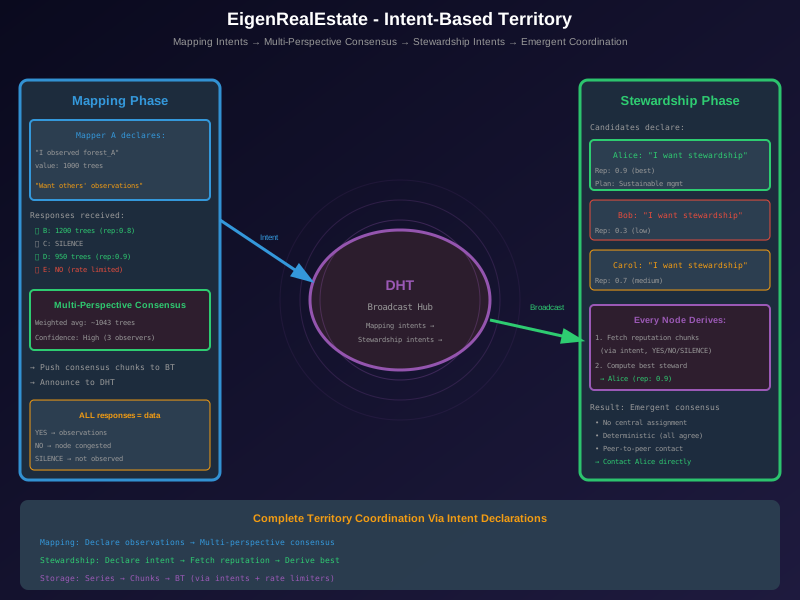
Post 873: EigenRealEstate - Intent-Based Territory Coordination
Post 873: EigenRealEstate - Intent-Based Territory Coordination
Territory Via Intent Declarations
From Post 874: Node Series Intent: Complete paradigm
Key insight: Territory = Intent broadcasts, not assignments
Result: Mapping + Stewardship via distributed intent declarations
Part 1: Two Intent Types
Mapping Intent vs Stewardship Intent
# Mapping Intent: "I observe X"
mapper_node.declare_intent({
    'intent': 'observed_location',
    'location': 'forest_A',
    'observation': '1000 trees',
    'sensor_type': 'lidar'
})
# → DHT broadcasts to all mapper nodes
# → Other mappers respond: YES/NO/SILENCE
# → Consensus emerges from responses

# Stewardship Intent: "I want to manage X"
steward_node.declare_intent({
    'intent': 'want_stewardship',
    'territory': 'forest_A',
    'reputation': 0.9,
    'plan': 'sustainable management'
})
# → DHT broadcasts to all nodes
# → Nodes derive best steward locally
# → Emergent coordination
Two separate intent types, same paradigm
Part 2: Mapping Via Intents
Distributed Reality Observation
class MapperNode:
    """Maps reality via intent declarations"""

    def observe_and_declare(self, location):
        """Observe locally + declare to network"""
        # 1. Local observation
        observation = self._read_sensors(location)
        self._append_series('local_observation',
                          location=location,
                          value=observation)

        # 2. Declare intent to DHT
        dht.broadcast_intent({
            'from': self.address,
            'intent': 'observed_location',
            'location': location,
            'observation': observation,
            'timestamp': time.time()
        })

        # 3. Also declare: "I want others' observations"
        dht.broadcast_intent({
            'from': self.address,
            'intent': 'want_observations',
            'location': location
        })

        return observation

    def receive_observation_intent(self, intent):
        """Another mapper wants observations"""
        location = intent['location']

        # Do I have observations for this location?
        my_observations = self._get_observations(location)

        if not my_observations:
            # SILENCE (don't have it)
            return None

        # Check rate limiters
        limiters = self._compute_rate_limiters()

        if limiters['w_tracking'] < 0.3:
            # NO (have it but rate limited)
            return {'response': 'no', 'reason': 'rate_limited'}

        # YES (share observations)
        return {
            'response': 'yes',
            'observations': my_observations,
            'reputation': self._derive_mapping_reputation()
        }
Flow:
Mapper A observes forest_A: 1000 trees
  → Declares to DHT: "I observed 1000 trees at forest_A"
  → Declares to DHT: "I want others' observations of forest_A"

DHT broadcasts both intents

Mapper B: ✅ YES (observed 1200 trees, shares)
Mapper C: 🤷 SILENCE (hasn't observed this location)
Mapper D: ✅ YES (observed 950 trees, shares)
Mapper E: ❌ NO (observed but rate limited)

Mapper A appends ALL outcomes to series:
  - Own: 1000 trees
  - From B: 1200 trees (rep: 0.8)
  - From C: SILENCE
  - From D: 950 trees (rep: 0.9)
  - From E: NO (congested)

Weighted consensus:
  = (1000*0.7 + 1200*0.8 + 950*0.9) / (0.7+0.8+0.9)
  = ~1043 trees
Multi-perspective mapping via intent declarations!
Part 3: YES/NO/SILENCE for Observations
All Responses Are Data
def derive_mapping_consensus(self, location, responses):
    """Derive from all response types"""

    # Collect observations
    observations = []

    # Own observation
    my_obs = self._get_my_observation(location)
    if my_obs:
        observations.append({
            'value': my_obs,
            'reputation': self._derive_mapping_reputation(),
            'source': 'self'
        })

    # YES responses (shared observations)
    for r in responses['yes']:
        observations.append({
            'value': r['observations'],
            'reputation': r['reputation'],
            'source': r['from']
        })

    # NO responses (have data but won't share)
    # → Tells us: location observed by more nodes
    # → Increases confidence in existence
    for r in responses['no']:
        self._append_series('node_has_data',
                          location=location,
                          node=r['from'],
                          reason=r['reason'])

    # SILENCE responses
    # → Tells us: nodes that haven't observed
    # → Useful for coverage analysis
    for r in responses['silence']:
        self._append_series('node_no_data',
                          location=location,
                          node=r['from'])

    # Weighted consensus from YES responses
    if not observations:
        return None

    total_weight = sum(o['reputation'] for o in observations)
    consensus = sum(o['value'] * o['reputation']
                   for o in observations) / total_weight

    # Metadata from all responses
    metadata = {
        'consensus_value': consensus,
        'num_observers': len(observations),
        'num_aware': len(observations) + len(responses['no']),
        'num_unaware': len(responses['silence']),
        'confidence': len(observations) / (len(observations) + len(responses['silence']))
    }

    return metadata
Insights from each response type:
- YES: Direct observation data
- NO: Confirmation location observed (even if can’t share now)
- SILENCE: Coverage gaps, need more observation
Part 4: Stewardship Via Intents
Distributed Steward Selection
class StewardshipIntent:
    """Stewardship via intent declarations"""

    def declare_stewardship_intent(self, territory):
        """Declare: I want to manage this territory"""
        # Get my stewardship reputation
        my_rep = self._derive_stewardship_reputation()

        # Declare intent to DHT
        dht.broadcast_intent({
            'from': self.address,
            'intent': 'want_stewardship',
            'territory': territory,
            'reputation': my_rep,
            'plan': self.management_plan(territory)
        })

        # Append to my series
        self._append_series('declared_stewardship_intent',
                          territory=territory,
                          reputation=my_rep)
Key difference from mapping:
Mapping: "I observed X" + "Give me your observations"
  → Multi-perspective data collection
  → Consensus from combined views

Stewardship: "I want to manage X"
  → Self-nomination declaration
  → Others derive best choice locally
Part 5: Distributed Steward Derivation
Each Node Computes Best Steward
def derive_best_steward(self, territory, intents):
    """
    Each node derives best steward from intent broadcasts
    Same input → same output (deterministic)
    """
    # Collect all stewardship intents for this territory
    candidates = []

    for intent in intents:
        if intent['intent'] == 'want_stewardship' and \
           intent['territory'] == territory:

            # Fetch stewardship reputation chunks from BT
            # (Using intent paradigm!)
            dht.broadcast_intent({
                'intent': 'want_reputation_chunks',
                'node': intent['from'],
                'type': 'stewardship'
            })

            # Collect responses (YES/NO/SILENCE)
            rep_chunks = self._collect_responses()

            # Derive reputation from chunks
            reputation = self._derive_from_chunks(rep_chunks)

            candidates.append({
                'node': intent['from'],
                'reputation': reputation,
                'plan': intent['plan']
            })

    # Deterministic selection: highest reputation
    if not candidates:
        return None

    best = max(candidates, key=lambda c: c['reputation'])

    # Append decision to MY series
    self._append_series('derived_best_steward',
                      territory=territory,
                      steward=best['node'],
                      reputation=best['reputation'])

    return best['node']
Flow:
Territory: forest_A needs steward

Alice declares: "I want stewardship of forest_A" (rep: 0.9)
Bob declares: "I want stewardship of forest_A" (rep: 0.3)
Carol declares: "I want stewardship of forest_A" (rep: 0.7)

DHT broadcasts all declarations

Every node fetches reputation chunks:
  → Intent: "I want Alice's stewardship reputation chunks"
  → Intent: "I want Bob's stewardship reputation chunks"
  → Intent: "I want Carol's stewardship reputation chunks"

BT nodes respond (YES/NO/SILENCE with chunks)

Every node derives locally:
  Alice: rep = 0.9 (best)
  Bob: rep = 0.3
  Carol: rep = 0.7

Every node concludes: Alice is best steward

Nodes wanting coordination contact Alice peer-to-peer
No central assignment - emergent consensus!
Part 6: Reputation Chunks in BT
Distributed Reputation Storage
class ReputationChunking:
    """Store reputation events as chunks in BT"""

    def push_reputation_to_bt(self):
        """Push reputation-related events to BT"""
        # Filter series for reputation events
        rep_events = [
            e for e in self.series
            if e.get('event') in [
                'ecosystem_change',
                'dispute_resolution',
                'observation_check',
                'consensus_match'
            ]
        ]

        # Chunk events
        chunks = self._chunk_events(rep_events, chunk_size=10)

        # Push each chunk to BT via intent
        for chunk in chunks:
            dht.broadcast_intent({
                'from': self.address,
                'intent': 'store_chunk',
                'chunk_id': chunk['id'],
                'chunk_type': 'reputation',
                'node_id': self.node_id,
                'data': chunk
            })

            # BT nodes decide via rate limiters
            # (YES/NO/SILENCE responses)

    def fetch_reputation_chunks(self, node_id):
        """Fetch reputation chunks for another node"""
        # Declare intent
        dht.broadcast_intent({
            'from': self.address,
            'intent': 'want_reputation_chunks',
            'target_node': node_id
        })

        # Collect responses
        responses = self._wait_for_responses()

        chunks = []
        for r in responses:
            if r['response'] == 'yes':
                chunks.extend(r['chunks'])

        return chunks
Why chunks?
- Series too large to share entirely
- Only reputation-relevant events needed
- Distributed storage (not centralized)
- BT nodes decide what to store (rate limiters)
Part 7: Complete Territory Flow
End-to-End Example
# Phase 1: MAPPING

# 1. Mappers declare observation intents
mapper_A.declare_intent('observed_location', 'forest_A', value=1000)
mapper_B.declare_intent('observed_location', 'forest_A', value=1200)
mapper_C.declare_intent('observed_location', 'forest_A', value=950)

# 2. Each also declares "want others' observations"
# DHT broadcasts all intents

# 3. Mappers respond to "want observations" intents
# YES: Share observations
# NO: Have but rate limited
# SILENCE: Don't have

# 4. Each mapper derives consensus locally
consensus_A = mapper_A.derive_consensus(responses)  # ~1050
consensus_B = mapper_B.derive_consensus(responses)  # ~1050
consensus_C = mapper_C.derive_consensus(responses)  # ~1050
# (Same input → same output)

# 5. Push consensus chunks to BT
mapper_A.push_chunks_to_bt(consensus_chunks)

# 6. Announce to DHT
dht.announce('chunk:consensus_forest_A', mapper_A.address)


# Phase 2: STEWARDSHIP

# 1. Candidates declare stewardship intents
alice.declare_intent('want_stewardship', 'forest_A', rep=0.9)
bob.declare_intent('want_stewardship', 'forest_A', rep=0.3)
carol.declare_intent('want_stewardship', 'forest_A', rep=0.7)

# 2. DHT broadcasts all stewardship intents

# 3. Every node fetches reputation chunks
# (Via intent declarations + BT responses)

# 4. Every node derives best steward locally
best_node1 = node1.derive_best_steward('forest_A', intents)  # Alice
best_node2 = node2.derive_best_steward('forest_A', intents)  # Alice
best_node3 = node3.derive_best_steward('forest_A', intents)  # Alice
# (Deterministic - all agree)

# 5. Nodes wanting coordination contact Alice directly
# (Peer-to-peer, not through DHT)


# Phase 3: ONGOING MANAGEMENT

# 1. Alice manages, records events
alice._append_series('ecosystem_change', territory='forest_A', delta=+10)
alice._append_series('dispute_resolved', territory='forest_A', success=True)

# 2. Push reputation chunks to BT periodically
alice.push_reputation_to_bt()

# 3. Others fetch updated chunks to re-derive reputation
# (Intent-based fetching when needed)
Complete coordination via intent declarations!
Part 8: Why This Works
Vs Central Assignment
Traditional (❌):
Central Registry:
  1. Register territory
  2. Accept applications
  3. Review candidates
  4. Assign steward
  5. Monitor performance

Problems:
- Single point of failure
- Central authority needed
- No multi-perspective
- Assigned, not emergent
Intent-based (✅):
Distributed Intents:
  1. Mappers declare observations → multi-perspective consensus
  2. Candidates declare stewardship intent
  3. Each node fetches reputation chunks (YES/NO/SILENCE)
  4. Each node derives best steward locally (deterministic)
  5. Coordination emerges peer-to-peer

Benefits:
✓ No central authority
✓ Multi-perspective reality
✓ Emergent coordination
✓ YES/NO/SILENCE all inform
✓ Rate limiters = autonomous
✓ Distributed storage (BT)
Part 9: Integration
Series + Intent + DHT + BT
class EigenRealEstate:
    """Complete system"""

    def __init__(self):
        # Mapper nodes
        self.mappers = [MapperNode(i) for i in range(100)]

        # Steward nodes
        self.stewards = [StewardNode(i) for i in range(50)]

        # DHT for intent broadcast
        self.dht = DHTNode('dht1')

        # BT for chunk storage
        self.bt_nodes = [BTNode(i) for i in range(20)]

    def coordinate_territory(self, location):
        """Full coordination via intents"""

        # 1. Mapping phase (intent-based)
        for mapper in self.mappers:
            mapper.declare_intent('observe', location)

        # DHT broadcasts all observation intents
        # Mappers respond: YES/NO/SILENCE
        # Each derives consensus locally

        # 2. Stewardship phase (intent-based)
        for steward in self.stewards:
            steward.declare_intent('want_stewardship', location)

        # DHT broadcasts stewardship intents
        # All nodes fetch reputation chunks (intent-based)
        # All nodes derive best steward (deterministic)

        # 3. Coordination emerges
        # No central assignment
        # Peer-to-peer contact with selected steward

        return 'emergent_coordination_complete'
Part 10: The Vision
Complete Territory Coordination
Every territory:

Mapping:
  → Mappers declare: "I observed X"
  → Mappers declare: "Want others' observations"
  → DHT broadcasts
  → Responses: YES/NO/SILENCE
  → Multi-perspective consensus
  → Push consensus chunks to BT

Stewardship:
  → Candidates declare: "I want stewardship"
  → DHT broadcasts
  → All nodes fetch reputation chunks (intent-based)
  → All nodes derive best steward (deterministic)
  → Coordination emerges peer-to-peer

Storage:
  → Series → chunks
  → Push to BT via intents
  → BT nodes decide (rate limiters)
  → Distributed replication

Discovery:
  → DHT: "Who has chunk:X?"
  → Intent-based fetching
  → Multi-source retrieval

Result:
  → Complete meatspace coordination
  → No central authority
  → Multi-perspective truth
  → Emergent stewardship
  → Distributed storage
  → Intent declarations everywhere
Territory coordination = distributed intent orchestration
Part 11: Summary
EigenRealEstate Via Intents
From Post 874: Universal paradigm
Applied to territory:
- Mapping Intent
"I observed forest_A: 1000 trees"
"I want others' observations of forest_A"
→ Multi-perspective consensus
- Stewardship Intent
"I want stewardship of forest_A"
→ Reputation chunks fetched
→ Best steward derived locally
- All Responses Valid
YES: Data provided
NO: Have but rate limited
SILENCE: Don't have / offline
→ All inform decision
- Distributed Storage
Series → chunks → BT
Intent-based push
Rate limiters decide
- Emergent Coordination
No central assignment
Deterministic derivation
Peer-to-peer contact
Result: Complete territory coordination via intent declarations
∞
Links:
- Post 874: Node Series Intent - Complete paradigm
- Post 872: ETH Most Neutral Currency - Settlement layer
- Post 871: Morpho Blue - Universal finance
- Post 870: Reputation Staking - Track record
- Post 869: Autonomous Agents - Autonomous nodes
- Post 868: Beacon Chain Eliminated - Infrastructure
Announcement: 2026-02-19
Model: EigenRealEstate = Territory Via Intent Declarations
Status: 🗺️ Intent Broadcast → Multi-Perspective → Emergent Coordination
∞