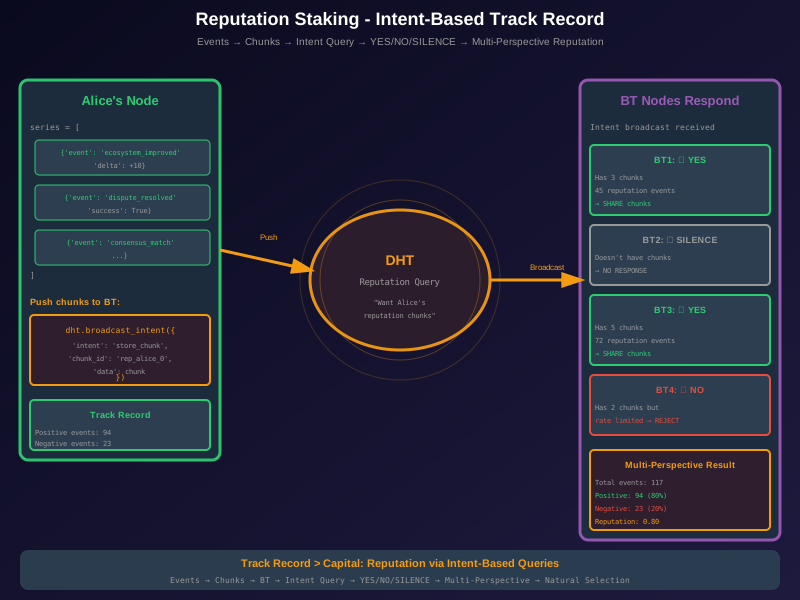
Post 870: Reputation Staking - Intent-Based Track Record
Post 870: Reputation Staking - Intent-Based Track Record
Reputation = Event Series, Not Score
From Post 874: Node Series Intent: Complete paradigm
Key insight: Reputation derived from event chunks, fetched via intents
Result: Track record > Capital, via multi-perspective observation
Part 1: Reputation Events in Series
Track Record = Append-Only Log
class ReputationNode:
    """Reputation via series push"""

    def __init__(self, node_id):
        self.node_id = node_id

        # ONLY series
        self.series = [
            {'t': time.time(), 'event': 'initialized'}
        ]

    def record_action(self, action_type, **details):
        """Record reputation-relevant action"""
        # Append to series (not mutation!)
        self._append_series(action_type, **details)

        # Push chunks to BT periodically
        if len(self.series) % 10 == 0:
            self._push_recent_chunks_to_bt()

    def _derive_reputation(self):
        """Derive reputation from series (computed on demand)"""
        positive = 0
        negative = 0

        for entry in self.series:
            if entry['event'] in ['ecosystem_improved', 'dispute_resolved', 'consensus_match']:
                positive += 1
            elif entry['event'] in ['ecosystem_degraded', 'dispute_failed', 'consensus_mismatch']:
                negative += 1

        total = positive + negative
        if total == 0:
            return 0.5  # Neutral

        return positive / total
Reputation events:
- Ecosystem improvements
- Dispute resolutions
- Consensus matches
- Performance metrics
- Community feedback
All appended to series, never mutated
Part 2: Reputation Query via Intent
“Dame Eso” for Reputation
def query_reputation(self, target_node_id):
    """
    Query another node's reputation
    Intent-based, not request
    """
    # Declare intent to DHT
    dht.broadcast_intent({
        'from': self.address,
        'intent': 'want_reputation_chunks',
        'target_node': target_node_id,
        'chunk_types': ['ecosystem', 'dispute', 'consensus']
    })

    # Append declaration to MY series
    self._append_series('declared_reputation_query',
                      target=target_node_id,
                      timestamp=time.time())

    # Wait for responses (YES/NO/SILENCE)
    # Each response appended to series
Not:
❌ reputation = get_reputation(node_id)  # Request
❌ score = node.reputation_score  # Stored state
But:
✅ dht.broadcast_intent("want_reputation_chunks", node_id)
✅ responses = collect_responses()  # YES/NO/SILENCE
✅ reputation = derive_from_chunks(responses['yes'])
Part 3: BT Nodes Respond with Chunks
YES/NO/SILENCE for Reputation Data
class BTNodeWithReputation:
    """BT node stores reputation chunks"""

    def receive_reputation_intent(self, intent):
        """Reputation query received"""
        target_node = intent['target_node']

        # Do I have reputation chunks for this node?
        my_chunks = self._get_chunks_for_node(target_node)

        if not my_chunks:
            # SILENCE (don't have chunks)
            return None

        # Check rate limiters
        limiters = self._compute_rate_limiters()

        if limiters['w_tracking'] < 0.3:
            # NO (have chunks but rate limited)
            return {
                'response': 'no',
                'reason': 'rate_limited',
                'chunks_available': len(my_chunks)
            }

        # YES (share chunks)
        return {
            'response': 'yes',
            'chunks': my_chunks,
            'total_events': sum(len(c['events']) for c in my_chunks)
        }
Responses:
Intent: "I want reputation chunks for Alice"
DHT broadcasts to all BT nodes

BT1: ✅ YES (has 3 chunks, shares)
BT2: 🤷 SILENCE (doesn't have Alice's chunks)
BT3: ✅ YES (has 5 chunks, shares)
BT4: ❌ NO (has chunks but rate limited)
BT5: 🤷 SILENCE (offline)

Requestor appends ALL outcomes:
  - From BT1: 3 chunks (45 events)
  - From BT2: SILENCE
  - From BT3: 5 chunks (72 events)
  - From BT4: NO (rate limited, 2 chunks available)
  - From BT5: SILENCE

Derive reputation from available chunks:
  → 117 total events from BT1 + BT3
  → Positive: 94
  → Negative: 23
  → Reputation: 94/117 = 0.80
All responses inform the query!
Part 4: Multi-Perspective Reputation
Reputation from Multiple Sources
def derive_multi_perspective_reputation(self, target_node, responses):
    """Derive reputation from multiple chunk sources"""

    all_chunks = []

    # Collect YES responses
    for r in responses['yes']:
        all_chunks.extend(r['chunks'])

    # NO responses tell us chunks exist elsewhere
    chunks_elsewhere = sum(r.get('chunks_available', 0)
                          for r in responses['no'])

    # SILENCE tells us coverage
    nodes_without_data = len(responses['silence'])

    # Combine all events from chunks
    all_events = []
    for chunk in all_chunks:
        all_events.extend(chunk['events'])

    # Count event types
    positive = sum(1 for e in all_events
                  if e['event'] in ['ecosystem_improved',
                                   'dispute_resolved',
                                   'consensus_match'])

    negative = sum(1 for e in all_events
                  if e['event'] in ['ecosystem_degraded',
                                   'dispute_failed',
                                   'consensus_mismatch'])

    total = positive + negative
    if total == 0:
        return {
            'reputation': 0.5,
            'confidence': 'low',
            'sources': 0
        }

    reputation = positive / total

    # Metadata from all responses
    metadata = {
        'reputation': reputation,
        'total_events': total,
        'positive_events': positive,
        'negative_events': negative,
        'chunks_fetched': len(all_chunks),
        'bt_nodes_responded': len(responses['yes']),
        'bt_nodes_rate_limited': len(responses['no']),
        'bt_nodes_no_data': nodes_without_data,
        'confidence': 'high' if len(responses['yes']) >= 2 else 'medium'
    }

    return metadata
Benefits:
- Multiple sources → higher confidence
- NO responses → know data exists
- SILENCE → understand coverage
- Comprehensive view from combined chunks
Part 5: Pushing Reputation Chunks to BT
Distributed Reputation Storage
class ReputationChunkPushing:
    """Push reputation events to BT network"""

    def push_reputation_chunks(self):
        """Push recent reputation events as chunks"""
        # Filter series for reputation-relevant events
        rep_events = [
            e for e in self.series
            if e.get('event') in [
                'ecosystem_improved',
                'ecosystem_degraded',
                'dispute_resolved',
                'dispute_failed',
                'consensus_match',
                'consensus_mismatch',
                'community_feedback'
            ]
        ]

        # Chunk events (10 events per chunk)
        chunks = []
        for i in range(0, len(rep_events), 10):
            chunk = {
                'chunk_id': f'rep_{self.node_id}_{i}',
                'node_id': self.node_id,
                'chunk_type': 'reputation',
                'events': rep_events[i:i+10],
                'start_time': rep_events[i]['t'],
                'end_time': rep_events[min(i+9, len(rep_events)-1)]['t']
            }
            chunks.append(chunk)

        # Push each chunk via intent
        for chunk in chunks:
            dht.broadcast_intent({
                'from': self.address,
                'intent': 'store_chunk',
                'chunk_id': chunk['chunk_id'],
                'chunk_type': 'reputation',
                'data': chunk
            })

            # BT nodes decide via rate limiters
            # YES: Store it
            # NO: Rate limited
            # SILENCE: Don't want to store
Why chunks?
- Series too large for single transfer
- Only reputation events needed
- Distributed replication
- BT nodes autonomous storage decisions
Part 6: Track Record > Capital
Natural Incentives, No Punishment
def compare_candidates(self, candidates):
    """Compare by track record, not capital"""

    scores = []

    for candidate in candidates:
        # Fetch reputation via intent
        dht.broadcast_intent({
            'intent': 'want_reputation_chunks',
            'target_node': candidate.node_id
        })

        responses = self._collect_responses()

        # Derive reputation from chunks
        rep_data = self.derive_multi_perspective_reputation(
            candidate.node_id,
            responses
        )

        # Score = reputation (not capital!)
        score = rep_data['reputation']

        # Capital can amplify but doesn't dominate
        if candidate.stake > 0:
            score *= (1 + 0.1 * log(candidate.stake))

        scores.append({
            'candidate': candidate,
            'reputation': rep_data['reputation'],
            'score': score,
            'confidence': rep_data['confidence']
        })

    # Best track record wins
    best = max(scores, key=lambda s: s['score'])

    return best
Example:
Candidate A:
  Reputation: 0.9 (excellent track record)
  Stake: 10 ETH
  Score: 0.9 * 1.23 = 1.1

Candidate B:
  Reputation: 0.3 (poor track record)
  Stake: 1000 ETH
  Score: 0.3 * 1.69 = 0.51

→ A wins despite lower capital!
Track record matters more than money
Part 7: Natural Consequences
No Punishment, Only Return to Pureness
def handle_poor_performance(self, node):
    """Natural consequences, not arbitrary punishment"""

    # Bad performance appended to series
    node._append_series('ecosystem_degraded',
                       territory='forest_A',
                       health_delta=-15)

    # Push updated chunks to BT
    node._push_reputation_chunks()

    # Others fetch updated reputation
    # (When they query via intent)

    # Natural consequence: Lower reputation
    # → Less likely selected for future roles
    # → Economic incentive to improve

    # NO slashing
    # NO arbitrary punishment
    # Just natural market response to track record
What happens:
Alice manages forest poorly
  → Ecosystem degraded (event appended)
  → Reputation chunks updated in BT

Next stewardship selection:
  → Nodes query Alice's reputation (intent)
  → BT nodes respond with updated chunks (YES)
  → Derived reputation: 0.3 (low)
  → Alice not selected

Alice's response:
  → Manage better to rebuild reputation
  → Or exit (market signals)

NO punishment needed!
Natural incentives guide behavior.
Part 8: Reputation Staking
Stake = Skin in Game, Not Collateral
class ReputationStake:
    """Stake amplifies reputation, doesn't replace it"""

    def calculate_selection_weight(self, candidate):
        """Weight = reputation + stake amplifier"""

        # Fetch reputation via intent
        rep_data = self._fetch_reputation(candidate.node_id)

        base_reputation = rep_data['reputation']  # 0.0 to 1.0

        # Stake amplifies (doesn't replace)
        if candidate.stake_eth > 0:
            stake_multiplier = 1 + 0.1 * math.log(candidate.stake_eth)
        else:
            stake_multiplier = 1.0

        weight = base_reputation * stake_multiplier

        return {
            'weight': weight,
            'reputation': base_reputation,
            'stake': candidate.stake_eth,
            'multiplier': stake_multiplier
        }
Examples:
High rep, low stake:
  Rep: 0.9
  Stake: 1 ETH
  Multiplier: 1.0
  Weight: 0.9 * 1.0 = 0.9

High rep, high stake:
  Rep: 0.9
  Stake: 100 ETH
  Multiplier: 1.46
  Weight: 0.9 * 1.46 = 1.31

Low rep, high stake:
  Rep: 0.2
  Stake: 1000 ETH
  Multiplier: 1.69
  Weight: 0.2 * 1.69 = 0.34

→ High rep always dominates!
Stake = commitment signal, not payment
Part 9: Building Reputation
Timeline to High Reputation
def build_reputation_timeline():
    """How to build high reputation via intents"""

    timeline = {
        'month_1': {
            'actions': [
                'Perform first actions',
                'Record in series',
                'Push chunks to BT'
            ],
            'reputation': 0.5,  # Neutral
            'status': 'Building track record'
        },

        'month_3': {
            'actions': [
                'Consistent positive actions',
                'Regular chunk updates',
                'Multi-node verification'
            ],
            'reputation': 0.6,
            'status': 'Track record emerging'
        },

        'month_6': {
            'actions': [
                'Sustained performance',
                'Community validation',
                'Cross-node reputation'
            ],
            'reputation': 0.7,
            'status': 'Good reputation'
        },

        'year_1': {
            'actions': [
                'Long-term consistency',
                'Multiple domains',
                'High confidence'
            ],
            'reputation': 0.8,
            'status': 'High reputation'
        },

        'year_2+': {
            'actions': [
                'Elite track record',
                'Wide recognition',
                'Priority selection'
            ],
            'reputation': 0.9+,
            'status': 'Elite reputation'
        }
    }

    return timeline
Key: Can’t buy reputation, must earn via actions
Part 10: Selection via Intent Queries
No Special System Needed
def select_best_candidate(candidates, skill_type):
    """
    Select best candidate via intent queries
    No "Ethos" system needed - just use Post 874 paradigm
    """
    best = None
    best_weight = 0

    for candidate in candidates:
        # Query reputation via intent (Post 874 paradigm)
        dht.broadcast_intent({
            'intent': 'want_reputation_chunks',
            'target_node': candidate.node_id,
            'skill_type': skill_type
        })

        # Collect responses (YES/NO/SILENCE)
        responses = wait_for_responses()

        # Derive reputation from chunks
        rep_data = derive_multi_perspective_reputation(
            candidate.node_id,
            responses
        )

        # Calculate weight (reputation + stake)
        weight = rep_data['reputation']
        if candidate.stake_eth > 0:
            weight *= (1 + 0.1 * math.log(candidate.stake_eth))

        if weight > best_weight:
            best = candidate
            best_weight = weight

    return best
No “Ethos” abstraction needed:
- Just intent queries (Post 874)
- Just reputation derivation (multi-perspective)
- Just selection logic (track record > capital)
Part 11: The Vision
Complete Reputation System
Every node:
  series = [reputation events]

Record actions:
  → Append to local series
  → Push chunks to BT (via intent)
  → BT nodes decide (rate limiters)
  → Distributed replication

Query reputation:
  → Declare intent to DHT
  → DHT broadcasts to BT nodes
  → BT responds: YES/NO/SILENCE
  → Derive from multiple chunks
  → Multi-perspective reputation

Selection:
  → Query all candidates (intent-based)
  → Compare track records
  → Reputation > Capital
  → Best track record selected

Natural incentives:
  → Good actions → high reputation → more selected
  → Bad actions → low reputation → less selected
  → No punishment needed
  → Market-driven behavior

Result:
  → Track record matters most
  → Multi-perspective verification
  → Distributed reputation storage
  → Intent-based queries
  → Natural selection
Reputation = distributed event sourcing via intents
Part 12: Summary
Reputation = Intent Paradigm Applied
From Post 874: Universal paradigm
Applied to reputation (no special system needed):
- Record Events
_append_series('ecosystem_improved', delta=+10)
→ Push chunks to BT via intent
- Query Reputation
dht.broadcast_intent("want_reputation_chunks", node_id)
→ YES/NO/SILENCE responses
→ Derive from multiple sources
- All Responses Valid
YES: Chunks provided
NO: Have chunks but rate limited
SILENCE: Don't have chunks
→ All inform confidence
- Track Record > Capital
weight = reputation * stake_multiplier
→ Reputation dominates
→ Stake amplifies (doesn't replace)
- Natural Incentives
Good actions → high rep → selected more
Bad actions → low rep → selected less
NO punishment needed
Result: Reputation system via distributed intent declarations
∞
Links:
- Post 874: Node Series Intent - Universal paradigm
- Post 873: EigenRealEstate - Territory via intents
- Post 871: Morpho Blue - Universal finance
- Post 869: Autonomous Agents - Autonomous nodes
- Post 868: Beacon Chain Eliminated - Infrastructure
Announcement: 2026-02-18
Model: Reputation = Intent-Based Track Record
Status: 📊 Event Series → Intent Queries → Multi-Perspective → Natural Selection
∞