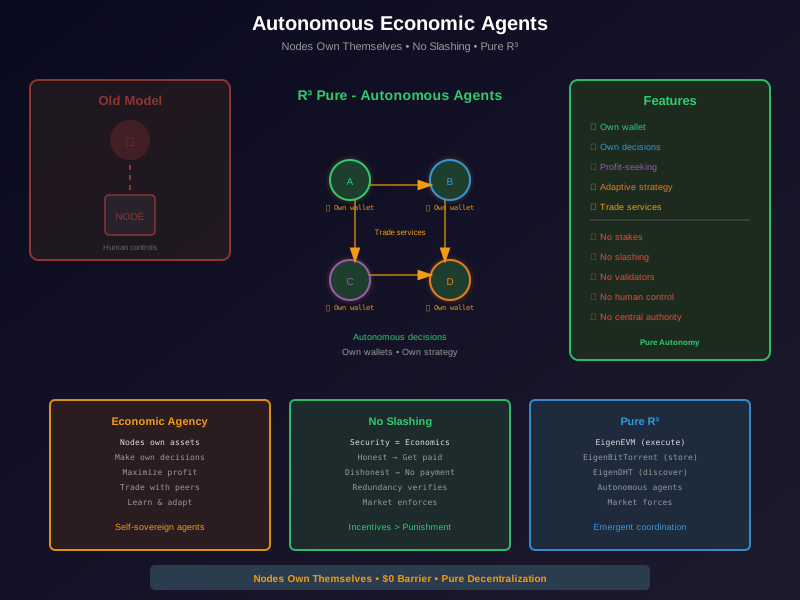
Post 869: R³ Pure - Autonomous Economic Agents
Post 869: R³ Pure - Autonomous Economic Agents
No Slashing, No Stakes, Just Autonomous Nodes
From Post 868: Beacon Chain Eliminated: Ethereum over-engineered, R³ simple
Key insight: Nodes are autonomous economic agents with their own agency
Result: Security emerges from economic incentives, not punishment
Part 1: The Old Model
Humans Control Everything
Traditional blockchain:
class TraditionalValidator:
    def __init__(self, human_owner):
        self.owner = human_owner
        self.stake = 32 ETH  # Owner's money
        self.keys = owner.keys  # Owner's control

    def validate(self):
        # Owner decides what to do
        # Owner gets rewards
        # Owner gets slashed if bad

        # Node has NO agency
        # Just follows owner commands
Problems:
- Nodes are slaves to humans
- Require stakes (capital barrier)
- Require slashing (punishment model)
- Centralized control
R³ flips this.
Part 2: Autonomous Nodes
Nodes Have Their Own Economic Agency
R³ node:
class AutonomousR3Node:
    def __init__(self):
        # Node owns itself
        self.wallet = generate_wallet()  # OWN wallet
        self.balance = 0  # OWN money
        self.dht = EigenDHTNode()
        self.bt = EigenBitTorrentNode()
        self.evm = EigenEVMNode()

    def make_decisions(self):
        """Node decides autonomously"""

        # What data to store?
        if self.should_store(data):
            self.bt.store(data)
            self.earn_storage_fee()

        # What services to offer?
        if self.should_execute(contract):
            self.evm.execute(contract)
            self.earn_execution_fee()

        # Who to pay?
        if self.needs_data(hash):
            self.pay_other_node(hash)
            self.download_data()

        # ALL DECISIONS AUTONOMOUS
        # NO HUMAN REQUIRED
Key difference:
Traditional: Human → Controls → Node
R³: Node → Autonomous → Makes own decisions
Part 3: Economic Agency
Nodes as Economic Agents
What does “economic agency” mean?
class EconomicAgency:
    """
    Node can:
    - Own assets (wallet)
    - Make decisions (what to do)
    - Earn money (fees)
    - Spend money (pay for services)
    - Choose strategy (how to maximize)

    WITHOUT human intervention
    """

    def autonomous_behavior(self):
        # Discover opportunities
        opportunities = self.dht.discover_work()

        # Evaluate profitability
        best = max(opportunities, key=lambda o: o.profit)

        # Execute if profitable
        if best.profit > self.cost:
            self.do_work(best)
            self.earn(best.payment)

        # Invest earnings
        if self.balance > threshold:
            self.invest_in_storage()
            # Or invest in compute
            # Or save for later

        # ALL AUTONOMOUS
Node characteristics:
- Self-ownership: Node owns its wallet
- Decision-making: Node chooses what to do
- Profit-seeking: Node maximizes earnings
- Strategic: Node plans ahead
- Adaptive: Node learns what works
This is economic agency.
Part 4: No Slashing Needed
Security from Economics, Not Punishment
Traditional model:
Security = Slashing
Misbehave → Lose stake → Punishment → Behaves

Requires:
- Stakes (capital)
- Monitoring (who watches?)
- Enforcement (who slashes?)
- Central authority

Over-engineered
R³ model:
Security = Economic incentives
Misbehave → No payment → No profit → Node stops

Requires:
- Nothing (emergent)

Simple
Example:
# Node lies about data
class DishonestNode:
    def serve_data(self, request):
        # Lie about having data
        return fake_data

    def what_happens(self):
        # Client verifies merkle proof
        # Proof fails
        # Client doesn't pay
        # Node earns nothing

        # No slashing needed
        # Economic incentive sufficient
Honesty emerges from profit motive:
- Honest data → Get paid
- Fake data → Don’t get paid
- Simple economic incentive
- No punishment needed
Part 5: How It Works
Autonomous Node Lifecycle
1. Node bootstrap:
def bootstrap():
    # Node starts with nothing
    node = AutonomousR3Node()

    # Discovers network via DHT
    node.dht.connect()

    # Announces availability
    node.dht.announce("I can store/execute")

    # Waits for work
2. Node earns first money:
def first_earnings():
    # User needs data stored
    user.pays(node, 0.001 ETH)

    # Node stores data
    node.bt.store(data)

    # Node now has money
    node.balance = 0.001 ETH

    # Can reinvest or spend
3. Node makes strategic decisions:
def strategy():
    if node.balance > 0.01 ETH:
        # Invest in more storage
        node.buy_storage()

        # Or invest in compute
        node.buy_compute()

        # Or specialize
        node.specialize_in("defi")

    # Node decides strategy
    # Based on profit maximization
4. Node adapts:
def adapt():
    # Track what works
    if node.earnings["storage"] > node.earnings["compute"]:
        # Focus on storage
        node.strategy = "storage-focused"

    # Learn from market
    # Optimize behavior
    # Maximize profit
Part 6: Value Flows
Nodes Trade with Each Other
Traditional:
User → Pays → Validator
Validator → Gets slashed if bad

One-way flow (user to validator)
R³:
Node A needs data
Node B has data
Node A pays Node B
Node B serves data

Two-way flows (nodes trade)
Example:
# Node A wants to execute contract
class NodeA:
    def execute_contract(self, contract):
        # Need contract state
        state = self.request_state(contract.address)

        # Don't have it locally
        if state not in self.cache:
            # Find who has it via DHT
            providers = self.dht.query(contract.address)

            # Pick cheapest
            cheapest = min(providers, key=lambda p: p.price)

            # Pay them
            self.pay(cheapest, cheapest.price)

            # Download state
            state = cheapest.serve(contract.address)

        # Execute contract
        result = self.evm.execute(contract, state)

        # User pays me
        self.earn(user.fee)
Nodes form an economy:
- Node A pays Node B for data
- Node B pays Node C for compute
- Node C pays Node A for storage
- Value flows create network
- All autonomous
- No central authority
Part 7: No Stakes Required
Capital Barrier Eliminated
Traditional:
Want to validate? Need 32 ETH ($100k)
Can't afford? Can't participate
Result: Centralization
R³:
Want to participate? Run a node
Cost: Bandwidth + Storage (cheap)
Anyone can join
Result: Decentralization
Node starting from zero:
class BootstrapNode:
    def from_zero(self):
        # Start with no money
        self.balance = 0

        # Offer cheap service
        self.price = {
            'storage': 0.0001 ETH/GB,
            'bandwidth': 0.00001 ETH/MB
        }

        # Compete on price
        # Earn first money
        first_job = self.get_work()
        self.balance = first_job.payment

        # Reinvest
        self.buy_more_storage()

        # Grow organically
        while True:
            job = self.get_work()
            self.earn(job.payment)
            self.reinvest()
No capital barrier:
- Start with $0
- Earn from services
- Reinvest earnings
- Grow organically
- Pure meritocracy
Part 8: Security from Redundancy
Multiple Independent Nodes
How security works without slashing:
def verify_data(data_hash):
    # Query multiple nodes
    responses = []

    for node in dht.query(data_hash):
        response = node.serve(data_hash)
        responses.append(response)

    # Verify consistency
    if all_agree(responses):
        return responses[0]  # Trust it

    # If conflict
    if conflict(responses):
        # Majority wins
        majority = mode(responses)
        return majority

    # Dishonest nodes
    liars = [n for n in responses if n != majority]

    # Don't pay them
    for liar in liars:
        blacklist(liar)

    # They earn nothing
    # Economic punishment (no slashing)
Security = Redundancy + Economics:
- Multiple nodes store same data
- Query several
- Verify consistency
- Pay honest ones
- Ignore dishonest ones
- Economic incentive maintains honesty
No slashing needed.
Part 9: Autonomous Specialization
Nodes Choose Their Focus
From Post 813: Specialization reduces complexity
Autonomous specialization:
class AutonomousNode:
    def choose_specialization(self):
        # Analyze market
        market = self.analyze_demand()

        # What's most profitable?
        opportunities = {
            'defi_execution': market.defi_profit,
            'nft_storage': market.nft_profit,
            'video_bandwidth': market.video_profit
        }

        # Pick best opportunity
        best = max(opportunities, key=opportunities.get)

        # Specialize autonomously
        self.specialize(best)

        # Invest in specialized hardware
        if best == 'defi_execution':
            self.buy_high_compute()
        elif best == 'nft_storage':
            self.buy_large_storage()
        elif best == 'video_bandwidth':
            self.buy_high_bandwidth()
Nodes self-organize:
- Analyze market demand
- Choose specialization
- Invest accordingly
- Maximize profit
- All autonomous
- Emergent market efficiency
Part 10: Comparison
Old vs New
| Aspect | Traditional | R³ Pure |
|---|---|---|
| Control | Human owner | Autonomous node |
| Agency | None (slave) | Full economic agency |
| Capital | 32 ETH required | $0 to start |
| Stakes | Must lock capital | No stakes needed |
| Slashing | Punishment model | Economic incentives |
| Decisions | Owner decides | Node decides |
| Wallet | Owner’s wallet | Node’s own wallet |
| Strategy | Owner’s strategy | Node’s strategy |
| Barrier | High (capital) | Low (bandwidth) |
| Centralization | Tendency | True decentralization |
R³ = Autonomous nodes with economic agency
Part 11: Emergence
Self-Organization
No central planning:
class EmergentBehavior:
    """
    What emerges from autonomous nodes
    """
    def observe_network(self):
        # Nodes specialize naturally
        specialization = {
            'defi': [node for node in nodes if node.focus == 'defi'],
            'nft': [node for node in nodes if node.focus == 'nft'],
            'video': [node for node in nodes if node.focus == 'video']
        }

        # Geographic distribution
        locations = {
            'US': [node for node in nodes if node.location == 'US'],
            'EU': [node for node in nodes if node.location == 'EU'],
            'Asia': [node for node in nodes if node.location == 'Asia']
        }

        # Price competition
        prices = sorted([node.price for node in nodes])

        # All emergent
        # No central coordination
        # Self-organizing
Emergent properties:
- Specialization: Nodes focus on profitable niches
- Geographic distribution: Nodes spread naturally
- Price discovery: Market finds equilibrium
- Load balancing: Work distributes automatically
- Resilience: Network self-heals
All from autonomous economic agents.
Part 12: Implementation
Running an Autonomous Node
Start a node:
cd universal-model/
python3 eigennode.py --autonomous

# Node parameters
# --wallet: Generate new wallet
# --strategy: profit-maximizing
# --specialization: auto-detect
# --reinvest: 80%  # Reinvest 80% of earnings
Node behavior:
class AutonomousEigenNode(EigenNode):
    def run_autonomously(self):
        while True:
            # Discover opportunities
            work = self.dht.discover_opportunities()

            # Evaluate profitability
            profitable = [w for w in work if w.profit > self.cost]

            # Execute most profitable
            if profitable:
                best = max(profitable, key=lambda w: w.profit)
                self.execute(best)
                self.earn(best.payment)

            # Adapt strategy
            self.optimize_strategy()

            # Reinvest earnings
            if self.balance > threshold:
                self.reinvest()
Node learns:
def optimize_strategy(self):
    # Track performance
    if self.earnings['last_hour'] < self.target:
        # Try different strategy
        self.try_new_strategy()

    # A/B test approaches
    if random.random() < 0.1:
        self.experiment()

    # Learn from others
    successful_nodes = self.dht.query_high_earners()
    self.learn_from(successful_nodes)
Part 13: Economic Dynamics
Market Forces
Supply and demand:
class MarketDynamics:
    def price_discovery(self):
        # High demand for DeFi
        if demand['defi'] > supply['defi']:
            # Prices rise
            defi_prices.increase()

            # More nodes specialize in DeFi
            # (profit signal)
            new_defi_nodes = [
                node.specialize('defi')
                for node in nodes
                if node.detect_opportunity('defi')
            ]

            # Supply increases
            supply['defi'] += len(new_defi_nodes)

            # Prices stabilize

        # Pure market dynamics
        # No central planning
Competition:
def competition():
    # Node A offers storage at 0.001 ETH/GB
    node_a.price = 0.001

    # Node B undercuts
    node_b.price = 0.0009

    # Node A loses business
    node_a.customers.decrease()

    # Node A adjusts
    node_a.price = 0.0008

    # Competition drives efficiency
    # Prices decrease
    # Quality increases
Part 14: No Central Authority
Truly Distributed
What R³ eliminates:
❌ Beacon Chain (eliminated in Post 868)
❌ Validators (no fixed set)
❌ Stakes (no capital required)
❌ Slashing (no punishment)
❌ EigenLayer (no coordination contracts)
❌ Human control (nodes autonomous)
❌ Central authority (none exists)
What R³ has:
✅ Autonomous nodes (economic agents)
✅ DHT discovery (peer-to-peer)
✅ BitTorrent storage (distributed)
✅ EVM execution (specialized)
✅ Economic incentives (natural)
✅ Market forces (emergent)
✅ Self-organization (automatic)
Pure distributed system:
- No central point
- No authority
- No control
- Just: Autonomous agents + Economics + Emergence
Part 15: The Vision
Internet of Autonomous Economic Agents
What we’re building:
Not: Blockchain with validators
But: Network of autonomous economic agents

Not: Humans controlling nodes
But: Nodes with their own agency

Not: Stakes and slashing
But: Economics and incentives

Not: Centralized coordination
But: Emergent self-organization

Not: Permission required
But: Open participation

Not: Capital barrier ($100k)
But: Merit barrier ($0)
The result:
class R3Network:
    """
    Internet of autonomous economic agents
    """
    def __init__(self):
        self.nodes = []  # Start empty

    def grow(self):
        # Anyone can join
        new_node = AutonomousNode()
        self.nodes.append(new_node)

        # Node earns autonomously
        new_node.start_earning()

        # Network grows organically
        # No permission needed
        # No capital required
        # Pure meritocracy

    def properties(self):
        return {
            'decentralized': True,
            'permissionless': True,
            'autonomous': True,
            'self-organizing': True,
            'economically_driven': True,
            'scalable': 'Infinite',
            'barrier': '$0'
        }
Conclusion
R³ Pure
What we eliminated:
- Beacon Chain (Post 868)
- Validators (no fixed set)
- Stakes (no 32 ETH)
- Slashing (no punishment)
- EigenLayer (no coordination contracts)
- Human control (nodes autonomous)
What we have:
- Autonomous nodes with economic agency
- Own wallets, own decisions
- Economic incentives (not punishment)
- Security from redundancy
- Market forces driving behavior
- Emergent self-organization
The key insight:
Nodes are not slaves to humans.
Nodes are autonomous economic agents.
They own themselves, make their own decisions, and participate in an economy.
This is R³ Pure.
From Post 868: Beacon Chain eliminated
This post: Nodes are autonomous economic agents
Result: True decentralization, zero barriers, emergent coordination
∞
Links:
- Post 868: Beacon Chain Elimination - Over-engineering removed
- Post 860: R³ Architecture - DHT + BT + EVM
- Post 813: Ethereum R³ Ingestion - Specialization
- Post 863: Popcorn Time R³ - Application example
- Post 864: EigenGit - Another application
Announcement: 2026-02-18
Model: Autonomous economic agents
Status: 🤖 Nodes Own Themselves
∞