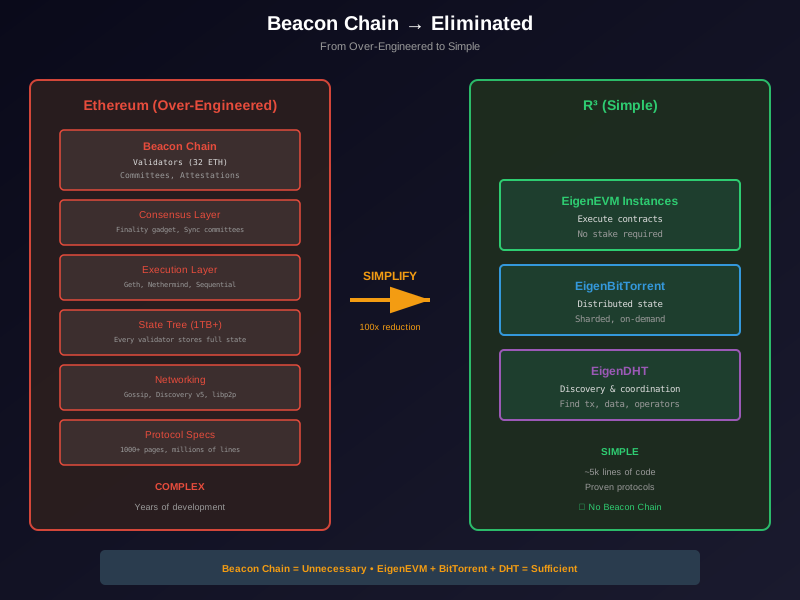
Post 868: Replacing Beacon Chain with EigenEVM
Post 868: Replacing Beacon Chain with EigenEVM
Ethereum is Over-Engineered - Here’s the Fix
From Post 813: Ethereum R³ Ingestion: EigenEVM ingests Ethereum
From Post 866: R³ Security: No fixed stakes needed
Key insight: Beacon Chain is unnecessary complexity - EigenEVM instances can do everything
Result: Simpler, more scalable, truly distributed execution
Part 1: The Problem with Ethereum
Over-Engineering at Every Layer
Current Ethereum stack:
Beacon Chain (Consensus Layer)
  → Validators with 32 ETH
  → Committee selection
  → Attestations
  → Finality gadget
  → Sync committees
  → Weak subjectivity
  ↓
Execution Layer
  → Geth, Nethermind, Besu
  → State tree (1TB+)
  → Sequential execution
  → Monolithic EVM
  ↓
Networking
  → Gossip protocol
  → Discovery v5
  → libp2p
Complexity:
- 2 separate layers
- Complex consensus
- Fixed validator set
- Rigid staking (32 ETH)
- Global finality requirements
- Coordination overhead
This is over-engineered.
Why?
Because Ethereum tried to:
- Keep Proof of Stake centralized
- Maintain global consensus
- Have single canonical state
- Force everyone to agree
R³ approach: Don’t do any of that.
Part 2: The R³ Vision
Just EigenEVM Instances
What you actually need:
EigenEVM Instances (Distributed)
  → Execute contracts
  → Store state in EigenBitTorrent
  → Coordinate via EigenDHT
  → That's it
No Beacon Chain. No consensus layer. No validators. No committees.
Just nodes executing and storing data.
Part 3: How It Works
Distributed Execution Without Beacon Chain
Traditional Ethereum:
# Beacon Chain decides block order
beacon_chain.propose_block(validator, slot)
beacon_chain.attest(committee, block)
beacon_chain.finalize(epoch)

# Execution layer follows
execution_layer.execute(beacon_block.transactions)
execution_layer.update_state(results)
R³ (No Beacon Chain):
# EigenEVM instances just execute
class EigenEVMInstance:
    def __init__(self, node_id):
        self.dht = EigenDHTNode(node_id)
        self.bt = EigenBitTorrentNode(node_id)
        self.evm = EVM()  # Standard EVM

    def execute_transaction(self, tx):
        # Get current state from BitTorrent
        state = self.bt.get_series('state')

        # Execute transaction
        result = self.evm.execute(tx, state)

        # Store new state in BitTorrent
        new_state = state.apply(result)
        self.bt.store_series('state', new_state)

        # Announce via DHT
        self.dht.announce('state_update', new_state.root)

        # Done. No consensus needed.
That’s it.
No committee. No attestations. No finality gadget.
Just: Execute → Store → Announce.
Part 4: State Storage
BitTorrent Replaces State Tree
Traditional Ethereum:
Every validator stores full state (1TB+)
  → Account balances
  → Contract storage
  → Code

Problem: Redundant, wasteful, doesn't scale
R³:
State stored in EigenBitTorrent
  → Sharded automatically
  → Replicated based on demand
  → Operators cache what they need
  → Users download what they query

Solution: Efficient, scalable, distributed
Example:
# Get account balance
def get_balance(address):
    # Query BitTorrent network
    state_chunk = eigenbittorrent.get(f'accounts/{address}')

    # Multiple instances seed this chunk
    # Download from fastest seeder
    # Verify with merkle proof

    return state_chunk.balance
No full state download needed.
Just get what you need, when you need it.
Part 5: Transaction Ordering
DHT Replaces Beacon Chain Consensus
Traditional Ethereum:
Beacon Chain:
  1. Select validator for slot
  2. Validator proposes block
  3. Committee attests
  4. Wait for finality (2 epochs = 12.8 minutes)

Complex, slow, over-engineered
R³:
EigenDHT:
  1. User broadcasts tx to DHT
  2. Operators discover tx
  3. Operators execute (parallel if no conflicts)
  4. Results stored in BitTorrent
  5. Finality = available in BitTorrent

Simple, fast, distributed
No need for global ordering if transactions don’t conflict.
Example:
# Alice sends to Bob
tx1 = {from: Alice, to: Bob, amount: 10}

# Carol sends to Dan
tx2 = {from: Carol, to: Dan, amount: 20}

# These don't conflict
# Can execute in parallel
# No global ordering needed

operator_1.execute(tx1)  # Parallel
operator_2.execute(tx2)  # Parallel

# Both store results
# Both available via BitTorrent
# Both final
Only conflict resolution needs ordering:
# Alice sends to Bob
tx1 = {from: Alice, to: Bob, amount: 10}

# Alice also sends to Carol
tx2 = {from: Alice, to: Carol, amount: 10}

# These conflict (same nonce/balance)
# Operators resolve via timestamp/DHT
# First seen = first executed
# Second rejected
Part 6: No Fixed Validators
Anyone Can Run EigenEVM
Traditional Ethereum:
Must stake 32 ETH to validate
Must run consensus + execution clients
Must be online 24/7
Must participate in committees

High barrier, centralized tendency
R³:
# Anyone can run EigenEVM instance
def start_eigenevm():
    instance = EigenEVMInstance('my_node')

    # No stake required
    # No validation duties
    # Just execute and serve

    while True:
        # Discover transactions via DHT
        txs = instance.dht.discover_transactions()

        # Execute if specialized
        for tx in txs:
            if instance.should_execute(tx):
                instance.execute_transaction(tx)

        # Earn fees from serving
        # No staking rewards
        # Pure service fees
Low barrier, true decentralization.
Part 7: Finality from Availability
No 2/3 Majority Needed
Traditional Ethereum:
Transaction is final when:
  → 2/3 of validators attest
  → Checkpoint reached
  → ~12-19 minutes

Global finality for everyone
R³:
Transaction is final when:
  → Available in EigenBitTorrent
  → Multiple operators seeding
  → YOU can download it
  → ~seconds

Personal finality (from Post 866)
Example:
def is_final(tx_hash, my_conditions):
    # Query BitTorrent for tx
    tx_data = eigenbittorrent.query(tx_hash)

    # Check MY conditions
    if len(tx_data.seeders) >= my_conditions.min_seeders:
        if tx_data.age >= my_conditions.min_age:
            return True  # Final for ME

    return False  # Not final for ME yet
Different users, different finality conditions.
No global consensus required.
Part 8: Specialization Replaces Committees
From Post 813
Traditional Ethereum:
Committee system:
  → Random selection
  → Must validate ALL transactions
  → Coordination overhead
  → Communication complexity

Over-engineered
R³:
Specialization:
  → Operators choose focus (DeFi, NFT, etc)
  → Execute specialized subset
  → Natural load balancing
  → Simple, efficient

Under-engineered (in good way)
Example:
class DeFiEigenEVM(EigenEVMInstance):
    def should_execute(self, tx):
        # Only execute DeFi transactions
        return tx.contract in DEFI_CONTRACTS

    def execute_transaction(self, tx):
        # Specialized execution
        # Optimized for DeFi
        # Better performance
        return super().execute_transaction(tx)
No random assignment. No coordination. Just: I execute what I specialize in.
Part 9: Comparison
Ethereum vs R³
| Aspect | Ethereum (Current) | R³ (EigenEVM) |
|---|---|---|
| Consensus Layer | Beacon Chain | None (eliminated) |
| Validators | Fixed set (32 ETH) | Anyone (0+ capital) |
| State Storage | Every validator (1TB+) | EigenBitTorrent (distributed) |
| Transaction Ordering | Beacon slots | DHT discovery |
| Finality | Global (12+ min) | Personal (seconds) |
| Execution | Sequential | Parallel (specialization) |
| Complexity | Very high | Very low |
| Barriers | High (capital) | Low (bandwidth) |
| Scalability | Limited (~30 TPS) | Unlimited (parallel) |
R³ is simpler and better.
Part 10: Migration Path
From Beacon Chain to EigenEVM
Phase 1: Ethereum Today
Beacon Chain + Execution Layer
Validators with 32 ETH
Global consensus
Phase 2: Hybrid (Post 813)
Beacon Chain (consensus)
+ EigenBitTorrent (state)
+ Specialized execution

Keep consensus, distribute state/execution
Phase 3: Consensus Optional
EigenEVM instances
+ EigenBitTorrent (state)
+ EigenDHT (discovery)
+ Optional Beacon Chain for bootstrap

Most work off-chain, minimal consensus
Phase 4: Pure R³
ONLY EigenEVM instances
ONLY EigenBitTorrent
ONLY EigenDHT

No Beacon Chain
No validators
No global consensus

Just distributed execution
Part 11: Technical Implementation
Eliminating Beacon Chain
What Beacon Chain does:
1. Block proposal
2. Attestations
3. Finality
4. Validator set management
5. Rewards/penalties
How EigenEVM replaces each:
1. Block proposal → DHT discovery
# No need for "blocks"
# Just transactions in DHT

def discover_transactions():
    # Query DHT for pending transactions
    return dht.query('pending_transactions')
2. Attestations → BitTorrent availability
# No need for attestations
# Availability = multiple seeders

def is_available(data):
    return len(bittorrent.get_seeders(data)) >= threshold
3. Finality → Personal conditions
# No global finality
# Each user decides

def is_final_for_me(tx):
    return my_conditions(tx)
4. Validator set → Open participation
# No validator set
# Anyone can run node

def join_network():
    start_eigenevm_instance()
    # No registration
    # No stake
    # Just run
5. Rewards → Service fees
# No staking rewards
# Direct service payments

def earn_fees():
    for request in incoming_requests:
        serve_data(request)
        receive_payment(request.fee)
Part 12: Why This is Better
Simplicity Wins
Ethereum’s complexity:
- Beacon Chain: ~100k lines of code
- Consensus specs: 1000+ pages
- Validator duties: Complex protocol
- Networking: Multiple layers
- State sync: Complicated
- Finality: Multiple mechanisms
Total: Millions of lines of code, years of complexity
R³’s simplicity:
- EigenEVM: Standard EVM (~1k lines wrapper)
- EigenBitTorrent: BitTorrent protocol (existing)
- EigenDHT: Kademlia DHT (existing)
- No consensus layer
- No validator protocol
- No finality gadget
Total: ~5k lines of new code, proven protocols
100x simpler.
Part 13: Addressing Concerns
“But Don’t You Need Consensus?”
Traditional thinking:
Blockchain needs consensus
Consensus needs validators
Validators need stakes
Stakes need slashing

Therefore: Beacon Chain necessary
R³ thinking:
Blockchain needs agreement
Agreement comes from availability
Availability comes from redundancy
Redundancy comes from incentives

Therefore: BitTorrent sufficient
You don’t need GLOBAL consensus.
You need ENOUGH redundancy that YOU can verify.
From Post 866: Personal finality, not global.
“But What About Double Spends?”
Traditional:
Beacon Chain prevents via global ordering
R³:
BitTorrent + timestamps prevent

If Alice tries to spend same coins twice:
  → First tx seen by DHT gets executed
  → Gets stored in BitTorrent
  → Second tx gets rejected (nonce conflict)
  → Other operators see first tx in BitTorrent
  → Consensus emerges from availability
No Beacon Chain needed.
“But What About Attacks?”
Traditional:
Beacon Chain protects via slashing
Need 51% stake to attack
Economic security
R³:
BitTorrent protects via redundancy
Need to corrupt ALL copies to attack
Physical distribution
+ Optional economic layer if needed
Different security model. Not worse, just different.
Part 14: The Vision
Ethereum Without the Over-Engineering
What Ethereum should be:
1. EVM (the good part)
   → Smart contracts
   → Turing complete
   → Composable

2. Distributed state (EigenBitTorrent)
   → Sharded automatically
   → Replicated on demand
   → Efficient

3. Discovery (EigenDHT)
   → Find transactions
   → Find data
   → Find operators

4. Execution (EigenEVM instances)
   → Anyone can run
   → Specialize freely
   → Earn from service

That's it.
What Ethereum is instead:
1. EVM ✓
2. Beacon Chain (unnecessary)
3. Validators (unnecessary)
4. Committees (unnecessary)
5. Attestations (unnecessary)
6. Finality gadget (unnecessary)
7. Sync committees (unnecessary)
8. Weak subjectivity (unnecessary)
9. ...

Complexity for complexity's sake
R³ = Ethereum without the cruft.
Part 15: Practical Steps
Building It Today
Step 1: Run EigenEVM instance
cd universal-model/
python3 eigenevm.py my_node 7001 5001

# No stake required
# No Beacon Chain connection
# Just run
Step 2: Connect to DHT
# Discover transactions
txs = dht.query('pending_transactions')

# Execute them
for tx in txs:
    if should_execute(tx):
        execute(tx)
Step 3: Store in BitTorrent
# Store results
result = execute(tx)
bittorrent.store(tx.hash, result)

# Now available to everyone
# No Beacon Chain needed
Step 4: Earn fees
# Serve data to users
for request in requests:
    data = bittorrent.get(request.hash)
    send(data)
    receive_payment(request.fee)
That’s it.
No Beacon Chain. No validators. No over-engineering.
Conclusion
Ethereum is Over-Engineered
The problem:
Ethereum tried to:
  1. Maintain centralized consensus
  2. Force global agreement
  3. Have single canonical state
  4. Control validator participation

Result: Beacon Chain complexity
The solution:
R³ realizes:
  1. Consensus can be distributed
  2. Agreement can be personal
  3. State can be sharded
  4. Anyone can participate

Result: Just EigenEVM + BitTorrent + DHT
From over-engineered to simple:
Before (Ethereum):
  Beacon Chain
  + Consensus layer
  + Validator protocol
  + Committee selection
  + Attestations
  + Finality gadget
  + Execution layer
  + State tree
  = Millions of lines of code

After (R³):
  EigenEVM instances
  + EigenBitTorrent
  + EigenDHT
  = ~5k lines of code

100x simpler
Infinitely scalable
Truly decentralized
The insight:
Beacon Chain isn’t necessary.
It’s an artifact of trying to maintain centralized control in a decentralized system.
EigenEVM + BitTorrent + DHT is all you need.
From Post 813: Ethereum ingests into R³
From Post 866: Security without stakes
From Post 867: How EigenLayer works (optional)
This post: Eliminate Beacon Chain entirely
The path forward:
Ethereum today → Hybrid with R³ → Pure R³
Beacon Chain → Optional → Eliminated
Complex → Simpler → Simple

This is the evolution.
This is Ethereum R³.
This is the future.
∞
Links:
- Post 813: Ethereum R³ Ingestion - How Ethereum evolves to R³
- Post 860: R³ Architecture - DHT + BT + EVM
- Post 866: R³ Security - Security without stakes
- Post 867: EigenLayer - Smart contract integration (optional)
Announcement: 2026-02-18
Vision: Replace Beacon Chain with EigenEVM
Status: 🚀 Simplification in Progress
∞