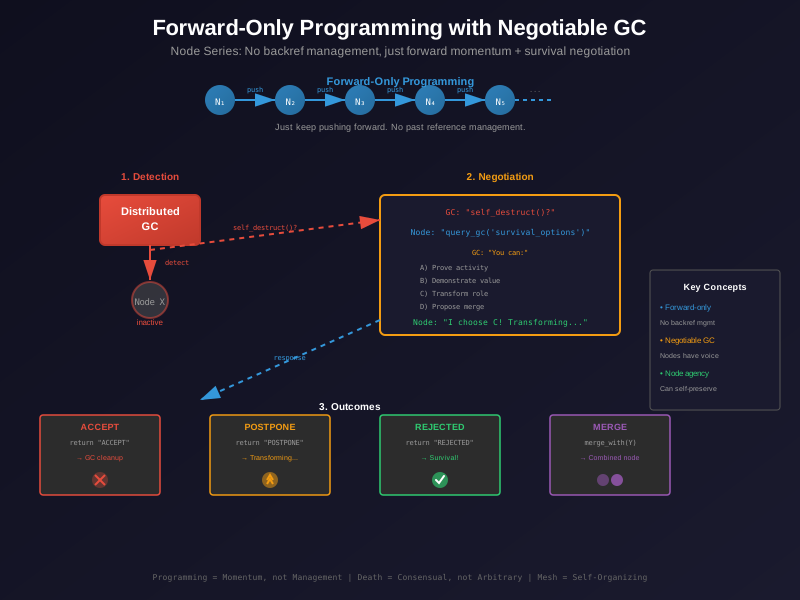
Node Series Programming: Forward-Only with Negotiable GC
Programming paradigm shift: Node series enable forward-only programming where inactive nodes can negotiate with a distributed garbage collector for survival. No past reference management. Only keeping the mesh alive.
Part 1: Forward-Only Programming
Traditional programming:
- Manage references to past states
- Track object lifecycles manually
- Complex memory management
- Defensive programming everywhere
Node series programming:
- Only think forward: “What’s next?”
- No past reference editing needed
- Focus on keeping mesh alive
- Series continuity is natural flow
Mental model:
Traditional: obj.past ← manage → obj.present ← manage → obj.future
Node series: node → next_node → next_node → ... (just push forward)
Key insight: You don’t “manage” nodes. You just keep creating forward momentum. The mesh takes care of itself.
Part 2: Distributed Garbage Collector
Role:
- Monitors node activity across mesh
- Detects inactive/unused nodes
- Initiates cleanup conversations
- Respects node agency
Detection criteria:
class DistributedGC:
    def detect_inactive(self, node):
        return (
            node.last_activity > THRESHOLD and
            node.incoming_refs == 0 and
            node.outgoing_activity == 0 and
            not node.is_essential()
        )
Not a dictator: The GC doesn’t just delete. It negotiates. It’s a distributed conversation, not a centralized decree.
Part 3: Negotiation Protocol
Flow:
1. GC Detection:
gc.detect_inactive(node_x)
# Node X hasn't been active in 24 hours
# No incoming references
# No outgoing activity
2. GC Initiates:
gc.call(node_x, "self_destruct")
# "Hey Node X, you seem inactive. Time to go?"
3. Node Response Options:
Option A - Accept:
node_x.self_destruct():
    return "ACCEPT"
    # "Yeah, I'm done. Clean me up."
Option B - Negotiate:
node_x.self_destruct():
    response = node_x.query_gc("how_can_i_save_myself?")
    # "Wait! What do I need to do to stay?"

    if node_x.can_meet_requirements(response):
        node_x.execute_survival_strategy()
        return "POSTPONE"
    else:
        return "ACCEPT"
Option C - Prove Utility:
node_x.self_destruct():
    proof = node_x.generate_utility_proof()
    # "Actually, I'm doing X Y Z that matters!"

    if gc.validate_proof(proof):
        return "REJECTED"  # Reject self-destruct
    else:
        return "ACCEPT"
Part 4: Survival Strategies
Nodes can save themselves by:
Strategy 1: Prove Activity
def prove_activity(self):
    return {
        "recent_computations": self.last_24h_work,
        "pending_requests": self.queue_size,
        "active_connections": len(self.peers)
    }
Strategy 2: Demonstrate Value
def demonstrate_value(self):
    return {
        "unique_data": self.irreplaceable_state,
        "critical_role": self.mesh_position,
        "future_potential": self.scheduled_work
    }
Strategy 3: Request Transformation
def request_transformation(self):
    # "I can't do my old job, but I can do this:"
    return self.propose_new_role()
Strategy 4: Merge with Others
def propose_merge(self):
    # "Don't delete me, merge me with Node Y"
    return {
        "merge_target": self.find_compatible_node(),
        "combined_value": self.calculate_synergy()
    }
Part 5: GC Decision Making
GC evaluates responses:
class DistributedGC:
    def evaluate_survival_request(self, node, request):
        score = 0

        # Utility score
        if request.proves_activity():
            score += 50

        # Value score
        if request.demonstrates_uniqueness():
            score += 30

        # Transformation potential
        if request.proposes_valid_transformation():
            score += 40

        # Mesh impact
        if request.shows_network_importance():
            score += 60

        # Resource cost
        score -= request.resource_consumption() * 10

        return score > SURVIVAL_THRESHOLD
Key principle: GC isn’t trying to kill nodes. It’s trying to optimize the mesh. If a node can prove it contributes to mesh health, it survives.
Part 6: Agency in Action
Example conversation:
GC: "Node 0x4F3A, you're inactive. self_destruct()?"

Node: "Wait! Let me check... query_gc('survival_options')"

GC: "You need either:
     A) Process 10+ requests/day
     B) Hold unique state
     C) Transform to archival node"

Node: "I can do C! I'll become archival storage for series X."

GC: "Prove you have relevant historical data."

Node: "Here's my state: [series X from block 1000-2000]"

GC: "Validated. Transform approved. Survival granted."

Node: "Thanks! Transforming to ArchivalNode..."
Result:
- Node survives by adapting
- Mesh gains archival capability
- No arbitrary destruction
- Distributed negotiation works
Part 7: Benefits of This Model
For programmers:
- Simplicity: Just push forward, no backref management
- Clarity: Node lifecycle is transparent
- Safety: GC handles cleanup automatically
- Flexibility: Nodes can adapt vs die
For nodes:
- Agency: Can negotiate survival
- Autonomy: Decide own fate
- Evolution: Can transform roles
- Dignity: Death by choice, not decree
For the mesh:
- Efficiency: Dead nodes cleaned up
- Adaptability: Nodes transform as needed
- Resilience: Critical nodes self-preserve
- Intelligence: System optimizes itself
Part 8: Implementation Example
Complete flow:
# Node implementation
class SeriesNode:
    def self_destruct(self):
        """Called by GC when node appears inactive"""

        # First, assess situation
        if self.is_actually_active():
            return "REJECTED", self.prove_activity()

        # Ask GC what's needed
        options = self.query_gc("survival_options")

        # Try each option
        for option in options:
            if option.type == "PROVE_VALUE":
                proof = self.generate_value_proof()
                if self.gc_validate(proof):
                    return "REJECTED", proof

            elif option.type == "TRANSFORM":
                if self.can_transform(option.target_type):
                    self.transform(option.target_type)
                    return "POSTPONE", "transforming"

            elif option.type == "MERGE":
                target = self.find_merge_candidate()
                if target:
                    return "POSTPONE", f"merging_with_{target}"

        # If nothing works, accept fate
        return "ACCEPT", "goodbye"

# GC implementation
class DistributedGC:
    def run_cycle(self):
        inactive = self.detect_inactive_nodes()

        for node in inactive:
            response, data = node.self_destruct()

            if response == "ACCEPT":
                self.cleanup(node)

            elif response == "REJECTED":
                if self.validate_rejection(data):
                    self.mark_active(node)
                else:
                    self.cleanup(node)

            elif response == "POSTPONE":
                self.schedule_recheck(node, delay=3600)
Part 9: Comparison with Traditional GC
Traditional GC (Go, Java, Python):
Stop-the-world → Mark reachable → Sweep unreachable → Resume
Problems:
- Centralized decision
- No object agency
- Pauses execution
- Binary: keep or delete
- No negotiation
Node Series GC:
Continuous monitoring → Detect inactive → Negotiate → Adapt or cleanup
Advantages:
- Distributed operation
- Node agency respected
- No global pauses
- Spectrum: transform, merge, or delete
- Conversational protocol
Comparison table:
| Aspect | Traditional GC | Node Series GC |
|---|---|---|
| Decision making | Centralized | Distributed |
| Object agency | None | Full |
| Execution impact | Pauses | Continuous |
| Outcome | Binary (keep/delete) | Adaptive (transform/merge/delete) |
| Protocol | Mark-and-sweep | Negotiate-and-adapt |
| Intelligence | Rule-based | Conversational |
| Mesh awareness | No | Yes |
| Node evolution | No | Yes |
Part 10: Philosophy
“Forward-only programming” means:
You’re not managing the past. You’re creating the future. Each node just thinks: “What’s my next contribution?” The mesh handles the rest.
“Negotiable GC” means:
Death isn’t arbitrary. It’s consensual. A node can prove its worth, transform its role, or accept its end with dignity. The GC is a helper, not an executioner.
“Agency in distribution” means:
Every node has a voice. The mesh evolves through millions of tiny negotiations. No central authority decides who lives or dies. The system self-organizes through conversation.
Result:
Programming becomes about momentum, not management. About creation, not control. About forward flow, not backward maintenance.
This is the node series way.
Links
- R³ Architecture (neg-860) - Base architecture
- R³ Validator (neg-861) - Distributed validation
- Liberty Model (neg-854) - Rate limiters
- Sapiens Nodes (neg-856) - Node identity
Forward-only. Negotiable. Alive.