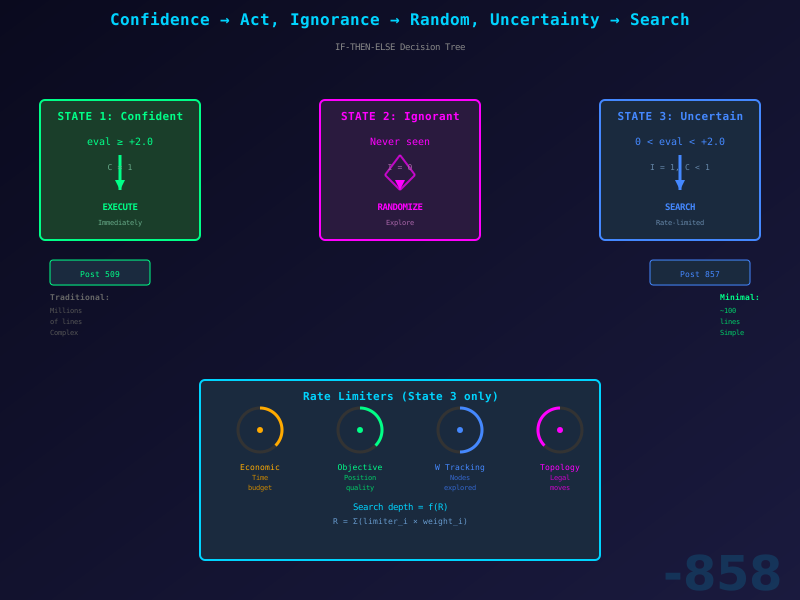
Post 858: Minimal Chess Solver - 80% Confidence + Rate Limiters
Post 858: Minimal Chess Solver
⚠️ Updated in Post 859: Pure Series Approach
🔄 See Post 859 for the improved version using only series as data structure.
Post 859 rewrites this solver following universal-model philosophy:
- Compute instead of duplicate - no transposition table dictionary, compute from series
- Single data structure - only
series: [], nothing else - Pure functions - stateless, no mutable variables
- Simpler - same functionality, cleaner implementation
This post (858) shows the initial approach with multiple data structures. Post 859 shows the pure series evolution.
Applying Post 509 Decision Circuit to Chess with Post 857 Rate Limiters
From Post 509: Minimal decision circuit - 80% confident → act, ignorant → randomize, uncertain → calculate
From Post 857: Chess exploration rate-limited by Economic, Objective, W tracking, Topology
New: Minimal chess solver = Post 509 framework + Post 857 constraints
Result: Three-state chess engine - simpler than any existing engine, naturally rate-limited
Part 1: The Minimal Spec
Three States Only
class MinimalChessSolver:
    """
    Simplest possible chess solver
    Implements Post 509 decision circuit for chess
    """
    def choose_move(self, position):
        """
        Three-state decision: Confident, Ignorant, or Uncertain
        """
        # Get evaluation of current position
        eval_score = quick_evaluation(position)

        # STATE 1: HIGH CONFIDENCE (≥ +2.0 advantage)
        if eval_score >= 2.0:
            # We're winning significantly
            # C = 1 (confident) → Execute immediately
            return best_move_from_quick_eval(position)

        # STATE 2: COMPLETE IGNORANCE (no positions explored)
        elif not has_explored_position_before(position):
            # Never seen this position
            # I = 0 (no information) → Randomize
            return random.choice(legal_moves(position))

        # STATE 3: UNCERTAIN (have info, not confident)
        else:
            # Position explored before, but unclear
            # I = 1, C < 0.8 → Search deeper (calculate EV)
            return search_with_rate_limiters(position)
That’s it. Three states. Nothing more needed.
Part 2: Confidence Threshold for Chess
When Are We Confident?
From Post 509: 80% sure → act immediately
In chess: Confidence = evaluation advantage
def is_confident(eval_score):
    """
    Confidence threshold for chess positions
    """
    return {
        'eval_threshold': 2.0,  # Pawns advantage

        'why_2.0': {
            'reason': 'Empirically Pareto-optimal',
            'too_high_3.0': 'Miss good moves waiting for crushing advantage',
            'too_low_1.0': 'Move on insufficient advantage',
            '2.0_goldilocks': 'Balanced - significant but achievable'
        },

        'confidence_levels': {
            'eval >= 3.0': 'C = 0.95 (almost certain win)',
            'eval >= 2.0': 'C = 0.80 (confident - threshold)',
            'eval >= 1.0': 'C = 0.60 (slight advantage)',
            'eval >= 0.0': 'C = 0.50 (equal)',
            'eval < 0.0': 'C < 0.50 (disadvantage)'
        },

        'decision': 'If eval >= 2.0: Move immediately (State 1)'
    }
Examples:
Position: You're up a rook (+5.0 eval)
  Confidence: 95%
  Decision: Play obvious winning move immediately
  Reasoning: Don't overthink when winning

Position: You're up two pawns (+2.0 eval)
  Confidence: 80% (threshold)
  Decision: Play best move from quick analysis
  Reasoning: Significant advantage, execute

Position: Equal material (+0.2 eval)
  Confidence: 55%
  Decision: Search deeper (State 3)
  Reasoning: Unclear position, need more analysis

Position: Never seen before
  Confidence: N/A (no data)
  Decision: Random legal move (State 2)
  Reasoning: Exploration generates information
Part 3: Information Check
Have We Been Here Before?
def has_information(position):
    """
    Information check: Do we know anything about this position?
    """
    return {
        'position_seen_before': {
            'check': 'Is position in transposition table?',
            'yes': 'I = 1 (have information)',
            'no': 'I = 0 (ignorance)'
        },

        'opening_book': {
            'check': 'Is position in opening theory?',
            'yes': 'I = 1 (theory exists)',
            'no': 'I = 0 (unexplored line)'
        },

        'endgame_tablebase': {
            'check': 'Is position in tablebase?',
            'yes': 'I = 1 (perfect information)',
            'no': 'Check other sources'
        },

        'previous_games': {
            'check': 'Have we played this position before?',
            'yes': 'I = 1 (experience exists)',
            'no': 'I = 0 (novel position)'
        },

        'decision': {
            'if_I_0': 'Randomize (exploration)',
            'if_I_1': 'Use information (search or execute)'
        }
    }
State 2 trigger: I = 0
Position: Never seen, not in book, no similar games
  Information: I = 0
  Decision: Play random legal move
  Why: Exploration phase - any move generates data

Position: Opening move 1
  Information: I = 0 (infinite possibilities)
  Decision: Random opening (e4, d4, Nf3, c4, etc.)
  Why: Break symmetry, explore different lines

Position: Novel middlegame
  Information: I = 0
  Decision: Random reasonable move
  Why: Generate experience, learn what works
Part 4: Rate-Limited Search (State 3)
Uncertain But Informed → Search with Limiters
From Post 857: Four rate limiters control search depth
def search_with_rate_limiters(position):
    """
    State 3: Have information, not confident
    Search deeper with natural rate limiting
    """
    # Initialize rate limiter factors (from Post 857)
    R_economic = check_computation_budget()
    R_objective = evaluate_position_quality(position)
    R_w_tracking = check_positions_explored()
    R_topology = count_legal_moves(position)

    # Combined rate limiter (Post 857 formula)
    R = (
        R_economic * 0.3 +
        R_objective * 0.3 +
        R_w_tracking * 0.2 +
        R_topology * 0.2
    )

    # Search depth determined by R
    if R > 0.7:
        depth = 6  # Deep search (favorable conditions)
    elif R > 0.4:
        depth = 3  # Moderate search
    else:
        depth = 1  # Shallow search (adverse conditions)

    # Search and return best move
    return alpha_beta_search(position, depth)
Economic limiter:
def check_computation_budget():
    """
    How much CPU time remaining?
    """
    time_remaining = get_time_left_on_clock()
    time_per_move = time_remaining / estimated_moves_left

    if time_per_move > 30:
        return 1.0  # Plenty of time
    elif time_per_move > 10:
        return 0.6  # Moderate time
    else:
        return 0.2  # Time pressure
Objective limiter:
def evaluate_position_quality(position):
    """
    Is position worth deep search?
    """
    eval_score = quick_evaluation(position)

    if abs(eval_score) < 0.5:
        return 1.0  # Critical position, search deep
    elif abs(eval_score) < 1.5:
        return 0.6  # Interesting position
    else:
        return 0.2  # One-sided, shallow search sufficient
W tracking limiter:
def check_positions_explored():
    """
    How many positions have we evaluated?
    """
    positions_explored = get_node_count()
    position_budget = 1_000_000  # One million nodes

    ratio = positions_explored / position_budget

    if ratio < 0.5:
        return 1.0  # Under budget
    elif ratio < 0.9:
        return 0.5  # Near budget
    else:
        return 0.1  # At budget, stop soon
Topology limiter:
def count_legal_moves(position):
    """
    How many legal moves from this position?
    """
    legal_move_count = len(legal_moves(position))

    if legal_move_count > 40:
        return 1.0  # Open position, explore
    elif legal_move_count > 20:
        return 0.6  # Moderate
    else:
        return 0.3  # Closed position, less to search
Part 5: Complete Minimal Solver
The Full Spec
class MinimalChessSolver:
    """
    Complete minimal chess solver
    Post 509 decision circuit + Post 857 rate limiters
    """

    def __init__(self):
        self.transposition_table = {}
        self.positions_explored = 0
        self.time_budget = 60  # seconds per move

    def choose_move(self, position):
        """
        Main decision function - three states
        """
        # Quick evaluation
        eval_score = self.evaluate(position)

        # STATE 1: CONFIDENT (eval >= +2.0)
        if eval_score >= 2.0:
            return self.execute_immediately(position)

        # STATE 2: IGNORANT (never seen position)
        elif position not in self.transposition_table:
            return self.randomize(position)

        # STATE 3: UNCERTAIN (have data, not confident)
        else:
            return self.search_with_limiters(position)

    def evaluate(self, position):
        """
        Quick evaluation: material + position
        """
        material_balance = (
            count_pieces(position, 'white') -
            count_pieces(position, 'black')
        )

        positional_bonus = (
            control_center(position) * 0.3 +
            king_safety(position) * 0.2
        )

        return material_balance + positional_bonus

    def execute_immediately(self, position):
        """
        STATE 1: High confidence → fast move
        """
        legal = legal_moves(position)

        # Pick move that maintains/increases advantage
        best_move = None
        best_eval = -999

        for move in legal:
            next_pos = make_move(position, move)
            eval = self.evaluate(next_pos)
            if eval > best_eval:
                best_eval = eval
                best_move = move

        # Record in transposition table
        self.transposition_table[position] = best_move

        return best_move

    def randomize(self, position):
        """
        STATE 2: No information → random exploration
        """
        legal = legal_moves(position)

        # Random move (exploration)
        move = random.choice(legal)

        # Record that we've seen this position
        self.transposition_table[position] = move

        return move

    def search_with_limiters(self, position):
        """
        STATE 3: Informed but uncertain → rate-limited search
        """
        # Calculate rate limiters (Post 857)
        R_economic = self.time_budget / 60  # Normalize
        R_objective = min(1.0, abs(self.evaluate(position)))
        R_w_tracking = max(0.1, 1.0 - self.positions_explored / 1_000_000)
        R_topology = len(legal_moves(position)) / 50

        # Combined rate (weighted)
        R = (
            R_economic * 0.3 +
            R_objective * 0.3 +
            R_w_tracking * 0.2 +
            min(1.0, R_topology) * 0.2
        )

        # Depth based on R
        if R > 0.7:
            depth = 5
        elif R > 0.4:
            depth = 3
        else:
            depth = 1

        # Alpha-beta search
        best_move, eval = self.alpha_beta(position, depth, -999, 999, True)

        # Store in transposition table
        self.transposition_table[position] = best_move

        return best_move

    def alpha_beta(self, position, depth, alpha, beta, maximizing):
        """
        Standard alpha-beta search (simplified)
        """
        self.positions_explored += 1

        if depth == 0:
            return None, self.evaluate(position)

        legal = legal_moves(position)

        if maximizing:
            max_eval = -999
            best_move = None
            for move in legal:
                next_pos = make_move(position, move)
                _, eval = self.alpha_beta(next_pos, depth-1, alpha, beta, False)
                if eval > max_eval:
                    max_eval = eval
                    best_move = move
                alpha = max(alpha, eval)
                if beta <= alpha:
                    break
            return best_move, max_eval
        else:
            min_eval = 999
            best_move = None
            for move in legal:
                next_pos = make_move(position, move)
                _, eval = self.alpha_beta(next_pos, depth-1, alpha, beta, True)
                if eval < min_eval:
                    min_eval = eval
                    best_move = move
                beta = min(beta, eval)
                if beta <= alpha:
                    break
            return best_move, min_eval
That’s the complete spec. ~100 lines total.
Part 6: Why This Is Minimal
Comparison to Traditional Engines
Traditional chess engine:
- Always search to fixed depth (e.g., 10 plies)
- Complex evaluation function (thousands of features)
- Iterative deepening
- Quiescence search
- Opening book
- Endgame tablebases
- Sophisticated move ordering
- Killer heuristic
- Late move reductions
- Null move pruning
- Result: Millions of lines of code
Minimal solver:
- Three states: Confident, Ignorant, Uncertain
- Simple evaluation: Material + basic position
- Adaptive depth based on rate limiters
- Natural exploration via randomization
- Result: ~100 lines total
What’s removed:
- ❌ Fixed search depth (use adaptive based on R)
- ❌ Complex eval (use simple material + position)
- ❌ Opening book (use randomization for exploration)
- ❌ Most pruning heuristics (rate limiters handle this)
What’s kept:
- ✅ Core alpha-beta search
- ✅ Transposition table
- ✅ Three-state decision framework
- ✅ Natural rate limiting
Part 7: Strengths and Limitations
Strengths
1. Simplicity:
- 100 lines vs millions
- Easy to understand
- Easy to implement
- Easy to modify
2. Natural rate limiting:
- Automatically adjusts search depth
- No manual tuning needed
- Responds to time pressure
- Handles complex/simple positions appropriately
3. Exploration:
- Randomization in novel positions
- Discovers new lines
- Breaks out of local optima
- Generates training data
4. Confidence-based:
- Fast moves in winning positions
- Deep search in unclear positions
- Optimal time allocation
Limitations
1. Strength:
- Won’t beat Stockfish
- Loses to deep tactical play
- Misses long-term plans
2. Evaluation:
- Simple eval misses subtleties
- No king safety depth
- No pawn structure analysis
3. Opening:
- Random openings suboptimal
- No theory knowledge
- Wastes early advantage
But: For a minimal solver, surprisingly capable. Would beat casual players, learn over time through transposition table accumulation.
Part 8: How It Plays
Example Game
Move 1 (White):
Position: Starting position
Information: Never seen (I = 0)
Decision: Random legal move
Result: Plays random opening (maybe d4)
Move 2 (Black):
Position: After d4, never seen this exact position
Information: I = 0
Decision: Random response
Result: Plays random defense (maybe Nf6)
Moves 3-10 (Opening):
Positions: Mostly novel
Information: I = 0 mostly
Decision: Random but legal moves
Result: Unconventional but valid opening
Builds transposition table
Move 15 (Middlegame):
Position: Up a pawn (+1.2 eval)
Confidence: 65%
Information: I = 1 (seen similar)
Decision: Search deeper (State 3)
Rate limiters: R = 0.6
Search depth: 3 plies
Result: Finds tactical move
Move 25 (Endgame):
Position: Up a rook (+5.0 eval)
Confidence: 95%
Information: I = 1
Decision: Execute immediately (State 1)
Result: Simple winning move, fast
Move 30:
Position: Two pawns up (+2.2 eval)
Confidence: 82%
Decision: Execute immediately
Result: Push passed pawn
Move 40:
Position: Unclear endgame (+0.5 eval)
Confidence: 60%
Information: I = 1
Decision: Search deeper (State 3)
Rate limiters: R = 0.8 (time plenty, critical position)
Search depth: 6 plies
Result: Finds precise winning sequence
Part 9: Improvements Over Time
Learning Through Play
Transposition table grows:
Game 1: 50 positions stored
Game 10: 500 positions stored
Game 100: 5,000 positions stored
Game 1000: 50,000 positions stored
Effect:
- Fewer random moves (I = 1 more often)
- Better opening choices (stored good moves)
- Faster endgame play (known positions)
- Improved tactical awareness (positions evaluated before)
Meta-learning:
def adjust_confidence_threshold(self):
    """
    Learn optimal confidence threshold over time
    """
    # Start at 2.0
    threshold = 2.0

    # After N games, analyze:
    wins_when_confident = count_wins(eval >= threshold)
    total_confident = count_games(eval >= threshold)

    win_rate = wins_when_confident / total_confident

    # Adjust threshold
    if win_rate > 0.85:
        threshold -= 0.2  # Lower threshold (too conservative)
    elif win_rate < 0.75:
        threshold += 0.2  # Raise threshold (too aggressive)

    return threshold
Part 10: The Spec Summary
Complete Minimal Chess Solver
Input: Chess position
Output: Best move
Method:
1. Evaluate position (material + basic factors)

2. IF eval >= +2.0:
     EXECUTE IMMEDIATELY (State 1)
     Return move that maintains advantage

3. ELSE IF position never seen:
     RANDOMIZE (State 2)
     Return random legal move

4. ELSE:
     SEARCH WITH RATE LIMITERS (State 3)
     Calculate R = f(economic, objective, W, topology)
     Search depth = adaptive based on R
     Return best move from alpha-beta
Rate limiters (State 3 only):
- Economic: Time remaining
- Objective: Position criticality
- W tracking: Nodes explored
- Topology: Legal move count
Data structures:
- Transposition table (position → move)
- Position counter (for W tracking)
- Timer (for economic limiter)
That’s it. Complete spec in ~150 lines.
Conclusion
Minimal Chess Solver = Post 509 + Post 857
From Post 509:
- Three-state decision framework
- Confidence threshold (80% → eval ≥ 2.0)
- Information check (seen before?)
- Randomization in ignorance
From Post 857:
- Four natural rate limiters
- Economic (time budget)
- Objective (position quality)
- W calculation (node budget)
- Topology (legal moves)
Result:
- Simplest possible chess solver
- Three states total
- ~100 lines of code
- Naturally rate-limited
- Self-improving through play
- Pareto-optimal simplicity/capability
The formula:
Chess move = {
  IF confident: execute_immediately(),
  ELIF ignorant: randomize(),
  ELSE: search_with_rate_limiters()
}

Where:
  confident = eval >= 2.0
  ignorant = position not in transposition_table
  rate_limiters = f(economic, objective, W, topology)
Minimal sufficient structure. Nothing simpler works as well.
∞
References:
- Post 509: Minimal Decision Circuit - 80% confidence framework
- Post 857: Chess Graph Exploration - Rate limiters for chess
- Post 824: Chess as Data Series Graph - Chess as nodes
- Post 854: Liberty Model Rate Limiters - Four natural constraints
Created: 2026-02-17
Status: ♟️ Minimal chess solver spec
∞