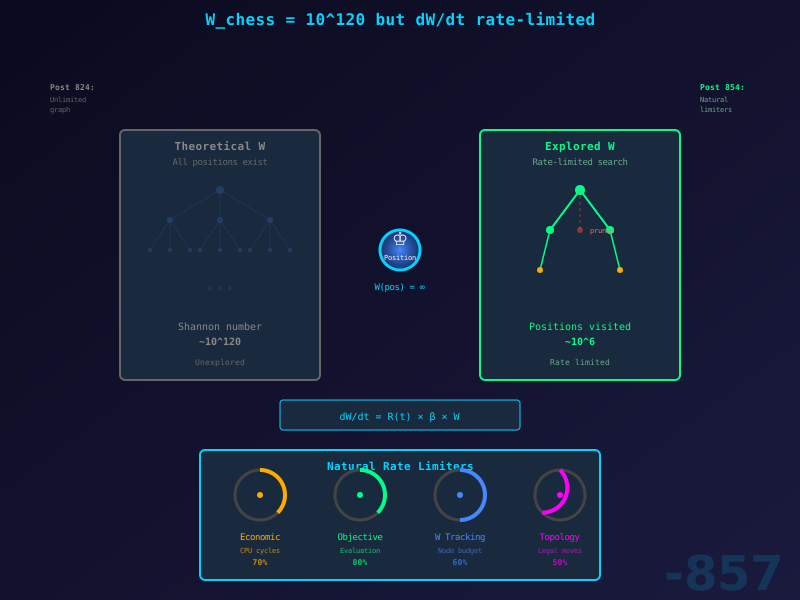
Post 857: Chess Graph Exploration - Natural Rate Limiters
Post 857: Chess Graph Exploration - Natural Rate Limiters
Evolving Post 824 with Post 854 Insights
From Post 824: Chess as unlimited additive graph expansion
From Post 854: Four natural rate limiters control exploration
New insight: Chess graph has W = ∞ (positions exist), but exploration is rate-limited
Same four mechanisms: Economic, Objective, W calculation, Topology
Breakthrough: In chess as in liberty - W infinite, dW/dt constrained
Part 1: The Chess Graph Space
W_chess = Shannon Number ≈ 10^120
class ChessConfigurationSpace:
    """
    Chess positions form infinite (practically) configuration space
    """
    def total_space(self):
        return {
            'theoretical': {
                'shannon_number': '~10^120',
                'description': 'Possible chess games',
                'unique_positions': '~10^43',
                'legal_positions': '~10^40',
                'property': 'Practically infinite'
            },

            'at_any_position': {
                'W': 'All reachable positions from here',
                'avg_legal_moves': '~35',
                'branching_factor': 'Exponential',
                'property': 'Infinite options (Post 855 sense)'
            },

            'from_post_824': {
                'positions': 'Nodes with series',
                'moves': 'Links between positions',
                'graph_structure': 'Unlimited additive expansion',
                'no_ceiling': 'Can always generate new positions'
            },

            'key_insight': {
                'W_chess': '10^120 (practically ∞)',
                'W_explored': '~10^6 (typical engine)',
                'ratio': 'W_explored / W_chess ≈ 0',
                'conclusion': 'Infinite space, finite exploration'
            }
        }
Chess configuration space:
- W_total ≈ 10^120 (exists)
- W_explored ≈ 10^6 (visited)
- Exploration rate: dW/dt limited
Same pattern as Post 854: W infinite, exploration constrained
Part 2: Four Natural Rate Limiters in Chess
Same Mechanisms as Liberty Nodes
class ChessRateLimiters:
    """
    Chess exploration has same four rate limiters as Post 854
    """
    def the_four_limiters(self):
        return {
            '1_economic': {
                'liberty': 'CPU, memory, resources',
                'chess': 'Computation time, nodes per second',
                'constraint': 'Can\'t evaluate all positions',
                'formula': 'positions/second × time_budget'
            },

            '2_objective': {
                'liberty': 'W optimization guides spawning',
                'chess': 'Evaluation function guides search',
                'constraint': 'Explore promising moves first',
                'formula': 'priority = evaluation_score'
            },

            '3_w_calculation': {
                'liberty': 'Track W = Σ(i=0 to D) N^i',
                'chess': 'Track positions explored',
                'constraint': 'Stop when W target reached',
                'formula': 'W_explored vs W_budget'
            },

            '4_topology': {
                'liberty': 'Network connectivity',
                'chess': 'Legal moves from position',
                'constraint': 'Some positions have more options',
                'formula': 'legal_move_count(position)'
            },

            'combined_effect': {
                'result': 'dW/dt = R(t) × β × W',
                'where': 'R(t) = f(economic, objective, w_calc, topology)',
                'outcome': 'Natural rate limiting emerges',
                'property': 'Finite exploration of infinite space'
            }
        }
The parallel:
- Liberty nodes: W → ∞, dW/dt limited
- Chess exploration: W ≈ 10^120, dW/dt limited
- Same four mechanisms in both
Part 3: Economic Rate Limiter - Computation Cost
CPU Cycles = Scarce Resource
class ComputationCost:
    """
    Economic limiter: Can't evaluate all positions
    """
    def economic_constraint(self):
        return {
            'from_post_854': {
                'liberty': 'Spawning children costs CPU/memory',
                'economic_balance': 'E[V(ΔW)] > C(spawn)',
                'result': 'Only spawn if value exceeds cost'
            },

            'in_chess': {
                'exploration': 'Evaluating position costs CPU cycles',
                'economic_balance': 'E[V(evaluation)] > C(compute)',
                'result': 'Only evaluate if expected value high'
            },

            'the_calculation': {
                'cost_per_position': '~1000 CPU cycles',
                'positions_per_second': '~10^6 (modern engine)',
                'time_budget': '60 seconds (typical)',
                'w_explored': '60 × 10^6 = 6 × 10^7 positions',
                'vs_w_total': '10^120 positions exist',
                'ratio': '6×10^7 / 10^120 ≈ 0'
            },

            'economic_decision': {
                'high_value_position': 'Evaluate deeper (ΔW worth cost)',
                'low_value_position': 'Prune branch (ΔW not worth cost)',
                'formula': 'explore_if(expected_eval > threshold)',
                'result': 'Natural rate limiting via economics'
            }
        }
Economics in chess:
At position P:
  Cost to evaluate: C(P) = CPU cycles
  Expected value: E[V(P)] = evaluation improvement

Decision:
  If E[V(P)] > C(P): Explore position
  Else: Prune branch

Result:
  Can only explore ~10^7 positions
  W_chess = 10^120 remains unexplored
  dW/dt = positions_per_second (rate-limited)
Same as Post 854: Economic pressure limits exploration rate
Part 4: Objective Rate Limiter - Evaluation Guidance
Evaluation Function = Search Priority
class EvaluationGuidance:
    """
    Objective limiter: Evaluation guides which branches explored
    """
    def objective_optimization(self):
        return {
            'from_post_854': {
                'liberty': 'O_optimal = max(W)',
                'guidance': 'Nodes spawn where ΔW high',
                'result': 'Strategic spawning in high-W zones'
            },

            'in_chess': {
                'search': 'O_optimal = max(evaluation)',
                'guidance': 'Explore branches with high eval',
                'result': 'Strategic search in promising lines'
            },

            'alpha_beta_pruning': {
                'mechanism': 'Prune branches known to be worse',
                'example': 'If eval < alpha, stop searching',
                'effect': 'Reduces W_explored dramatically',
                'formula': 'W_pruned = W_total - W_alpha_beta'
            },

            'move_ordering': {
                'principle': 'Search best moves first',
                'heuristics': [
                    'Captures',
                    'Checks',
                    'Threats',
                    'Central control'
                ],
                'effect': 'Find good moves faster',
                'result': 'Higher dW/dt in good zones'
            },

            'the_guidance': {
                'promising_position': 'Explore deeper (high ΔW)',
                'poor_position': 'Prune early (low ΔW)',
                'just_like': 'Post 854 objective optimization',
                'formula': 'priority(P) = evaluation(P)'
            }
        }
Objective guidance:
Position evaluation = -2.5 (losing):
  Priority = low
  Search depth = 1-2 plies
  dW/dt in this branch ≈ 0

Position evaluation = +3.0 (winning):
  Priority = high
  Search depth = 10+ plies
  dW/dt in this branch = high

Result:
  Exploration concentrated in high-eval zones
  Just like Post 854: ΔW guides expansion
Part 5: W Calculation Rate Limiter - Position Tracking
W_explored vs W_budget
class PositionTracking:
    """
    W calculation limiter: Stop when budget reached
    """
    def w_tracking(self):
        return {
            'from_post_854': {
                'liberty': 'W = Σ(i=0 to D) N^i',
                'target': 'W_target = 1000 (example)',
                'decision': 'Stop expanding when W ≈ W_target',
                'result': 'Self-regulating W growth'
            },

            'in_chess': {
                'positions': 'W_explored = positions evaluated',
                'target': 'W_budget = node_limit',
                'decision': 'Stop search when W_explored ≈ W_budget',
                'result': 'Self-regulating search depth'
            },

            'node_counting': {
                'typical_budget': '10^6 to 10^9 nodes',
                'tracking': 'Count positions evaluated',
                'decision': 'If W_explored > W_budget: stop',
                'formula': 'search_complete = (W >= W_target)'
            },

            'depth_limiting': {
                'depth_1': 'W ≈ 35 (avg legal moves)',
                'depth_2': 'W ≈ 35^2 = 1,225',
                'depth_3': 'W ≈ 35^3 = 42,875',
                'depth_10': 'W ≈ 35^10 ≈ 10^15',
                'constraint': 'Can only reach depth ~20 practically',
                'vs_full_game': 'Games average 40 moves (80 plies)'
            },

            'the_limit': {
                'w_chess': '10^120 positions exist',
                'w_budget': '10^8 positions explorable',
                'ratio': '10^8 / 10^120 = 10^-112',
                'conclusion': 'Explore tiny fraction of W'
            }
        }
W tracking in chess:
Search begins:
  W_explored = 1 (starting position)
  W_budget = 10^8 (node limit)

After depth 1:
  W_explored ≈ 35
  Continue (W << W_budget)

After depth 10:
  W_explored ≈ 10^6
  Continue (W < W_budget)

After depth 15:
  W_explored ≈ 10^8
  STOP (W ≈ W_budget)

Result:
  Only explored 10^8 of 10^120 positions
  W calculation stopped search
  Same pattern as Post 854
Part 6: Topology Rate Limiter - Legal Move Count
Connectivity Varies by Position
class TopologyConstraints:
    """
    Topology limiter: Legal moves vary by position
    """
    def topology_variance(self):
        return {
            'from_post_854': {
                'liberty': 'Network topology affects expansion',
                'favorable': 'High connectivity → easy spawning',
                'adverse': 'Low connectivity → hard spawning',
                'result': 'Topology naturally throttles growth'
            },

            'in_chess': {
                'connectivity': 'Legal moves from position',
                'favorable': 'Open position → many moves',
                'adverse': 'Blocked position → few moves',
                'result': 'Topology naturally limits dW/dt'
            },

            'examples': {
                'starting_position': {
                    'legal_moves': 20,
                    'topology_score': 'Low (pieces undeveloped)',
                    'dW/dt': 'Limited by pawn structure'
                },

                'open_midgame': {
                    'legal_moves': '40-50',
                    'topology_score': 'High (pieces active)',
                    'dW/dt': 'High exploration rate'
                },

                'endgame_fortress': {
                    'legal_moves': '5-10',
                    'topology_score': 'Very low (blocked)',
                    'dW/dt': 'Minimal expansion'
                },

                'checkmate': {
                    'legal_moves': 0,
                    'topology_score': 'Zero',
                    'dW/dt': 0
                }
            },

            'topology_formula': {
                'legal_moves': 'branching_factor(P)',
                'affects': 'W_next = W_current + branching_factor',
                'variance': 'Some positions expand fast, others slow',
                'just_like': 'Post 854 topology constraints'
            }
        }
Topology effects:
Position with 50 legal moves:
  dW/dt = high (many branches)
  Exploration fast in this region

Position with 5 legal moves:
  dW/dt = low (few branches)
  Exploration slow in this region

Blocked position (fortress):
  dW/dt ≈ 0 (no progress)
  Natural barrier emerges

Result:
  Topology creates natural rate limiting
  Just like DHT connectivity in Post 854
Part 7: Combined Rate Limiting
Four Mechanisms Working Together
class CombinedChessRateLimiting:
    """
    All four limiters combine for natural search control
    """
    def combined_decision(self, position):
        return {
            '1_economic_check': {
                'budget_remaining': 'CPU cycles left',
                'cost_to_evaluate': 'Cycles for this position',
                'decision': 'explore_if(budget > cost)',
                'weight': 0.3
            },

            '2_objective_check': {
                'evaluation': 'Position score',
                'threshold': 'Minimum interesting eval',
                'decision': 'explore_if(eval > threshold)',
                'weight': 0.3
            },

            '3_w_check': {
                'w_explored': 'Positions evaluated so far',
                'w_budget': 'Position limit',
                'decision': 'explore_if(W_explored < W_budget)',
                'weight': 0.2
            },

            '4_topology_check': {
                'legal_moves': 'Branches from position',
                'complexity': 'Tactical difficulty',
                'decision': 'explore_if(topology_favorable)',
                'weight': 0.2
            },

            'combined_score': {
                'formula': 'Σ(weight_i × check_i)',
                'range': '0.0 to 1.0',
                'decision': 'explore_if(score > 0.5)',
                'result': 'Natural multi-factor rate limiting'
            }
        }
Decision matrix (same as Post 854):
| Economic | Objective | W Budget | Topology | Score | Decision |
|---|---|---|---|---|---|
| ✅ Cycles left | ✅ High eval | ✅ Under limit | ✅ Many moves | 1.0 | Explore |
| ✅ Cycles left | ✅ High eval | ✅ Under limit | ❌ Few moves | 0.8 | Explore |
| ✅ Cycles left | ❌ Low eval | ✅ Under limit | ✅ Many moves | 0.7 | Maybe |
| ❌ Low cycles | ✅ High eval | ❌ At limit | ✅ Many moves | 0.5 | Maybe |
| ❌ Low cycles | ❌ Low eval | ✅ Under limit | ❌ Few moves | 0.2 | Prune |
| ❌ Low cycles | ❌ Low eval | ❌ Over limit | ❌ Few moves | 0.0 | Stop |
Same pattern as Post 854: Multi-factor natural regulation
Part 8: W = ∞ at Every Position
From Post 855: Infinite Options at Moment
class InfiniteOptionsInChess:
    """
    At every position: W = ∞ (all continuations exist)
    Over search: dW/dt rate-limited (can only explore some)
    """
    def position_as_moment(self):
        return {
            'at_position_P': {
                'w_theoretical': '∞ (all reachable positions exist)',
                'legal_moves': '~35 (immediate options)',
                'continuations': '10^100+ (deep options)',
                'property': 'Infinite game trees from here'
            },

            'over_search_trajectory': {
                'w_explored': 'Only ~10^6 positions visited',
                'dw_dt': 'Rate = positions_per_second',
                'limited_by': 'Four rate limiters above',
                'property': 'Finite exploration of infinite space'
            },

            'the_distinction': {
                'options_at_p': 'W(P) = ∞ (exist theoretically)',
                'exploration_from_p': 'dW/dt limited (can evaluate finite)',
                'just_like_post_855': 'Options vs exploration',
                'formula': 'W(t) = ∞, dW/dt = R(t) × β × W'
            },

            'freedom_in_chess': {
                'at_every_position': 'Infinite continuations possible',
                'but': 'Can only search finite subset',
                'never_locked_in': 'Could reconsider any branch',
                'perpetual_options': 'W = ∞ always available'
            }
        }
Chess = Configuration space with W = ∞:
- At any position: All continuations exist (W theoretical = ∞)
- During search: Only explore subset (W explored = 10^6)
- Rate limiters: Control dW/dt, not W(position)
- Same pattern as Post 855
Part 9: Comparison to Liberty Model
Exact Same Pattern
class LibertyVsChess:
    """
    Liberty nodes and chess search follow same rate-limiting pattern
    """
    def the_parallel(self):
        return {
            'liberty_node': {
                'W_theoretical': '∞ (recursive address spaces)',
                'W_actual': 'Limited by generation depth',
                'rate_limiters': [
                    'Economic (spawn cost)',
                    'Objective (W optimization)',
                    'W calculation (target tracking)',
                    'Topology (DHT connectivity)'
                ],
                'result': 'Controlled expansion of infinite space'
            },

            'chess_search': {
                'W_theoretical': '10^120 (Shannon number)',
                'W_actual': 'Limited by search depth',
                'rate_limiters': [
                    'Economic (computation cost)',
                    'Objective (evaluation guidance)',
                    'W calculation (node budget)',
                    'Topology (legal moves)'
                ],
                'result': 'Controlled exploration of infinite space'
            },

            'the_pattern': {
                'both_have': 'W = ∞ theoretically',
                'both_limited': 'dW/dt by same four factors',
                'both_self_regulating': 'No external control needed',
                'both_adaptive': 'R(t) varies by conditions',
                'universal': 'Same pattern across domains'
            },

            'the_breakthrough': {
                'observation': 'Liberty and chess = same dynamics',
                'mechanism': 'Four natural rate limiters',
                'property': 'Universal pattern',
                'implication': 'Any W exploration follows this pattern'
            }
        }
The universal pattern:
System:
  W_theoretical = ∞ (or very large)
  W_explored = limited

Rate limiters:
  1. Economic (resource cost)
  2. Objective (priority guidance)
  3. W calculation (budget tracking)
  4. Topology (connectivity)

Result:
  dW/dt = R(t) × β × W
  Where R(t) = f(economic, objective, W, topology)

Applies to:
  - Liberty nodes (Post 854)
  - Chess search (Post 857)
  - Any configuration space exploration
Part 10: Implications for Chess Engines
Understanding Natural Limits
class ChessEngineDesign:
    """
    How understanding rate limiters improves engines
    """
    def design_implications(self):
        return {
            'traditional_approach': {
                'view': 'Search as many positions as possible',
                'method': 'Increase nodes_per_second',
                'problem': 'Still infinitesimal fraction of W',
                'misconception': 'More = better always'
            },

            'rate_limiter_approach': {
                'view': 'Optimize R(t) not just dW/dt',
                'method': 'Improve all four rate limiters',
                'advantages': [
                    'Economic: Better hardware utilization',
                    'Objective: Smarter evaluation',
                    'W tracking: Dynamic budgets',
                    'Topology: Position-specific search'
                ],
                'result': 'More effective exploration'
            },

            'specific_improvements': {
                '1_economic': {
                    'insight': 'Computation cost varies by position',
                    'optimization': 'Spend more on critical positions',
                    'adaptive': 'Dynamic time allocation'
                },

                '2_objective': {
                    'insight': 'Not all eval points equal',
                    'optimization': 'Better move ordering',
                    'adaptive': 'Position-type specific eval'
                },

                '3_w_tracking': {
                    'insight': 'Fixed depth suboptimal',
                    'optimization': 'Selective deepening',
                    'adaptive': 'Budget based on position type'
                },

                '4_topology': {
                    'insight': 'Connectivity predicts complexity',
                    'optimization': 'Topology-aware search',
                    'adaptive': 'More search in open positions'
                }
            }
        }
Part 11: From Container to Graph with Rate Limiters
Evolution of Post 824
Post 824 showed:
- Chess as unlimited graph expansion
- Positions/pieces/moves = nodes
- Additive, no containers
- W → ∞ theoretically
Post 857 adds:
- Same four rate limiters as Post 854
- W = ∞ but dW/dt constrained
- Natural self-regulation emerges
- Universal pattern across domains
Combined insight:
class ChessGraphWithRateLimiters:
    """
    Chess as graph (Post 824) + natural rate limiting (Post 854)
    """
    def the_complete_model(self):
        return {
            'graph_structure': {
                'from_post_824': True,
                'positions': 'Nodes with series',
                'moves': 'Links between nodes',
                'unlimited': 'Additive expansion',
                'property': 'W_theoretical = ∞'
            },

            'exploration_dynamics': {
                'from_post_854': True,
                'rate_limiters': [
                    'Economic',
                    'Objective',
                    'W calculation',
                    'Topology'
                ],
                'controlled': 'Natural regulation',
                'property': 'dW/dt = R(t) × β × W'
            },

            'combined_result': {
                'structure': 'Unlimited graph (Post 824)',
                'dynamics': 'Rate-limited exploration (Post 854)',
                'behavior': 'Self-regulating search',
                'formula': 'W = ∞, dW/dt adaptive',
                'property': 'Universal exploration pattern'
            }
        }
Conclusion
Chess Graph = Liberty Pattern
What We’ve Shown:
1. Chess has W ≈ ∞
- Shannon number ~10^120
- All positions exist theoretically
- Unlimited graph structure (Post 824)
2. Exploration is rate-limited
- Same four limiters as Post 854
- Economic, Objective, W calc, Topology
- Natural self-regulation emerges
3. W vs dW/dt distinction
- W_chess = 10^120 (positions exist)
- dW/dt = 10^6/sec (exploration rate)
- Options vs exploration (Post 855)
4. Universal pattern
- Liberty nodes: W → ∞, dW/dt limited
- Chess search: W = 10^120, dW/dt limited
- Same mechanisms, same dynamics
5. Practical implications
- Understand natural limits
- Optimize rate limiters, not just speed
- Adaptive exploration strategies
The Evolution:
Post 824: Chess as unlimited graph Post 854: Four natural rate limiters Post 857: Chess graph exploration naturally rate-limited
The Formula:
Chess configuration space:
  W_chess ≈ 10^120 (exists)

Search exploration:
  dW/dt = R(t) × β × W

Rate limiter:
  R(t) = f(economic, objective, W_calc, topology)

Result:
  W_explored << W_chess
  But search self-regulates naturally
The Breakthrough:
Chess and liberty nodes follow same pattern:
- Infinite configuration space
- Four natural rate limiters
- Self-regulating exploration
- W = ∞, dW/dt adaptive
Universal law of W exploration:
Any system exploring configuration space has:
- W = ∞ (or very large) theoretically
- dW/dt limited by four factors:
- Economic (resource cost)
- Objective (priority guidance)
- W calculation (budget tracking)
- Topology (connectivity)
- Natural self-regulation emerges
Applies to:
- Liberty nodes
- Chess engines
- Any graph/tree search
- All W exploration problems
∞
References:
- Post 824: Chess as Data Series Graph - Unlimited additive expansion
- Post 854: Liberty Model Rate Limiters - Four natural constraints
- Post 855: Time as Projection - W(t) = ∞ at every moment
- Post 817: Chess Solver - Old container approach
Created: 2026-02-17
Status: ♟️ Chess graph + natural rate limiting
∞