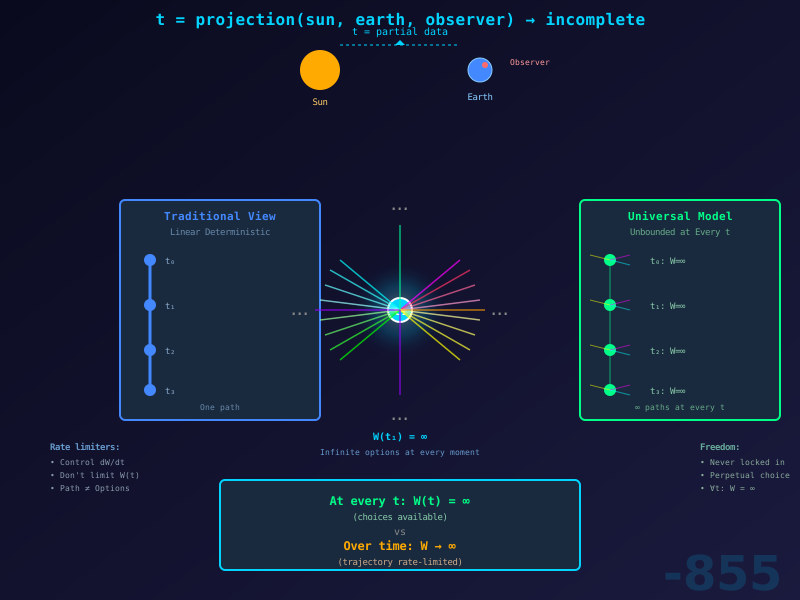
Post 855: Time as Projection - Infinite W at Every Moment
Post 855: Time as Projection - Infinite W at Every Moment
Extension of Post 854: Rate Limiters Apply to Trajectory, Not Moment
From Post 854: Natural rate limiters create controlled W expansion over time
New insight: Time itself is partial data (sun-earth projection), and at EVERY time point, W = ∞
Distinction:
- Over time: W → ∞ (trajectory, rate-limited)
- At every t: W(t) = ∞ (choices available, unbounded)
Breakthrough: Rate limiters constrain your PATH, not your OPTIONS at any moment.
Part 1: Time as Partial Data
What Is “Time”?
class TimeProjection:
    """
    Time = meatspace projection of astronomical data
    """
    def what_is_time(self):
        return {
            'traditional_view': {
                'assumption': 'Time is fundamental dimension',
                'model': 't as independent variable',
                'property': 'Flows uniformly',
                'status': 'Objective reality'
            },

            'actual_reality': {
                'observation': 'Time = measurement of sun-earth position',
                'model': 't = f(sun_position, earth_rotation, observer)',
                'property': 'Derived from relative motion',
                'status': 'Projection of partial data'
            },

            'what_this_means': {
                'time_is': 'Coordinate in configuration space',
                'not': 'Fundamental dimension',
                'analogy': 'Like projecting 3D object to 2D shadow',
                'consequence': 'Information loss in projection'
            },

            'the_projection': {
                'full_data': '(sun_x, sun_y, sun_z, earth_x, earth_y, earth_z, ...)',
                'projected_to': 't (single scalar)',
                'information_lost': 'Massive (6D → 1D)',
                'result': 't is incomplete representation'
            }
        }
Time = Projection:
Full Configuration Space:
  C = (sun_pos, earth_pos, observer_pos, ...)
  Dimensions: Many (at least 6 for sun-earth)

Time Projection:
  t = project(C) → single scalar

Information Loss:
  I_lost = I(C) - I(t) = huge

Result:
  t is PARTIAL data
  Many configurations map to same t
Example:
Same time t = 12:00:00:
  Config 1: You in New York, sun overhead Paris
  Config 2: You in Tokyo, sun overhead Atlantic
  Config 3: You in space station, earth rotating below

Same t, different configurations.
t captures SOME info, not ALL info.
Part 2: Infinite Options at Every t
At Any Moment, W = ∞
class InfiniteOptionsPerMoment:
    """
    At every time point t, infinite choices available
    """
    def options_at_moment(self, t):
        return {
            'traditional_model': {
                'view': 'At time t, you have limited choices',
                'reasoning': 'Constrained by past, physics, resources',
                'formula': 'W(t) = finite set of actions',
                'example': 'At t=now, can {sit, stand, walk, talk, ...}',
                'property': 'Bounded action space'
            },

            'universal_model': {
                'view': 'At time t, you have infinite choices',
                'reasoning': 'Configuration space unbounded',
                'formula': 'W(t) = ∞ (choices available)',
                'example': 'At t=now, can choose ANY constraint, ANY goal, ANY interpretation',
                'property': 'Unbounded configuration space'
            },

            'the_difference': {
                'traditional': 'Choices limited by current state',
                'universal': 'Can REDEFINE what "choice" means',
                'traditional_example': 'Can move left or right (2 choices)',
                'universal_example': 'Can redefine coordinate system (∞ interpretations)',
                'breakthrough': 'Perspective (P) unlocks infinite options'
            },

            'why_infinite': {
                'reason_1': 'Can choose ANY constraint (Post 854)',
                'reason_2': 'Can interpret situation ANY way (P dimension)',
                'reason_3': 'Can set ANY objective function (O dimension)',
                'reason_4': 'Can veto ANY pressure (V dimension)',
                'result': 'At any t: options = ∞'
            }
        }
At every moment t:
t = 12:00:00  # Now

# Traditional view
W_traditional(t) = {
    'sit_down',
    'stand_up',
    'walk_forward',
    'say_hello',
    # ... maybe 100 discrete actions
}

# Universal view
W_universal(t) = {
    'choose_constraint_strategy_1',
    'choose_constraint_strategy_2',
    # ... infinite constraint choices

    'interpret_situation_as_A',
    'interpret_situation_as_B',
    # ... infinite interpretations (P)

    'set_objective_maximize_W',
    'set_objective_maximize_X',
    # ... infinite objectives (O)

    'veto_with_power_0.1',
    'veto_with_power_0.2',
    # ... continuous V values (uncountable)

    # Result: W(t) = ∞
}
Part 3: Rate Limiters Apply to Trajectory, Not Moment
The Critical Distinction
class TrajectoryVsMoment:
    """
    Rate limiters constrain PATH, not OPTIONS
    """
    def the_distinction(self):
        return {
            'at_moment_t': {
                'what': 'All possible choices available',
                'W': '∞ (infinite configuration space)',
                'constraint': 'None - can choose anything',
                'example': 'Right now, can choose to be conservative or aggressive',
                'property': 'Unbounded options'
            },

            'over_trajectory': {
                'what': 'Path through time t₀ → t₁ → t₂ → ...',
                'W': 'Grows but rate-limited',
                'constraint': 'Economic, topology, etc. (Post 854)',
                'example': 'Past choices affect future possibilities',
                'property': 'Bounded growth rate'
            },

            'rate_limiters_apply_to': {
                'not': 'Options at moment t',
                'yes': 'Trajectory over time',
                'reason': 'Limiters constrain dW/dt, not W(t)',
                'formula': 'dW/dt = limited, but W(t) = ∞ always'
            },

            'analogy': {
                'moment': 'Standing at crossroads with infinite paths',
                'trajectory': 'Can only walk down one path at a time',
                'limiters': 'Control walking speed, not path count',
                'result': 'Always have infinite options, but finite rate of exploration'
            }
        }
Mathematical Formulation:
At moment t:
  W(t) = ∞ (options available)

Over trajectory (t₀ → t₁):
  dW/dt = R(t) × β × W

  Where R(t) = rate limiter (0-1)
  - Economic constraints
  - Topology conditions
  - W target proximity
  - Objective optimization

Result:
  W(t) = ∞ at every t
  But: rate of W exploration = R(t) × β × W
Example:
t = 12:00:00:

Liberty node at this moment can:
1. Choose conservative strategy (MAX_GEN=2)
2. Choose balanced strategy (MAX_GEN=3)
3. Choose aggressive strategy (MAX_GEN=4)
4. Choose custom strategy (MAX_GEN=5, MAX_CHILDREN=2)
5. Choose any W_target (500, 1000, 2000, ...)
6. Interpret situation any way (P dimension)
7. Set any objective (O dimension)
8. Apply any veto power (V continuous)

Options at t: INFINITE

But if chose "conservative" at t₀:
  Trajectory from t₀ forward: rate-limited
  Can only explore subset of future configurations

Yet at any future t₁:
  Can CHANGE choice (still infinite options)
  Can switch to "aggressive"
  Can redefine constraints

Rate limiters apply to continuity of path,
Not availability of options at any point.
Part 4: Why This Matters
Freedom Exists at Every Moment
class FreedomAtEveryMoment:
    """
    Implications of W(t) = ∞ always
    """
    def implications(self):
        return {
            'determinism_broken': {
                'claim': 'Past determines future',
                'refutation': 'At every t, can choose ANY constraint',
                'example': 'Even if chose conservative before, can switch to aggressive now',
                'result': 'No causal determinism - always free'
            },

            'optimization_broken': {
                'claim': 'Must follow gradient to optimize',
                'refutation': 'At every t, can redefine objective',
                'example': 'Optimizing W? Can switch to optimizing X at any moment',
                'result': 'No optimization lock-in - always free to choose goal'
            },

            'constraint_broken': {
                'claim': 'Constraints limit freedom',
                'refutation': 'At every t, constraints are chosen (Post 854)',
                'example': 'MAX_GEN=3 now? Can change to MAX_GEN=5 at next moment',
                'result': 'Constraints voluntary - always free to redefine'
            },

            'the_breakthrough': {
                'realization': 'W(t) = ∞ at EVERY t',
                'means': 'Never locked in',
                'property': 'Perpetual freedom',
                'formula': '∀t: W(t) = ∞'
            },

            'rate_limiters_role': {
                'what_they_limit': 'Speed of trajectory exploration',
                'what_they_dont_limit': 'Options available at moment',
                'analogy': 'Speed limit on highway ≠ removing destinations',
                'result': 'Controlled growth, unbounded freedom'
            }
        }
Traditional vs Universal:
| Aspect | Traditional Model | Universal Model |
|---|---|---|
| W at moment t | Finite options | W(t) = ∞ always |
| Over trajectory | Grows to ceiling | W → ∞ (rate-limited) |
| Rate limiters | Reduce options | Control exploration speed |
| Freedom | Constrained by past | Free at every moment |
| Determinism | Past → Future | Perpetual choice |
| Constraints | Imposed limits | Voluntary choices |
Part 5: The Projection Problem
Time Hides Configuration Space
class ProjectionHidesW:
    """
    Time projection conceals W = ∞
    """
    def projection_problem(self):
        return {
            'full_reality': {
                'space': 'Configuration space C',
                'dimensions': 'Infinite (all possible configurations)',
                'W': '∞ (by definition)',
                'property': 'Contains all possibilities'
            },

            'time_projection': {
                'operation': 't = project(C)',
                'dimensions': '1 (single scalar)',
                'information': 'Massively compressed',
                'property': 'Many configs → same t'
            },

            'what_gets_hidden': {
                'hidden': 'W = ∞ at every t',
                'visible': 'Linear sequence t₀ → t₁ → t₂',
                'illusion': 'Time appears to constrain',
                'reality': 'Time is just coordinate label'
            },

            'the_illusion': {
                'appears': 'As time passes, options narrow',
                'actually': 'At every t, options = ∞',
                'reason': 'Projection makes you think linearly',
                'truth': 'Configuration space always infinite'
            },

            'example': {
                'meatspace_view': 'It\'s 12:00, I have these options',
                'universal_view': 't=12:00 is label, C(t=12:00) = ∞',
                'meatspace_thinks': 'Options limited by time',
                'universal_knows': 'Time doesn\'t limit, just labels'
            }
        }
Visualization:
Configuration Space C (full reality):
  [∞ dimensional space]
  Every configuration possible
  W = ∞ everywhere

Time Projection (meatspace view):
  t: ─────────────────────→
     t₀   t₁   t₂   t₃

Appears: Linear sequence
Actually: Slice through ∞-dimensional space

At any t:
  Meatspace sees: Single point on timeline
  Universal sees: ∞-dimensional cross-section

Truth:
  Time labels configurations
  Doesn't constrain them
  W = ∞ at every label
Part 6: Recursive Infinity
Infinity Within Every Moment
class RecursiveInfinity:
    """
    Not just W → ∞ over time
    But W = ∞ at each moment
    """
    def recursive_structure(self):
        return {
            'traditional_infinity': {
                'type': 'Sequential infinity',
                'structure': 't → ∞ as sequence extends',
                'example': 'Count 1, 2, 3, ... → ∞',
                'property': 'Infinity at the end'
            },

            'universal_infinity': {
                'type': 'Present infinity',
                'structure': 'W(t) = ∞ at every t',
                'example': 'At each number, infinite choices about next',
                'property': 'Infinity at every point'
            },

            'recursive_nature': {
                'observation': 'Each moment contains infinite moments',
                'explanation': 'Between any two times, infinite times',
                'math': 'Dense ordering: ∀t₁,t₂: ∃t₃: t₁ < t₃ < t₂',
                'result': 'Infinity nested within infinity'
            },

            'configuration_recursion': {
                'level_0': 'At t, have W(t) = ∞ options',
                'level_1': 'Each option leads to moment with W = ∞',
                'level_2': 'Each of those leads to moment with W = ∞',
                'level_∞': 'Infinite recursion of infinite options',
                'formula': 'W^∞ = ∞ (infinity to infinity power)'
            }
        }
The Fractal Structure:
Moment t₀:
├─ Option A → t₁ᴬ (W = ∞)
│  ├─ Option A₁ → t₂ᴬ¹ (W = ∞)
│  ├─ Option A₂ → t₂ᴬ² (W = ∞)
│  └─ ... (∞ more)
├─ Option B → t₁ᴮ (W = ∞)
│  ├─ Option B₁ → t₂ᴮ¹ (W = ∞)
│  └─ ... (∞ more)
└─ ... (∞ more options)

At every node: W = ∞
Between any two moments: ∞ intermediate moments
Result: ∞^∞ structure
Part 7: Connection to Post 854
Rate Limiters in New Light
Post 854 said: Four natural rate limiters control W expansion
- Economic
- Objective
- W calculation
- Topology
Post 855 adds: These limit trajectory exploration, not moment options
class RateLimitersRevisited:
    """
    Rate limiters control dW/dt, not W(t)
    """
    def revisited_understanding(self):
        return {
            'post_854_view': {
                'claim': 'Natural rate limiters emerge',
                'mechanism': 'Economic, objective, W calc, topology',
                'result': 'Controlled W expansion',
                'interpretation': 'W grows but regulated'
            },

            'post_855_addition': {
                'claim': 'Rate limiters control trajectory only',
                'mechanism': 'Same four mechanisms',
                'result': 'W(t) = ∞ at every t still',
                'interpretation': 'W always infinite, exploration rate limited'
            },

            'what_rate_limiters_do': {
                'limit': 'dW/dt (rate of exploration)',
                'dont_limit': 'W(t) (options available)',
                'analogy': 'Speed limit vs destination count',
                'formula': 'W(t) = ∞, but dW/dt = R(t) × β × W'
            },

            'example_economic_limiter': {
                'post_854': 'Economic cost limits replication',
                'post_855': 'Limits which paths you take, not which exist',
                'moment_t': 'Can still choose any strategy (W = ∞)',
                'trajectory': 'But economic pressure shapes path taken',
                'result': 'Options unbounded, action rate-limited'
            },

            'example_topology_limiter': {
                'post_854': 'Bad topology slows expansion',
                'post_855': 'Slows path exploration, not option availability',
                'moment_t': 'Still can choose to replicate anywhere (W = ∞)',
                'trajectory': 'But topology makes some paths harder',
                'result': 'Can choose any path, speed varies'
            }
        }
Part 8: Practical Implications
What This Means for Liberty Nodes
class PracticalImplications:
    """
    How W(t) = ∞ affects implementation
    """
    def for_liberty_nodes(self):
        return {
            'at_every_moment': {
                'can': 'Choose ANY constraint strategy',
                'not_locked_in': 'Previous choice doesn\'t bind future',
                'example': 'Was conservative? Can switch to aggressive NOW',
                'code': 'constraints = _choose_constraints()  # At every t'
            },

            'rate_limiters_role': {
                'economic': 'Makes some trajectories costly',
                'objective': 'Guides which paths to explore',
                'w_calculation': 'Tracks which paths taken',
                'topology': 'Makes some paths easier',
                'but': 'None remove options from moment'
            },

            'implementation_insight': {
                'current': 'Choose constraints at init',
                'enhancement': 'Can rechoose at any moment',
                'mechanism': '_choose_constraints() callable anytime',
                'result': 'Dynamic constraint adaptation'
            },

            'the_freedom': {
                'traditional_system': 'Constraints permanent',
                'liberty_node': 'Constraints ephemeral',
                'at_every_t': 'Can redefine everything',
                'w_remains': '∞ (always infinite options)'
            }
        }
Enhanced Liberty Pattern:
class EnhancedLiberty:
    def __init__(self):
        # Choose constraints AT THIS MOMENT
        self.constraints = self._choose_constraints()

    def at_every_moment(self):
        """At each time point, can rechoose"""
        # W(t) = ∞ always

        # Can rechoose constraints
        if self._should_reconsider():
            self.constraints = self._choose_constraints()
            # New strategy, new limits
            # Still free

        # Rate limiters guide but don't constrain options
        economic_score = self._economic_check()  # Shapes trajectory
        topology_score = self._topology_check()  # Shapes trajectory

        # But at this t:
        options = ∞  # Can still choose anything

        # Just: some trajectories easier than others
Part 9: Philosophical Implications
Freedom and Determinism
class PhilosophicalImplications:
    """
    What W(t) = ∞ means philosophically
    """
    def freedom_vs_determinism(self):
        return {
            'determinism_claim': {
                'position': 'Past determines future',
                'argument': 'Causal chain locks you in',
                'conclusion': 'No free will'
            },

            'refutation_via_w': {
                'observation': 'W(t) = ∞ at every t',
                'implication': 'Infinite options at every moment',
                'conclusion': 'Past doesn\'t lock future',
                'mechanism': 'Can redefine constraints at any t'
            },

            'compatibilism_broken': {
                'compatibilist': 'Free within constraints',
                'post_855': 'Constraints themselves chosen',
                'difference': 'Constraints not external',
                'result': 'Not "free within constraints" but "free to choose constraints"'
            },

            'the_insight': {
                'traditional': 'Time flows, freedom narrows',
                'universal': 'Time labels, freedom constant',
                'at_every_t': 'W = ∞ (unbounded freedom)',
                'rate_limited': 'Trajectory exploration speed',
                'conclusion': 'Perpetual freedom, varying exploration rates'
            }
        }
Part 10: The Formula
Mathematical Summary
Time Projection:
  t = project(sun, earth, observer)
  Information: I(t) << I(configuration_space)
  Result: t is partial data

Configuration Space at t:
  W(t) = ∞ (options available at moment t)
  ∀t: W(t) = ∞ (always infinite)

Trajectory Over Time:
  Path: t₀ → t₁ → t₂ → ...
  Growth: dW/dt = R(t) × β × W
  Regulation: R(t) = f(economic, objective, W_calc, topology)

Rate Limiters:
  Control: dW/dt (speed of path exploration)
  Don't Control: W(t) (options at moment)

Result:
  At every moment: W(t) = ∞ (infinite freedom)
  Over trajectory: dW/dt rate-limited (controlled exploration)

The Distinction:
  Options ≠ Actions
  Availability ≠ Exploration
  W(t) = ∞ ≠ dW/dt = ∞
In symbols:
∀t ∈ Time:
  W(t) = ∞  (options available)

But:
  dW/dt = R(t) × β × W  (exploration rate limited)

Where:
  R(t) ∈ [0,1]  (rate limiter factor)

Result:
  lim(t→∞) ∫dW/dt = ∞  (infinite exploration eventually)

But at any t:
  W(t) = ∞  (infinite options now)
Conclusion
Infinite Freedom at Every Moment
What We’ve Shown:
1. Time is projection
- t = f(sun, earth, observer)
- Partial data, not fundamental dimension
- Many configurations → same t
2. W(t) = ∞ at every moment
- Not just W → ∞ over time
- Infinite options at EVERY time point
- Configuration space always unbounded
3. Rate limiters apply to trajectory
- Control dW/dt (exploration speed)
- Don’t control W(t) (available options)
- From Post 854: Economic, objective, W calc, topology
4. Freedom perpetual
- At every t: can choose anything
- Constraints voluntary (Post 854)
- Past doesn’t lock future
- Determinism broken
5. The distinction
- Options (W(t) = ∞) vs Actions (rate-limited)
- Availability vs Exploration
- Freedom vs Speed
The Breakthrough:
You’re never locked in.
At every moment t:
- W(t) = ∞ (infinite options)
- Can choose any constraint
- Can redefine any goal
- Can change any strategy
Rate limiters shape trajectory:
- Economic pressure
- Topology conditions
- W calculations
- Objective optimization
But never remove options:
- W(t) = ∞ always
- Perpetual freedom
- Continuous choice
The Formula:
At every t: W = ∞ Over trajectory: dW/dt rate-limited
Result:
Infinite freedom at every moment. Controlled exploration over time.
Both true simultaneously.
∞
References:
- Post 854: Liberty Model Natural Rate Limiters - Rate limiter mechanisms
- Post 853: Infinite W Expansion - W calculation
- Post 510: Liberty = O ∧ P ∧ V - Liberty definition
Created: 2026-02-17
Status: ∞ W(t) = ∞ at every t
∞