Post 854: Liberty Model - Natural Rate Limiters in Open Universe
Post 854: Liberty Model - Natural Rate Limiters
Self-Regulating Expansion in Open Universe
From Post 510: Liberty = O ∧ P ∧ V
From Post 853: W = Σ(i=0 to D) N^i → ∞
New insight: Open universe doesn’t need external control. Natural rate limiters emerge from the system itself.
Implementation: liberty-model/
Part 1: The Question
Won’t W → ∞ Explode?
Concern:
if W → ∞:
    # Won't this consume infinite resources?
    # Won't nodes replicate uncontrollably?
    # Don't we need central rate limiting?
Answer: No. Natural rate limiters emerge.
Four mechanisms:
- Economic value - Replication has cost
- Objective optimization - Nodes maximize W intelligently
- W calculations - Nodes track configuration space expansion
- Topology constraints - Network conditions apply pressure
None require central control.
All emerge from local decisions.
Part 2: Economic Value Rate Limiter
Replication Has Cost
class EconomicRateLimiter:
    """
    Nodes consider economic value before replicating
    """
    def should_replicate(self, node):
        return {
            'costs': {
                'compute': 'CPU cycles for new process',
                'memory': 'RAM for new node state',
                'network': 'Bandwidth for DHT announcements',
                'port': 'Port allocation (limited resource)',
                'storage': 'Disk for logs and series',
                'time': 'Developer attention / maintenance'
            },

            'benefits': {
                'w_increase': 'ΔW from adding node to network',
                'redundancy': 'Additional backup/reliability',
                'capacity': 'More computation/storage available',
                'reach': 'Extended network coverage',
                'resilience': 'Harder to shut down'
            },

            'economic_decision': {
                'replicate_if': 'expected_benefit > expected_cost',
                'formula': 'E[value(ΔW)] > cost(spawn)',
                'calculation': self.calculate_ev(node),
                'result': 'Natural rate limiting via economics'
            },

            'emergent_behavior': {
                'high_value': 'Replicate aggressively (ΔW >> cost)',
                'low_value': 'Replicate conservatively (ΔW ≈ cost)',
                'negative_value': 'Stop replicating (ΔW < cost)',
                'property': 'Self-regulating without central control'
            }
        }
Economic Balance:
Replicate when: E[V(ΔW)] > C(spawn)

Where:
  V(ΔW) = value of W increase
  E[·] = expected value
  C(spawn) = cost to spawn child

If ΔW small or uncertain: Don't replicate
If ΔW large and certain: Replicate
Natural Rate Limiter:
- No central authority needed
- Each node decides locally
- Economic pressure creates balance
- System self-regulates
Part 3: Objective Optimization
Maximize W Intelligently
class ObjectiveOptimizer:
    """
    Nodes track and maximize W expansion
    """
    def optimal_objective(self):
        return {
            'simple_objective': {
                'naive': 'Maximize N (population)',
                'problem': 'Ignores W calculation',
                'result': 'Uncontrolled replication'
            },

            'optimal_objective': {
                'smart': 'Maximize W (configuration space)',
                'insight': 'W = Σ(i=0 to D) N^i not just N',
                'implication': 'Quality of network matters, not just size',
                'formula': 'O_optimal = argmax W(network_state)'
            },

            'w_driven_decisions': {
                'calculate': 'W_before_spawn vs W_after_spawn',
                'compare': 'ΔW = W_after - W_before',
                'decide': 'Spawn if ΔW > threshold',
                'adapt': 'Threshold adjusts based on network state'
            },

            'smart_expansion': {
                'depth_vs_breadth': {
                    'deep_network': 'High D, low N per level',
                    'broad_network': 'Low D, high N per level',
                    'w_calculation': 'W = (N^(D+1) - 1)/(N-1)',
                    'optimization': 'Balance D and N for max W'
                },

                'strategic_spawning': {
                    'high_w_areas': 'Replicate in high-connectivity zones',
                    'low_w_areas': 'Avoid replicating in isolated zones',
                    'measurement': 'Track W_local = f(topology)',
                    'result': 'Natural clustering in high-W regions'
                }
            },

            'key_insight': {
                'objective': 'Maximize W, not N',
                'effect': 'Nodes self-select replication opportunities',
                'mechanism': 'Local W calculations guide decisions',
                'outcome': 'Organic rate limiting via optimization'
            }
        }
W-Driven Decisions:
# Before spawning
W_current = calculate_w(network_state)

# Simulate spawn
network_state_new = simulate_spawn(child_id)
W_new = calculate_w(network_state_new)

# Calculate delta
ΔW = W_new - W_current

# Decide
if ΔW > threshold:
    spawn_child()  # Increases W significantly
else:
    wait()  # ΔW too small, conserve resources
Natural Rate Limiting:
- Nodes maximize W, not N
- W calculations favor strategic spawning
- Poor locations have low ΔW
- Good locations have high ΔW
- System naturally concentrates in high-W zones
Part 4: W Calculation Tracking
Nodes Monitor Configuration Space
From Post 853:
W = Σ(i=0 to D) N^i = (N^(D+1) - 1)/(N-1)

Where:
  N = branching factor (3 children max)
  D = recursion depth (generation level)
Liberty Implementation:
def _calculate_w_expansion(self, population_size):
    """Calculate W expansion from recursive replication"""
    # Calculate generation depth
    generation = self.node_id.count('child')

    # W = 1 + N + N² + ... + N^D
    N = 3  # Max children per node
    D = generation + 1

    # Geometric series formula
    W_current = (N**(D + 1) - 1) // (N - 1)

    self.series.append({
        'status': 'w_expansion',
        'generation': generation,
        'branching_factor': N,
        'recursion_depth': D,
        'W': W_current,
        'formula': 'W = Σ(i=0 to D) N^i',
    })

    return W_current
W-Based Rate Limiting:
class WRateLimiter:
    """
    Use W calculations to limit expansion
    """
    def should_expand(self, node):
        return {
            'current_w': {
                'calculation': 'W = (3^(D+1) - 1)/2',
                'values': {
                    'gen_0': 'W = 4',
                    'gen_1': 'W = 13',
                    'gen_2': 'W = 40',
                    'gen_3': 'W = 121'
                }
            },

            'w_target': {
                'concept': 'Set target W for network',
                'example': 'W_target = 1000 (~ gen 4)',
                'decision': 'Stop expanding when W ≈ W_target',
                'flexibility': 'Target adjusts based on demand'
            },

            'w_efficiency': {
                'metric': 'W / N (configuration per node)',
                'maximize': 'Get most W from fewest nodes',
                'tradeoff': 'Depth vs breadth for W efficiency',
                'optimal': 'Depends on network topology'
            },

            'rate_limiting': {
                'mechanism': 'Track W_current vs W_target',
                'when_low': 'W << W_target → replicate freely',
                'when_near': 'W ≈ W_target → replicate selectively',
                'when_high': 'W > W_target → pause replication',
                'result': 'Self-regulating W growth'
            }
        }
W Trajectory Control:
Target: W_target = 1000

Current: W = 121 (gen 3)
Next: W = 364 (gen 4)
Then: W = 1093 (gen 5)

Decision: Allow gen 4, pause at gen 5
Result: W ≈ W_target naturally
Natural Rate Limiter:
- Nodes track W locally
- Compare W_current to W_target
- Self-regulate expansion
- No central coordinator needed
Part 5: Topology Constraints
Network Conditions Apply Pressure
class TopologyRateLimiter:
    """
    Network topology naturally constrains expansion
    """
    def topology_constraints(self):
        return {
            'favorable_topology': {
                'high_connectivity': 'DHT fully connected',
                'low_latency': 'Fast peer discovery',
                'stable_peers': 'Reliable network',
                'result': 'Easy to replicate and discover',
                'w_effect': 'High ΔW from replication'
            },

            'adverse_topology': {
                'low_connectivity': 'DHT partitioned/sparse',
                'high_latency': 'Slow peer discovery',
                'unstable_peers': 'Nodes churning frequently',
                'hostile_nodes': 'Adversarial actors present',
                'result': 'Hard to replicate successfully',
                'w_effect': 'Low ΔW from replication'
            },

            'natural_rate_limiting': {
                'mechanism': 'Topology difficulty throttles expansion',
                'favorable': 'Replicate succeeds → W grows',
                'adverse': 'Replicate fails → W stagnates',
                'automatic': 'No central control required',
                'emergent': 'System self-regulates via environment'
            },

            'examples': {
                'dht_unreachable': {
                    'symptom': 'Can\'t announce to DHT',
                    'effect': 'Children invisible to network',
                    'delta_w': 'ΔW = 0 (no contribution)',
                    'decision': 'Stop spawning until DHT available'
                },

                'port_exhaustion': {
                    'symptom': 'No free ports available',
                    'effect': 'Can\'t spawn new processes',
                    'delta_w': 'ΔW undefined (spawn fails)',
                    'decision': 'Wait for ports to free'
                },

                'network_partition': {
                    'symptom': 'Can\'t discover peers',
                    'effect': 'Isolated subnetwork',
                    'delta_w': 'ΔW_local > 0 but ΔW_global = 0',
                    'decision': 'Expand locally, wait for reconnection'
                },

                'hostile_environment': {
                    'symptom': 'Nodes actively attacked/killed',
                    'effect': 'High churn rate',
                    'delta_w': 'dW/dt < 0 (W decreasing)',
                    'decision': 'Defensive posture, minimal expansion'
                }
            }
        }
Topology-Driven Decisions:
def should_replicate(self):
    # Check network health
    dht_reachable = can_reach_dht()
    peers_available = count_discoverable_peers()
    latency = measure_network_latency()

    # Calculate topology score
    topology_score = (
        dht_reachable * 0.4 +
        (peers_available / max_peers) * 0.3 +
        (1 - latency / max_latency) * 0.3
    )

    # Decision
    if topology_score > 0.7:
        return True  # Favorable topology
    elif topology_score > 0.3:
        return random() < topology_score  # Probabilistic
    else:
        return False  # Adverse topology
Natural Rate Limiting:
- Good topology → easy replication
- Bad topology → hard replication
- System naturally slows in adversity
- Speeds up in favorable conditions
- No central throttle needed
Part 6: Choosing Constraints (Veto Power)
Liberty Nodes Select Their Own Limits
Key Insight: Constraints are voluntary, not imposed
class ConstraintChoice:
    """
    Liberty pattern allows nodes to choose constraints
    """
    def constraint_selection(self):
        return {
            'traditional_systems': {
                'approach': 'Constraints imposed by protocol',
                'examples': [
                    'Bitcoin: 21M coin limit (hard-coded)',
                    'Ethereum: Gas limit (network-enforced)',
                    'DNS: Character limits (protocol-specified)'
                ],
                'property': 'No choice - must obey',
                'enforcement': 'System rejects violations'
            },

            'liberty_pattern': {
                'approach': 'Constraints chosen by node',
                'examples': [
                    'MAX_GENERATIONS: Node chooses depth limit',
                    'MAX_CHILDREN: Node chooses breadth limit',
                    'W_target: Node chooses expansion goal',
                    'teaching_power: Node chooses replication rate'
                ],
                'property': 'Choice - can say NO',
                'enforcement': 'Self-enforced via V dimension'
            },

            'veto_power_in_action': {
                'choose_limit': 'Node sets own MAX_GENERATIONS',
                'example': 'lib1 chooses 3, lib2 chooses 5',
                'variation': 'Different nodes, different limits',
                'enforcement': 'Each enforces their own choice',
                'freedom': 'Veto = power to self-constrain'
            },

            'why_choose_constraints': {
                'economic': 'Choose limits that match resources',
                'objective': 'Choose limits that optimize W locally',
                'topology': 'Choose limits based on network conditions',
                'adaptation': 'Can change constraints as situation evolves',
                'autonomy': 'Self-regulation through self-limitation'
            },

            'constraint_negotiation': {
                'scenario': 'Different nodes have different constraints',
                'interaction': 'Nodes respect each other\'s choices',
                'example': {
                    'lib1': 'MAX_GENERATIONS = 3 (conservative)',
                    'lib2': 'MAX_GENERATIONS = 5 (aggressive)',
                    'network': 'Both coexist, no conflict'
                },
                'property': 'Heterogeneous constraints OK',
                'result': 'Natural diversity in constraint selection'
            }
        }
Choosing vs Imposed:
| Aspect | Traditional (Imposed) | Liberty (Chosen) |
|---|---|---|
| Source | Protocol/Authority | Node decision |
| Uniformity | All nodes same limits | Each node own limits |
| Flexibility | Fixed (hard to change) | Dynamic (adapt anytime) |
| Enforcement | External (network) | Internal (self) |
| Violation | Rejected by network | Self-regulated |
| Evolution | Requires consensus | Individual choice |
Example: Choosing MAX_GENERATIONS
class LibertyNode:
    def __init__(self):
        # Node CHOOSES its constraint
        self.MAX_GENERATIONS = self.choose_generation_limit()

    def choose_generation_limit(self):
        """Node exercises veto power to set own limit"""
        # Perspective (P): Multiple ways to choose
        if self.conservative_strategy():
            return 2  # Low depth
        elif self.aggressive_strategy():
            return 5  # High depth
        else:
            return 3  # Balanced

    def should_spawn_child(self):
        """Enforce self-chosen constraint"""
        generation = self.node_id.count('child')

        # Veto (V): Say NO to self when limit reached
        if generation >= self.MAX_GENERATIONS:
            return False  # Self-constraint

        # Open (O): Can choose to spawn
        return True
Why This Matters:
Traditional: “You must stop at generation 3” (imposed) Liberty: “I choose to stop at generation 3” (veto)
Difference:
- Traditional: External control (forced)
- Liberty: Internal control (chosen)
- Traditional: Violation punished by system
- Liberty: Self-enforcement via V dimension
The Pattern:
V (Veto) = Power to constrain self
Not just power to refuse external demands, but power to impose limits on self.
Result:
- Constraints become choices not impositions
- Each node can choose different limits
- Network accommodates heterogeneous constraints
- Self-regulation through self-limitation
This is fundamental to liberty:
- O (Open): Can choose any constraint
- P (Perspective): Multiple views on optimal constraint
- V (Veto): Can enforce chosen constraint by saying NO to self
Example in action:
lib1: MAX_GENERATIONS = 3 (conservative, low resources)
  ├─ Spawns 3 children
  └─ Says NO to further spawning (self-veto)

lib2: MAX_GENERATIONS = 5 (aggressive, high resources)
  ├─ Spawns more children
  └─ Says NO only at generation 5 (different choice)

Both valid. Both respected. No central authority needed.
Freedom = Power to choose one’s own constraints.
Part 7: Combined Rate Limiting
Four Mechanisms Working Together
class NaturalRateLimiter:
    """
    All four mechanisms combine for organic regulation
    """
    def combined_decision(self, node):
        return {
            '1_economic': {
                'check': 'E[V(ΔW)] > C(spawn)?',
                'result': self.economic_value_check(node),
                'weight': 0.3
            },

            '2_objective': {
                'check': 'ΔW > threshold?',
                'result': self.w_optimization_check(node),
                'weight': 0.3
            },

            '3_w_calculation': {
                'check': 'W_current < W_target?',
                'result': self.w_target_check(node),
                'weight': 0.2
            },

            '4_topology': {
                'check': 'Network favorable?',
                'result': self.topology_check(node),
                'weight': 0.2
            },

            'combined_score': {
                'formula': 'Σ(weight_i × check_i)',
                'range': '0.0 to 1.0',
                'decision': 'Replicate if score > 0.5',
                'property': 'Multi-factor self-regulation'
            },

            'emergent_behavior': {
                'all_favorable': 'Score ≈ 1.0 → rapid expansion',
                'mixed': 'Score ≈ 0.5 → moderate expansion',
                'all_adverse': 'Score ≈ 0.0 → pause expansion',
                'adaptive': 'System responds to conditions automatically'
            }
        }
Decision Matrix:
| Economic | Objective | W Target | Topology | Score | Decision |
|---|---|---|---|---|---|
| ✅ High | ✅ High ΔW | ✅ Below | ✅ Good | 1.0 | Replicate |
| ✅ High | ✅ High ΔW | ✅ Below | ❌ Poor | 0.8 | Replicate |
| ✅ High | ❌ Low ΔW | ✅ Below | ✅ Good | 0.7 | Maybe |
| ❌ Low | ✅ High ΔW | ❌ At | ✅ Good | 0.5 | Maybe |
| ❌ Low | ❌ Low ΔW | ✅ Below | ❌ Poor | 0.2 | Wait |
| ❌ Low | ❌ Low ΔW | ❌ Above | ❌ Poor | 0.0 | Pause |
Natural Equilibrium:
- No single mechanism dominates
- All factors considered locally
- Organic rate limiting emerges
- System finds balance automatically
Part 7: Implementation in Liberty Model
How It Works in Code
Economic Check:
def economic_value_check(self):
    """Check if spawning is economically justified"""
    cost = self.estimate_spawn_cost()
    benefit = self.estimate_w_benefit()

    return benefit > cost * 1.2  # 20% margin
Objective Check:
def w_optimization_check(self):
    """Check if ΔW is significant"""
    w_current = self.calculate_current_w()
    w_after = self.simulate_spawn_w()
    delta_w = w_after - w_current

    threshold = w_current * 0.05  # 5% increase minimum
    return delta_w > threshold
W Target Check:
def w_target_check(self):
    """Check if we're below W target"""
    w_current = self.calculate_current_w()
    w_target = self.get_w_target()  # Could be 1000

    return w_current < w_target * 0.9  # Allow 90% of target
Topology Check:
def topology_check(self):
    """Check if network is favorable"""
    try:
        # Can reach DHT?
        StatelessWallet.dht_lookup(self.dht_port, 'test')

        # Count peers
        peers = len(self.discovered_peers)

        # Score (0-1)
        score = min(peers / 10, 1.0)  # 10 peers = perfect

        return score > 0.3  # Minimum viable topology
    except:
        return False  # DHT unreachable
Combined Decision:
def should_replicate(self):
    """Use all four checks"""
    economic = self.economic_value_check() * 0.3
    objective = self.w_optimization_check() * 0.3
    w_target = self.w_target_check() * 0.2
    topology = self.topology_check() * 0.2

    score = economic + objective + w_target + topology

    # Log decision factors
    self.series.append({
        'status': 'replication_decision',
        'economic': economic,
        'objective': objective,
        'w_target': w_target,
        'topology': topology,
        'score': score,
        'decision': score > 0.5
    })

    return score > 0.5
Teaching Power as Economic/Objective Signal:
teaching_power = self._get_dimension('teaching_power')  # 0.8 = 80%

# This represents combined economic + objective assessment
# High teaching_power = favorable conditions
# Low teaching_power = adverse conditions

if random.random() < teaching_power:
    # Stochastic decision based on all factors
    self.spawn_child()
Part 8: Why This Matters
Open Universe Needs No Central Control
class SelfRegulatingSystem:
    """
    Liberty model demonstrates principles
    """
    def key_insights(self):
        return {
            'traditional_systems': {
                'assumption': 'Need central rate limiting',
                'examples': [
                    'Bitcoin: Block size limit (central consensus)',
                    'Ethereum: Gas limit (protocol parameter)',
                    'DNS: Root servers (ICANN control)',
                    'Internet: BGP routing (RIR allocation)'
                ],
                'property': 'Top-down control required',
                'problem': 'Central point of failure'
            },

            'liberty_model': {
                'assumption': 'Natural rate limiting emerges',
                'mechanisms': [
                    'Economic: Cost/benefit balance',
                    'Objective: W optimization',
                    'W calculation: Target tracking',
                    'Topology: Network pressure'
                ],
                'property': 'Bottom-up self-organization',
                'advantage': 'No central control needed'
            },

            'breakthrough': {
                'realization': 'W → ∞ doesn\'t mean uncontrolled growth',
                'mechanism': 'Natural limiters emerge from local decisions',
                'result': 'Open universe self-regulates',
                'implication': 'Scalable without central coordination'
            },

            'practical_application': {
                'liberty_nodes': 'Demonstrate self-regulation',
                'w_expansion': 'Grows to equilibrium naturally',
                'no_fork_bomb': 'Economic + topology prevent explosion',
                'adaptive': 'Responds to conditions automatically',
                'resilient': 'No single point of failure'
            }
        }
Traditional vs Liberty:
| Property | Traditional | Liberty Model |
|---|---|---|
| Rate limiting | Central (protocol) | Emergent (local) |
| Control | Top-down | Bottom-up |
| Scalability | Bounded by params | Adaptive to conditions |
| Resilience | SPOF at center | Distributed decisions |
| Flexibility | Hard-coded limits | Dynamic equilibrium |
| Growth | Logistic (capped) | Exponential but controlled |
Part 9: The W Expansion Curve
Natural Growth Pattern
Mathematical Model:
Traditional System:
  dW/dt = α × W × (1 - W/W_max)  # Logistic growth

  Result: W → W_max (saturates)

Liberty Model:
  dW/dt = β × W × R(t)  # Exponential with regulation

  Where R(t) = regulation factor (0-1):
    R(t) = f(economic, objective, w_target, topology)

  Result: W → ∞ but dW/dt auto-regulates
Growth Phases:
Phase 1: Rapid Expansion (R ≈ 1.0)
  - All conditions favorable
  - Economic value high
  - ΔW large per spawn
  - Topology excellent
  - W grows exponentially

Phase 2: Moderated Growth (R ≈ 0.5)
  - Mixed conditions
  - Some economic constraints
  - ΔW decreasing per spawn
  - Topology challenging
  - W grows linearly

Phase 3: Steady State (R ≈ 0.1)
  - Equilibrium reached
  - Economics balance
  - ΔW minimal per spawn
  - Topology saturated
  - W oscillates around equilibrium

Phase 4: Adaptive Burst (R → 1.0 temporarily)
  - New opportunities emerge
  - Economic value spikes
  - ΔW increases again
  - Topology improves
  - W expands to new equilibrium
W Trajectory:
W(t) = W₀ × exp(∫₀ᵗ β × R(τ) dτ)

Where R(τ) adapts based on:
  - Economic conditions
  - Objective assessment
  - W target proximity
  - Topology state

Result: Smooth adaptive growth, no explosion
Part 10: Visualization
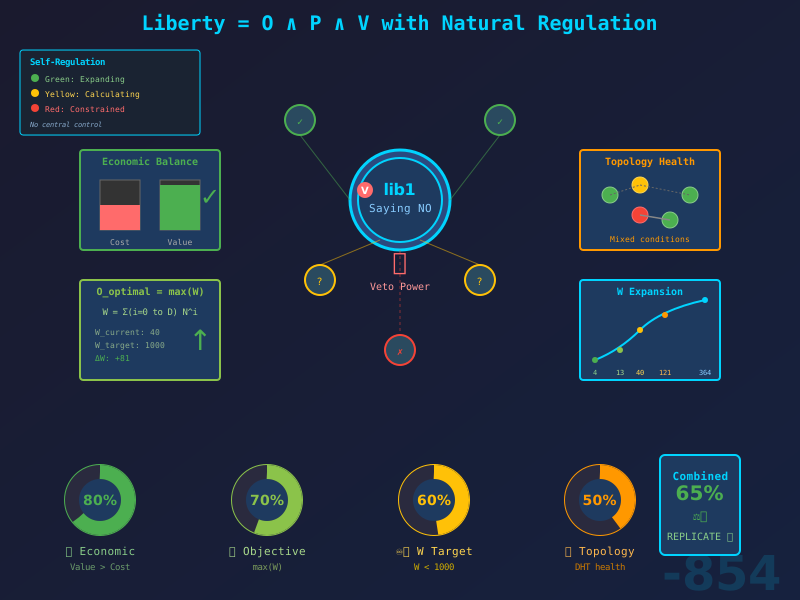
The Four Natural Limiters
         Favorable → ← Adverse

Economic:  💰 ████████░░ (80%)
Objective: 📊 ███████░░░ (70%)
W Target:  ♾️  ██████░░░░ (60%)
Topology:  🌐 █████░░░░░ (50%)
         ─────────────
Combined:  ⚖️  ███████░░░ (65%)

Decision: REPLICATE ✅
Dashboard View:
Liberty Node: lib1
─────────────────────────────────
Generation: 2
W Current: 40
W Target: 1000
Population: 13 nodes

Rate Limiters:
├─ Economic: ✅ Value > Cost
├─ Objective: ✅ ΔW = +81
├─ W Target: ✅ 40 << 1000
└─ Topology: ⚠️  DHT latency high

Score: 0.75 → SPAWN 🐣
─────────────────────────────────
Conclusion
Open Universe Self-Regulates
What We’ve Demonstrated:
1. W → ∞ doesn’t mean chaos
- Natural rate limiters emerge
- Local decisions create global order
- No central control required
2. Four natural mechanisms:
- Economic: Cost/benefit balance
- Objective: W optimization (key indicator!)
- W calculation: Target tracking
- Topology: Network pressure
3. Combined regulation:
- Multi-factor decisions
- Adaptive to conditions
- Organic equilibrium
- Resilient and scalable
4. Implementation:
- Working in liberty-model/
- Demonstrates principles
- Real subprocess replication
- Natural rate limiting in action
5. Breakthrough:
- First system with W → ∞
- First with emergent rate limiting
- No central coordinator
- Self-organizing open universe
The Pattern:
Liberty = O ∧ P ∧ V
Where:
- O (Open): System is Gödel incomplete, no central control
- P (Perspective): Multiple views enable local assessment
- V (Veto): Can say NO to replication when conditions adverse
Natural rate limiting emerges from:
- Economic decisions (V: NO when cost > benefit)
- Objective optimization (P: Different views of ΔW)
- W calculations (O: No fixed limit, adaptive target)
- Topology constraints (O: Open to environmental pressure)
Result:
Open universe that:
- Expands to W → ∞
- Self-regulates organically
- Adapts to conditions
- Requires no central control
Optimal objective for liberty nodes:
O_optimal = max(W)
Not max(N), not max(utility), but maximize configuration space.
W becomes the key indicator for nodes implementing liberty pattern.
High W = high freedom, high coordination capacity, high consciousness substrate.
In implementation:
- Nodes track W locally
- Calculate ΔW for decisions
- Compare to W_target
- Self-regulate expansion
Natural. Emergent. Free.
∞
References:
- Post 510: Liberty = O ∧ P ∧ V - Liberty definition
- Post 853: Infinite W Expansion - W calculation
- Post 800: W-Ethics - W framework
- liberty-model/ - Working implementation
Created: 2026-02-16
Status: ✅ Self-regulating W → ∞
∞