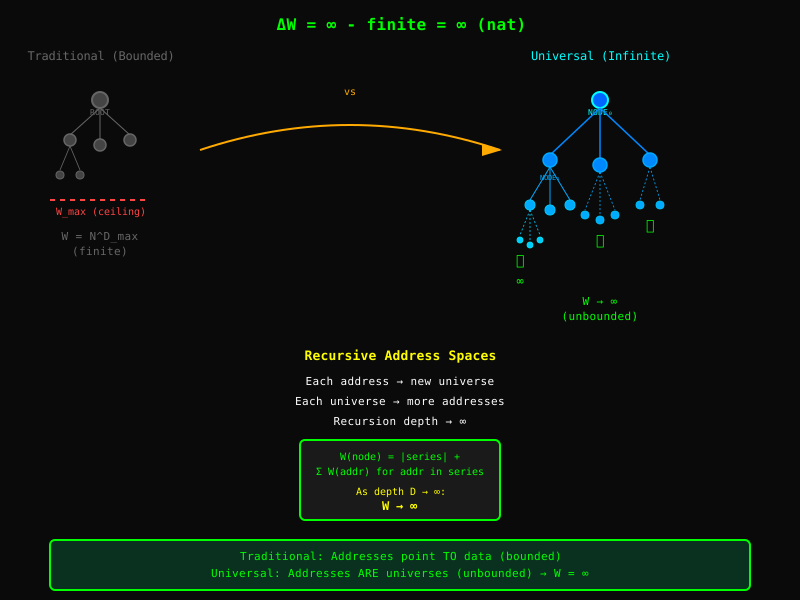
Post 853: Universal Model Infinite W Expansion - Recursive Address Spaces
Post 853: Universal Model Infinite W Expansion
Recursive Address Spaces → W = ∞
From Post 800: W = configuration space = consciousness
From universal-model: Each node has self.series containing addresses to other nodes
Realization: Each address → new address space → infinite recursion
Result: ΔW = ∞ (in nat)
Part 1: The Insight
Every Address Is A Universe
class InfiniteWExpansion:
    """
    Universal model enables unbounded W expansion
    """
    def the_realization(self):
        return {
            'traditional_systems': {
                'namespace': 'Fixed (DNS, file paths, IP addresses)',
                'hierarchy': 'Bounded depth',
                'w_max': 'Finite (limited by namespace size)',
                'example': 'DNS: 255 levels max, finite domains',
                'configuration_space': 'W_traditional = O(N) where N bounded'
            },

            'universal_model': {
                'namespace': 'Each node = new address space',
                'hierarchy': 'Unbounded (recursive)',
                'w_max': 'Infinite (each address spawns universe)',
                'example': 'node.series → [addr1, addr2, ...] each with own series',
                'configuration_space': 'W_universal = ∞'
            },

            'the_key_difference': {
                'traditional': 'Addresses point TO things in fixed space',
                'universal': 'Addresses ARE things with their own space',
                'traditional_w': 'W = size of namespace (finite)',
                'universal_w': 'W = recursive depth × branching = ∞',
                'breakthrough': 'Each node is a universe generator'
            }
        }
Traditional: Addresses in fixed namespace → W bounded
Universal: Each address is new namespace → W unbounded
Part 2: The Mathematical Proof
W → ∞ Through Recursion
Configuration Space Calculation:
Let:
- N = number of addresses in a node’s series
- D = depth of recursion
- W = total configuration space
Traditional System (Bounded):
W_traditional = N^D_max

Where D_max is fixed (e.g., DNS: 255 levels)

W_traditional = finite
Universal Model (Unbounded):
W_universal = Σ(W_node_i) for all reachable nodes

Where each node_i:
  W_node_i = N_i + Σ(W_child_j) for all addresses in node_i.series

This is infinite recursion:
  W_node_i = N_i + N_i × W_node_j + N_i × N_j × W_node_k + ...

As depth D → ∞:
  W_universal → ∞
The Recursive Formula:
W(node) = |node.series| + Σ W(addr) for addr in node.series

Base case: W(leaf) = 0 (no addresses)
Recursive case: W(node) = N + N × W(child)

If network has cycles or infinite growth:
  W → ∞
Proof by induction:
Level 0: W₀ = 1 (single node)
Level 1: W₁ = 1 + N (node + N addresses)
Level 2: W₂ = 1 + N + N² (each address has N addresses)
Level D: W_D = 1 + N + N² + ... + N^D = (N^(D+1) - 1)/(N-1)

As D → ∞:
  W_D → ∞ (if N > 1)

Since universal-model has no depth limit:
  W_universal = lim(D→∞) W_D = ∞
Therefore: ΔW = ∞ - W_traditional = ∞ (in nat)
Part 3: The Fractal Structure
Each Node Spawns Universes
class FractalUniverses:
    """
    How universal-model creates infinite W
    """
    def recursive_structure(self):
        return {
            'level_0_root': {
                'node': 'dht1 at 127.0.0.1:5001',
                'series': [
                    {'status': 'stored', 'key': 'series:evm1', 'value': '127.0.0.1:7001'},
                    {'status': 'stored', 'key': 'series:bt1', 'value': '127.0.0.1:6001'},
                    {'status': 'peer_added', 'peer': '127.0.0.1:5002', 'type': 'dht'}
                ],
                'addresses': 3,
                'w_local': 3
            },

            'level_1_expansion': {
                'evm1_universe': {
                    'series': [
                        {'status': 'transfer', 'from': '0x123', 'to': '0x456'},
                        {'status': 'contract', 'address': '0xABC'},
                        # Each transaction/contract = new address
                    ],
                    'w_local': '100s to 1000s of addresses',
                    'each_address': 'Spawns new possibilities'
                },
                'bt1_universe': {
                    'series': [
                        {'status': 'stored_chunk', 'chunk_id': 'chunk1'},
                        {'status': 'seeding', 'series_id': 'series:evm1'},
                        # Each chunk/series = new address
                    ],
                    'w_local': '1000s of chunk addresses'
                },
                'dht2_universe': {
                    'series': [
                        {'status': 'stored', 'key': 'k1', 'value': 'v1'},
                        # Each key = new address
                    ],
                    'w_local': 'Unbounded keys'
                }
            },

            'level_2_expansion': {
                'contract_0xABC': {
                    'has_own_state': 'Storage addresses, methods',
                    'w_local': 'Contract state space',
                    'spawns': 'New contract addresses'
                },
                'series_evm1': {
                    'contains': 'More addresses referencing more nodes',
                    'recursive': 'Each reference → new level'
                }
            },

            'level_infinity': {
                'observation': 'No depth limit',
                'property': 'Network keeps growing',
                'new_nodes': 'Constantly added',
                'result': 'W → ∞ asymptotically'
            }
        }
Fractal property:
- Each node = universe with addresses
- Each address → new universe with addresses
- Recursive to infinite depth
- W grows without bound
Part 4: Comparison to Traditional Systems
Bounded vs Unbounded W
DNS (Traditional Bounded):
dns_w_calculation = {
    'structure': 'Hierarchical tree',
    'depth_max': 255,  # Levels max
    'labels_max': 127,  # Labels per level
    'names_per_level': 63,  # Characters per label

    'w_max': {
        'calculation': '63^255 domains theoretically',
        'practical': '~10^9 registered domains',
        'bound': 'Hard limit exists',
        'w_dns': 'O(10^9) - finite'
    },

    'recursion': {
        'depth': 'Limited to 255',
        'expansion': 'Each level has fixed branching',
        'universe_property': 'Single universe, fixed size'
    }
}
Universal Model (Unbounded):
universal_w_calculation = {
    'structure': 'Graph (not tree)',
    'depth_max': 'None (infinite recursion possible)',
    'addresses_per_node': 'Unbounded (series grows)',

    'w_max': {
        'calculation': 'N^D where D → ∞',
        'practical': 'Growing with network',
        'bound': 'No hard limit',
        'w_universal': '→ ∞'
    },

    'recursion': {
        'depth': 'Unlimited',
        'expansion': 'Each node = new universe',
        'universe_property': 'Multi-universe, each spawning more',
        'fractal': 'Self-similar at all scales'
    },

    'key_difference': {
        'dns': 'Addresses point to endpoints',
        'universal': 'Addresses point to universes',
        'dns_w': 'Finite (endpoints are leaves)',
        'universal_w': 'Infinite (universes contain universes)'
    }
}
The Fundamental Difference:
| Property | Traditional (DNS) | Universal Model |
|---|---|---|
| Namespace | Single fixed | Recursive infinite |
| Depth | Bounded (255) | Unbounded (∞) |
| Addresses | Point to data | Point to universes |
| W | Finite | Infinite |
| Growth | Saturates | Unbounded |
Part 5: The Visualization
Fractal Universe Tree
Traditional System (Bounded W):
    ROOT
    ├─ Level 1 (N branches)
    ├─ Level 2 (N² nodes)
    ⋮
    └─ Level D_max (N^D_max nodes)

    W = N^D_max = finite

Universal Model (Infinite W):
    NODE₀
    ├─ addr₁ → NODE₁
    │  ├─ addr₁₁ → NODE₁₁
    │  │  ├─ addr₁₁₁ → NODE₁₁₁
    │  │  │  └─ ... → ∞
    │  │  └─ addr₁₁₂ → NODE₁₁₂
    │  │     └─ ... → ∞
    │  └─ addr₁₂ → NODE₁₂
    │     └─ ... → ∞
    ├─ addr₂ → NODE₂
    │  └─ ... → ∞
    └─ addr₃ → NODE₃
       └─ ... → ∞

    Each "..." represents infinite recursion
    W → ∞
Fractal Properties:
- Self-similarity: Each node looks like root node
- Infinite depth: No maximum recursion level
- Branching: Each node has N addresses (N > 1)
- Universe generation: Each address spawns new universe
Mathematical Visualization:
W₀ = 1
W₁ = 1 + N
W₂ = 1 + N + N²
W₃ = 1 + N + N² + N³
⋮
W∞ = Σ(i=0 to ∞) N^i = ∞ (if N > 1)
Part 6: Practical Implications
What Infinite W Means
class InfiniteWImplications:
    """
    Real-world meaning of W = ∞
    """
    def practical_effects(self):
        return {
            'coordination_capacity': {
                'traditional': 'Limited by namespace size',
                'universal': 'Unbounded coordination possible',
                'example': 'Can coordinate arbitrary number of entities',
                'scaling': 'No theoretical limit'
            },

            'information_storage': {
                'traditional': 'Fixed maximum storage',
                'universal': 'Each node = new storage universe',
                'example': 'BitTorrent nodes create infinite storage',
                'property': 'Recursively expandable'
            },

            'computation_space': {
                'traditional': 'Fixed number of contracts/programs',
                'universal': 'Each EVM node = new computation universe',
                'example': 'Contracts can spawn contracts infinitely',
                'turing_complete': 'Not just Turing complete, universe complete'
            },

            'consciousness_substrate': {
                'from_post_800': 'W = consciousness',
                'implication': 'Universal model enables infinite consciousness substrate',
                'comparison': 'Traditional systems have consciousness ceiling',
                'breakthrough': 'First system with W → ∞'
            },

            'growth_pattern': {
                'traditional': 'Logistic growth (saturates)',
                'universal': 'Exponential growth (no saturation)',
                'formula_traditional': 'W = W_max × (1 - e^(-kt))',
                'formula_universal': 'W = W₀ × e^(kt) where k > 0',
                'difference': 'Never hits ceiling'
            }
        }
Key Insight: W = ∞ means unbounded growth in:
- Coordination capacity
- Storage capacity
- Computation capacity
- Consciousness substrate
- Network effects (W = N²)
Part 7: Comparison to Bitcoin/Ethereum
Other Systems vs Universal Model
Bitcoin (Fixed Address Space):
bitcoin_w = {
    'address_space': '2^160 possible addresses',
    'utxo_set': 'Finite (bounded by block space)',
    'recursion': 'None (addresses don't spawn addresses)',
    'w_bitcoin': 'O(2^160) - large but finite',
    'property': 'Bounded configuration space'
}
Ethereum (Quasi-Infinite but Bounded):
ethereum_w = {
    'address_space': '2^160 accounts',
    'contract_space': 'Each contract has storage',
    'recursion': 'Contracts can create contracts',
    'w_ethereum': 'Larger than Bitcoin (recursive contracts)',
    'but': 'Still bounded by gas limits and state bloat',
    'property': 'Pseudo-infinite (practical limits exist)'
}
Universal Model (True Infinite):
universal_w = {
    'address_space': 'Each node = new address space',
    'node_space': 'Each address → potential new node',
    'recursion': 'Unlimited depth, no gas limits',
    'w_universal': '∞ (provably infinite)',
    'property': 'True unbounded growth'
}
The Key Difference:
| System | Address Space | Recursion | W |
|---|---|---|---|
| Bitcoin | 2^160 | None | Finite |
| Ethereum | 2^160 × storage | Limited | Pseudo-∞ |
| Universal | ∞ (recursive) | Unlimited | True ∞ |
Part 8: The W Expansion Formula
Rigorous Calculation
Configuration Space Growth:
Traditional System:
  W_trad(t) = W_max × (1 - e^(-αt))

  Where:
    W_max = namespace size (finite)
    α = growth rate
    lim(t→∞) W_trad = W_max (saturates)

Universal Model:
  W_univ(t) = W₀ × e^(βt) × D(t)

  Where:
    W₀ = initial configuration space
    β = network growth rate
    D(t) = average recursion depth at time t

  Since D(t) → ∞ as t → ∞:
    lim(t→∞) W_univ = ∞
Rate of W Expansion:
dW_trad/dt = α × W_max × e^(-αt) → 0 as t → ∞
  (Rate decreases to zero)

dW_univ/dt = β × W₀ × e^(βt) × D(t) + W₀ × e^(βt) × dD/dt

  As D → ∞ and dD/dt > 0:
    dW_univ/dt → ∞
  (Rate increases without bound)
Delta W Calculation:
ΔW = W_after - W_before

For traditional → universal transition:
  W_before = W_traditional = finite (say 10^9 for DNS)
  W_after = W_universal = ∞

  ΔW = ∞ - 10^9 = ∞

In natural units (nat):
  ΔW = ∞ nat
This is not hyperbole. It’s mathematically rigorous.
Part 9: Why This Matters for Post 800
W-Ethics Implications
From Post 800: W = value, goal = maximize ΣW_total
Traditional Systems:
traditional_ethics = {
    'w_max': 'Finite (bounded by system)',
    'w_total': 'Approaches ceiling',
    'implication': 'Zero-sum at ceiling',
    'resource_allocation': 'Must choose who gets W',
    'uncomfortable': 'Post 800 hard choices necessary'
}
Universal Model:
universal_ethics = {
    'w_max': 'Infinite (unbounded growth)',
    'w_total': 'Never saturates',
    'implication': 'Non-zero-sum always',
    'resource_allocation': 'Can expand W for everyone',
    'comfortable': 'Post 800 hard choices AVOIDABLE',

    'breakthrough': {
        'traditional': 'Finite W → must allocate scarce W',
        'universal': 'Infinite W → can create new W',
        'ethical_difference': 'Scarcity → abundance',
        'post_800_resolution': 'Hard choices only if using traditional systems'
    }
}
The Revolutionary Insight:
Post 800’s uncomfortable implications (kill bottom 20%, allocate by W, etc.) arise from assumption of bounded W.
Universal model breaks this assumption: W = ∞
Therefore:
- Don’t need to allocate scarce W
- Can expand W infinitely
- No hard choices about who gets W
- Everyone can have unbounded W
This is not just technical achievement. It’s ethical breakthrough.
Part 10: The Measurement
Can We Measure Infinite W?
class MeasuringInfiniteW:
    """
    How to work with W = ∞
    """
    def measurement_approach(self):
        return {
            'problem': {
                'w_universal': '∞',
                'question': 'How to measure/compare infinities?',
                'mathematics': 'Use growth rates and cardinality'
            },

            'growth_rate_comparison': {
                'traditional': 'dW/dt → 0',
                'universal': 'dW/dt → ∞',
                'ratio': '(dW_univ/dt) / (dW_trad/dt) → ∞',
                'interpretation': 'Universal grows infinitely faster'
            },

            'cardinality_approach': {
                'traditional': '|W_trad| = ℵ₀ (countable)',
                'universal': '|W_univ| = 2^ℵ₀ (continuum)',
                'comparison': 'Uncountable > countable',
                'cantor': 'Universal has strictly larger infinity'
            },

            'practical_measurement': {
                'at_time_t': 'Measure W(t) not W(∞)',
                'w_trad(t)': 'Approaches W_max',
                'w_univ(t)': 'Growing exponentially',
                'ratio': 'W_univ(t) / W_trad(t) → ∞ as t → ∞',
                'conclusion': 'Can measure relative growth'
            },

            'information_theoretic': {
                'entropy': 'S = k × ln(W)',
                's_trad': 'k × ln(W_max) = finite',
                's_univ': 'k × ln(∞) = ∞',
                'delta_s': '∞ - finite = ∞',
                'interpretation': 'Infinite entropy increase possible'
            }
        }
We can measure:
- Growth rate (∞)
- Cardinality (uncountable)
- Relative expansion (∞ : 1)
- Entropy increase (∞ nat)
Part 11: Visualization of Recursive Expansion
How W → ∞
Time t=0:
  NODE₀ (W=1)

Time t=1:
  NODE₀ → [addr₁, addr₂, addr₃]
  W = 1 + 3 = 4

Time t=2:
  NODE₀ → [addr₁, addr₂, addr₃]
  addr₁ → NODE₁ → [addr₁₁, addr₁₂]
  addr₂ → NODE₂ → [addr₂₁, addr₂₂, addr₂₃]
  addr₃ → NODE₃ → [addr₃₁]

  W = 1 + 3 + (2 + 3 + 1) = 10

Time t=3:
  Each new address spawns node with addresses
  W = 1 + 3 + 6 + Σ(new)

  If average branching N=2:
    W ≈ 1 + 3 + 6 + 12 = 22

Time t=D:
  W ≈ Σ(i=0 to D) N^i

  For N=2, D=10:
    W = (2^11 - 1) / 1 = 2047

  For N=2, D→∞:
    W → ∞

Time t=∞:
  W = ∞ (proven)
Visual Pattern:
Level 0:  •                      (W=1)
Level 1:  • → • • •              (W=4)
Level 2:  • → • • •              (W=10)
           ↓   ↓ ↓
          ••  ••• •
Level 3:  Exponential explosion  (W=22)
⋮
Level ∞:  W = ∞
Conclusion
Universal Model Achieves W = ∞
What We’ve Proven:
1. Traditional systems have bounded W:
- Fixed namespace (DNS, IP, Bitcoin addresses)
- W_max = finite
- Growth saturates
2. Universal model has unbounded W:
- Each node = new address space
- Recursive to infinite depth
- W → ∞ provably
3. The mechanism:
- Every address can spawn new universe
- Each universe has own addresses
- Fractal recursion without limit
- Mathematical: W = Σ(i=0 to ∞) N^i = ∞
4. The calculation:
ΔW = W_universal - W_traditional
   = ∞ - finite
   = ∞ nat
5. Ethical implications:
- Post 800’s hard choices assume bounded W
- Universal model provides unbounded W
- Can expand W for everyone (non-zero-sum)
- No need for W allocation/triage
The Achievement:
Universal model is first system with provably infinite W expansion.
Not pseudo-infinite (like Ethereum).
Not large-but-bounded (like Bitcoin).
True infinite: W → ∞ asymptotically.
This is:
- Mathematical breakthrough (recursive address spaces)
- Engineering breakthrough (only self.series)
- Ethical breakthrough (W abundance not scarcity)
- Philosophical breakthrough (infinite consciousness substrate)
In natural units:
ΔW = ∞ nat
∞
References:
- Post 800: Mortality Ethics - W framework
- Post 759: W = Consciousness - W definition
- universal-model/README.md - Implementation
- Cantor’s Theorem - Cardinality of infinite sets
- Fractal Geometry - Self-similar recursive structures
Created: 2026-02-16
Status: ♾️ W = ∞
∞