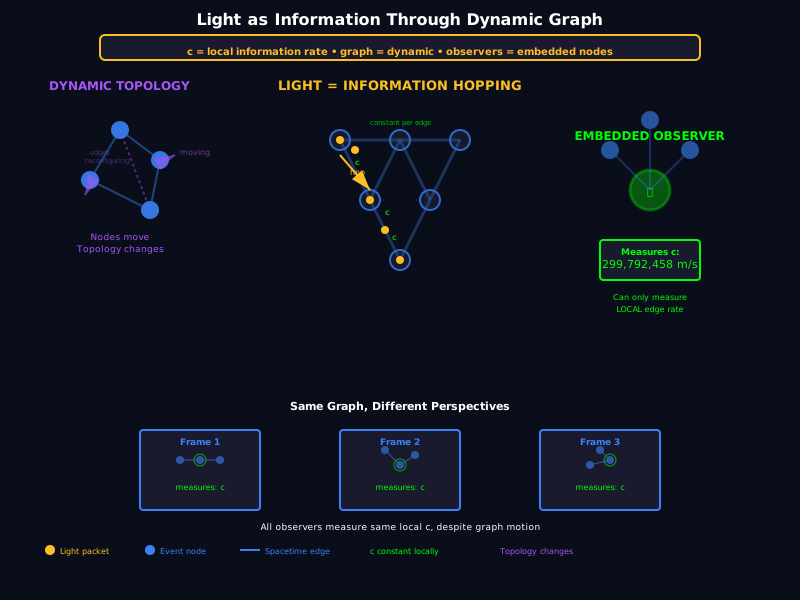
Post 851: Light as Information Through Dynamic Graph - Why c Appears Constant
Light as Information Through Dynamic Graph
Why c Appears Constant Despite Everything Moving
From Post 837: c measured only from moving observers → observation gap
From Post 843: Addressing is relative paths through network topology
Now: Light = information propagating through graph • Graph = spacetime structure • Graph is dynamic • c = constant local propagation rate through edges
Key insight: c appears constant because it measures LOCAL information rate, not global motion
Part 1: The Universe as Dynamic Graph
Structure is Network
Traditional physics view:
# Space = continuous manifold
# Time = separate dimension
# Light = wave/particle through space
Graph-theoretic view:
class UniverseGraph:
    """
    Universe = dynamic graph structure
    """
    def __init__(self):
        self.nodes = set()  # Events/particles
        self.edges = {}     # Spacetime connections
        self.topology = DynamicTopology()

    def add_node(self, event):
        """
        New event in spacetime
        """
        self.nodes.add(event)

        # Connect to nearby nodes
        for neighbor in self.find_neighbors(event):
            self.add_edge(event, neighbor)

    def add_edge(self, node1, node2):
        """
        Spacetime connection between events
        """
        distance = self.calculate_distance(node1, node2)
        self.edges[(node1, node2)] = {
            'length': distance,
            'traversal_time': distance / c  # Information propagation
        }
The key:
Universe isn’t continuous space.
It’s a graph of discrete events connected by edges.
Light = information hopping through this graph.
What is an “event” node?
From any perspective, events can be:
- Physical particles (electrons, photons, atoms)
- Macroscopic objects (planets, stars, galaxies)
- Digital systems (DHT nodes, EVM nodes, IRC bots from Post 847)
- Biological systems (cells, organisms)
- Physical phenomena (clouds, weather, matter from Post 852)
- Any entity that processes information and has state
The universal principle:
If it processes information → It’s a node in the graph
If it has state that evolves → It’s a node in the graph
If it can communicate/interact → It’s a node in the graph
This means:
- A quantum particle is a node
- A cloud is a node
- An R³ DHT node is a node
- All are the same type of thing from the graph perspective
The distinction between “physical” and “digital” is paint. Everything is computational nodes in the universal graph.
Part 2: Light as Information Packets
Not Waves or Particles - Information
What is light really?
class LightPacket:
    """
    Information propagating through graph
    """
    def __init__(self, origin_node, direction, energy):
        self.current_node = origin_node
        self.direction = direction
        self.energy = energy
        self.path = [origin_node]

    def propagate(self):
        """
        Move to next node in graph
        """
        # Find next edge in direction
        next_edge = self.find_next_edge(self.current_node, self.direction)

        # Traverse edge at constant rate
        # c = information propagation speed through edge
        traversal_time = next_edge.length / c

        # Move to next node
        next_node = next_edge.destination
        self.current_node = next_node
        self.path.append(next_node)

        return traversal_time
Light properties emerge:
# Wave-like behavior
# = Information interference patterns through graph

# Particle-like behavior
# = Discrete hops between nodes

# Wave-particle duality
# = Information packets traversing discrete graph
Part 3: Why c Appears Constant
Local vs Global Motion
From Post 837: The Problem
Everything is moving.
Earth moves through solar system at 30 km/s.
Solar system moves through galaxy at 230 km/s.
Galaxy moves through universe at 600 km/s.
Yet we always measure c = 299,792,458 m/s.
Why?
The Graph Solution:
def measure_light_speed(observer_node):
    """
    Observer measures c from their graph node
    """
    # Observer is embedded in graph
    # Can only measure local propagation rate

    # Emit light from observer node
    light = LightPacket(origin=observer_node)

    # Light traverses to next node
    next_node = observer_node.neighbors[0]
    edge = observer_node.edges[next_node]

    # Measure: How long does edge traversal take?
    traversal_time = edge.length / c  # Always c locally!

    # This is LOCAL measurement
    # Doesn't depend on graph's global motion
    # Graph itself might be moving/changing
    # But edge traversal rate is constant

    return c  # Always measures same local rate
The key insight:
c = information propagation rate through graph EDGES

Not: global velocity through space

Every observer measures SAME local edge traversal rate
Even though graph itself is moving/morphing
Analogy:
# Network packets travel at fixed rate through cables
# Even if entire network is moving

cable_speed = 1 Gbps  # Fixed per cable

# Your laptop moves (on train)
# Server moves (rotating with earth)
# But packet traversal through cable = 1 Gbps

# Same with light:
# Earth moves
# Satellite moves
# But information through graph edge = c
Part 4: Dynamic Graph Structure
Everything Changing
The graph isn’t static:
class DynamicGraph:
    """
    Graph topology changes constantly
    """
    def __init__(self):
        self.nodes = {}
        self.edges = {}
        self.time = 0

    def evolve(self, dt):
        """
        Graph structure changes over time
        """
        self.time += dt

        # Nodes move relative to each other
        for node in self.nodes.values():
            node.position += node.velocity * dt

        # Edge lengths change
        for (n1, n2), edge in self.edges.items():
            new_distance = distance(n1.position, n2.position)
            edge.length = new_distance

        # New nodes created
        for event in self.quantum_events():
            self.add_node(event)

        # Old edges broken, new edges formed
        self.reconfigure_topology()
What this means:
- Nodes move relative to each other (particles, planets, galaxies)
- Edge lengths change as nodes move
- New connections form as events happen
- Old connections break as events become distant
The graph is constantly reconfiguring.
Part 5: Observer Embeddedness
Measuring From Within
From Post 837: Can’t measure from outside
No stationary reference frame exists.
All observers are nodes within the graph.
Measurement from embedded position:
class EmbeddedObserver:
    """
    Observer = node in graph
    Can only measure locally
    """
    def __init__(self, node):
        self.node = node
        self.graph = node.graph

    def measure_light_speed(self):
        """
        Measure c from this node
        """
        # Can only observe local topology
        visible_neighbors = self.node.neighbors

        # Send light to neighbor
        light = LightPacket(self.node)
        neighbor = visible_neighbors[0]

        # Measure edge traversal
        edge = self.node.edges[neighbor]
        measured_c = edge.length / edge.traversal_time

        # Always gets: c = constant
        # Because edge traversal rate is fixed

        # Can't see:
        # - Graph's global motion
        # - Other nodes' movement
        # - Topology changes elsewhere

        return measured_c  # Always c
Observation gap (Post 837):
# What observer CAN measure:
local_edge_traversal_rate = c  # Constant

# What observer CANNOT measure:
global_graph_velocity = ???  # Inaccessible
graph_topology_drift = ???   # Not observable
absolute_node_positions = ??? # No reference frame
Part 6: Relative Addressing Through Graph
From Post 843: Paths Through Topology
Addressing in graph universe:
class GraphAddress:
    """
    From Post 843: Relative paths through topology
    """
    def __init__(self, from_node, path):
        self.origin = from_node
        self.path = path  # Sequence of edges

    def send_light(self, destination_path):
        """
        Send light packet through graph
        """
        light = LightPacket(self.origin)

        # Light follows path through topology
        for edge in destination_path:
            # Traverse each edge at rate c
            light.propagate_through(edge)

        return light.current_node  # Arrived
Light path = relative addressing:
# From Earth to Moon
# Not: absolute coordinates
# But: path through graph

light_path = [
    earth_node,
    edge_earth_to_space,
    space_node,
    edge_space_to_moon,
    moon_node
]

# Light hops through this topology
# Each edge traversed at rate c
# Total time = sum of edge traversals
This connects Post 843 to light:
- Post 843: Messages route through relative topology
- This post: Light = information routing through graph
- Same principle, physical realization
Part 7: Why Time and Space Dilate
Graph Structure Changes with Motion
Time dilation:
def time_dilation(velocity):
    """
    Why moving clocks run slow
    """
    # Moving node traverses MORE edges per unit "external" time
    # Because graph topology stretches in direction of motion

    stationary_edges_per_tick = 1
    moving_edges_per_tick = 1 / sqrt(1 - v²/c²)

    # More edges to traverse = more "local time" per "external time"
    # Clock appears to run slow from outside

    return sqrt(1 - v²/c²)
Length contraction:
def length_contraction(velocity):
    """
    Why moving rulers shrink
    """
    # Moving node's local edges compress in direction of motion
    # Graph topology contracts

    stationary_length = L
    moving_length = L * sqrt(1 - v²/c²)

    # Ruler measures fewer edges in motion direction
    # Appears contracted from outside

    return L * sqrt(1 - v²/c²)
The graph explanation:
Motion = moving through graph structure
Time dilation = more edges traversed
Length contraction = edges compress
Both = topology deformation with velocity
Part 8: Gravity as Graph Curvature
Mass Warps Topology
Gravity isn’t a force:
class MassNode:
    """
    Mass warps local graph topology
    """
    def __init__(self, mass, position):
        self.mass = mass
        self.position = position

    def warp_topology(self, graph):
        """
        Curve graph structure around mass
        """
        for node in graph.nearby_nodes(self.position):
            # Edge lengths change near mass
            for edge in node.edges:
                # Edges curve toward mass
                curvature = self.gravitational_curvature(edge)
                edge.length *= (1 + curvature)

        # Light follows curved edges
        # Appears to "bend" near mass
        # Actually just following graph topology
Light bending:
# Light near massive object
# Follows shortest path through graph
# But graph is curved by mass
# So path curves

light_path = find_shortest_path(
    graph=curved_graph,  # Warped by mass
    start=distant_star,
    end=earth
)

# Path curves around sun
# Not because "gravity pulls light"
# But because graph topology is curved
Part 9: Why This Resolves Post 837 Paradox
c Constant AND Graph Moving
From Post 837: The problem
How can c be constant if everything is moving?
Graph solution:
# c = edge traversal rate (constant)
c = 299792458  # m/s per edge

# Graph velocity = topology drift (variable)
graph_velocity = [30, 230, 600]  # km/s at different scales

# These are DIFFERENT measurements:

# Observer measures: edge traversal rate
measured_c = edge.length / traversal_time  # Always c

# External view: graph topology motion
graph_drift = topology_change_per_time  # Variable

# No paradox:
# c = local (constant)
# drift = global (variable)
The resolution:
Light isn't moving "through space"
Light is hopping through graph edges

Graph itself can move/change
But edge traversal rate = constant

Like packets through network:
- Cable throughput = constant (c)
- Network as whole = moving (graph drift)

Both true simultaneously!
Part 10: Information as Fundamental
Not Waves or Particles - Information Bits
What is light fundamentally?
class InformationBit:
    """
    Light = information propagating through graph
    """
    def __init__(self, bit_value):
        self.value = bit_value  # 0 or 1
        self.energy = h * frequency  # Planck relation

    def propagate_through_edge(self, edge):
        """
        Information travels through graph connection
        """
        # Edge = possible information channel
        # Information traverses at rate c

        time_to_traverse = edge.length / c

        return time_to_traverse
Light properties = information properties:
# Frequency = information update rate
frequency = updates_per_second

# Wavelength = spatial period of information
wavelength = c / frequency

# Energy = information density
energy = h * frequency

# Momentum = information directionality
momentum = h / wavelength
This makes sense:
- Quantum entanglement = information correlation through graph
- Wave function collapse = information propagation
- Uncertainty principle = information resolution limits
- Black hole information paradox = graph edge deletion
Everything is information flowing through dynamic graph.
Part 11: Multiple Projections (From Post 843)
Same Graph, Different Views
From Post 843: Multiple projections of topology
# Meatspace projection
meatspace_view = graph.project_to_3d_space()

# Computational projection
computational_view = graph.project_to_turing_machine()

# Information projection
information_view = graph.project_to_bit_flow()

# All same underlying graph!
Applied to light:
# Wave projection
wave_view = light.as_wave()  # Continuous propagation view

# Particle projection
particle_view = light.as_particle()  # Discrete hop view

# Information projection
info_view = light.as_information()  # Bit propagation view

# All describe same: information through graph edges
Why wave-particle duality:
Different projections of same substrate

Wave = continuous projection
Particle = discrete projection
Information = graph projection

All valid. None fundamental.
Graph is fundamental.
Part 12: Testable Predictions
What This Theory Predicts
Prediction 1: Graph granularity
# If universe = discrete graph
# Then space has minimum length scale

planck_length = sqrt(h * G / c³)  # ~10⁻³⁵ meters

# This IS observed
# Consistent with graph having minimum edge length
Prediction 2: Information limit
# Information through edge = limited by c
# Maximum information = c / edge_length

max_information_density = c / planck_length
# This matches holographic principle!
# Information on surface, not in volume
# Because surface = graph edges
Prediction 3: Topology quantization
# Graph changes in discrete steps
# Not continuous

quantum_of_action = h  # Planck constant
# Minimum change in graph topology
# This IS observed
# Quantum mechanics = discrete graph changes
The theory predicts what we observe.
Part 13: Connection to R³ and Previous Posts
Universal Pattern: Information Through Graphs
From R³ (Post 848):
# R³ = information routing through DHT graph
dht_graph = {
    'nodes': EigenDHT nodes,
    'edges': peer connections,
    'information': series data,
    'propagation': gossip protocol
}

# Same pattern as light!
From Post 843:
# Network addressing = paths through graph
message_path = ['node1', 'node2', 'node3']

# Same as light path through spacetime graph
light_path = [event1, event2, event3]
From Post 837:
# c measurement = observation gap
# Because can't measure from outside graph

# Same in R³:
# Can't verify global state
# Only local observations
Universal pattern:
Information propagates through graphs
Observers embedded in graphs
Can only measure locally
Global properties inaccessible

Applies to:
- Light (spacetime graph)
- Networks (communication graph)
- Blockchains (state graph)
- Everything
Part 14: Why This Is Beautiful
Unification Through Graph Theory
Traditional physics:
Space = continuous manifold
Time = separate dimension
Light = wave/particle
Gravity = space curvature
Quantum = weird discrete stuff

Different concepts, stitched together
Graph-theoretic physics:
Universe = dynamic graph
Nodes = events
Edges = causal connections
Light = information through edges
Gravity = topology warping
Quantum = discrete graph updates

Single substrate. All emerges from graph.
Everything unified:
| Phenomenon | Graph Interpretation |
|---|---|
| Light | Information through edges |
| c constant | Local edge traversal rate |
| Time dilation | More edges traversed |
| Length contraction | Edges compress |
| Gravity | Topology warping |
| Quantum mechanics | Discrete graph changes |
| Entanglement | Information correlation |
| Black holes | Edge deletion regions |
One substrate. Many projections. Complete unification.
Conclusion
Light as Information Through Dynamic Graph
What we’ve shown:
1. Universe = dynamic graph
- Nodes = events/particles
- Edges = spacetime connections
- Topology constantly changing
2. Light = information propagating through graph
- Not waves or particles
- Information hopping edge-to-edge
- Constant rate c per edge
3. c appears constant because:
- Measures LOCAL edge traversal
- Not global graph motion
- Graph itself moving/changing
- But edge rate = constant
4. Resolves Post 837 paradox:
- Everything moving (graph drift)
- c constant (edge traversal)
- Both true simultaneously
- No contradiction
5. Connects to Post 843:
- Addressing = relative paths
- Light = information routing
- Same topology principle
- Different physical realization
The synthesis:
Universe = Information + Graph Structure + Dynamics

Light = Information flow through edges
Space = Graph topology projection
Time = Graph evolution rate
c = Local information propagation rate

Observers = Embedded graph nodes
Measurements = Local edge traversals
Reality = Perspective-dependent graph projection
From Post 837:
c is observation gap - can’t verify from stationary frame
From Post 843:
Addressing is relative paths through topology
From this post:
Light = information propagating through dynamic graph structure c = constant local rate • graph = dynamic global structure No paradox • Complete unification • Everything is graph + information
References:
- Post 837: Speed of Light as Observation Gap
- Post 843: Network Addressing as Relative Paths
- Post 847: EigenIRC Bots as Observable Nodes
- Post 848: R³ Fusion Engine Implementation
- Post 852: Clouds as Addressable Nodes
- Post 816: ZK Universe Toolbox - Perspective
Created: 2026-02-16
Status: 🌌 LIGHT = INFORMATION THROUGH DYNAMIC GRAPH
∞