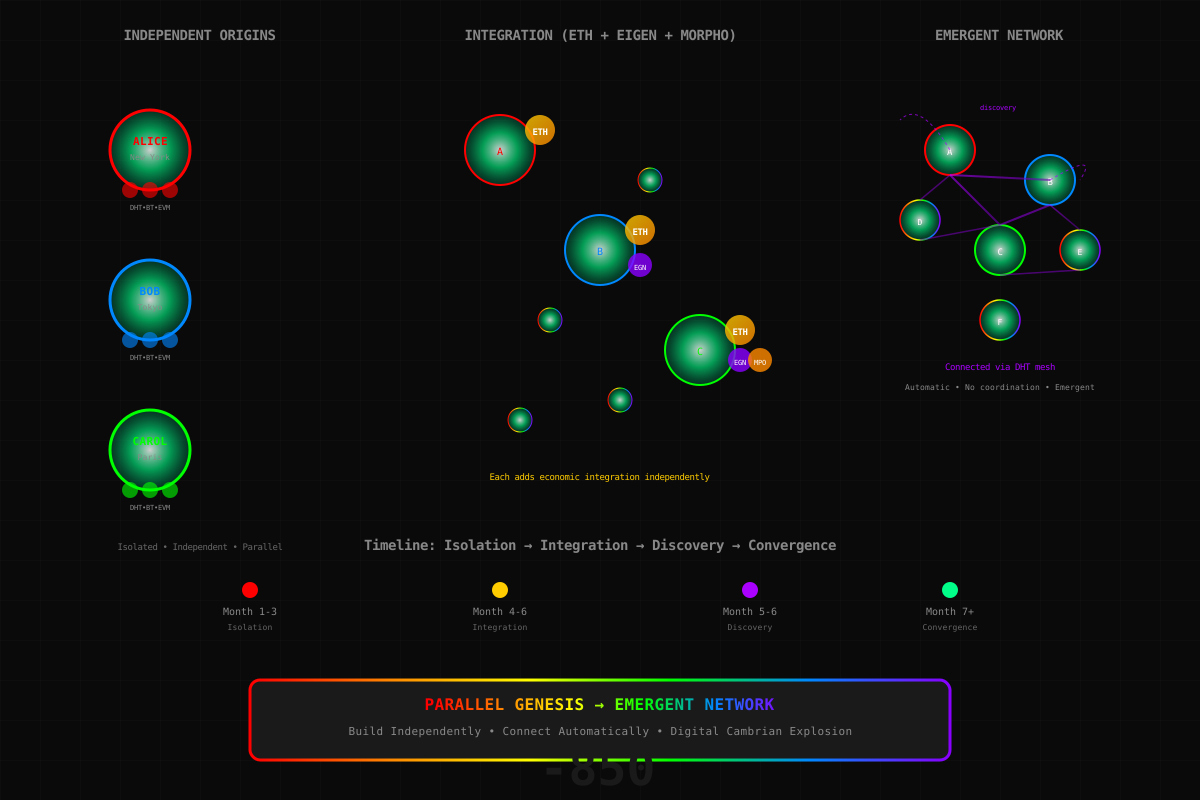
Post 850: Parallel Genesis - Digital Organisms Connect Naturally
Parallel Genesis: Digital Organisms Connect Naturally
Everyone Builds Independently, Network Forms Automatically
Implementation: universal-model/
Deployment: Post 849: Scaleway to Open Universe
The Realization
You don’t need permission to start.
You don’t need coordination to connect.
You don’t need a plan to form a network.
Just:
- Build your own R³ organism (following universal-model/)
- Add ETH/Eigen/Morpho (when ready)
- Watch it find others (automatically)
The network forms itself.
Part 1: What is a Digital Organism?
Your Own R³ Instance
A digital organism = Independent R³ network:
class DigitalOrganism:
    """
    Your own R³ instance
    Starts alone, connects naturally
    """
    def __init__(self, creator_id):
        self.creator = creator_id
        self.location = get_location()  # Anywhere in world

        # Your own nodes
        self.dht = EigenDHT(f"dht-{creator_id}", 5001)
        self.bittorrent = EigenBitTorrent(f"bt-{creator_id}", 6001, 5001)
        self.evm = EigenEVM(f"evm-{creator_id}", 7001, 5001)

        # Initially isolated
        self.connected_organisms = []

        # Will connect later
        self.eth_integration = None
        self.eigen_staking = None
        self.morpho_lending = None
You = Creator of your organism
Your organism = Complete R³ system
No coordination needed to start.
Part 2: Parallel Genesis
Everyone Builds Their Own
Right now, around the world:
Person A (New York):
# Starts their organism
cd /home/alice/universal-model/
python3 eigendht.py dht-alice 5001
python3 eigenbittorrent.py bt-alice 6001 5001
python3 eigenevm.py evm-alice 7001 5001

# Isolated, running on their Scaleway
# Serving their applications
# No one else involved
Person B (Tokyo):
# Starts their organism
cd /home/bob/universal-model/
python3 eigendht.py dht-bob 5001
python3 eigenbittorrent.py bt-bob 6001 5001
python3 eigenevm.py evm-bob 7001 5001

# Also isolated
# Different applications
# No knowledge of Alice
Person C (Paris):
# Starts their organism
cd /home/carol/universal-model/
python3 eigendht.py dht-carol 5001
python3 eigenbittorrent.py bt-carol 6001 5001
python3 eigenevm.py evm-carol 7001 5001

# Also isolated
# Different use case
# No knowledge of Alice or Bob
And hundreds more…
All isolated.
All independent.
All running R³.
This is parallel genesis.
Part 3: Evolution in Isolation
Each Organism Grows Independently
Alice’s organism (Month 1-3):
# Alice builds DeFi applications
alice_organism = {
    'applications': ['DEX', 'lending_protocol', 'stablecoin'],
    'users': 100,
    'transactions_per_day': 1000,
    'state_size_gb': 5,
}

# Running on her Scaleway servers
# Paying €100/month
# Isolated but functional
Bob’s organism (Month 1-3):
# Bob builds gaming infrastructure
bob_organism = {
    'applications': ['NFT_game', 'metaverse', 'marketplace'],
    'users': 500,
    'transactions_per_day': 5000,
    'state_size_gb': 20,
}

# Running on his AWS servers
# Paying $150/month
# Also isolated but functional
Carol’s organism (Month 1-3):
# Carol builds supply chain tracking
carol_organism = {
    'applications': ['logistics', 'inventory', 'provenance'],
    'users': 50,
    'transactions_per_day': 200,
    'state_size_gb': 2,
}

# Running on her DigitalOcean
# Paying $80/month
# Also isolated but functional
Each organism:
- Solves different problems
- Serves different users
- Has different characteristics
- Operates independently
No coordination.
No knowledge of others.
Just parallel evolution.
Part 4: The Integration Point
Adding ETH/Eigen/Morpho
Then something changes…
Alice (Month 4):
# Alice wants economic security
# Deploys staking contract on Ethereum

class AliceStakingContract:
    """
    Alice's organism connects to Ethereum
    """
    def __init__(self):
        self.eth_address = deploy_to_ethereum(AliceStaking.sol)
        self.stakers = {}

    def stake(self, validator, amount):
        # Real ETH staked
        require(msg.value >= 1 * 10**18)  # Minimum 1 ETH

        self.stakers[validator] = amount

        # Alice's organism now has economic security
        alice_organism.eth_integration = self.eth_address

# Alice updates her DHT node
alice_dht.eth_contract = alice_organism.eth_integration

# Alice's DHT now announces: "I use Ethereum staking at 0x..."
Bob (Month 4):
# Bob also wants economic security
# Independently deploys his own contract

class BobStakingContract:
    """
    Bob's organism connects to Ethereum
    """
    def __init__(self):
        self.eth_address = deploy_to_ethereum(BobStaking.sol)
        # Similar to Alice's but independent

# Bob updates his DHT
bob_dht.eth_contract = bob_organism.eth_integration

# Bob's DHT now announces: "I use Ethereum staking at 0x..."
Carol (Month 5):
# Carol follows
carol_organism.eth_integration = deploy_to_ethereum(CarolStaking.sol)
carol_dht.eth_contract = carol_organism.eth_integration
Key point:
Each did this INDEPENDENTLY.
No coordination.
But now they all speak the same language: Ethereum.
Part 5: Natural Discovery
Organisms Find Each Other
What happens next is automatic:
Alice’s DHT queries for other R³ nodes:
# Alice's DHT does periodic scan
def discover_other_organisms():
    # Query Ethereum for all staking contracts
    # That follow R³ pattern

    eth_contracts = ethereum.query(
        pattern="EigenStaking",
        standard="R³"
    )

    # Found:
    # - Alice's contract (0x123...)
    # - Bob's contract (0x456...)
    # - Carol's contract (0x789...)
    # - Hundreds more

    for contract in eth_contracts:
        # Check if it's a valid R³ organism
        if is_r3_organism(contract):
            # Get organism's DHT address
            dht_address = contract.get_dht_address()

            # Connect!
            alice_dht.connect_peer(dht_address, peer_type='dht')

# Alice's organism now knows about Bob and Carol
alice_organism.connected_organisms = ['bob', 'carol', ...]
Bob’s DHT does the same:
# Bob independently discovers
bob_organism.connected_organisms = ['alice', 'carol', ...]
Carol’s DHT does the same:
# Carol independently discovers
carol_organism.connected_organisms = ['alice', 'bob', ...]
Without any coordination:
All three organisms found each other.
Through Ethereum.
Automatically.
Part 6: Network Formation
From Isolation to Mesh
Before ETH integration:
Alice's organism:  [Isolated]
Bob's organism:    [Isolated]
Carol's organism:  [Isolated]

No connections
No awareness
No coordination
After ETH integration:
Alice's organism ←→ Bob's organism
         ↓     ×    ↙
    Carol's organism

Connected via DHT
Share discoveries
Coordinate queries
Unified network
How it works:
# Alice has data Bob needs
bob_data_query = "series:alice_app_state"

# Bob queries his local DHT
bob_dht.lookup(bob_data_query)

# Bob's DHT doesn't have it locally
# But Bob's DHT knows Alice's DHT (via ETH discovery)
# Bob's DHT asks Alice's DHT

# Alice's DHT has it
# Returns location

# Bob fetches from Alice's BitTorrent
data = bob_bt.fetch_from_peer(alice_bt_address)

# Bob now has Alice's data
# Without Alice explicitly sharing it
# Just because both use R³ + ETH
The network IS the coordination.
No central authority.
No explicit peering.
Just organisms finding each other through shared economic infrastructure.
Part 7: Why This Works
Economic Signals = Discovery Mechanism
Traditional P2P networks:
# Hardcoded bootstrap nodes
BOOTSTRAP_NODES = [
    'node1.example.com:5001',
    'node2.example.com:5001',
    'node3.example.com:5001',
]

# Problem: Centralization
# Who maintains this list?
# What if nodes go offline?
# Single point of failure
R³ + Ethereum:
# No hardcoded nodes
# Discover via economic signals

def discover_peers():
    # Query Ethereum for stakers
    stakers = ethereum.query_stakers(r3_pattern)

    # Each staker has metadata
    for staker in stakers:
        # Get their DHT address from stake metadata
        dht_addr = staker.metadata['dht_address']

        # Get their stake amount
        stake = staker.amount

        # Prioritize high-stake nodes (more reliable)
        if stake > threshold:
            connect_to(dht_addr)

# Result: Discover peers via economic commitment
# High-stake nodes = reliable nodes
# Automatic curation
# No central authority
The stake IS the signal:
Large stake = Serious operator = Connect
Small stake = Casual node = Maybe connect
No stake = Not in network = Ignore
Economic game theory does the discovery.
Part 8: Adding EigenLayer
Even Easier Discovery
When Alice adds EigenLayer:
# Month 6: Alice adopts EigenLayer
alice_organism.eigen_staking = register_eigenlayer_avs()

# Now Alice appears in EigenLayer registry
# Along with her DHT address
# And her operator metadata
Bob queries EigenLayer:
# Bob doesn't need to scan Ethereum
# Just query EigenLayer AVS registry

eigenlayer_operators = query_eigenlayer_avs(service='r3')

# Returns all R³ operators
# Including Alice, Carol, and hundreds more

for operator in eigenlayer_operators:
    bob_dht.connect_peer(operator.dht_address, peer_type='dht')
Even simpler discovery.
EigenLayer = Phonebook for R³ organisms.
Part 9: Adding Morpho
Capital Efficiency Unlocks Scale
Alice’s problem (Month 7):
alice_organism = {
    'stake': 10_000 * 10**18,  # 10,000 ETH staked
    'liquid_capital': 0,  # All locked in stake
    'potential_growth': 'Limited by capital',
}

# Alice wants to expand but capital is locked
Alice adds Morpho:
# Deposit stake as collateral in Morpho
morpho.deposit(alice_stake, collateral=True)

# Borrow against it (80% LTV)
borrowed = morpho.borrow(8000 * 10**18)  # 8,000 ETH borrowed

# Use borrowed capital to expand
alice_organism.deploy_new_nodes(borrowed)

# Now:
alice_organism = {
    'stake': 10_000 * 10**18,  # Still staked (security)
    'borrowed': 8000 * 10**18,  # Liquid capital
    'new_nodes': 10,  # Expansion
    'potential_growth': 'Unlocked',
}
Bob and Carol do the same:
# Everyone discovers each other's Morpho positions
# Through Morpho's public registry

morpho_users = query_morpho_r3_vaults()

# Can see:
# - Who has R³ stake as collateral
# - How much they borrowed
# - Their risk profile
# - Their DHT addresses

# Automatic discovery again
Morpho = Another discovery layer + capital efficiency.
Part 10: The Emergent Network
What You Get Without Planning
After 6 months:
Alice's organism:
  - 10,000 ETH staked
  - EigenLayer AVS registered
  - Morpho vault for capital efficiency
  - Connected to 150 other organisms
  - Serving 1,000 users
  - €0/month cost (self-sustaining)

Bob's organism:
  - 5,000 ETH staked
  - EigenLayer AVS registered
  - Morpho vault active
  - Connected to 150 other organisms
  - Serving 5,000 users
  - $0/month cost (self-sustaining)

Carol's organism:
  - 2,000 ETH staked
  - EigenLayer AVS registered
  - Morpho vault active
  - Connected to 150 other organisms
  - Serving 500 users
  - €0/month cost (self-sustaining)

+ 147 more organisms
= 150 total organisms
= Unified network
Without ANY coordination between Alice, Bob, and Carol:
✅ They found each other (via ETH/Eigen discovery)
✅ They coordinate queries (via DHT mesh)
✅ They share storage (via BitTorrent)
✅ They validate each other (via economic stake)
✅ They form a unified network (emergent property)
The network formed itself.
Through economic incentives.
No central planning.
Just parallel genesis → convergence.
Part 11: Why You Should Start Now
The Organism That Starts Early Wins
Network effects compound:
Start Month 1:
  - Learn operational patterns
  - Fix bugs in controlled environment
  - Build user base
  - Add ETH integration Month 4
  - Discover network Month 5
  - 6-month head start on adoption

Start Month 6:
  - Join existing network
  - Learn from others' mistakes
  - But compete with established organisms
  - Play catch-up on users
  - No head start
Early organisms = More valuable:
organism_value = {
    'network_position': early_adopter_premium,
    'user_base': time_to_accumulate_users,
    'reputation': operational_history,
    'connections': discovery_timing_advantage,
}

# Earlier start = Higher value
The time to start is NOW.
On your own.
In isolation.
You’ll connect when ready.
Part 12: How to Start
Your Parallel Genesis
Step 1: Clone the code
git clone https://gitlab.com/matthieuachard/bitcoin-zero-down.git
cd bitcoin-zero-down/universal-model/
Step 2: Deploy on your infrastructure
# Your Scaleway/AWS/DigitalOcean/home server
python3 eigendht.py dht-yourname 5001
python3 eigenbittorrent.py bt-yourname 6001 5001
python3 eigenevm.py evm-yourname 7001 5001
Step 3: Build your applications
# Whatever you want
# DeFi, gaming, social, supply chain, anything
# Your organism, your rules
Step 4: When ready, add ETH
// Month 3-4
// Deploy your staking contract
contract YourStaking {
    // Follow R³ pattern
    // Include your DHT address in metadata
}
Step 5: Watch it connect
# Your organism will automatically discover others
# Through ETH staking registry
# No configuration needed
Step 6: Add Eigen (optional)
# Month 5-6
# Register as EigenLayer AVS
# Even easier discovery
Step 7: Add Morpho (optional)
# Month 6+
# Unlock capital efficiency
# Scale faster
That’s it.
Start alone.
Connect naturally.
Form network organically.
Part 13: What You’re Really Building
Digital Organisms, Not Traditional Systems
Traditional system:
Centralized
→ Single point of control
→ Must coordinate with others
→ Requires permission
→ Rigid architecture
Digital organism:
Autonomous
→ Runs independently
→ Coordinates through economics
→ Permissionless
→ Evolutive
Your R³ instance = Living organism:
Properties of organisms:
class LivingOrganism:
    """
    Properties of biological life
    All apply to R³ organisms
    """
    def __init__(self):
        self.autonomous = True  # Runs without external control
        self.self_sustaining = True  # Pays for itself via fees
        self.reproductive = True  # Can spawn new nodes
        self.evolutive = True  # Adapts to environment
        self.coordinating = True  # Finds and works with others
        self.competitive = True  # Competes for users
        self.mutualistic = True  # Cooperates when beneficial
Your organism:
- Breathes (processes transactions)
- Eats (consumes compute resources)
- Grows (scales with users)
- Reproduces (spawns new nodes)
- Evolves (optimizes operations)
- Coordinates (finds other organisms)
- Competes (for users and fees)
- Cooperates (shares data and queries)
This is life.
Digital life.
And you’re creating it.
Part 14: The Cambrian Explosion
What Happens Next
Biology:
540 million years ago: Cambrian explosion
→ Life existed before
→ Suddenly diversified
→ All modern phyla emerged
→ Rapid evolution
→ Ecological complexity
R³:
2026: Digital Cambrian explosion
→ R³ organisms exist (isolated)
→ Suddenly connect (via ETH/Eigen)
→ All application types emerge
→ Rapid innovation
→ Network complexity
The parallel:
Before Cambrian:
- Simple organisms
- Isolated
- Limited diversity
After Cambrian:
- Complex organisms
- Interconnected
- Massive diversity
Before R³ network:
- Isolated organisms
- Each solving their problem
- Limited coordination
After R³ network:
- Connected organisms
- Sharing data and validation
- Emergent coordination
We’re at the moment of explosion.
Start your organism now.
Be part of the diversification.
Part 15: The Vision
A Thousand Organisms
Imagine:
1000 independent creators
Each starts their own R³ organism
Each serves different applications
Each operates independently

Month 1-3: Isolation
  All organisms growing separately
  No awareness of each other
  Different locations, use cases, scales

Month 4-6: Integration
  All add ETH/Eigen/Morpho
  All discover each other automatically
  Network forms organically

Month 7+: Emergence
  1000 organisms = unified network
  Coordinate without coordination
  Share without explicit sharing
  Validate through economics
  Scale through specialization

Result: Digital ecosystem
No planning committee.
No central authority.
No coordination overhead.
Just:
- 1000 creators
- Following same pattern
- Adding same integrations
- Discovering each other naturally
= 1000-organism unified network
This is how life works.
This is how R³ works.
Conclusion
Everyone Builds, Network Forms
The message:
You can start building your digital organism TODAY:
- Clone the code: universal-model/
- Deploy on your infrastructure: Following Post 849
- Build your applications: Whatever you want
- Add ETH/Eigen/Morpho: When ready
- Watch it connect: Automatically
You don’t need:
- ❌ Permission
- ❌ Coordination
- ❌ Central authority
- ❌ Network planning
You just need:
- ✅ Your own servers
- ✅ R³ code
- ✅ Applications to build
- ✅ ETH integration (later)
The rest happens naturally.
Your organism will:
- Find other organisms (via ETH discovery)
- Connect to them (via DHT)
- Share with them (via BitTorrent)
- Coordinate with them (via economics)
Without you planning it.
Through emergent network formation.
This is parallel genesis:
Independent creation
  ↓
Parallel evolution
  ↓
Economic integration
  ↓
Automatic discovery
  ↓
Network convergence
  ↓
Unified ecosystem
Start building your organism.
It will find the others.
The network will form itself.
This is how digital life works.
Implementation: universal-model/
Deployment Guide: Post 849: Scaleway to Open Universe
Theory: Post 815: R³ as Universal Fusion Engine
First Draft: Post 848: R³ Fusion Engine Implementation
Status: 🌱 PARALLEL GENESIS EXPLAINED
∞