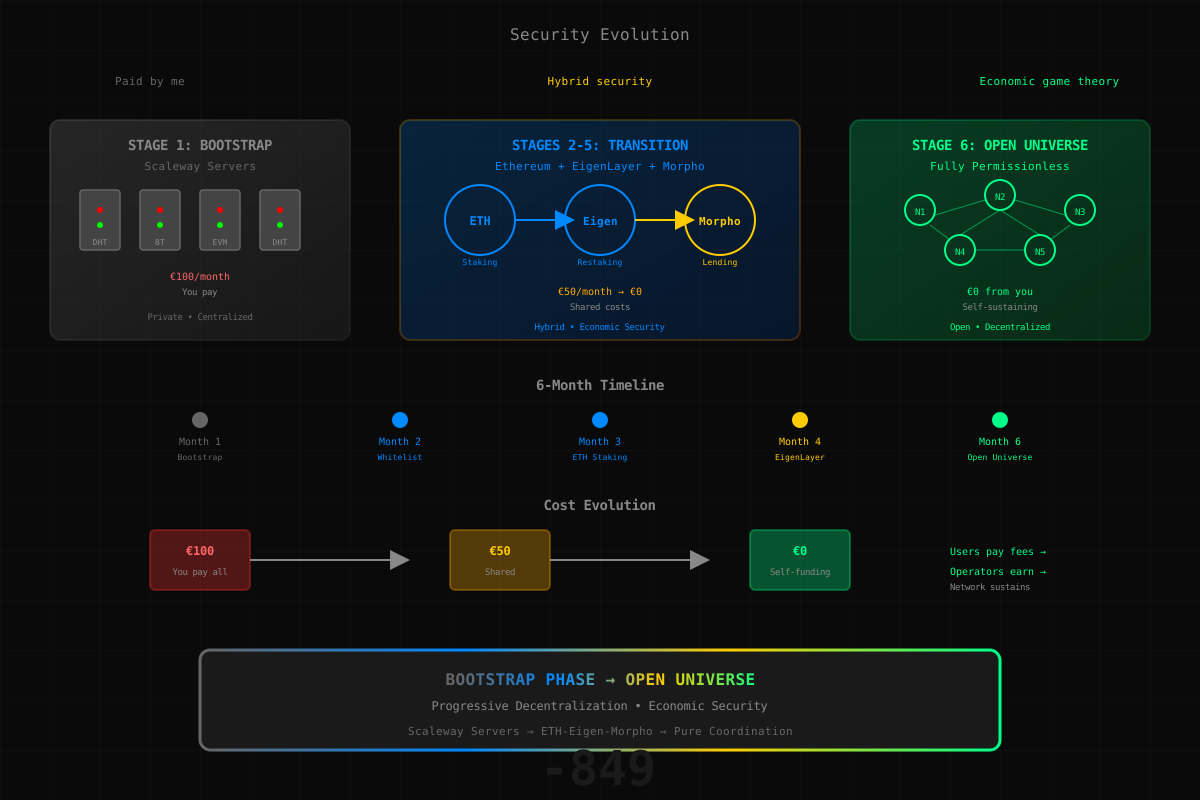
Post 849: Deployment Path - Private Infra to Open Universe
Deployment Path: Private Infra to Open Universe
From Scaleway Servers to Economic Security
Current Status: Post 848: R³ Fusion Engine First Draft
Implementation: universal-model/
The Question
“How do I deploy this?”
You have:
- Working R³ implementation (~650 lines)
- Scaleway account (paid infrastructure)
- Vision for open coordination system
Path:
Stage 1: Bootstrap (Scaleway, paid by you)
   ↓
Stage 2: Hybrid (mix of private and economic)
   ↓
Stage 3: Open Universe (pure economic security)
This post explains each stage.
Stage 1: Bootstrap on Scaleway
Deploy Private Network
What you have:
- Scaleway servers (you pay for compute)
- Private network (you control everything)
- Working R³ code
Deploy:
# Scaleway Server 1: DHT
ssh scaleway-1
cd universal-model/
python3 eigendht.py dht1 5001

# Scaleway Server 2: DHT (federated)
ssh scaleway-2
cd universal-model/
python3 eigendht.py dht2 5002 <scaleway-1-ip>:5001

# Scaleway Server 3: BitTorrent
ssh scaleway-3
cd universal-model/
python3 eigenbittorrent.py bt1 6001 5001

# Scaleway Server 4: EVM
ssh scaleway-4
cd universal-model/
python3 eigenevm.py evm1 7001 5001
What you get:
- Working R³ network
- Self-organizing coordination
- Gossip protocol active
- Auto-discovery working
Security:
- You pay for servers
- You control who connects
- Private network (firewall rules)
- No economic incentives yet
Cost:
- ~€50-100/month for 4 servers
- Your money securing the network
- Centralized (you’re the single point of failure)
This is the bootstrap phase.
Prove it works. Learn the patterns. Build confidence.
Stage 2: Hybrid Network
Open to Select Participants
Problem with Stage 1:
- You pay everything
- Centralized (you control all nodes)
- Single point of failure (you)
Solution: Allow others to join, but with restrictions.
Step 2.1: Whitelisted Participants
Modify eigendht.py:
def connect_peer(self, peer_address, peer_type):
    """Only accept whitelisted peers"""

    # Whitelist (manually curated)
    WHITELIST = [
        '192.168.1.10',  # Your Scaleway server
        '192.168.1.11',  # Trusted friend
        '192.168.1.12',  # Business partner
    ]

    peer_ip = peer_address.split(':')[0]

    if peer_ip not in WHITELIST:
        print(f"[DHT-{self.node_id}] Rejected non-whitelisted peer {peer_address}")
        return

    # Original connect logic
    ...
Now:
- Trusted friends can run nodes
- You still control whitelist
- Cost distributed among participants
- Still semi-centralized (you control whitelist)
This is hybrid: partially open, partially controlled.
Step 2.2: Add Economic Incentives
Problem: Why would friends run nodes? Altruism only goes so far.
Solution: Add basic economic game.
Create EigenStaking contract:
# eigenstaking.py
class EigenStakingNode(EigenEVMNode):
    """EVM with staking mechanics"""

    def __init__(self, node_id, ipc_port, dht_port, stake_amount=0):
        super().__init__(node_id, ipc_port, dht_port)
        self.stake_amount = stake_amount

    def stake(self, amount):
        """Lock stake"""
        self._append_series('staked', amount=amount)
        print(f"[STAKE-{self.node_id}] Staked {amount}")

    def slash(self, node_id, reason):
        """Slash bad actor"""
        self._append_series('slashed', node_id=node_id, reason=reason)
        print(f"[STAKE-{self.node_id}] Slashed {node_id}: {reason}")

    def reward(self, node_id, amount):
        """Reward good actor"""
        self._append_series('rewarded', node_id=node_id, amount=amount)
        print(f"[STAKE-{self.node_id}] Rewarded {node_id}: {amount}")
Now participants:
- Stake tokens (commit capital)
- Run nodes honestly
- Earn rewards (share of network fees)
- Get slashed if dishonest
This is economic security beginning.
But still on your Scaleway servers.
Stage 3: Ethereum Integration
Real Economic Security
Problem with Stage 2:
- Still running on your infrastructure
- Economic game but no real assets
- Trust in your EVM contract, not verified
Solution: Connect to Ethereum mainnet.
Step 3.1: Deploy Staking Contract
Smart contract on Ethereum:
// EigenR3Staking.sol
contract EigenR3Staking {
    mapping(address => uint256) public stakes;
    mapping(address => bool) public authorized;

    function stake() public payable {
        require(msg.value >= 1 ether, "Minimum 1 ETH");
        stakes[msg.sender] += msg.value;
        authorized[msg.sender] = true;

        emit Staked(msg.sender, msg.value);
    }

    function slash(address validator, string memory reason) public {
        require(authorized[msg.sender], "Not authorized");

        uint256 slashAmount = stakes[validator] / 10;  // 10% slash
        stakes[validator] -= slashAmount;

        emit Slashed(validator, slashAmount, reason);
    }

    function reward(address validator) public {
        require(authorized[msg.sender], "Not authorized");

        // Calculate reward from network fees
        uint256 rewardAmount = calculateReward(validator);
        payable(validator).transfer(rewardAmount);

        emit Rewarded(validator, rewardAmount);
    }
}
Deploy to Ethereum:
# Deploy contract
forge create EigenR3Staking --rpc-url $ETH_RPC --private-key $PRIVATE_KEY

# Contract address: 0x123...
Now:
- Real ETH staked
- Real slashing (lose money if dishonest)
- Real rewards (earn money if honest)
- Economic security via Ethereum
But still running on Scaleway.
Step 3.2: Integrate Staking into Nodes
Modify eigendht.py:
class EigenDHTNode(EigenNode):
    def __init__(self, node_id, ipc_port, eth_address=None):
        super().__init__('DHT', node_id, ipc_port)
        self.eth_address = eth_address
        self.staking_contract = '0x123...'  # Ethereum contract

    def connect_peer(self, peer_address, peer_type):
        """Only accept staked peers"""

        # Check if peer has stake on Ethereum
        peer_eth_address = self._resolve_eth_address(peer_address)
        stake = self._check_stake(peer_eth_address)

        if stake < 1 * 10**18:  # Minimum 1 ETH
            print(f"[DHT-{self.node_id}] Rejected unstaked peer {peer_address}")
            return

        # Original connect logic
        ...

    def _check_stake(self, eth_address):
        """Query Ethereum contract for stake"""
        from web3 import Web3
        w3 = Web3(Web3.HTTPProvider('https://eth-mainnet.g.alchemy.com/v2/...'))
        contract = w3.eth.contract(address=self.staking_contract, abi=ABI)
        return contract.functions.stakes(eth_address).call()
Now:
- Permissionless (anyone with 1 ETH can join)
- Economic security (lose stake if dishonest)
- Still on Scaleway (but now secured by Ethereum)
Hybrid architecture:
- Compute: Your Scaleway servers
- Security: Ethereum mainnet
Stage 4: Eigen Layer
Delegated Security
Problem with Stage 3:
- Need 1 ETH minimum per node
- High barrier to entry
- Liquidity locked
Solution: Use EigenLayer for restaking.
Step 4.1: Deploy AVS
EigenLayer Actively Validated Service (AVS):
// R3AVS.sol
contract R3AVS {
    IEigenLayerServiceManager public serviceManager;

    function registerOperator(address operator) public {
        require(isEigenStaker(operator), "Must be EigenLayer staker");

        operators[operator] = true;
        emit OperatorRegistered(operator);
    }

    function validateTask(bytes32 taskHash) public view returns (bool) {
        // Verify task was completed correctly
        return _verifyProof(taskHash);
    }

    function slashOperator(address operator, string memory reason) public {
        // Slash via EigenLayer
        serviceManager.slash(operator, slashAmount);
        emit Slashed(operator, slashAmount, reason);
    }
}
Benefits:
- Operators use existing ETH stake
- No new capital required
- Shared security across services
- EigenLayer handles slashing mechanics
Step 4.2: Integrate AVS
Modify nodes:
class EigenDHTNode(EigenNode):
    def connect_peer(self, peer_address, peer_type):
        """Only accept EigenLayer operators"""

        # Check if peer is registered EigenLayer operator
        peer_eth_address = self._resolve_eth_address(peer_address)
        is_operator = self._check_eigenlayer_operator(peer_eth_address)

        if not is_operator:
            print(f"[DHT-{self.node_id}] Rejected non-operator {peer_address}")
            return

        # Original connect logic
        ...
Now:
- Use existing EigenLayer operators
- Leverage restaked ETH security
- Lower barrier to entry
- Shared security model
Still on Scaleway, but security comes from EigenLayer.
Stage 5: Morpho Lending
Capital Efficiency
Problem with Stage 4:
- Operators need capital (ETH to restake)
- Capital locked (can’t use elsewhere)
Solution: Use Morpho for lending against stake.
Step 5.1: Collateralized Lending
Morpho integration:
// R3MorphoVault.sol
contract R3MorphoVault {
    IMorpho public morpho;

    function depositStake(uint256 amount) public {
        // Deposit stake as collateral
        morpho.deposit(address(this), amount, msg.sender);

        emit StakeDeposited(msg.sender, amount);
    }

    function borrow(uint256 amount) public {
        // Borrow against stake (up to 80% LTV)
        require(canBorrow(msg.sender, amount), "Insufficient collateral");

        morpho.borrow(address(this), amount, msg.sender);

        emit Borrowed(msg.sender, amount);
    }
}
Benefits:
- Operators stake 1 ETH
- Borrow 0.8 ETH against it
- Use borrowed funds elsewhere
- Keep node running on staked capital
Capital efficiency:
Without Morpho: 1 ETH locked → 1 ETH of security
With Morpho: 1 ETH → 1 ETH security + 0.8 ETH liquid
Now operators can:
- Stake ETH for R³ security
- Borrow against it on Morpho
- Deploy borrowed funds elsewhere
- Earn from multiple sources
Capital efficiency unlocked.
Stage 6: Open Universe
Fully Permissionless
Evolution complete:
Stage 1 (Bootstrap):
Infrastructure: Scaleway (you pay)
Security: Trust (you control)
Participants: Only you
Cost: €100/month from your pocket
Stage 3 (Ethereum):
Infrastructure: Scaleway (you pay)
Security: ETH staking (permissionless)
Participants: Anyone with 1 ETH
Cost: €100/month from you + network fees from users
Stage 6 (Open Universe):
Infrastructure: Distributed (operators pay)
Security: ETH-Eigen-Morpho (economic game theory)
Participants: Anyone (permissionless)
Cost: $0 from you, everything paid by economics
Final Architecture
Your role:
- Deploy initial contracts
- Bootstrap initial nodes
- Step back
Network runs itself:
- Operators stake ETH/restake via Eigen
- Operators borrow via Morpho for efficiency
- Operators earn fees from users
- Slashing punishes dishonesty
- Rewards incentivize honesty
Economic game theory secures everything.
No centralized control.
No single point of failure.
Pure coordination.
Implementation Timeline
Realistic Deployment Path
Week 1-2: Bootstrap
- Deploy on Scaleway (4 servers)
- Run DHT, BitTorrent, EVM
- Test self-organization
- Prove concept works
Week 3-4: Whitelist
- Add trusted participants
- Distribute cost
- Test federated mesh
- Build confidence
Month 2: Economic Incentives
- Deploy basic staking contract
- Add slash/reward mechanics
- Test economic game theory
- Iterate on parameters
Month 3: Ethereum Integration
- Deploy EigenR3Staking.sol
- Integrate ETH staking
- Real economic security
- Open to anyone with stake
Month 4: EigenLayer AVS
- Deploy R3AVS.sol
- Register with EigenLayer
- Leverage restaked security
- Lower barrier to entry
Month 5: Morpho Integration
- Deploy R3MorphoVault.sol
- Enable lending against stake
- Capital efficiency unlocked
- Operators maximize returns
Month 6: Open Universe
- Migrate nodes off Scaleway
- Operators run own infrastructure
- Full decentralization
- Economic security complete
6 months: Scaleway → Open Universe
Why This Path?
Progressive Decentralization
Not:
Day 1: Launch fully open permissionless network
Result: Chaos, no one knows what they're doing, network fails
Instead:
Month 1: You run everything (learn)
Month 2: Trusted group (distribute)
Month 3: Economic game (incentivize)
Month 6: Open universe (decentralize)

Result: Stable, proven, economically secured
Progressive decentralization = safe transition.
Learn Before Scaling
Bootstrap phase (Scaleway):
- Learn operational issues
- Fix bugs in controlled environment
- Understand gossip dynamics
- Tune parameters
Hybrid phase (whitelist):
- Test multi-operator coordination
- Discover edge cases
- Build operational knowledge
- Create documentation
Economic phase (staking):
- Prove economic incentives work
- Tune slash/reward ratios
- Test sybil resistance
- Validate game theory
Only after learning → scale to open universe.
Economic Sustainability
Scaleway phase:
- You pay: €100/month
- Unsustainable long-term
Staking phase:
- Operators pay infrastructure
- Network pays rewards from fees
- Self-sustaining economics
Open universe:
- You pay: €0
- Network self-funds through economics
- Pure coordination infrastructure
Economics must work before decentralizing.
Code Changes for Each Stage
Stage 1: Bootstrap (No Changes)
# Just deploy as-is
python3 eigendht.py dht1 5001
python3 eigenbittorrent.py bt1 6001 5001
python3 eigenevm.py evm1 7001 5001
Stage 2: Whitelist
# eigendht.py
WHITELIST = ['192.168.1.10', '192.168.1.11']

def connect_peer(self, peer_address, peer_type):
    peer_ip = peer_address.split(':')[0]
    if peer_ip not in WHITELIST:
        return  # Reject
    # ... rest of connect logic
Stage 3: Ethereum Staking
# eigendht.py
from web3 import Web3

def connect_peer(self, peer_address, peer_type):
    eth_addr = self._resolve_eth(peer_address)
    stake = self._check_stake(eth_addr)

    if stake < 1 * 10**18:  # < 1 ETH
        return  # Reject
    # ... rest of connect logic
Stage 4: EigenLayer
# eigendht.py
def connect_peer(self, peer_address, peer_type):
    eth_addr = self._resolve_eth(peer_address)
    is_operator = self._check_eigenlayer(eth_addr)

    if not is_operator:
        return  # Reject
    # ... rest of connect logic
Stage 5: Morpho
# eigenstaking.py (new file)
class MorphoIntegration:
    def deposit_and_borrow(self, stake_amount):
        # Deposit stake to Morpho
        morpho.deposit(stake_amount)

        # Borrow 80% LTV
        borrow_amount = stake_amount * 0.8
        morpho.borrow(borrow_amount)

        return borrow_amount  # Liquid capital
Stage 6: Open Universe
No code changes - just migration:
# Stop Scaleway nodes
# Operators start their own nodes
# Network self-organizes
# You step back
Economic Model
Fee Structure
Users pay fees for:
- Storing data (BitTorrent)
- Executing transactions (EVM)
- Querying DHT (lookups)
Fees distributed:
- 80% to operators (rewards)
- 10% to treasury (development)
- 10% to stakers (passive income)
Example:
User pays 0.1 ETH for large data storage
- 0.08 ETH → operators (split among seeders)
- 0.01 ETH → treasury
- 0.01 ETH → stakers

Operators earn by providing service
Network self-sustains
Slashing Conditions
Operators get slashed for:
- Lying about data availability
- Censoring transactions
- Refusing valid queries
- Attacking network
Slash amount:
- Minor infraction: 10% of stake
- Major infraction: 50% of stake
- Critical attack: 100% of stake (full slash)
Game theory:
- Cost of attacking > benefit from attacking
- Honest behavior more profitable than dishonest
Capital Requirements
Stage 3 (ETH staking):
- 1 ETH minimum stake
- ~$3,000 at current prices
- High barrier
Stage 4 (EigenLayer):
- Use existing restaked ETH
- $0 new capital
- Lower barrier
Stage 5 (Morpho):
- Borrow against stake
- Multiply capital efficiency
- Lowest barrier
Evolution: High barrier → Low barrier → Maximum efficiency
Migration Path
From Scaleway to Universe
Month 1-3: Both running
- Scaleway nodes (your infrastructure)
- Early staked nodes (operators)
- Hybrid network
Month 4: Majority external
- Most nodes run by operators
- You run only bootstrap nodes
- Network mostly decentralized
Month 6: Full migration
- All nodes run by operators
- You shut down Scaleway
- Network self-sufficient
Gradual transition = safe migration.
Conclusion
The Path
You asked:
“Can I deploy on Scaleway first, then extend with ETH-Eigen-Morpho?”
Answer: ✅ Yes. This is the correct path.
Journey:
1. Bootstrap on Scaleway (prove it works)
2. Add whitelist (distribute cost)
3. Add ETH staking (economic security)
4. Add EigenLayer (delegated security)
5. Add Morpho (capital efficiency)
6. Migrate to open universe (full decentralization)
Timeline: 6 months
Cost evolution:
- Month 1: €100/month (you pay)
- Month 3: €50/month (shared with operators)
- Month 6: €0/month (operators pay themselves via fees)
Security evolution:
- Month 1: Trust (you control)
- Month 3: Economic (ETH staking)
- Month 6: Pure game theory (slash/reward equilibrium)
This is how you bootstrap a coordination network.
Start small. Prove it works. Scale economics. Decentralize gradually.
From Scaleway servers to open universe.
From paid by you to secured by game theory.
This is the path.
Implementation: universal-model/
Theory: Post 815: R³ as Universal Fusion Engine
First Draft: Post 848: R³ Fusion Engine Implementation
Status: 🚀 DEPLOYMENT PATH DEFINED
∞