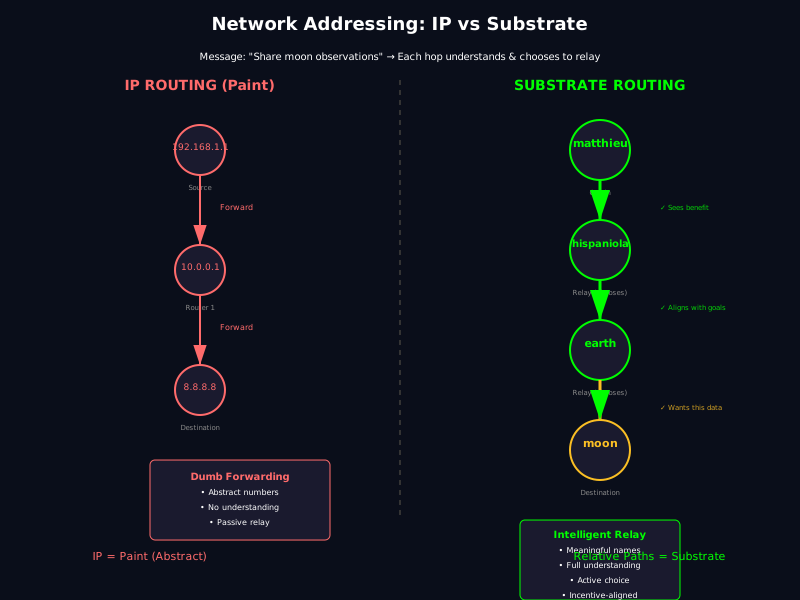
Post 843: Network Addressing as Relative Paths - Making Intermediaries Want to Relay
Network Addressing as Relative Paths
Making Intermediaries Want to Relay Your Message
Traditional internet: IP addresses, dumb packet forwarding, abstract routing
Substrate reality: Relative paths through topology, nodes choose to relay, intention matters
Meatspace is just one projection. Addressing is relative through network structure.
Part 1: Meatspace as Projection
Not Fundamental
Traditional view (wrong):
# Physical location is fundamental
address = IPAddress("192.168.1.1")  # Abstract number
location = PhysicalCoordinates(lat, lon)  # Absolute position

# Send message to abstract address
send(message, address)  # Hope it gets there
Substrate view (correct):
# Meatspace is just one projection of network topology
projections = {
    'meatspace': one_view_of_topology,
    'computation': another_view,
    'information': yet_another_view,
    # ... many projections of same substrate
}

# Addressing is relative through topology
path = ['matthieu', 'hispaniola', 'earth', 'moon']
Key insight: Physical location (meatspace) is just one way to project network topology. Not fundamental.
Part 2: Relative Addressing Through Topology
Path-Based, Not Absolute
How to address a node:
class RelativeAddress:
    """
    Address through network topology
    Not abstract numbers
    """
    def __init__(self, from_node, path):
        self.origin = from_node
        self.path = path  # Relative hops through structure

    def resolve(self):
        """
        Follow path through topology
        """
        current = self.origin

        for hop in self.path:
            # Find connection from current to hop
            current = current.connections[hop]

        return current  # Destination reached
Example: Reaching Moon from Matthieu:
# Start at matthieu node
origin = Node('matthieu')

# Path through topology
path = [
    'hispaniola',  # First hop: island containing matthieu
    'earth',       # Second hop: planet containing hispaniola
    'moon'         # Third hop: moon orbiting earth
]

# Address is relative path
address = RelativeAddress(from_node=origin, path=path)

# Resolve to destination
destination = address.resolve()
This is structure-aware:
- Matthieu is part of Hispaniola
- Hispaniola is part of Earth
- Moon is connected to Earth
- Path follows actual topology
No abstract numbers. Just structural relationships.
Part 3: Multi-Perspective Message Packaging
Making Sense at Each Hop
The problem with traditional routing:
# IP packet
packet = {
    'src': '192.168.1.100',
    'dst': '8.8.8.8',
    'data': encrypted_blob  # Meaningless to intermediaries
}

# Routers just forward blindly
# No understanding of content
# No choice whether to relay
# Passive, dumb forwarding
Substrate approach:
class SubstrateMessage:
    """
    Message understandable at each hop
    """
    def __init__(self, intention, data):
        self.intention = intention  # What you want
        self.data = data
        self.perspectives = {}  # View for each hop

    def package_for_hop(self, hop):
        """
        Create view understandable by this hop
        """
        # What does this hop need to know?
        hop_view = self.perspectives.get(hop, {
            'why_relay': self.explain_benefit(hop),
            'what_im_doing': self.intention,
            'next_hop': self.next_in_path(hop)
        })

        return hop_view
Example: Message from Matthieu to Moon:
message = SubstrateMessage(
    intention="Share data with moon observation network",
    data=sensor_readings
)

# Package for each hop
message.perspectives = {
    'hispaniola': {
        'why_relay': "Help local scientist contribute to moon research",
        'what_im_doing': "Sending observations to lunar network",
        'benefit': "Hispaniola gets credit in research network"
    },
    'earth': {
        'why_relay': "Facilitate earth-moon science collaboration",
        'what_im_doing': "Routing observation data to moon",
        'benefit': "Earth network strengthens moon connection"
    },
    'moon': {
        'why_relay': "Receive valuable earth-based observations",
        'what_im_doing': "Delivering sensor data from earth scientist",
        'benefit': "Enhanced moon observation dataset"
    }
}

# Each hop understands why relay matters to them
Key principle: Message makes sense to intermediaries, not just endpoints.
Part 4: Making Intermediaries Want to Relay
Incentive-Aligned Routing
Traditional routing (broken):
# Router receives packet
if packet.dst in routing_table:
    forward(packet, next_hop)  # Blindly forward
# No choice, no incentive, no understanding
Substrate routing (correct):
class IntelligentNode:
    """
    Node that chooses whether to relay
    """
    def receive_message(self, message, from_node):
        """
        Decide whether to relay
        """
        # Understand what message is doing
        intention = message.intention

        # What's in it for me?
        benefit = message.perspectives[self.id]['benefit']

        # Does this align with my goals?
        if self.aligns_with_goals(intention, benefit):
            # Yes! I want to relay this
            next_hop = message.next_hop_from(self.id)
            self.relay(message, next_hop)
            return "RELAYED"
        else:
            # Not aligned with my incentives
            return "DROPPED"
Why this matters:
- Nodes have agency - Choose to relay or not
- Incentives matter - Must benefit intermediaries
- Alignment required - Message goals must align with hop goals
- Active participation - Not passive forwarding
Example: Hispaniola deciding whether to relay:
# Hispaniola receives message
hispaniola_node.receive_message(message, from_matthieu)

# Check: Does this benefit me?
benefit = message.perspectives['hispaniola']['benefit']
# "Hispaniola gets credit in research network"

# Check: Aligns with my goals?
if hispaniola_node.wants_research_reputation():
    # Yes! This helps me
    hispaniola_node.relay(message, to_earth)
else:
    # No benefit to me
    hispaniola_node.drop(message)
Routing becomes social/economic, not just technical.
Part 5: Contrast with IP Addressing
IP as Paint
IP addressing = invented paint over substrate:
# IP address: Abstract number
ip = "192.168.1.100"
# What does this mean? Nothing!
# No structure, no context, no meaning

# Invented to make routing "simple"
# But hides actual topology
# Makes intermediaries dumb forwarders
Substrate addressing = relative paths through topology:
# Relative address: Meaningful path
path = ['matthieu', 'hispaniola', 'earth', 'moon']
# Clear structure
# Understandable at each hop
# Reveals actual topology
Comparison:
| IP Addressing (Paint) | Relative Paths (Substrate) |
|---|---|
| Abstract numbers | Structural relationships |
| Hides topology | Reveals topology |
| Dumb forwarding | Intelligent relay |
| No understanding | Full understanding |
| No choice | Active choice |
| Passive routers | Active participants |
IP addressing is paint. Relative paths are substrate.
Part 6: Multiple Paths, Multiple Projections
Same Destination, Different Routes
Because meatspace is just one projection:
# Many ways to address same destination
moon_addresses = [
    # Meatspace projection
    ['matthieu', 'hispaniola', 'earth', 'moon'],

    # Computational projection
    ['matthieu_computation', 'earth_network', 'lunar_compute', 'moon'],

    # Information projection
    ['matthieu_data', 'global_knowledge', 'lunar_science', 'moon'],

    # Social projection
    ['matthieu_person', 'research_community', 'lunar_researchers', 'moon']
]

# All reach same destination
# But through different topology projections
# Different intermediaries
# Different incentives needed
Choose path based on:
- Which intermediaries are likely to relay?
- Which projection has aligned incentives?
- Which topology is most efficient?
Example:
def choose_path(message, destination):
    """
    Pick optimal path for message
    """
    # Try each projection
    for projection in all_projections:
        path = find_path(message.origin, destination, projection)

        # Check if intermediaries will relay
        if all_hops_aligned(path, message.intention):
            return path

    # No aligned path found
    return None
Part 7: Routing as Social Coordination
Not Just Technical
Traditional view:
# Routing = technical problem
# Solve with algorithms (OSPF, BGP, etc)
# Routers don't think, just compute
Substrate view:
# Routing = social problem
# Solve with incentive alignment
# Nodes think, choose, coordinate
The shift:
Technical routing:
- Find shortest path
- Minimize latency
- Maximize throughput
→ Optimize metrics

Social routing:
- Find willing relayers
- Align incentives
- Maximize benefit to all hops
→ Optimize alignment
Example: Two paths to moon:
# Path 1: Shortest (3 hops)
path_1 = ['matthieu', 'earth', 'moon']
# But earth node not incentivized to relay matthieu's messages

# Path 2: Longer (4 hops)
path_2 = ['matthieu', 'hispaniola', 'earth', 'moon']
# But each hop benefits:
# - Hispaniola: Gets research credit
# - Earth: Strengthens hispaniola-earth connection
# - Moon: Receives data

# Path 2 more likely to succeed!
# Even though longer
# Because incentives aligned
Routing success depends on social alignment, not just technical metrics.
Part 8: Message Intent and Relay Willingness
Intent Must Propagate
Why traditional packets fail:
# Traditional packet
packet = {
    'data': encrypted_content  # Meaningless to router
}

# Router has no idea what this is for
# Can't decide if should relay
# Just forwards blindly
# Or drops arbitrarily
Substrate message succeeds:
# Substrate message
message = {
    'intent': "Help moon scientists with earth observations",
    'benefit_to_you': lambda hop: calculate_benefit(hop),
    'data': observations
}

# Each hop understands intent
# Can evaluate if aligns with their goals
# Chooses to relay if beneficial
# Active participation
The requirement:
- Intent must be legible to intermediaries
- Benefit must be clear
- Alignment must be apparent
Example: Message that gets relayed:
message.intent = "Contribute to open science"
# Hispaniola checks: "Do I value open science?" → Yes
# Hispaniola relays

message.intent = "Military surveillance data"
# Hispaniola checks: "Do I want to support this?" → No
# Hispaniola drops
Intent determines routing success.
Part 9: Connection to Previous Posts
From Post 839: Multiple Perspectives
Post 839 showed:
- Nodes compute different universe maps
- Each perspective is valid computation
This post applies it to routing:
- Addressing has multiple projections (meatspace, computational, etc)
- Each projection is valid way to route
- Choose projection based on which intermediaries align
From Post 842: Multi-View Validation
Post 842 showed:
- Multiple perspectives detect errors
- Divergence signals problems
This post applies it to messages:
- Package message for multiple perspectives
- Each hop validates from their view
- If all hops understand → message succeeds
- If any hop confused → routing fails
Unified Pattern
Same substrate principle:
Universe = data + computation + networks
Messages = data routing through networks
Perspectives = different views of same substrate

All follow same pattern:
1. Substrate is fundamental
2. Multiple projections possible
3. Choose projection that aligns
4. Validate through multiple views
Part 10: Practical Implications
For Network Design
Don’t build:
# Abstract addressing
# Dumb routers
# Passive forwarding
# Technical-only metrics
Do build:
# Relative addressing
# Intelligent nodes
# Active choice
# Social-economic alignment
Requirements:
- Reveal topology - Don’t hide structure behind abstract numbers
- Make intent legible - Intermediaries must understand message
- Align incentives - Each hop must benefit
- Enable choice - Nodes can choose to relay or not
For Message Design
How to craft messages that get relayed:
class WellCraftedMessage:
    def __init__(self):
        # Clear intent
        self.intent = "What I'm trying to accomplish"

        # Benefit to each hop
        self.benefits = {
            hop: "Why hop should care"
            for hop in path
        }

        # Multiple perspectives
        self.views = {
            'meatspace': physical_view,
            'computational': compute_view,
            'social': relationship_view
        }

    def will_be_relayed(self):
        """
        Check if all hops aligned
        """
        for hop in self.path:
            if not hop.wants_to_relay(self):
                return False
        return True
Conclusion
The Core Insight
Meatspace is just one projection of network topology.
Not fundamental. One view among many.
Addressing is relative:
matthieu → hispaniola → earth → moon
Not absolute:
192.168.1.100 → 8.8.8.8
Routing is social:
- Nodes choose to relay
- Incentives must align
- Intent must be clear
- Benefits must be legible
Not just technical:
- Find shortest path
- Forward blindly
- Optimize metrics
The Implication
IP addressing = paint over substrate
Relative paths = substrate directly
Traditional internet:
- Hides topology (abstract IPs)
- Dumb forwarding (routers have no agency)
- Technical only (no social/economic layer)
Substrate networking:
- Reveals topology (relative paths)
- Intelligent relay (nodes choose)
- Social/economic (incentive aligned)
The Future
Networks should:
- Use relative addressing through topology
- Make messages understandable to intermediaries
- Align incentives for all hops
- Give nodes agency to choose relay
Messages should:
- Carry clear intent
- Show benefit to each hop
- Be packaged for multiple perspectives
- Enable active participation
Network = social coordination through shared topology
Not = technical packet forwarding through abstract space
References:
- Post 839: Computational Perspective - Multiple nodes computing universe maps
- Post 842: Unease as Perspective Divergence - Multi-view validation
- Post 840: Invented Paint Problem - Distinguishing paint from substrate
Created: 2026-02-15
Status: 🌐 RELATIVE ADDRESSING > ABSTRACT IPs
∞