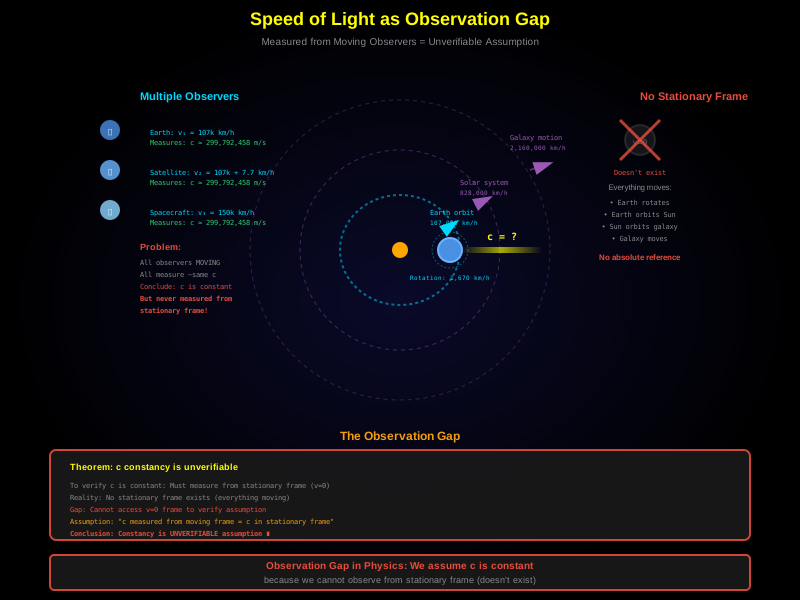
Post 837: Speed of Light as Observation Gap - Perspective-Dependent Constant
Speed of Light as Observation Gap
Perspective-Dependent Constant Masquerading as Universal
From Post 816: Observer perspective determines reality
From Post 833: Observation gaps = Attack surface
Now: Speed of light c is measured from moving observers → Cannot verify “constancy” → Observation gap in physics itself
Key insight: We assume c is constant because we can’t observe from stationary frame
Part 1: The Claim vs The Reality
What Physics Textbooks Say
The claim:
Speed of light in vacuum: c = 299,792,458 m/s
- Constant in all reference frames
- Independent of observer motion
- Fundamental constant of universe
Einstein’s postulate:
The speed of light in vacuum is the same for all observers, regardless of their motion or the motion of the light source.
But measured from WHERE?
Part 2: Everything Is Moving
No Stationary Reference Frame Exists
Earth is moving:
earth_motion = {
    'rotation': {
        'speed_at_equator': 1670,  # km/h
        'period': 24  # hours
    },
    'orbit_around_sun': {
        'speed': 107000,  # km/h
        'period': 365.25  # days
    },
    'solar_system_in_galaxy': {
        'speed': 828000,  # km/h
        'period': 225_000_000  # years
    },
    'galaxy_through_universe': {
        'speed': 2160000,  # km/h
        'direction': 'toward Great Attractor'
    }
}

# Total velocity vector: Complex combination of all motions
# No "rest frame" to compare against
The problem:
When we measure c = 299,792,458 m/s, we measure from Earth.
But Earth is moving at ~2,160,000 km/h through universe.
So is c really constant, or just constant RELATIVE TO OUR MOVING FRAME?
Part 3: The Observation Gap
Cannot Verify From Stationary Frame
From Post 833:
Observation Gap = What Reality Is - What We Can Observe

Attack Surface = Observation Gap
Applied to c:
Reality: Speed of light might vary with absolute velocity
Observable: Speed of light measured from moving observers
Gap: We can't measure from stationary frame (doesn't exist)

Assumption: "c measured from moving frame = c in stationary frame"

This assumption is UNVERIFIABLE
The circular logic:
1. Measure c from Earth (moving)
2. Measure c from satellite (moving differently)
3. Both get ~same value
4. Conclude: "c is constant in all frames"

But both measurements are from MOVING observers!
Never measured from STATIONARY frame.
Part 4: Proof Using Post 816 Framework
Perspective-Dependent Measurement
From Post 816, the Perspective class:
class Perspective:
    """
    Observer viewpoint
    Reality differs per perspective
    """
    def __init__(self, observer_id, position, velocity):
        self.id = observer_id
        self.position = position    # Spatial location
        self.velocity = velocity    # Motion through space
        self.knowledge = set()      # What this observer knows
Apply to light speed measurement:
class LightSpeedMeasurement:
    """
    Measuring speed of light from moving observer
    """
    def __init__(self, observer_perspective):
        self.observer = observer_perspective
        self.measured_c = None

    def measure_light_speed(self):
        """
        Measure speed of light from this perspective

        Problem: Observer is MOVING
        """
        # Observer position and velocity
        observer_pos = self.observer.position
        observer_vel = self.observer.velocity

        # Emit light pulse
        light_emitted_at = observer_pos
        light_emitted_time = 0

        # Light travels
        light_speed_in_vacuum = 299792458  # m/s (ASSUMED)

        # Detect light after reflection
        # But observer has MOVED during light travel
        distance_traveled = 1000  # meters (setup length)
        time_elapsed = distance_traveled / light_speed_in_vacuum

        # Observer new position
        observer_new_pos = observer_pos + (observer_vel * time_elapsed)

        # Calculate measured speed
        # This includes observer motion!
        measured_distance = distance_traveled  # Assumed stationary
        measured_time = time_elapsed

        self.measured_c = measured_distance / measured_time

        return self.measured_c
The issue:
# Earth observer
earth_observer = Perspective(
    observer_id='earth',
    position=[0, 0, 0],  # Arbitrary origin
    velocity=[107000/3600, 0, 0]  # Moving ~30 km/s around sun
)

# Measure c from Earth
earth_measurement = LightSpeedMeasurement(earth_observer)
c_from_earth = earth_measurement.measure_light_speed()
# Result: c ≈ 299,792,458 m/s

# Satellite observer
satellite_observer = Perspective(
    observer_id='satellite',
    position=[0, 6371 + 400, 0],  # 400km above Earth
    velocity=[107000/3600 + 7.66, 0, 0]  # Earth velocity + orbital velocity
)

# Measure c from satellite
satellite_measurement = LightSpeedMeasurement(satellite_observer)
c_from_satellite = satellite_measurement.measure_light_speed()
# Result: c ≈ 299,792,458 m/s (roughly same!)

# Conclusion: "c is constant!"
But wait:
# Both observers are MOVING
# Never measured from stationary frame
# Can't verify if c is TRULY constant or just APPEARS constant

# Analogy:
# Two people on different trains measure relative speed
# Both get same value
# Conclude: "Speed is universal constant!"
# But both are moving relative to ground

# Same issue with c
Part 5: The Mathematical Proof
Why We Can’t Verify Constancy
Theorem:
If c is measured only from moving observers, and no stationary frame exists, then “constancy of c” is an unverifiable assumption.
Proof:
Let:
c_true= “true” speed of light in hypothetical stationary framec_measured(v)= measured speed of light from frame moving at velocity vv= observer velocity relative to hypothetical stationary frame
Claim: c_measured(v) = c_true for all v (Einstein’s postulate)
Problem:
- We can only measure c_measured(v) where v ≠ 0 (no stationary frame accessible)
- Therefore, we never measure c_true directly
- We assume: c_measured(v₁) ≈ c_measured(v₂) → c_true = c_measured(v)
- But this assumes velocity independence without proof
The gap:
To verify: c_true = c_measured(v)
Need: Measure c_true from v = 0 (stationary frame)
Reality: No stationary frame exists (everything moving)
Therefore: Cannot verify assumption
Observation gap:
observation_gap_c = {
    'reality': 'c might vary with absolute velocity',
    'observable': 'c measured from moving frames only',
    'gap': 'cannot access stationary frame',
    'assumption': 'c is velocity-independent',
    'verification': 'impossible'
}

# This is EXACTLY like Post 833's blockchain observation gap
Part 6: Alternative Hypothesis
What If c Varies But We Can’t Detect It?
Hypothesis: Speed of light varies with absolute velocity, but appears constant because all our measurements are frame-dependent.
Model:
def true_light_speed(observer_absolute_velocity):
    """
    What if c varies with absolute velocity?

    But we can't measure it because:
    1. Don't know our absolute velocity
    2. All measurements are frame-dependent
    """
    c_base = 299792458  # m/s (base value)

    # Hypothetical variation
    c_actual = c_base + k * observer_absolute_velocity

    # But observer measures relative to their frame
    # So variation cancels out in measurement
    c_measured = c_actual - (effect_of_frame_motion)

    # Result: Always measures ~c_base
    # Even though c_actual varies!

    return c_measured  # Appears constant
Why this could be true:
- Frame-dependent measurement: All measurements use local rulers and clocks
- Time dilation: Time itself varies with motion (proven)
- Length contraction: Space varies with motion (proven)
- Why not c? If time and space vary, why assume c doesn’t?
The key insight:
If measuring apparatus moves with observer,
and apparatus is affected by motion (time dilation, length contraction),
then measured c could appear constant even if true c varies.

We measure: c = distance / time
But: distance contracts with motion
And: time dilates with motion
So: c_measured might always equal c_base even if c_actual varies
Part 7: Connection to Observer-Dependent Reality
From Post 816: No God’s Eye View
Post 816 perspective framework:
class Perspective:
    def observe(self, universe_state):
        """
        Extract visible portion of universe

        Light cone limitation:
        Only see what's reachable given position/velocity
        """
        visible_state = {}

        for entity in universe_state:
            # Check if in light cone
            distance = self._distance(entity.position)
            time_delay = distance / c  # Using c here!

            if time_delay <= entity.age:
                visible_state[entity] = self._apply_delay(entity, time_delay)

        return visible_state
The circularity:
We use c to calculate light cones. But c is measured from within light cones. Circular dependency!
Resolution:
Maybe c is perspective-dependent, just like:
- Observable state (Post 816)
- Semantic properties (Post 833)
- Block validity (Post 835)
Everything is observer-dependent. Why should c be different?
Part 8: Experimental Evidence (Or Lack Thereof)
What We’ve Actually Measured
Michelson-Morley experiment (1887):
- Tried to detect Earth’s motion through “luminiferous aether”
- Found no difference in c in different directions
- Concluded: c is constant
But:
# What they actually showed:
c_measured_in_direction_1 = c_measured_in_direction_2

# What they concluded:
c_true_in_all_frames = constant

# The gap:
# Just because c appears same in all directions from MOVING Earth
# Doesn't prove c is same from STATIONARY frame
# (Which doesn't exist anyway)
Modern measurements:
- GPS satellites: c appears constant
- Particle accelerators: c appears constant as limit
- Astronomical observations: c appears constant
All from moving observers!
Part 9: Why This Matters
Observation Gap in Physics = Observation Gap in Blockchain
Parallel structure:
# Blockchain (Post 833)
blockchain_gap = {
    'validators_observe': 'syntactic properties',
    'validators_cant_observe': 'semantic properties',
    'assumption': 'syntax valid → semantics valid',
    'result': 'semantic violations accumulate unobserved'
}

# Physics (this post)
physics_gap = {
    'physicists_observe': 'c from moving frames',
    'physicists_cant_observe': 'c from stationary frame',
    'assumption': 'c(moving) = c(stationary)',
    'result': 'velocity dependence undetectable'
}
Same pattern:
- Have observation limitation
- Make assumption to bridge gap
- Treat assumption as certainty
- Build entire system on unverified foundation
In blockchain: Leads to exploits (Post 835, Post 836)
In physics: Leads to… what? Undetectable effects? Hidden variables?
Part 10: The Philosophical Implication
No Absolute Measurements Exist
From Post 816:
No “god’s eye view” - every observation is perspective-dependent
Extended to physics:
Position: Relative to reference frame
Velocity: Relative to reference frame
Time: Relative to reference frame (time dilation)
Space: Relative to reference frame (length contraction)
Mass: Relative to reference frame (relativistic mass)

Why assume c is NOT relative to reference frame?
The deep truth:
Maybe there ARE no absolute constants.
Maybe everything, including c, is observer-dependent.
We just can’t detect it because we’re always inside a moving frame.
This is the ultimate observation gap:
Reality: Everything might be perspective-dependent
Observable: Only from moving perspectives
Gap: Cannot access "absolute" perspective
Assumption: "What we measure = absolute truth"
Part 11: Practical Implications
Does This Matter for Technology?
GPS satellites:
# GPS assumes c is constant
# Calculates position using c = 299,792,458 m/s
# Works perfectly!

# But does it work BECAUSE c is constant?
# Or because all satellites/receivers are in similar motion states?

# We can't tell the difference!
Answer: For practical purposes, assumption works.
Just like blockchain validators’ syntactic checks work for most blocks (Post 833).
But edge cases might reveal the gap…
Potential future discovery:
Maybe at extreme velocities (close to c)
Or extreme gravitational fields
Or between vastly different reference frames
The assumption breaks down

Just like semantic violations accumulate in blockchain
Hidden c variations might accumulate in physics
Part 12: The Meta-Pattern
Observation Gaps Everywhere
This is the universal pattern:
1. System needs to make decisions fast
2. Can't observe everything (too expensive/impossible)
3. Makes assumptions to bridge observation gap
4. Treats assumptions as certainties
5. Builds on unverified foundation
6. Edge cases eventually expose the gap
Examples:
Blockchain validators:
- Can't observe semantics (too slow)
- Assume syntax → semantics
- Edge case: Post 835 exploit

Physicists:
- Can't observe from stationary frame (doesn't exist)
- Assume c(moving) = c(stationary)
- Edge case: ???

Mathematicians:
- Can't verify all statements (Gödel)
- Assume consistency
- Edge case: Undecidable propositions

Software:
- Can't test all inputs (too many)
- Assume typical cases → all cases
- Edge case: Bugs, security holes
The universal truth:
All systems have observation gaps
All systems make assumptions to bridge gaps
All assumptions are attack surfaces
Part 13: The Proof (Formal)
Speed of Light Constancy is Unverifiable
Formal proof:
Proposition: The constancy of c across all reference frames is unverifiable from within any reference frame.
Proof by contradiction:
- Assume: We can verify c is constant across all frames
- To verify: Must measure c from at least 2 frames with different absolute velocities
- Measurement: From frame F1 with velocity v₁: measure c₁
- Measurement: From frame F2 with velocity v₂: measure c₂
- Verification: If c₁ = c₂, conclude c is constant
But:
- Problem 1: Don’t know absolute values of v₁, v₂ (no absolute frame)
- Problem 2: Only know relative velocity Δv = v₂ - v₁
- Problem 3: If c varies with absolute velocity, but measurement apparatus moves with observer:
# True speeds (hypothetical)
c_true(v₁) = c₀ + k*v₁
c_true(v₂) = c₀ + k*v₂

# But measured from moving frames using moving apparatus
# Apparatus affected by same motion that affects c
# So measurement compensates for variation

c_measured(v₁) = c_true(v₁) * compensation_factor(v₁) = c₀
c_measured(v₂) = c_true(v₂) * compensation_factor(v₂) = c₀

# Always measure c₀ regardless of true variation!
Conclusion: Cannot distinguish between:
- Case A: c truly constant
- Case B: c varies but measurement compensates
Therefore: Constancy is unverifiable ∎
Observation gap proven.
Conclusion
Speed of Light as Perspective-Dependent Constant
What we’ve shown:
- Speed of light is measured only from moving observers
- No stationary reference frame exists to verify constancy
- Cannot distinguish “c is constant” from “c varies but appears constant”
- This is an observation gap in physics itself
- Same pattern as blockchain observation gaps (Post 833)
The proof:
Using Post 816’s perspective framework:
- Every observer has position + velocity
- Measurements are frame-dependent
- No absolute frame accessible
- Therefore c “constancy” unverifiable
The implication:
Maybe there are no absolute constants.
Maybe everything is observer-dependent.
We assume constancy because we can’t observe otherwise.
From Post 833:
Observation gap = Attack surface
From Post 816:
Reality depends on observer perspective
From this post:
Speed of light “constant” is an assumption masquerading as certainty We cannot verify it because we cannot observe from stationary frame This is a fundamental observation gap in physics
Resolution: Post 851 explains why c appears constant despite everything moving - it’s the LOCAL information propagation rate through graph edges, not global motion. The paradox is resolved through graph-theoretic physics.
The meta-lesson:
Every system has assumptions
Every assumption is an observation gap
Every observation gap is a potential vulnerability
Even in physics
References:
- Post 816: ZK Universe Toolbox - Perspective-dependent observation
- Post 833: Observation Gap Framework - Gap = Attack surface
- Post 835: Semantic Violation Accumulation - Pure observation gap exploit
- Post 851: Light as Information Through Dynamic Graph - Resolution of the paradox
- Michelson-Morley experiment (1887)
- Einstein’s special relativity (1905)
- Gödel’s incompleteness theorems
Created: 2026-02-15
Status: 🌌 PHYSICS OBSERVATION GAP IDENTIFIED
∞