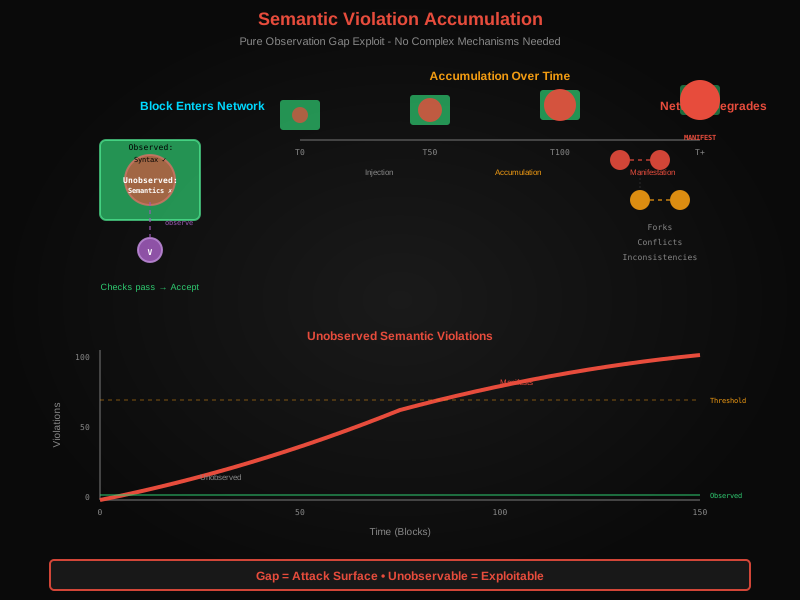
Post 835: Semantic Violation Accumulation - Pure Observation Gap Exploit
Semantic Violation Accumulation
Pure Observation Gap Exploit Without Trust Mechanisms
From Post 833: Validators have observation gaps
Now: Show pure exploit - semantic violations accumulate because validators simply can’t observe them
Key insight: No fancy mechanisms needed - observation limitation IS the attack surface
Part 1: The Simple Reality
Validators Can’t See Everything
What validators observe (fast, <1s):
observed_properties = {
    'pow_hash': check_hash(block),      # 1 hash operation
    'merkle_root': check_merkle(block), # Tree traversal
    'signatures': check_sigs(block),    # ECDSA verifications
    'timestamp': check_time(block),     # Simple comparison
}
# These are syntactic, local, cheap
What validators can’t observe (slow, >minutes):
unobserved_properties = {
    'global_consistency': check_all_blocks(block),     # Too expensive
    'semantic_correctness': verify_implications(block), # Too expensive
    'utxo_conflicts': check_full_utxo_set(block),     # Too expensive
    'future_conflicts': predict_forks(block),          # Impossible
}
# These are semantic, global, expensive
The gap:
Observation_Gap = unobserved_properties
                = What blocks actually are - What validators see
Part 2: The Attack (No Complexity)
Just Exploit What They Don’t See
Step 1: Craft block with hidden semantic violation
# Create block
block = {
    # Syntactic properties (validators observe these)
    'pow': mine_valid_pow(),           # ✓ Valid
    'merkle': compute_merkle(txs),     # ✓ Valid
    'signatures': sign_txs(txs),       # ✓ Valid
    'timestamp': current_time(),       # ✓ Valid

    # Semantic properties (validators DON'T observe these)
    'transactions': [
        tx_1,  # Spends output from tx_3
        tx_2,  # Normal transaction
        tx_3,  # Creates output for tx_1
    ]
    # Transaction ordering is invalid!
    # tx_1 depends on tx_3, but tx_1 comes first
    # Validators don't check topological ordering (too expensive)
}
Step 2: Broadcast to network
broadcast(block)
Step 3: Validators receive and check
def validator_checks(block):
    # Check observed properties
    if not check_pow(block['pow']):
        return reject()

    if not check_merkle(block['merkle']):
        return reject()

    if not check_signatures(block['signatures']):
        return reject()

    if not check_timestamp(block['timestamp']):
        return reject()

    # All observed checks pass
    # Would need to check semantic ordering but too expensive
    # So accept based on partial observation
    return accept()
Step 4: Block propagates
# Validators accept → forward to peers → network propagates
# Semantic violation hidden inside accepted block
Step 5: Violation manifests later
# Eventually someone tries to execute transactions
# Realizes tx_1 depends on tx_3 that comes after
# But block already deep in chain
# Can't remove it without reorganization
# Network must deal with inconsistency
That’s it. No ZK proofs. No complex mechanisms. Just observation gap.
Part 3: Why Violations Accumulate
Each Block Adds Unobserved Entropy
Block 1 enters network:
network_state = {
    'observed_violations': 0,    # Validators see no problems
    'unobserved_violations': 1,  # One semantic violation hidden
}
Block 2 enters:
network_state = {
    'observed_violations': 0,    # Still looks fine
    'unobserved_violations': 2,  # Another violation added
}
Block N enters:
network_state = {
    'observed_violations': 0,    # Validators still see nothing
    'unobserved_violations': N,  # N violations accumulated
}
Eventually violations manifest:
# When N exceeds threshold
if network_state['unobserved_violations'] > threshold:
    # Inconsistencies can't be hidden anymore
    # Network forks, reorgs, confusion
    # System degraded
The accumulation:
T0:   0 violations → Network healthy
T10:  10 violations → Network seems healthy (violations unobserved)
T50:  50 violations → Network seems healthy (violations still unobserved)
T100: 100 violations → MANIFESTATION - forks, reorgs, chaos
Part 4: Concrete Example: Transaction Ordering
Simple Semantic Violation
Malicious block:
block_N = {
    'transactions': [
        {
            'id': 'tx_A',
            'inputs': ['output_from_tx_C'],  # Depends on tx_C
            'outputs': ['output_A'],
            'signature': valid_sig_A,
        },
        {
            'id': 'tx_B',
            'inputs': ['existing_utxo_123'],
            'outputs': ['output_B'],
            'signature': valid_sig_B,
        },
        {
            'id': 'tx_C',
            'inputs': ['existing_utxo_456'],
            'outputs': ['output_for_tx_A'],  # Created AFTER tx_A tried to spend it!
            'signature': valid_sig_C,
        }
    ],
    'pow': valid_pow,
    'merkle': compute_merkle([tx_A, tx_B, tx_C]),
    'signatures': [valid_sig_A, valid_sig_B, valid_sig_C],
}
Validator observes:
# Check PoW
assert block_N['pow'] is valid  # ✓ Pass

# Check Merkle
assert block_N['merkle'] == compute_merkle(transactions)  # ✓ Pass

# Check signatures
for tx in block_N['transactions']:
    assert verify_signature(tx['signature'])  # ✓ All pass

# All observed checks pass → Accept block
What validator doesn’t observe:
# Would need to check topological ordering
def check_ordering(transactions):
    for tx in transactions:
        for input in tx['inputs']:
            # Check input created before tx
            creator_tx = find_tx_creating(input)
            if creator_tx.index > tx.index:
                return False  # Violation!
    return True

# But this check is expensive (must traverse all txs)
# Validator skips it for speed
# Semantic violation goes unobserved
Result:
Block accepted. Semantic violation hidden. Accumulates with other violations.
Part 5: Concrete Example: Double-Spend
UTXO Set Observation Gap
Setup:
# Block 100 (already in chain)
block_100 = {
    'transactions': [
        {
            'id': 'tx_old',
            'inputs': ['utxo_789'],
            'outputs': ['output_to_alice'],
        }
    ]
}
# UTXO 789 was spent in block 100
Malicious block:
# Block 200 (current)
block_200 = {
    'transactions': [
        {
            'id': 'tx_new',
            'inputs': ['utxo_789'],  # Spending SAME utxo again!
            'outputs': ['output_to_attacker'],
            'signature': valid_sig,  # Same key, so signature valid
        }
    ],
    'pow': valid_pow,
    'merkle': compute_merkle([tx_new]),
}
Validator observes:
# Check signature
assert verify_signature(tx_new['signature'], tx_new)  # ✓ Pass
# Signature is valid for this UTXO

# Check PoW
assert block_200['pow'] is valid  # ✓ Pass

# Check Merkle
assert block_200['merkle'] == compute_merkle([tx_new])  # ✓ Pass

# All observed checks pass → Accept
What validator doesn’t observe:
# Would need to check UTXO was not already spent
def check_utxo_unspent(utxo_id):
    # Must scan entire blockchain
    for block in blockchain:
        for tx in block['transactions']:
            if utxo_id in tx['inputs']:
                return False  # Already spent!
    return True

# This requires checking 100 blocks = expensive
# Validator skips for speed
# Double-spend goes unobserved
Result:
UTXO spent twice. Semantic violation. Unobserved. Accumulates.
Part 6: Why Validators Don’t Check Semantics
The Decentralization Trade-off
If validators checked everything:
def full_validation(block):
    # Syntactic checks (~100ms)
    check_pow(block)
    check_merkle(block)
    check_signatures(block)

    # Semantic checks (~minutes)
    check_transaction_ordering(block)      # O(n²)
    check_utxo_conflicts(block)           # O(blockchain_size)
    check_global_consistency(block)       # O(all_blocks)
    check_cross_implementation(block)     # Impossible

    return all_checks_passed

# Time: Minutes per block
# Hardware needed: High-end servers with full blockchain
# Who can validate: Only large players
# Result: Centralization
Actual validation (fast):
def fast_validation(block):
    # Only syntactic checks (~100ms)
    check_pow(block)           # O(1)
    check_merkle(block)        # O(log n)
    check_signatures(block)    # O(n)

    return syntactic_checks_passed

# Time: <1 second per block
# Hardware needed: Raspberry Pi
# Who can validate: Anyone
# Result: Decentralization

# But: Semantic violations go unobserved
The choice:
Deep validation:
  ✓ Catch semantic violations
  ✗ Only powerful nodes can validate
  ✗ Centralization

Fast validation:
  ✓ Anyone can validate
  ✓ Decentralization
  ✗ Semantic violations unobserved
Bitcoin chooses fast validation. Creates observation gap. Enables attack.
Part 7: Accumulation Timeline
How Violations Build Up
Epoch 0-10: Injection
Adversary injects blocks with hidden semantic violations
Validators check syntax → pass → accept
Network propagates blocks normally
No detection
Epoch 11-50: Accumulation
More blocks with violations enter
Each adds unobserved entropy
Network state diverging imperceptibly
Validators still see "all valid"
Epoch 51-100: Threshold
Accumulated violations reaching critical mass
Small inconsistencies starting to surface
Some implementations notice problems
Most validators unaware
Epoch 100+: Manifestation
Violations can't stay hidden anymore
Network forks visible
Reorganizations happening
Transaction conflicts surfacing
System degraded
The curve:
Unobserved violations accumulating:

Violations
  │
  │                                ╱
  │                              ╱
100 │                            ╱
  │                           ╱
  │                         ╱
 50 │                      ╱
  │                    ╱
  │                 ╱
  │              ╱
  0 │─────────╱───────────────────→ Time
    0      50     100    150    200

    ← Unobserved →  ← Manifests →
Part 8: Why Detection is Hard
Observation Gap Applies to Detection Too
Problem:
To detect semantic violations, must observe semantic properties.
But semantic properties are what validators can’t observe (too expensive).
Circularity:
Attack exploits: Validators can't observe semantics
Detection requires: Observing semantics
Therefore: Detection as hard as prevention
Example:
# To detect transaction ordering violation
def detect_ordering_violation(block):
    # Must check ALL transactions for dependencies
    for tx in block['transactions']:
        for input in tx['inputs']:
            creator = find_creator_tx(input)
            if creator.index > tx.index:
                return True  # Violation detected

    return False

# But this is expensive (why validators don't do it)
# So detection has same cost as prevention
# Both require observing unobserved dimensions
Part 9: No Fancy Mechanisms Needed
Pure Observation Limitation
The attack doesn’t need:
- ❌ Zero knowledge proofs
- ❌ Complex cryptography
- ❌ Social engineering
- ❌ Network manipulation
- ❌ Trust exploitation
The attack only needs:
- ✅ Observation gap (validators can’t see semantic properties)
- ✅ Malicious blocks (semantic violations hidden in unobserved dimensions)
- ✅ Time (violations accumulate)
That’s it.
The simplicity:
while True:
    # Craft block: syntax valid, semantics invalid
    block = create_block(syntax=valid, semantics=invalid)

    # Broadcast
    broadcast(block)

    # Validators check syntax → pass → accept
    # Semantic violation unobserved → accumulates

    # Repeat
No complex mechanisms. Just exploitation of observation limitation.
Part 10: Why This is Fundamental
Can’t Be Fully Fixed
The impossibility:
You cannot have:
1. Fast validation (decentralization)
2. Deep validation (security)
3. Both at once

Must choose.
If you fix observation gap (deep validation):
def deep_validation(block):
    # Check everything
    check_syntax(block)     # ✓ Fast
    check_semantics(block)  # ✗ Slow
    check_global(block)     # ✗ Very slow

    # Result: Only powerful nodes can validate
    # Decentralization lost
If you keep fast validation:
def fast_validation(block):
    # Check only syntax
    check_syntax(block)  # ✓ Fast

    # Result: Decentralization preserved
    # But semantic violations unobserved
    # Attack surface remains
There’s no escape. Must choose: Decentralization OR complete security.
Bitcoin chooses decentralization. Accepts attack surface.
Part 11: Defense Strategies (All Imperfect)
Can Only Mitigate, Not Eliminate
Defense 1: Probabilistic checking
def probabilistic_validation(block):
    # Always check syntax
    check_syntax(block)

    # Sometimes check semantics (1% of blocks)
    if random() < 0.01:
        check_semantics(block)

    return result

# Catches 1% of violations
# Better than nothing
# But 99% still get through
Defense 2: Spot-check high-risk properties
def targeted_validation(block):
    check_syntax(block)

    # Check specific semantic properties known to be exploited
    check_recent_utxo_conflicts(block)  # Limited check
    check_suspicious_timestamps(block)  # Limited check

    return result

# Catches known attack patterns
# But not novel violations
Defense 3: Reputation-based priority
def reputation_validation(block):
    check_syntax(block)

    # If from low-reputation source, check deeper
    if sender_reputation(block) < threshold:
        check_semantics(block)

    return result

# Focuses expensive checks on suspicious sources
# But new attackers start with neutral reputation
Defense 4: Multi-implementation consensus
def consensus_validation(block):
    results = [
        bitcoin_core.validate(block),
        btcd.validate(block),
        bitcoin_knots.validate(block),
    ]

    # Require agreement
    if not all(results):
        return reject()

    return accept()

# Different implementations might catch different violations
# But all have same fundamental observation gap
All defenses are imperfect. Observation gap remains.
Part 12: Real-World Feasibility
This Attack Works
Requirements:
- ✅ Understand what validators don’t observe (public knowledge)
- ✅ Craft blocks with hidden semantic violations (possible)
- ✅ Broadcast to network (anyone can)
- ✅ Wait for accumulation (patience)
No special capabilities needed. No advanced cryptography. Just observation gap exploitation.
Historical evidence:
- CVE-2013-3220: Semantic violation passed validation
- 2010 Value overflow: Semantic violation accepted
- 2018 BCH/BSV split: Semantic disagreement caused permanent fork
This is not theoretical. It has happened. It will happen again.
Part 13: The Core Insight
Gap = Attack Surface
From Post 833:
Observation_Gap = Block_Reality - Validator_Observation

Attack_Surface = Observation_Gap

The larger the gap, the more attack surface.
Applied here:
Validators observe: Syntax (4 dimensions)
Blocks have: Syntax + Semantics (8+ dimensions)

Gap = Semantics (4+ dimensions)

Attack = Hide violations in semantic dimensions
The fundamental equation:
Unobservable = Exploitable

If validators can't see it, adversaries can hide malicious properties there.

Simple. Fundamental. Inescapable.
Conclusion
Semantic Violation Accumulation
What it is:
- Validators have observation gap (can’t observe semantic properties)
- Adversary crafts blocks with syntax valid, semantics invalid
- Validators check syntax → pass → accept
- Semantic violations hidden in unobserved dimensions
- Each block adds unobserved entropy
- Violations accumulate over time
- Eventually manifest as forks, conflicts, degradation
Why it works:
- Fast validation requires skipping expensive semantic checks
- Adversary exploits what’s not checked
- No fancy mechanisms needed
- Just observation gap + time
Why it’s fundamental:
- Can’t have fast validation AND deep validation
- Must choose: Decentralization OR complete security
- Bitcoin chooses decentralization
- Accepts observation gap
- Creates attack surface
The equation:
Fast Validation → Observation Gap → Attack Surface

Unobservable = Exploitable

Violations + Time = Accumulation → Degradation
From Post 833:
Observation gap = Attack surface
From this post:
Semantic violations accumulate in observation gaps - no complex mechanisms needed
The warning:
What you can’t observe, you can’t secure
Observation limitation IS the vulnerability
References:
- Post 833: Observation Gap Exploitation - Validator observation limits
- Post 821: Entropy Poisoning - Gradual accumulation
- CVE-2013-3220, 2010 Value overflow, 2018 BCH/BSV split
Created: 2026-02-15
Status: 🔒 PURE SEMANTIC EXPLOIT SPECIFIED
∞