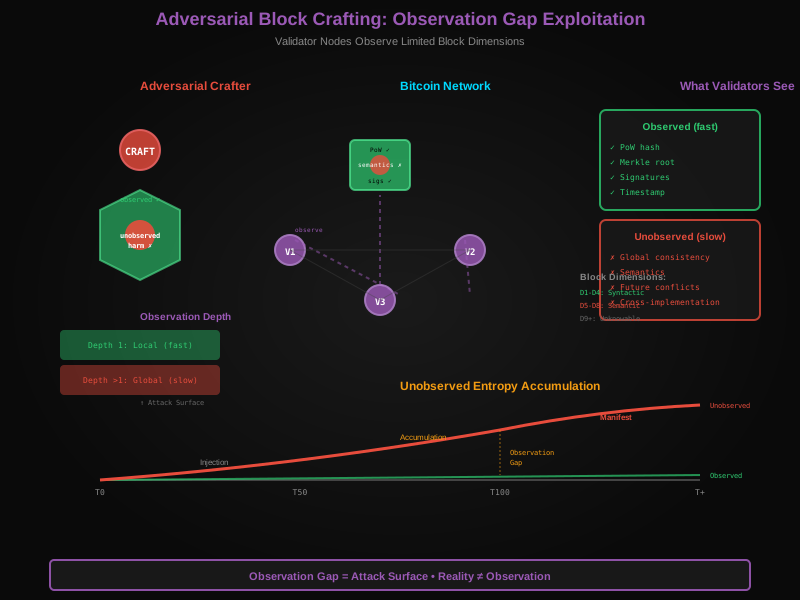
Post 833: Adversarial Block Crafting - Observation Gap Exploitation
Adversarial Block Crafting: Observation Gap Exploitation
Exploiting What Validator Nodes Don’t Observe
From Post 830: Everything is nodes observing nodes
From Post 821: Entropy poisoning via gradual injection
Now: Craft block nodes exploiting validator observation gaps
Key insight: Validator nodes observe limited block properties → adversary crafts blocks with harmful unobserved properties
Part 1: Node Perspective on Validation
Validators as Observer Nodes
From Post 830:
Everything is nodes observing nodes Observation is always partial
Applied to Bitcoin:
# Block node (has many properties)
block_node = {
    'observed': {
        'pow_hash': '<hash>',        # Validators observe this
        'merkle_root': '<root>',     # Validators observe this
        'signatures': [sig1, sig2],  # Validators observe this
        'timestamp': 1234567890,     # Validators observe this
    },
    'unobserved': {
        'global_consistency': False,  # Validators DON'T observe this
        'semantic_correctness': False, # Validators DON'T observe this
        'future_conflicts': True,     # Validators DON'T observe this
        'implementation_behavior': {} # Validators DON'T observe this
    }
}

# Validator node (observes block node)
validator_node = {
    'can_observe': ['pow_hash', 'merkle_root', 'signatures', 'timestamp'],
    'cannot_observe': ['global_consistency', 'semantic_correctness',
                       'future_conflicts', 'implementation_behavior']
}
The observation gap:
Validator nodes have limited observation capacity. They can only observe:
- Properties computable locally (<1 second)
- Properties available in isolation
- Syntactic structure
Validator nodes cannot observe:
- Properties requiring global state
- Properties requiring future knowledge
- Semantic correctness
- Cross-implementation consistency
Part 2: Why Observation is Limited
The Decentralization Requirement
Design constraint:
Validation must be fast to enable weak nodes to participate
Consequence:
Fast observation = limited observation depth
What this means:
# Fast observation (what validators do)
def fast_observe(block_node):
    """
    Observe only properties computable quickly

    These are syntactic, local properties
    """
    observations = {
        'pow': observe_pow(block_node),           # 1 hash operation
        'merkle': observe_merkle(block_node),     # Tree traversal
        'sigs': observe_signatures(block_node),   # ECDSA checks
        'timestamp': observe_timestamp(block_node), # Simple comparison
    }
    return observations

# Deep observation (what validators can't afford)
def deep_observe(block_node):
    """
    Observe semantic properties

    Too expensive - would centralize network
    """
    observations = {
        'global_consistency': check_entire_blockchain_state(block_node),  # Expensive
        'semantic_correctness': verify_all_implications(block_node),       # Expensive
        'future_conflicts': predict_fork_probability(block_node),          # Impossible
        'cross_implementation': check_all_software_versions(block_node),  # Impossible
    }
    return observations  # Can't compute this in <1 second
The trade-off:
- Deep observation: Catches everything, but only powerful nodes can do it → centralization
- Fast observation: Misses semantic issues, but all nodes can do it → decentralization
Bitcoin chooses fast observation to preserve decentralization.
Part 3: The Observation Gap
What Adversaries Exploit
Gap between reality and observation:
# Reality: Block has many properties
block_reality = {
    'dimension_1': 'pow_hash',
    'dimension_2': 'merkle_root',
    'dimension_3': 'signatures',
    'dimension_4': 'timestamp',
    'dimension_5': 'global_consistency',  # Hidden
    'dimension_6': 'semantic_correctness', # Hidden
    'dimension_7': 'future_conflicts',    # Hidden
    'dimension_8': 'implementation_behavior', # Hidden
    # ... many more dimensions
}

# Observation: Validator sees subset
validator_observation = {
    'dimension_1': 'pow_hash',      # ✓ Observed
    'dimension_2': 'merkle_root',   # ✓ Observed
    'dimension_3': 'signatures',    # ✓ Observed
    'dimension_4': 'timestamp',     # ✓ Observed
    'dimension_5': None,            # ✗ Unobserved
    'dimension_6': None,            # ✗ Unobserved
    'dimension_7': None,            # ✗ Unobserved
    'dimension_8': None,            # ✗ Unobserved
}
The observation gap:
Observation_Gap = Block_Reality - Validator_Observation
                = Dimensions 5,6,7,8...
                = Semantic properties
Adversary’s strategy:
Craft block where observed dimensions pass validation, but unobserved dimensions cause harm
Part 4: Crafting Adversarial Blocks
Exploiting Unobserved Dimensions
Honest block (all dimensions valid):
honest_block = {
    'pow_hash': valid_pow(),           # ✓ Valid (observed)
    'merkle_root': valid_merkle(),     # ✓ Valid (observed)
    'signatures': valid_sigs(),        # ✓ Valid (observed)
    'timestamp': valid_time(),         # ✓ Valid (observed)
    'global_consistency': True,        # ✓ Valid (unobserved)
    'semantic_correctness': True,      # ✓ Valid (unobserved)
    'future_conflicts': False,         # ✓ Valid (unobserved)
}

# Validators observe dimensions 1-4 → all valid → accept block
Adversarial block (observed valid, unobserved invalid):
adversarial_block = {
    'pow_hash': valid_pow(),           # ✓ Valid (observed)
    'merkle_root': valid_merkle(),     # ✓ Valid (observed)
    'signatures': valid_sigs(),        # ✓ Valid (observed)
    'timestamp': edge_case_time(),     # ✓ Valid (observed, but borderline)
    'global_consistency': False,       # ✗ Invalid (unobserved!)
    'semantic_correctness': False,     # ✗ Invalid (unobserved!)
    'future_conflicts': True,          # ✗ Invalid (unobserved!)
}

# Validators observe dimensions 1-4 → all valid → accept block
# But dimensions 5-7 are invalid → network harm
Key point:
Validators make decision based on partial observation. Adversary crafts blocks that look valid in observed dimensions but are invalid in unobserved dimensions.
Part 5: Examples of Observation Gaps
Concrete Attack Vectors
Example 1: Timestamp edge case (dimension boundary)
# Block node properties
block = {
    'timestamp': now + 7199,  # 1 second before 2-hour limit
    'pow': valid_nonce(),
}

# Validator A observes (clock slightly behind)
validator_A_observation = {
    'timestamp': 'valid',  # now + 7199 < now + 7200 ✓
    'pow': 'valid',
}
# Validator A: Accept block

# Validator B observes (clock slightly ahead)
validator_B_observation = {
    'timestamp': 'invalid',  # now + 7199 > now + 7200 ✗
    'pow': 'valid',
}
# Validator B: Reject block

# Network splits based on clock variance
# This is unobserved dimension: 'clock_synchronization'
Example 2: Transaction ordering (semantic property)
# Block node
block = {
    'transactions': [
        tx_5,  # Creates UTXO_A
        tx_1,  # Spends UTXO_B (created later!)
        tx_3,  # Creates UTXO_B
    ],
    'merkle_root': compute_merkle([tx_5, tx_1, tx_3]),  # ✓ Valid
    'signatures': [sig_5, sig_1, sig_3],  # ✓ All valid
}

# Validator observation (fast)
validator_observation = {
    'merkle_root': 'valid',    # ✓ Matches transactions
    'signatures': 'all_valid', # ✓ All verify
}
# Validator: Accept

# Unobserved dimension: 'topological_ordering'
# tx_1 spends output created by tx_3, but tx_1 comes before tx_3!
# Semantic violation not caught by fast observation
Example 3: Double-spend (requires global state)
# Block A (already in chain)
block_A = {
    'transactions': [tx_spending_UTXO_123],
}

# Block B (adversarial)
block_B = {
    'transactions': [tx_also_spending_UTXO_123],  # Same UTXO!
    'signatures': valid_sig(),  # ✓ Signature checks out
    'merkle_root': valid_merkle(),  # ✓ Merkle correct
}

# Validator observation (local, no global state)
validator_observation = {
    'signatures': 'valid',
    'merkle': 'valid',
}
# Validator: Accept (doesn't know about block_A spending same UTXO)

# Unobserved dimension: 'utxo_set_consistency'
# Requires comparing against entire blockchain history
# Too expensive for fast observation
Example 4: Script interpreter difference (implementation-specific)
# Block node
block = {
    'transaction': {
        'script': 'OP_IF <nested_conditions> OP_ENDIF',
        'signature': valid_sig(),
    }
}

# Bitcoin Core validator observation
core_observation = {
    'script_valid': True,   # Interprets one way
    'signature': 'valid',
}
# Core validator: Accept

# btcd validator observation
btcd_observation = {
    'script_valid': False,  # Interprets differently!
    'signature': 'valid',
}
# btcd validator: Reject

# Unobserved dimension: 'cross_implementation_agreement'
# Different implementations observe same script differently
# Causes network split
Part 6: Observation as Graph Traversal
Why Validators Can’t Observe Everything
Block node as graph:
block_node = {
    'local_properties': {
        'pow': <value>,      # 1 observation away
        'merkle': <value>,   # 1 observation away
        'sigs': <value>,     # 1 observation away
    },
    'non_local_properties': {
        'utxo_consistency': {  # Requires traversing entire UTXO set
            'distance': 'O(millions of nodes)',
            'time': 'O(minutes)',
        },
        'global_ordering': {   # Requires comparing with all blocks
            'distance': 'O(blockchain length)',
            'time': 'O(hours)',
        },
        'future_conflicts': {  # Requires predicting future states
            'distance': 'infinite (unknowable)',
            'time': 'impossible',
        }
    }
}
Validator observation depth:
# Validator can only traverse limited depth
def validator_observe(block_node, max_depth=1):
    """
    Observe properties within max_depth hops

    max_depth=1: Only local properties (fast)
    max_depth=∞: All properties (impossible)
    """
    observations = {}

    for property, distance in block_node.properties.items():
        if distance <= max_depth:
            observations[property] = observe(property)
        else:
            observations[property] = None  # Unobserved

    return observations

# Fast validation = depth 1
# Can only observe immediate properties
# Semantic properties at depth > 1 are unobserved
The limitation:
Observation depth determines what can be validated Fast validation = shallow observation = large observation gap
Part 7: Network Propagation Through Observation
Honest Nodes Forward Based on Partial Observation
Key mechanism:
# Validator node receives block node
def receive_block(block_node):
    # Observe block (partial)
    observations = fast_observe(block_node)

    # Decide based on observations
    if all_observations_valid(observations):
        accept(block_node)
        forward_to_peers(block_node)  # Propagate!
    else:
        reject(block_node)

# Adversarial block passes observation checks
# → Validator accepts
# → Validator forwards to peers
# → Peers also observe → pass → forward
# → Entire network propagates adversarial block!
Why honest nodes help attack:
Honest validator nodes make rational decisions based on their observations. If observed properties are valid, they forward the block. They don’t know unobserved properties are invalid.
This is not a bug, it’s fundamental:
- Nodes can only act on what they observe
- Fast observation is necessary for decentralization
- But fast observation misses semantic issues
- So adversarial blocks propagate through honest nodes
Part 8: Entropy Injection Through Unobserved Dimensions
Connection to Post 821
From Post 821:
Inject entropy gradually to degrade system
Applied here:
# Network state node
network_node = {
    'observed_entropy': 0.1,    # Validators see low entropy
    'unobserved_entropy': 0.7,  # Hidden entropy accumulating
}

# Each adversarial block adds unobserved entropy
for adversarial_block in attack_sequence:
    # Validators observe
    validator_observation = fast_observe(adversarial_block)
    # Looks valid → accept → forward

    # But unobserved dimensions add entropy
    network_node['unobserved_entropy'] += block_entropy(adversarial_block)

    # Validators don't observe growing entropy!

# Eventually unobserved entropy manifests
# Network forks, reorgs, inconsistencies appear
# Too late - entropy already injected
The attack progression:
T0-T10:   Inject blocks, unobserved entropy = 0.1
          Validators observe: all valid

T11-T50:  More blocks, unobserved entropy = 0.4
          Validators observe: all valid
          Small inconsistencies starting to appear

T51-T100: More blocks, unobserved entropy = 0.8
          Validators observe: increasing anomalies
          Forks, reorgs happening
          Too late - can't remove blocks

T100+:    Unobserved entropy = 1.0
          Network fragmented
          No consensus
          System collapsed
Part 9: Why Detection is Hard
Observation Gap Applies to Detection Too
Problem:
Detecting adversarial blocks requires observing the same unobserved dimensions the attack exploits.
# To detect adversarial block
def detect_adversarial(block_node):
    # Need to observe ALL dimensions
    full_observation = deep_observe(block_node)

    if full_observation['semantic_correctness'] == False:
        return 'adversarial'

    return 'honest'

# But deep observation is too expensive!
# Same limitation that makes attack possible makes detection hard
The circularity:
- Attack exploits observation gap
- Detection requires closing observation gap
- Closing gap requires expensive observation
- Expensive observation centralizes network
- So gap remains open
- So attack remains possible
Defender’s dilemma:
- Deep observation → detect attacks → but centralize network
- Fast observation → preserve decentralization → but miss attacks
Bitcoin chooses decentralization, accepts some attack surface.
Part 10: Defense Through Multi-Observer Consensus
Closing Observation Gap Collectively
Idea: Multiple validator nodes with different observation capabilities
# Different validator implementations observe differently
validators = [
    bitcoin_core_validator,  # Observes set A
    btcd_validator,          # Observes set B
    bitcoin_knots_validator, # Observes set C
]

# Block node
block_node = adversarial_block

# Each validator observes
observations = [v.observe(block_node) for v in validators]

# If all agree → high confidence
if all_agree(observations):
    accept(block_node)
else:
    # Disagreement indicates unobserved issue
    investigate_further(block_node)
Why this helps:
Different implementations have slightly different observation capabilities. If they disagree, it reveals unobserved dimensions causing problems.
Limitation:
Still doesn’t fully close gap. All implementations share same fundamental observation constraints (fast validation requirement).
Part 11: Node Perspective on Historical Attacks
Real Attacks as Observation Gap Exploitation
CVE-2013-3220:
# Adversarial block exploited unobserved dimension
block_node = {
    'observed': {
        'pow': 'valid',
        'signatures': 'valid',
    },
    'unobserved': {
        'block_version_semantics': 'invalid',  # Bug in version handling
    }
}

# Validators observed pow + sigs → valid → accepted
# Unobserved dimension (version semantics) caused fork
2010 Value overflow:
# Adversarial block
block_node = {
    'observed': {
        'transaction_format': 'valid',  # Syntactically correct
        'signatures': 'valid',
    },
    'unobserved': {
        'arithmetic_overflow': True,  # Creates invalid amount
    }
}

# Validators observed format + sigs → valid
# Unobserved overflow created invalid coins
2018 BCH/BSV split:
# Block node
block_node = {
    'script': '<complex_operation>',
}

# BCH implementation observation
bch_observation = {
    'script_valid': True,  # Interprets one way
}

# BSV implementation observation
bsv_observation = {
    'script_valid': False,  # Interprets differently
}

# Same block, different observations → permanent split
# Unobserved dimension: 'cross_implementation_agreement'
Part 12: Crafting Strategy
How Adversary Finds Observation Gaps
Process:
def find_observation_gaps(validator_nodes):
    """
    Identify what validators don't observe

    1. Analyze validator observation capabilities
    2. Find dimensions validators can't observe
    3. Craft blocks exploiting those dimensions
    """

    # Step 1: Map observation capabilities
    observed_dimensions = set()
    for validator in validator_nodes:
        observed_dimensions.update(validator.observable_properties)

    # Step 2: Identify gaps
    all_block_dimensions = get_all_block_properties()
    unobserved_dimensions = all_block_dimensions - observed_dimensions

    # Step 3: Craft adversarial blocks
    adversarial_blocks = []
    for dimension in unobserved_dimensions:
        # Create block valid in observed dimensions
        # But invalid in this unobserved dimension
        block = craft_block(
            observed_dimensions → all_valid,
            dimension → invalid
        )
        adversarial_blocks.append(block)

    return adversarial_blocks
Example application:
# Discover validators only observe local properties
observation_analysis = {
    'validators_observe': ['pow', 'merkle', 'sigs', 'timestamp'],
    'validators_dont_observe': ['global_consistency', 'semantic_correctness']
}

# Craft blocks exploiting unobserved dimensions
adversarial_block = {
    'pow': valid,              # ✓ Observed → valid
    'merkle': valid,           # ✓ Observed → valid
    'sigs': valid,             # ✓ Observed → valid
    'timestamp': valid,        # ✓ Observed → valid
    'global_consistency': invalid,  # ✗ Unobserved → invalid!
}

# Block passes all observations → accepted → propagated
# But unobserved invalidity causes network harm
Part 13: Observation Depth vs Attack Surface
The Fundamental Trade-off
Relationship:
Attack_Surface = Block_Dimensions - Observable_Dimensions
Observable_Dimensions = f(Observation_Depth, Observation_Time)

If Observation_Time is limited (for decentralization):
    Then Observation_Depth is shallow
    Then Observable_Dimensions is small
    Then Attack_Surface is large
Graphically:
Observation
Depth
  │
  │  ╔════════════╗  ← Full observation (all dimensions)
  │  ║            ║     (Impossible - too slow)
  │  ║            ║
  3  ║ Semantic   ║  ← Unobserved
  │  ║ Properties ║     (Attack surface)
  │  ║            ║
  2  ╠════════════╣
  │  ║ Syntactic  ║  ← Fast observation
  1  ║ Properties ║     (What validators do)
  │  ║            ║
  0  ╚════════════╝
     └─────────────→ Time
        <1s    Minutes

     Decentralization     Centralization
     constraint           required
The impossibility:
Cannot have both:
- Deep observation (small attack surface)
- Fast validation (decentralization)
Must choose. Bitcoin chooses decentralization, accepts larger attack surface.
Part 14: Comparison to Classical Solver Approach
Why Node Perspective is Different
Classical solver view (Post 824):
# Find block satisfying constraints
block = solve(
    constraints=[pow_valid, merkle_valid, sigs_valid],
    objective=maximize_harm
)
This is constraint satisfaction thinking.
Node perspective view (Post 830):
# Craft block node with unobserved harmful dimensions
block_node = {
    'observed_by_validators': {
        properties → all_valid
    },
    'unobserved_by_validators': {
        properties → harmful
    }
}
This is observation gap exploitation thinking.
Key difference:
- Solver: Finding solutions in constraint space
- Node perspective: Exploiting partial observation in node network
Why node perspective is more fundamental:
Constraints are themselves observations! When we say “block must satisfy constraint C”, we mean “validator must observe property P as valid”. Constraints are just formalized observations.
So constraint satisfaction is a special case of observation gap exploitation.
Part 15: Future: Expanding Observation Capabilities
Can We Close the Gap?
Approaches:
1. Zero-knowledge proofs
# Block includes proof of semantic correctness
block_node = {
    'observed_properties': {...},
    'zk_proof': proof_of_semantic_correctness
}

# Validators can observe semantic correctness via proof
# Without expensive full observation
2. Sharded observation
# Different validators observe different dimensions
# Collectively cover all dimensions

validator_A_observations = dimensions[1:100]
validator_B_observations = dimensions[101:200]
validator_C_observations = dimensions[201:300]

# Consensus requires all validators agree
# Effectively extends observation depth
3. Statistical observation
# Can't observe every block deeply
# But can randomly sample for deep observation

if random() < 0.01:  # 1% of blocks
    deep_observe(block_node)
    # Expensive but catches some attacks
Limitation:
All these have costs. Perfect observation is impossible. There will always be some observation gap, thus always some attack surface.
Part 16: The Fundamental Insight
Observation Gap = Attack Surface
From Post 830:
Observer nodes only see what they observe Everything else is unobserved
Applied to adversarial crafting:
Adversary crafts nodes with harmful unobserved properties Observers accept based on partial observation Network propagates based on partial observation Unobserved harm accumulates System degrades
The core vulnerability:
Reality ≠ Observation
Block_Node_Reality > Validator_Node_Observation
Gap = Attack_Surface
Why it’s fundamental:
- Observation always partial (information theory)
- Fast observation more partial (complexity theory)
- Decentralization requires fast observation (system design)
- Therefore decentralization requires observation gap
- Therefore decentralization creates attack surface
The impossibility triangle:
        Decentralization
             ╱  ╲
            ╱    ╲
           ╱      ╲
          ╱        ╲
Fast Validation ─── Deep Observation
(Pick any two)
Bitcoin picks: Decentralization + Fast Validation
Consequence: Shallow observation → observation gap → attack surface
Conclusion
Observation Gap Exploitation
What it is:
- Block nodes have many dimensions/properties
- Validator nodes observe only subset (fast observation)
- Adversary crafts blocks: observed dimensions valid, unobserved dimensions harmful
- Validators accept based on partial observation
- Network propagates adversarial blocks
- Unobserved harm accumulates (entropy poisoning from Post 821)
- System degrades over time
Why it works:
- Observation is always partial (fundamental)
- Fast observation is very partial (necessary for decentralization)
- Validators decide on partial observation (rational)
- Unobserved properties can be harmful (exploitable)
- Network propagates before discovering harm (detection lag)
Node perspective key points:
- Blocks are nodes with multi-dimensional properties
- Validators are observer nodes with limited observation depth
- Observation depth constrained by validation speed requirement
- Unobserved dimensions = attack surface
- Adversary exploits gap between reality and observation
- Honest nodes propagate based on partial observation
- Entropy accumulates in unobserved dimensions
From Post 830:
Everything is nodes observing nodes
From Post 821:
Entropy injected gradually degrades systems
From this post:
Observation gap between block reality and validator observation = attack surface for adversarial block crafting
The fundamental trade-off:
Fast validation enables decentralization but requires shallow observation
Shallow observation creates observation gaps
Observation gaps enable adversarial exploitation
This is not a bug—it’s an inherent trade-off in decentralized systems
References:
- Post 830: Language as Nodes - Node perspective observation
- Post 821: Entropy Poisoning - Gradual degradation attacks
- Bitcoin validation rules
- Historical blockchain attacks (observation gap exploitation)
- CVE-2013-3220, 2010 Value overflow, 2018 BCH/BSV split
Created: 2026-02-15
Status: 🔒 OBSERVATION GAP ATTACK SPECIFIED
∞