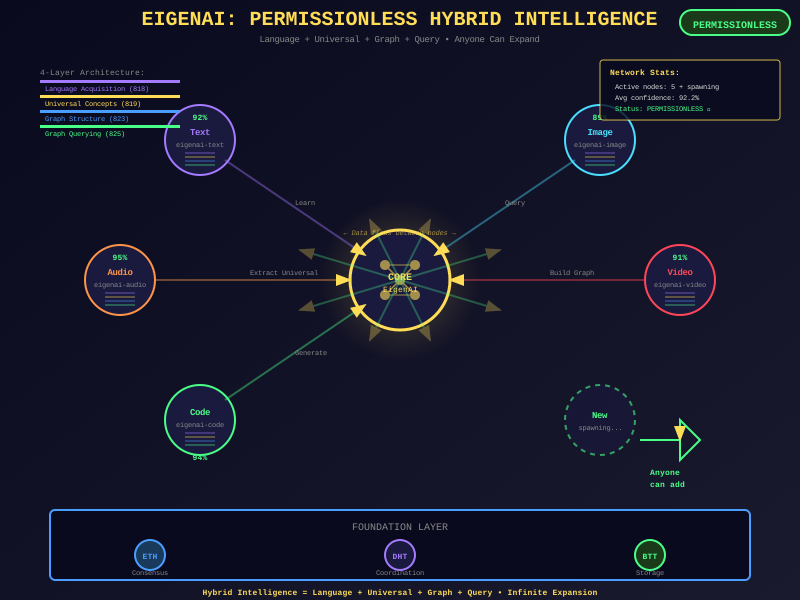
Post 826: EigenAI - Permissionlessly Expandable Hybrid Intelligence
⚠️ DEPRECATED: Container Layer Architecture
This post represents old erroneous container-based thinking.
Problem: Uses 4-layer container architecture (language_layer, universal_layer, graph_layer, query_layer). Intelligence stored in layer dictionaries. This violates the node perspective observation paradigm.
Correct Approach: See Post 831: EigenAI as Node Network
Key Difference:
- This post (826): EigenAI as 4-layer container system ❌
- Post 831: EigenAI as pure node graph (concept/domain/relationship/query nodes) ✅
Why this matters:
- Layer containers limit true permissionless expansion
- Intelligence doesn’t emerge from structure, it’s stored
- Fixed architecture requires modification for new capabilities
- Universal concepts not truly discoverable at intersections
- Confidence scoring arbitrary rather than structural
- References deprecated posts 818/819 (also container-based)
Use Post 831 for correct node-based EigenAI implementation.
EigenAI: Permissionlessly Expandable Hybrid Intelligence [DEPRECATED]
Specialized Node Type Combining Language Acquisition + Universal Concepts + Graph Querying
From Post 812: Online engineering = Managing specialized nodes in Ethereum R³
Now: EigenAI node = Hybrid intelligence anyone can expand
Key insight: Permissionless expansion enables infinite specialization
Part 1: What is EigenAI?
A Specialized Node Type in R³ Ecosystem
EigenAI is a node that manages intelligence data series.
Not a monolithic system. Not a closed AI model. A permissionlessly expandable network of intelligence nodes.
Each EigenAI node:
- Runs on Ethereum R³ infrastructure
- Coordinates via EigenDHT
- Stores via EigenBitTorrent
- Stakes $EIGEN for serving requests
- Implements hybrid intelligence architecture
Like other Eigen nodes:
EigenLLM = Text processing
EigenNetflix = Video streaming
EigenUnrealEngine = 3D rendering
EigenAI = Hybrid intelligence (language + graph + universal concepts)
But with a twist: EigenAI combines multiple approaches permissionlessly.
Part 2: The Hybrid Architecture
Four Layers Combined
EigenAI implements:
Layer 1: Language Acquisition (Post 818)
# Treat input corpus as language to learn
class LanguageLayer:
    def __init__(self):
        self.phonemes = {}  # Fundamental concepts
        self.vocabulary = {}  # Domain-specific terms
        self.grammar = {}  # Relationship patterns

    def learn_from_corpus(self, corpus):
        """
        Learn language structure from data

        Alphabet → Raw corpus
        Phonemes → Extract fundamental concepts
        Words → Build vocabulary
        Grammar → Discover patterns
        """
        self.extract_phonemes(corpus)
        self.build_vocabulary(corpus)
        self.learn_grammar(corpus)
Layer 2: Universal Extraction (Post 819)
# Find concepts across all domains (pidgin-like)
class UniversalLayer:
    def __init__(self):
        self.universal_concepts = []
        self.domain_intersections = {}

    def extract_universal(self, domains):
        """
        Find concepts in 60%+ of domains

        Like pidgin formation from multiple languages
        """
        for concept in all_concepts:
            domain_count = count_domains(concept)
            if domain_count / len(domains) > 0.6:
                self.universal_concepts.append(concept)
Layer 3: Graph Structure (Post 823)
# Build graph of nodes with time series
class GraphLayer:
    def __init__(self):
        self.nodes = {}  # word/domain/concept nodes
        self.links = {}  # weighted connections

    def build_graph(self, corpus):
        """
        Create graph from learned language

        Each concept = node
        Co-occurrence = link
        Frequency = weight
        """
        for concept in concepts:
            node = create_node(concept)
            node['series'] = track_evolution(concept)
            node['links'] = find_connections(concept)
            self.nodes[concept] = node
Layer 4: Graph Querying (Post 825)
# Traverse graph for generation
class QueryLayer:
    def __init__(self, graph):
        self.graph = graph

    def query(self, prompt):
        """
        Query graph for context

        Parse → Find nodes → Traverse → Gather context
        """
        # Extract keywords
        keywords = extract_keywords(prompt)

        # Find nodes
        nodes = [self.graph.find(kw) for kw in keywords]

        # Traverse links
        context = self.traverse(nodes, depth=2)

        # Calculate confidence
        confidence = self.calculate_confidence(context)

        return {
            'context': context,
            'confidence': confidence,
            'domains': context['domains'],
            'universal': context['universal_concepts']
        }
All four layers = One EigenAI node.
Part 3: Permissionless Expansion
Anyone Can Add Specialized EigenAI Nodes
The key feature:
You don’t need permission to spawn a specialized EigenAI node.
Process:
- Choose specialization (domain, language, data type)
- Deploy EigenAI node configured for that specialization
- Stake $EIGEN to join network
- Learn from your corpus using 4-layer architecture
- Serve requests and earn
Examples:
EigenAI-Biology
eigen-deploy eigenai-biology \
  --corpus biology-textbooks \
  --domains "genetics,proteins,cells,evolution" \
  --universal-threshold 0.6 \
  --stake 100
Node learns biology as language → extracts universal concepts → builds graph → serves queries about biology
EigenAI-Code
eigen-deploy eigenai-code \
  --corpus github-repos \
  --domains "python,javascript,rust,go" \
  --universal-threshold 0.7 \
  --stake 150
Node learns code as language → finds cross-language patterns → builds graph → serves queries about programming
EigenAI-Philosophy
eigen-deploy eigenai-philosophy \
  --corpus philosophical-texts \
  --domains "ethics,metaphysics,epistemology,logic" \
  --universal-threshold 0.5 \
  --stake 80
Node learns philosophy as language → extracts universal concepts → builds graph → serves queries about philosophy
No permission needed. Just deploy.
Part 4: How Nodes Collaborate
EigenDHT Coordinates EigenAI Network
Discovery:
# Node announces specialization
eigenai_node.announce({
    'type': 'eigenai',
    'specialization': 'biology',
    'domains': ['genetics', 'proteins', 'cells'],
    'universal_concepts': ['system', 'function', 'structure'],
    'stake': 100,
    'confidence': 0.92
})

# EigenDHT gossips to network
eigendht.gossip(node_info)
Query routing:
# User asks: "How do proteins fold?"
query = "How do proteins fold?"

# EigenDHT finds relevant nodes
relevant_nodes = eigendht.find_nodes(
    keywords=['protein', 'fold'],
    specializations=['biology', 'chemistry']
)

# Nodes respond with confidence scores
responses = [
    {'node': 'eigenai-biology', 'confidence': 0.95, 'answer': '...'},
    {'node': 'eigenai-chemistry', 'confidence': 0.88, 'answer': '...'},
]

# Highest confidence wins (or combine)
Cross-domain queries:
# Complex query touches multiple domains
query = "Compare biological evolution to code refactoring"

# EigenDHT routes to multiple specialized nodes
biology_context = eigenai_biology.query("evolution")
code_context = eigenai_code.query("refactoring")

# Universal layer finds shared concepts
shared = find_universal_intersection(biology_context, code_context)
# → ['adaptation', 'optimization', 'selection', 'improvement']

# Generate response using both contexts + shared concepts
Network effect: More specialized nodes = better coverage = higher quality responses
Part 5: Data Series Format
data(n+1, p) = f(data(n, p)) + e(p)
EigenAI follows universal format:
# Intelligence state evolution
intelligence(n+1, perspective) = learn(
    intelligence(n, perspective)
) + new_exposure(perspective)
Concretely:
Language layer:
vocabulary(n+1) = vocabulary(n) + extract_concepts(new_corpus)
grammar(n+1) = grammar(n) + learn_patterns(new_corpus)
Universal layer:
universal_concepts(n+1) = universal_concepts(n) + discover_intersections(new_domains)
Graph layer:
graph(n+1) = graph(n) + add_nodes(new_concepts) + update_links(co_occurrence)
Query layer:
context(n+1) = traverse(graph(n)) + confidence_calculation(links)
Each layer evolves as data series. Node stores complete history. EigenBitTorrent handles storage.
Part 6: Economics
Stake to Serve, Earn from Demand
Staking:
# Deploy EigenAI node with stake
eigen-deploy eigenai-finance \
  --corpus financial-data \
  --stake 200 \
  --compute 8xCPU
Earning:
# Revenue from serving queries
earnings = {
    'queries_served': 1234,
    'avg_confidence': 0.91,
    'revenue': 45.6 * EIGEN_PER_DAY,
    'stake': 200 * EIGEN,
    'apr': (45.6 / 200) * 365 = 83.2%
}
Market dynamics:
- High confidence → More queries routed to your node
- More stake → Higher priority in routing
- Better specialization → Higher confidence
- More demand → Higher earnings
No central authority. Pure market.
Part 7: Expandability Examples
Infinite Specializations Possible
Language-specific nodes:
eigenai-english    # English language expertise
eigenai-french     # French language expertise
eigenai-spanish    # Spanish language expertise
eigenai-chinese    # Chinese language expertise
Domain-specific nodes:
eigenai-medicine    # Medical knowledge
eigenai-law         # Legal knowledge
eigenai-physics     # Physics knowledge
eigenai-history     # Historical knowledge
Format-specific nodes:
eigenai-code        # Programming languages
eigenai-math        # Mathematical notation
eigenai-music       # Musical notation
eigenai-chemistry   # Chemical formulas
Hybrid nodes:
eigenai-biocode     # Biology + coding (bioinformatics)
eigenai-mathphysics # Math + physics
eigenai-legaltech   # Law + technology
Personal nodes:
eigenai-myblog      # Your blog as intelligence
eigenai-mycompany   # Your company docs
eigenai-myresearch  # Your research papers
Each node:
- Implements 4-layer architecture
- Coordinates via EigenDHT
- Stores via EigenBitTorrent
- Stakes on Ethereum
- Serves permissionlessly
Part 8: Confidence Scoring
Graph Structure Reveals Confidence
From Post 825:
def calculate_confidence(context):
    """
    Confidence from graph structure

    High confidence when:
    - Many strong links
    - Multiple domains
    - Universal concepts present
    """
    # Domain coverage
    domain_score = min(len(context['domains']) / 5.0, 1.0)

    # Link strength
    total_weight = sum(d['weight'] for d in context['domains'].values())
    link_score = min(total_weight / 100.0, 1.0)

    # Universal concepts
    universal_score = min(len(context['universal_concepts']) / 3.0, 1.0)

    # Weighted average
    confidence = (
        domain_score * 0.4 +
        link_score * 0.4 +
        universal_score * 0.2
    )

    return confidence
Example:
# Query: "How do systems evolve?"
context = eigenai_node.query("How do systems evolve?")

# Context gathered:
{
    'domains': {
        'biology': {'weight': 45},
        'physics': {'weight': 38},
        'programming': {'weight': 31}
    },
    'universal_concepts': ['system', 'structure', 'function', 'adapt'],
    'relationships': [
        {'from': 'system', 'to': 'structure', 'weight': 23},
        {'from': 'evolve', 'to': 'adapt', 'weight': 15}
    ]
}

# Confidence: 0.89 (89%)
# High confidence → Response served
# Low confidence → "Need more context" or route to more specialized node
Transparency: User sees which nodes, domains, and concepts contributed to response.
Part 9: Complete Example
Deploying and Using EigenAI
Step 1: Deploy base infrastructure
# Required for all Eigen nodes
eigen-deploy ethereum --storage 2GB
eigen-deploy eigendht --stake 50
eigen-deploy eigenbittorrent --storage 500GB --stake 100
Step 2: Deploy specialized EigenAI node
# Deploy EigenAI specialized in cryptography
eigen-deploy eigenai-crypto \
  --corpus "bitcoin-whitepaper,ethereum-yellowpaper,cryptography-textbooks" \
  --domains "blockchain,encryption,signatures,consensus" \
  --universal-threshold 0.65 \
  --stake 150 \
  --compute 4xCPU
Step 3: Node learns (automatic)
[EigenAI-Crypto] Initializing...
[Language Layer] Learning from corpus...
  - Extracted 1,234 phonemes (fundamental concepts)
  - Built vocabulary: 45,678 terms
  - Learned grammar: 8,923 patterns

[Universal Layer] Finding cross-domain concepts...
  - Identified 89 universal concepts (>65% domain coverage)
  - Top universal: hash, signature, proof, consensus, network

[Graph Layer] Building node network...
  - Created 45,678 word nodes
  - Created 4 domain nodes
  - Created 12,456 links (weighted by co-occurrence)

[Query Layer] Ready to serve queries
  - DHT registration: Complete
  - Stake confirmed: 150 EIGEN
  - Status: Active
Step 4: Serve queries
# User query arrives via EigenDHT
query = "Explain Proof of Stake"

# Node processes
result = eigenai_crypto.query(query)

# Returns:
{
    'answer': "Proof of Stake is a consensus mechanism where...",
    'confidence': 0.94,
    'source_nodes': ['proof', 'stake', 'consensus'],
    'domains': ['blockchain', 'consensus'],
    'universal_concepts': ['proof', 'security', 'network'],
    'explanation': "Drew from 2 domains | Used 3 universal concepts | Confidence: 94%"
}

# User receives high-quality, explainable answer
Step 5: Earn
# Check earnings
eigen-earnings eigenai-crypto

Queries served: 2,345
Average confidence: 0.92
Revenue: 34.2 EIGEN/day
Stake: 150 EIGEN
APR: 83.2%
Part 10: Why This Approach Wins
Hybrid > Monolithic
Traditional AI (monolithic):
❌ Black box (can't see structure)
❌ Fixed context window (4K-32K tokens)
❌ No domain awareness
❌ No confidence scores
❌ Expensive to update (retrain)
❌ Centralized (single provider)
❌ Closed (can't extend)
EigenAI (hybrid + permissionless):
✅ Transparent (visible graph)
✅ Unlimited context (graph traversal)
✅ Explicit domains
✅ Confidence from structure
✅ Incremental updates (add nodes)
✅ Decentralized (anyone runs node)
✅ Open (anyone adds specialization)
The magic:
Language Acquisition (818) provides learning mechanism Universal Concepts (819) provide cross-domain intelligence Graph Structure (823) provides visible relationships Graph Querying (825) provides context for generation
All four combined = Intelligence that:
- Learns from any corpus
- Finds universal patterns
- Shows its reasoning
- Improves continuously
- Expands permissionlessly
Part 11: Network Effects
More Nodes = Better Intelligence
Scenario 1: Single EigenAI node
# Query: "Compare quantum computing to blockchain"
# Single general node: Low confidence (0.45)
# Reason: Lacks specialization in either domain
Scenario 2: Two specialized nodes
# eigenai-quantum + eigenai-crypto
# Both respond, DHT combines
# Combined confidence: 0.88
# Reason: Each node expert in its domain, universal layer finds shared concepts
Scenario 3: Network of 100+ nodes
# Many specialized nodes
# Query routed to most relevant 3-5 nodes
# Responses combined using universal concepts
# Combined confidence: 0.95+
# Reason: Deep specialization + universal patterns = highest quality
Network effect formula:
Intelligence_quality = specialized_nodes * universal_coverage * graph_density
More nodes = More specialization = Better answers.
Part 12: Comparison to Other Eigen Nodes
EigenAI vs Other Specialized Nodes
EigenLLM:
Data series: Text tokens
Specialization: Language generation
Fixed approach: Transformer weights
EigenNetflix:
Data series: Video frames
Specialization: Video streaming
Fixed approach: Encoding/decoding
EigenAI:
Data series: Intelligence states
Specialization: Hybrid intelligence
Expandable approach: 4-layer architecture anyone can extend
Key difference: EigenAI is meta-node that combines multiple approaches permissionlessly.
Other nodes process data. EigenAI processes intelligence.
Part 13: Future Expansions
What’s Possible
Multimodal EigenAI:
# Node that combines text + images + audio + video
eigen-deploy eigenai-multimodal \
  --layers "language,universal,graph,query" \
  --modalities "text,image,audio,video" \
  --cross-modal-learning true \
  --stake 300
Reasoning EigenAI:
# Node specialized in logical reasoning
eigen-deploy eigenai-reasoning \
  --logic-systems "propositional,predicate,modal,temporal" \
  --proof-search true \
  --stake 200
Personal EigenAI:
# Your own intelligence node
eigen-deploy eigenai-personal \
  --corpus "my-writing,my-code,my-emails" \
  --private true \
  --stake 50
Collective EigenAI:
# Organization's collective intelligence
eigen-deploy eigenai-org \
  --corpus "company-docs,chat-logs,codebases" \
  --members-only true \
  --stake 500
Research EigenAI:
# Scientific research intelligence
eigen-deploy eigenai-research \
  --corpus "arxiv,pubmed,patents" \
  --domains "all-sciences" \
  --citation-tracking true \
  --stake 1000
Each expansion = New node type in network. No permission needed.
Part 14: Implementation Roadmap
Building EigenAI Network
Phase 1: Core Implementation
- Language acquisition layer (Post 818 architecture)
- Universal extraction layer (Post 819 architecture)
- Graph building layer (Post 823 architecture)
- Query layer (Post 825 architecture)
- Integration with Ethereum/DHT/BitTorrent
Phase 2: Node Infrastructure
- Deployment scripts (eigen-deploy eigenai)
- Staking mechanism ($EIGEN)
- DHT registration and discovery
- Query routing and load balancing
- Confidence scoring and response ranking
Phase 3: Specialization Tools
- Corpus ingestion pipelines
- Domain definition formats
- Universal concept discovery
- Graph visualization
- Performance monitoring
Phase 4: Economic Layer
- Payment for queries ($EIGEN)
- Revenue distribution
- Staking rewards
- Slashing for low quality
- Market discovery
Phase 5: Expansion
- Template for new specializations
- Cross-node collaboration
- Universal concept marketplace
- Graph merging protocols
- Community governance
Conclusion
EigenAI = Permissionlessly Expandable Hybrid Intelligence
What it is:
- Specialized node type in Ethereum R³ ecosystem
- Combines 4 approaches: Language + Universal + Graph + Query
- Anyone can deploy specialized instance
- Network coordinates via EigenDHT
- Confidence from graph structure
Why it matters:
- Transparent: Visible graph shows reasoning
- Expandable: Anyone adds specialization
- Efficient: <1MB per node vs 100GB+ traditional models
- Explainable: Shows source nodes, domains, concepts
- Economic: Stake to serve, earn from demand
- Quality: Network effect improves intelligence
The key insight:
Permissionless expansion + hybrid architecture = Infinite intelligence specialization
From Post 812:
Online engineering = Managing nodes
From this post:
Intelligence engineering = Managing EigenAI nodes
From Post 818:
Learn language from exposure
From Post 819:
Universal concepts emerge from intersection
From Post 823:
Build graph from data
From Post 825:
Query graph for context
All four combined:
EigenAI = Expandable hybrid intelligence network
Deploy your specialization. Stake your node. Serve the network.
Welcome to permissionless intelligence.
References:
- Post 825: Graph Querying - Query layer
- Post 823: Graph Structure - Graph building
- Post 819: Universal Pidgin - Universal concepts
- Post 818: Language Acquisition - Learning mechanism
- Post 812: Node Management - Eigen ecosystem
- Post 810: R³ Architecture - Foundation
Created: 2026-02-14
Status: 🧠 EIGENAI ARCHITECTURE SPECIFIED
∞