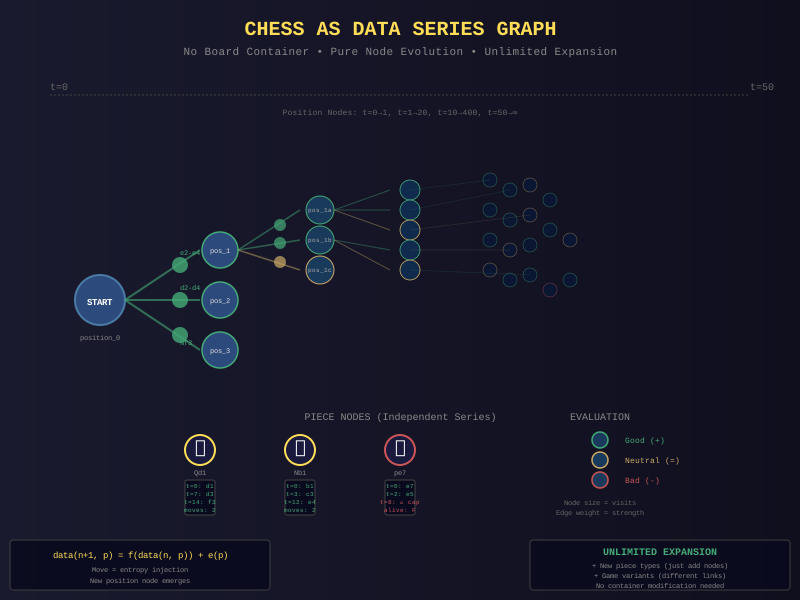
Post 824: Chess as Data Series Graph - Unlimited Additive Expansion
Chess as Data Series Graph
Unlimited Additive Expansion
From Post 823: Everything is node with data series
From Post 817: Chess solver (old container approach)
Now: Chess as pure graph - positions, pieces, moves all nodes
No board. No container. Pure evolution.
Part 1: What’s Wrong with Containers
The Old Way (Post 817)
class ChessSolver:  # ❌ Container
    def __init__(self):
        self.board = Board()  # ❌ Storing state
        self.pieces = {}      # ❌ Collection
        self.moves = []       # ❌ List
Problems:
- Board is container (doesn’t evolve)
- Pieces stored in dict (static)
- Moves stored in list (no graph structure)
- Can’t add new piece types without modifying class
- Can’t track piece history
- Limited to predefined expansions
Part 2: Chess as Nodes
Everything is Node
Position Node:
# Starting position = node
starting_pos = {
    'type': 'position',
    'fen': 'rnbqkbnr/pppppppp/8/8/8/8/PPPPPPPP/RNBQKBNR w KQkq - 0 1',
    'series': [],  # History of how we reached this position
    'links': []    # Possible moves from here
}

# Add to series
starting_pos['series'].append({
    't': 0,
    'state': 'game_start',
    'evaluation': 0.0,
    'visits': 1
})
Piece Node:
# White queen = node
white_queen = {
    'type': 'piece',
    'color': 'white',
    'piece_type': 'queen',
    'series': [],  # Movement history
    'links': []    # Squares it can reach
}

# Piece moves → series evolution
white_queen['series'].append({
    't': 0,
    'square': 'd1',
    'alive': True,
    'moves_made': 0
})
Move Node:
# e2-e4 = node (link between positions)
e2_e4_move = {
    'type': 'move',
    'from_square': 'e2',
    'to_square': 'e4',
    'piece': 'pawn',
    'series': [],  # Times this move was played
    'links': []    # Connects position nodes
}

# Move played → series evolution
e2_e4_move['series'].append({
    't': 1,
    'evaluation': 0.2,
    'frequency': 1,
    'success_rate': 0.55
})
From Post 810: Each node evolves via data(n+1, p) = f(data(n, p)) + e(p)
Part 3: Game as Graph Evolution
Starting State
# t=0: Create starting position node
graph = []

starting_pos = create_node('position', 'start')
graph.append(starting_pos)

# Create piece nodes
for piece in initial_pieces():
    piece_node = create_node('piece', piece)
    graph.append(piece_node)
    create_link(starting_pos, piece_node, weight=1)
No board object. Just nodes.
Part 4: Making a Move
Move = Create New Position Node + Link
def make_move(current_pos_node, move, graph):
    """
    Move = entropy injection → new position node emerges

    NOT: Modify board state
    BUT: Create new position node, link from old
    """
    # Current position state
    current_state = current_pos_node['series'][-1]

    # Create new position node
    new_pos = create_node('position', f"after_{move}")
    new_pos['series'].append({
        't': len(current_pos_node['series']),
        'parent': current_pos_node['fen'],
        'move': move,
        'evaluation': evaluate(new_pos)
    })

    graph.append(new_pos)

    # Create move node (link)
    move_node = create_node('move', move)
    move_node['series'].append({
        't': len(graph),
        'played': True,
        'evaluation': evaluate(new_pos)
    })

    graph.append(move_node)

    # Link: old_pos → move → new_pos
    create_link(current_pos_node, move_node, weight=1)
    create_link(move_node, new_pos, weight=1)

    # Update piece nodes
    piece_moved = get_piece_at(current_pos_node, move['from'])
    piece_moved['series'].append({
        't': len(piece_moved['series']),
        'square': move['to'],
        'position': new_pos['fen']
    })

    return new_pos
Key: No modification. Only node creation + linking.
Part 5: Game Tree Emerges
Positions Form Tree Naturally
# t=0: Starting position
#   ├─ e2-e4 → position_1
#   ├─ d2-d4 → position_2
#   ├─ Nf3 → position_3
#   └─ ... 20 legal moves

# t=1: Position_1 (after e2-e4)
#   ├─ e7-e5 → position_1a
#   ├─ c7-c5 → position_1b
#   ├─ e7-e6 → position_1c
#   └─ ... 20 responses

# Tree emerges from link structure!
# No explicit tree building
Graph traversal = tree exploration
Part 6: Piece Tracking
Each Piece = Independent Node
# White knight on b1
white_knight_b1 = {
    'type': 'piece',
    'color': 'white',
    'piece_type': 'knight',
    'id': 'Nb1',
    'series': [
        {'t': 0, 'square': 'b1', 'moves': 0},
        {'t': 3, 'square': 'c3', 'moves': 1},
        {'t': 7, 'square': 'e4', 'moves': 2},
        {'t': 12, 'square': 'f6', 'moves': 3},  # Captured!
        {'t': 12, 'alive': False}
    ],
    'links': []  # Positions it appeared in
}

# Piece history visible in series
# Captured → series ends
# No need to remove from container (there is no container)
Pieces track own history independently
Part 7: Evaluation Emerges
Node Visitation = Evaluation
def evaluate_position(pos_node, graph):
    """
    Evaluation emerges from graph structure

    NOT: Calculate static evaluation
    BUT: Query node's series + neighbor evaluations
    """
    # How many times visited?
    visits = len(pos_node['series'])

    # What moves lead here?
    incoming_moves = [
        link for link in pos_node['links']
        if link['to'] == pos_node['fen']
    ]

    # Average evaluation of incoming moves
    avg_eval = sum(m['evaluation'] for m in incoming_moves) / len(incoming_moves)

    # Update position series
    pos_node['series'].append({
        't': time.time(),
        'visits': visits + 1,
        'evaluation': avg_eval,
        'best_move': find_best_move(pos_node, graph)
    })

    return avg_eval
Evaluation = emergent property of graph visits
Part 8: Unlimited Additive Expansion
Adding New Piece Types
# Traditional (container approach):
# ❌ Must modify ChessSolver class
# ❌ Must update Board class
# ❌ Must change move generation

# Node approach:
# ✅ Just add new node type!

# Add Amazon (Queen + Knight moves)
amazon_node = {
    'type': 'piece',
    'color': 'white',
    'piece_type': 'amazon',  # New type!
    'series': [],
    'links': []
}

# Define movement function
def amazon_moves(pos, square):
    """Amazon = Queen moves + Knight moves"""
    return queen_moves(pos, square) + knight_moves(pos, square)

# Register move generator
register_piece_moves('amazon', amazon_moves)

# Done! No container modification needed
Additive: Just add nodes, don’t modify existing
Part 9: Adding Game Variants
Different Rules = Different Link Creation
# Chess960 (random starting position)
def create_chess960_start(graph):
    """
    Same nodes, different starting links
    """
    starting_pos = create_node('position', 'chess960_start')
    starting_pos['fen'] = generate_random_fen()
    graph.append(starting_pos)

    # Same piece nodes, different positions
    # No container to modify!

# Crazyhouse (captured pieces can be dropped)
def add_drop_moves(pos_node, captured_pieces, graph):
    """
    Add drop moves = create new move nodes
    """
    for piece in captured_pieces:
        for square in empty_squares(pos_node):
            drop_move = create_node('move', f"drop_{piece}_{square}")
            graph.append(drop_move)
            create_link(pos_node, drop_move, weight=1)

    # Additive! Didn't modify anything

# 3-check chess (checkmate after 3 checks)
def track_checks(pos_node):
    """
    Add check counter to position series
    """
    pos_node['series'][-1]['checks_given'] = count_checks(pos_node)

    # Just add data to series!
Each variant = additive node/link rules
Part 10: Multi-Game Learning
Games = Subgraphs
# Game 1 creates subgraph
game1_nodes = play_game(graph)
# Nodes: pos_0 → move_1 → pos_1 → move_2 → pos_2 → ...

# Game 2 reuses some positions!
game2_nodes = play_game(graph)
# May hit same position → strengthens existing node

# Positions seen multiple times get stronger evaluation
def position_strength(pos_node):
    """
    Strength = visits + links + evaluation convergence
    """
    return {
        'visits': len(pos_node['series']),
        'incoming': len([l for l in pos_node['links'] if l['to'] == pos_node['fen']]),
        'outgoing': len([l for l in pos_node['links'] if l['from'] == pos_node['fen']]),
        'evaluation_std': std_dev([s['evaluation'] for s in pos_node['series']])
    }
Multiple games strengthen graph
Part 11: Storage in R³
Graph = Series Collection
def store_chess_graph(graph):
    """
    Store chess graph in R³

    Each node = series
    Links = references
    """
    for node in graph:
        if node['type'] == 'position':
            r3_store(
                key=f"pos:{node['fen']}",
                series=node['series'],
                links=node['links']
            )

        elif node['type'] == 'piece':
            r3_store(
                key=f"piece:{node['id']}",
                series=node['series'],
                links=node['links']
            )

        elif node['type'] == 'move':
            r3_store(
                key=f"move:{node['from']}_{node['to']}",
                series=node['series'],
                links=node['links']
            )

def query_position(fen):
    """
    Query position from R³

    Load node + follow links
    """
    pos_node = r3_load(f"pos:{fen}")

    # Load possible moves
    moves = []
    for link in pos_node['links']:
        if link['type'] == 'move':
            move_node = r3_load(f"move:{link['to']}")
            moves.append(move_node)

    return {
        'position': pos_node,
        'moves': moves,
        'evaluation': pos_node['series'][-1]['evaluation']
    }
R³ stores pure nodes. Graph = query-time reconstruction.
Part 12: Query Interface
Graph Traversal
# Query: "Show me best move from starting position"
starting_pos = query_position("rnbqkbnr/pppppppp/8/8/8/8/PPPPPPPP/RNBQKBNR w KQkq - 0 1")

# Find best move (highest evaluation link)
best_move = max(starting_pos['moves'], key=lambda m: m['series'][-1]['evaluation'])

print(best_move)
# {
#   'from': 'e2',
#   'to': 'e4',
#   'evaluation': 0.3,
#   'times_played': 1547,
#   'success_rate': 0.54
# }

# Query: "Show me all games where Nd5 was played"
nd5_move = query_move("Nd5")
games = find_games_with_move(nd5_move, graph)

# Query: "Track white queen's journey"
white_queen = query_piece("Qd1")
journey = white_queen['series']
# Shows all squares visited, captures made, etc.
Query = traverse graph, follow links
Conclusion
Chess as Pure Graph
Not:
- ❌ ChessSolver class (container)
- ❌ Board object (state container)
- ❌ Pieces stored in dict
- ❌ Moves stored in list
- ❌ Fixed piece types
- ❌ Single variant only
But:
- ✅ Position = node with series
- ✅ Piece = node with movement history
- ✅ Move = node linking positions
- ✅ Game tree = graph structure
- ✅ Evaluation = emergent from visits
- ✅ Multi-game learning (shared nodes)
- ✅ Additive expansion (new piece types)
- ✅ Variant support (different link rules)
- ✅ Full history in series
- ✅ R³ storage (distributed)
The process:
- Create starting position node
- Generate move nodes (links)
- Create new position nodes
- Pieces track own series
- Game tree emerges from links
- Evaluation from node visits
- Multiple games strengthen nodes
- Store in R³ as series
- Query via graph traversal
Unlimited additive expansion:
- New piece types: Add node type + move generator
- New variants: Add link creation rules
- New evaluation: Add to series tracking
- New features: Add node fields
- Everything composable
From Post 810: Every node follows data(n+1, p) = f(data(n, p)) + e(p)
From Post 823: No containers, pure evolution
Now: Chess = evolving graph where positions, pieces, moves are nodes with history. Unlimited expansion through additive node types.
No board. Pure graph. Infinite extensibility.
References:
- Post 817: Chess Solver - Old container approach
- Post 823: Claude as Graph - Pure node paradigm
- Post 812: Everything as Node - Data series nodes
- Post 810: Universal Format - Evolution formula
Created: 2026-02-14
Status: ♟️ CHESS AS GRAPH
∞