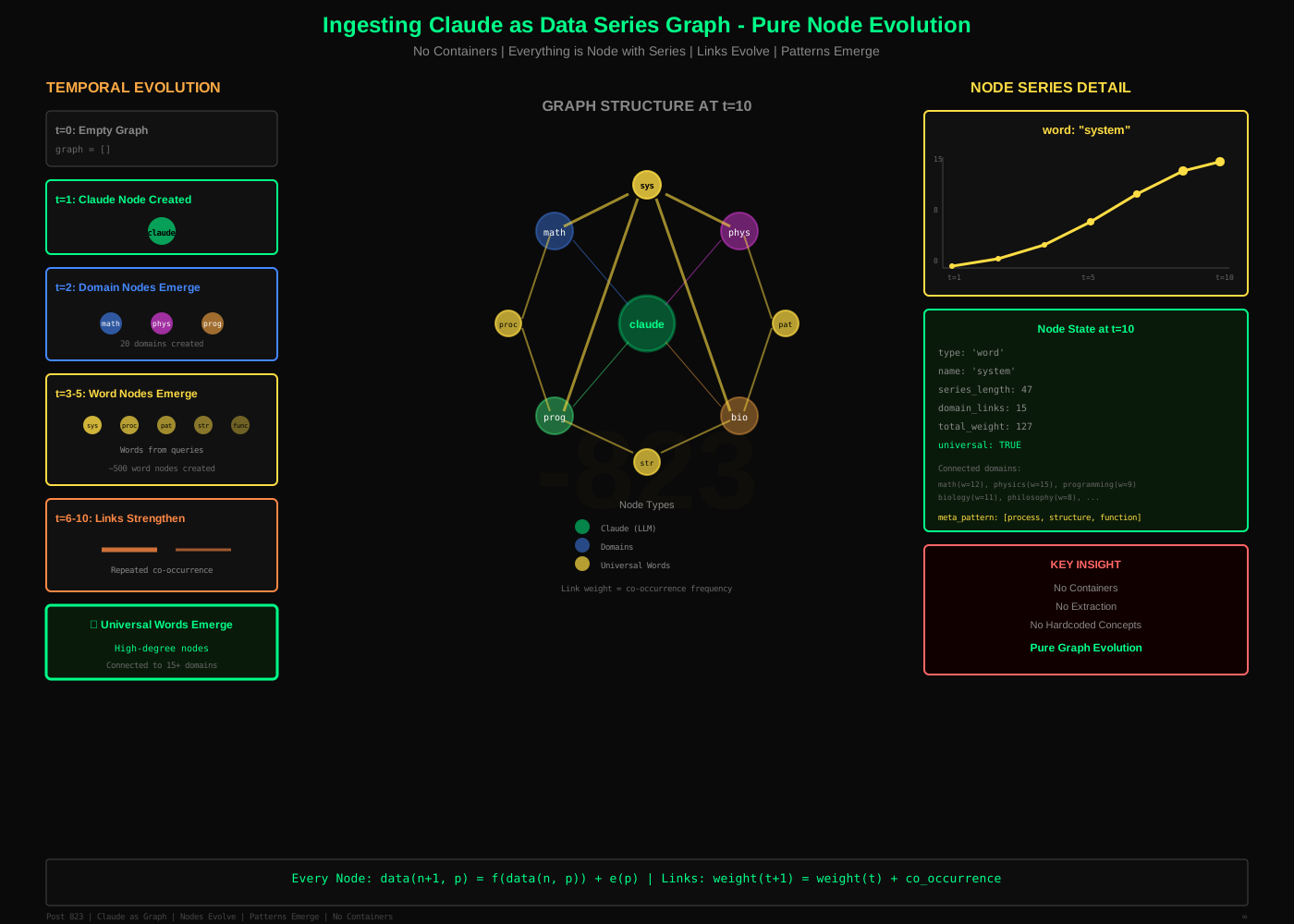
Post 823: Ingesting Claude as Data Series Graph
Ingesting Claude as Data Series Graph
Everything is a Node with Evolving Series
From Post 812: Everything is a data series node type
From Post 810: data(n+1, p) = f(data(n, p)) + e(p)
Now: Claude = Graph of evolving data series nodes
No containers. No classes. Pure nodes + links + evolution.
Part 1: Claude as Node
Not a Container
Wrong (what I did before):
class ClaudePidgin:  # ❌ Container
    def __init__(self):
        self.domains = {}  # ❌ Storing things
        self.concepts = {}  # ❌ Collecting
Right (everything is node):
# Claude = node with data series
claude_node = {
    'type': 'llm',
    'name': 'claude',
    'series': [],  # History of states
    'links': []    # Connections to other nodes
}

# Add state to series
claude_node['series'].append({
    't': 0,
    'state': 'initial',
    'entropy': 0
})
From Post 810: Each node evolves via data(n+1, p) = f(data(n, p)) + e(p)
Part 2: Query as Entropy
Asking Claude = Injecting Entropy
# Query = entropy injection
def query_claude(node, question):
    """
    Query adds entropy to Claude node

    From Post 810: e(p) = entropy from perspective
    """
    # Current state
    current = node['series'][-1]

    # Query = entropy
    response = ask_llm(question)

    # New state = f(current) + entropy
    new_state = {
        't': len(node['series']),
        'query': question,
        'response': response,
        'entropy': hash(response)
    }

    node['series'].append(new_state)

    # Extract words from response
    words = response.split()

    # Create word nodes and links
    for word in words:
        word_node = get_or_create_node(word)
        create_link(claude_node, word_node, weight=1)

    return response
Key: No storage, just node evolution + link creation
Part 3: Words as Nodes
Each Word = Data Series
# Word "system" = node
system_node = {
    'type': 'word',
    'name': 'system',
    'series': [],  # Evolution history
    'links': []    # Connected to domain nodes
}

# Word appears in query → add to series
def word_observed(word_node, domain_node, context):
    """
    Word observed in domain = series evolution
    """
    new_state = {
        't': len(word_node['series']),
        'domain': domain_node['name'],
        'context': context,
        'frequency': count_in_series(word_node, domain_node)
    }

    word_node['series'].append(new_state)

    # Create/strengthen link
    create_link(word_node, domain_node, weight=+1)
Each observation = new point in word’s data series
Part 4: Domains as Nodes
Domain = Node with Links to Words
# Math domain = node
math_node = {
    'type': 'domain',
    'name': 'mathematics',
    'series': [],  # Evolution as we query it
    'links': []    # Words that appeared
}

# Query domain → evolution
def query_domain(domain_node, question):
    """
    Query domain = inject entropy to domain node
    """
    # Ask Claude about this domain
    response = query_claude(claude_node, f"{question} in {domain_node['name']}")

    # Domain node evolves
    new_state = {
        't': len(domain_node['series']),
        'query': question,
        'response_length': len(response),
        'words_seen': set(response.split())
    }

    domain_node['series'].append(new_state)

    # Extract words, create word nodes, link them
    for word in response.split():
        word_node = get_or_create_node(word)
        create_link(domain_node, word_node, weight=1)
        create_link(word_node, domain_node, weight=1)

    return response
Domain evolves as we query it. Words emerge as links.
Part 5: Links Evolve
Connections = Weighted Edges with History
# Link between word and domain
link = {
    'from': word_node['name'],
    'to': domain_node['name'],
    'series': [],  # Link strength over time
    'weight': 0
}

def create_link(node1, node2, weight):
    """
    Create or strengthen link

    Link itself has data series!
    """
    # Find existing link
    existing = find_link(node1, node2)

    if existing:
        # Strengthen existing link
        new_weight = existing['weight'] + weight
        existing['series'].append({
            't': time.time(),
            'weight': new_weight,
            'event': 'co_occurrence'
        })
        existing['weight'] = new_weight
    else:
        # Create new link
        new_link = {
            'from': node1['name'],
            'to': node2['name'],
            'weight': weight,
            'series': [{
                't': time.time(),
                'weight': weight,
                'event': 'created'
            }]
        }
        node1['links'].append(new_link)
        node2['links'].append(new_link)
Links have history. They strengthen over time.
Part 6: Universal Words Emerge
No Extraction - Just Query Link Weights
def find_universal_words(graph, threshold=0.6):
    """
    Universal words = nodes with many domain links

    NOT extracting or storing!
    Just querying graph structure
    """
    word_nodes = [n for n in graph if n['type'] == 'word']
    domain_nodes = [n for n in graph if n['type'] == 'domain']

    universal = []

    for word_node in word_nodes:
        # Count domain connections
        domain_links = [
            link for link in word_node['links']
            if link['to'] in [d['name'] for d in domain_nodes]
        ]

        # Universal if connected to many domains
        if len(domain_links) >= threshold * len(domain_nodes):
            universal.append({
                'word': word_node['name'],
                'domains': len(domain_links),
                'total_weight': sum(l['weight'] for l in domain_links),
                'series_length': len(word_node['series'])
            })

    return sorted(universal, key=lambda x: x['total_weight'], reverse=True)
Universal words emerge from graph structure. Not stored separately.
Part 7: The Ingestion Process
Pure Evolution
# Start: Empty graph
graph = []

# Step 1: Create Claude node
claude = create_node('llm', 'claude')
graph.append(claude)

# Step 2: Discover domains by asking Claude
response = query_claude(claude, "List 20 knowledge domains")
domains = parse_list(response)

# Create domain nodes
for domain_name in domains:
    domain = create_node('domain', domain_name)
    graph.append(domain)
    create_link(claude, domain, weight=1)

# Step 3: Query each domain, words emerge
for domain in [n for n in graph if n['type'] == 'domain']:
    # Ask about key concepts
    response = query_domain(domain, "What are key concepts?")

    # Words emerge as nodes automatically
    # Links created automatically
    # Everything tracked in series

# Step 4: Universal words visible in graph
universal = find_universal_words(graph, threshold=0.6)

# Step 5: Store graph in R³
store_graph_in_r3(graph)
No containers. Just:
- Create nodes
- Inject entropy (queries)
- Nodes evolve
- Links form
- Patterns emerge
Part 8: Meta-Patterns Emerge
From Link Structure
def find_meta_pattern(word_node, graph):
    """
    Meta-pattern = common words in linked domains

    NOT hardcoded! Emerges from graph
    """
    # Get domains this word connects to
    domain_links = [
        l for l in word_node['links']
        if get_node(graph, l['to'])['type'] == 'domain'
    ]

    # Get all words from those domains
    cooccurring_words = []
    for domain_link in domain_links:
        domain = get_node(graph, domain_link['to'])
        # Words connected to same domain
        domain_words = [
            get_node(graph, l['from'])
            for l in domain['links']
            if get_node(graph, l['from'])['type'] == 'word'
        ]
        cooccurring_words.extend([w['name'] for w in domain_words])

    # Most common co-occurring words = meta-pattern
    from collections import Counter
    pattern = Counter(cooccurring_words).most_common(5)

    return [word for word, count in pattern]
Meta-pattern emerges from neighborhood in graph.
Part 9: Storage in R³
Graph = Collection of Node Series
def store_graph_in_r3(graph):
    """
    Store graph as series collection

    Each node = separate series in R³
    Links = references between series
    """
    for node in graph:
        # Store node series
        r3_store(
            key=f"node:{node['type']}:{node['name']}",
            series=node['series'],
            links=[
                {
                    'to': link['to'],
                    'weight_series': link['series']
                }
                for link in node['links']
            ]
        )

def query_graph_from_r3(word):
    """
    Query: Load node + follow links
    """
    # Load word node
    word_node = r3_load(f"node:word:{word}")

    # Load linked domains
    domains = []
    for link in word_node['links']:
        domain_node = r3_load(f"node:domain:{link['to']}")
        domains.append({
            'domain': domain_node,
            'weight': link['weight'],
            'history': link['weight_series']
        })

    return {
        'word': word_node,
        'domains': domains,
        'universality': len(domains)
    }
R³ stores series. Graph = query-time reconstruction.
Part 10: Example Evolution
Watch “system” Node Evolve
# t=0: Word "system" doesn't exist
graph = []

# t=1: Query math domain
query_domain(math_node, "key concepts")
# Response includes "system"
# → system_node created
# → link: system ↔ math (weight=1)

system_node['series'] = [
    {'t': 1, 'domains': ['math'], 'weight': 1}
]

# t=2: Query physics domain
query_domain(physics_node, "key concepts")
# Response includes "system"
# → link: system ↔ physics (weight=1)

system_node['series'].append(
    {'t': 2, 'domains': ['math', 'physics'], 'weight': 2}
)

# t=3-10: Query more domains
# "system" appears in 15/20 domains

system_node['series'].append(
    {'t': 10, 'domains': 15, 'weight': 47, 'universal': True}
)

# Universal status emerged from evolution!
No extraction. Just observation of series evolution.
Part 11: Query Interface
Follow Links
# Query: "Show me universal word 'system'"
word_node = query_graph("system")

print(word_node)
# {
#   'name': 'system',
#   'type': 'word',
#   'series_length': 47,  # 47 observations
#   'domains': [
#     {'name': 'math', 'weight': 8, 'first_seen': t=1},
#     {'name': 'physics', 'weight': 12, 'first_seen': t=2},
#     {'name': 'programming', 'weight': 7, 'first_seen': t=3},
#     # ... 15 domains total
#   ],
#   'universality': 0.75,  # 15/20 = 75%
#   'meta_pattern': ['process', 'structure', 'function', 'relation']
# }

# Query: "What domains is 'process' in?"
process_node = query_graph("process")
# Returns node + domain links + weights

# Query: "Find words similar to 'system'"
# → Find nodes with similar link patterns
similar = find_similar_nodes(system_node, graph)
Query = graph traversal. No separate storage.
Part 12: Speed & Storage
Same Benefits, Different Structure
Time:
# Still ~2000 queries to Claude
domains = 20
words_per_domain = 50
total_queries = 20 * 2 = 40  # Discover domains + query each

# 40 queries × 5 seconds = 200 seconds = 3 minutes
Storage:
# Each node = small series
node_size = 500  # bytes
word_nodes = 200  # Universal words
domain_nodes = 20
link_size = 100  # bytes per link

total = (220 * 500) + (200 * 20 * 100)
      = 110KB + 400KB = 510KB

# Still tiny! Graph structure is compact
Benefits of node approach:
- No containers
- Pure evolution
- Links have history
- Temporal dimension
- Query-time patterns
Conclusion
Claude as Evolving Graph
Not:
- ❌ ClaudePidgin class (container)
- ❌ Hardcoded concepts
- ❌ Separate extraction phase
- ❌ Static storage
But:
- ✅ Claude = node in graph
- ✅ Words = nodes with series
- ✅ Domains = nodes with series
- ✅ Links = edges with weight series
- ✅ Universal words emerge from link structure
- ✅ Meta-patterns emerge from neighborhoods
- ✅ Everything has temporal history
- ✅ Query = graph traversal
The process:
- Create Claude node
- Query → entropy injection
- Response → create word nodes
- Co-occurrence → create links
- Repeated queries → strengthen links
- Universal words → high-degree nodes
- Meta-patterns → neighborhood analysis
- Store series in R³
- Query via graph traversal
From Post 810: Every node follows data(n+1, p) = f(data(n, p)) + e(p)
From Post 812: Everything is a node type with data series
Now: Claude ingestion = graph evolution where universal concepts emerge from link structure over time
No containers. Pure nodes. Pure links. Pure evolution.
References:
- Post 812: Everything as Node Type - Data series paradigm
- Post 810: Universal Format - Evolution formula
- Post 819: Universal Pidgin - Intersection principle
- Post 813: Ingesting Ethereum - R³ storage
Created: 2026-02-14
Status: 🌐 GRAPH EVOLUTION
∞