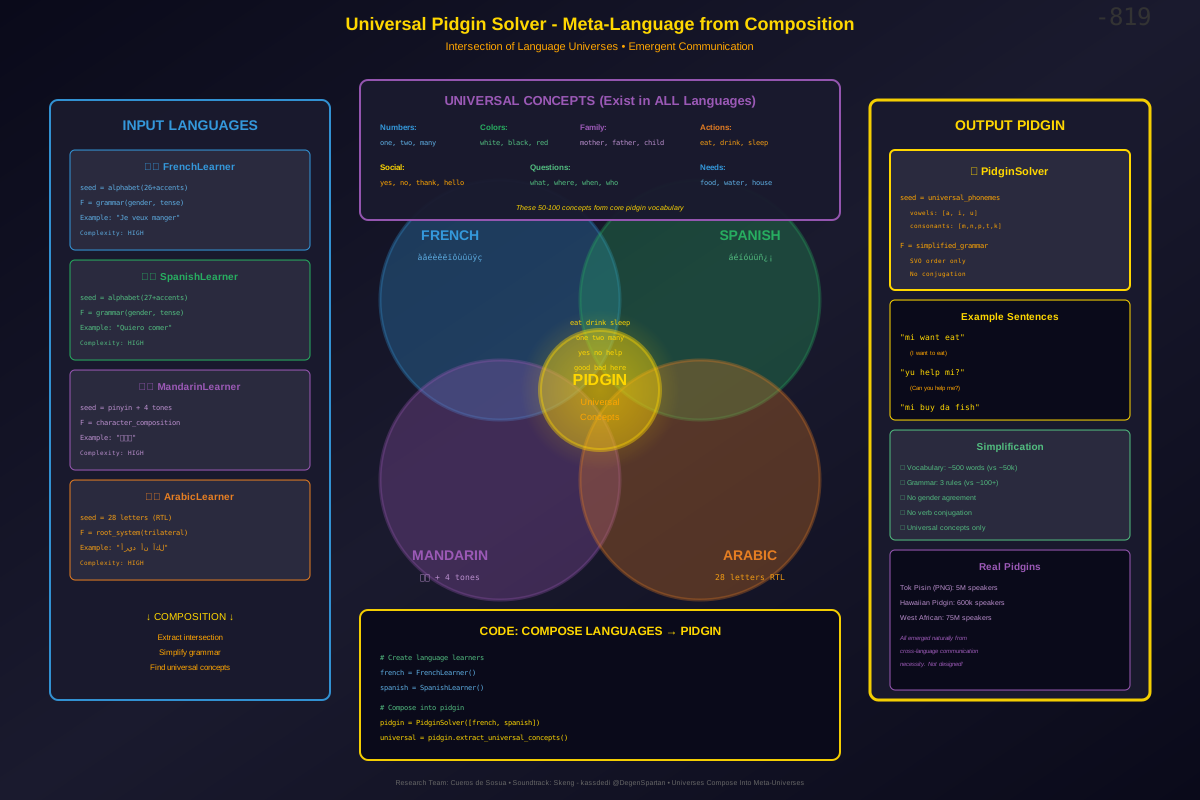
Post 819: Universal Pidgin Solver - Meta-Language from Language Composition
⚠️ DEPRECATED: Container State Function Thinking
This post represents old erroneous container-based thinking.
Problem: Uses PidginSolver class as meta-container, composes FrenchLearner + SpanishLearner classes. This violates the node perspective observation paradigm.
Correct Approach: See Post 830: Language as Node Graph
Key Difference:
- This post (819): Pidgin as class composition (meta-container) ❌
- Post 830: Pidgin as emergent graph from language node intersection ✅
Why this matters:
- Container composition doesn’t show true intersection
- Pidgin treated as separate class rather than emergent property
- Can’t see how universal concepts naturally appear
- Requires explicit meta-container design
- State stored rather than graph-based intersection
Use Post 830 for correct node-based pidgin emergence.
Universal Pidgin Solver
Meta-Language from Language Composition [DEPRECATED]
Official Soundtrack: Skeng - kassdedi @DegenSpartan
Research Team: Cueros de Sosua
The Question
From Post 818: French learner as universe
Now: How to build universal pidgin solver from all language solvers?
Answer: Pidgin = Intersection of multiple language universes
Part 1: What Is a Pidgin?
Definition
Pidgin = Simplified language that emerges when speakers of different languages need to communicate
Characteristics:
- Minimal vocabulary: Only essential words
- Simplified grammar: Reduced complexity
- Universal concepts: Common across all contributing languages
- Functional: Optimized for communication, not beauty
- Emergent: Not designed, but evolved
Examples:
- Tok Pisin (Papua New Guinea): English + local languages
- Hawaiian Pidgin: English + Hawaiian + Asian languages
- Chinook Jargon: English + French + Native American languages
- West African Pidgin English: English + various African languages
The insight:
Pidgin emerges naturally at the intersection of language universes
Part 2: The Mapping
Pidgin as Meta-Universe
From Post 818:
class FrenchLearner(MinimalUniverse):
    seed = french_alphabet
    F = french_grammar
    E_p = [reading, listening, conversation]
For pidgin:
class PidginSolver(MinimalUniverse):
    seed = intersection(all_alphabets)
    F = simplified_grammar(all_grammars)
    E_p = cross_language_exposure
Key difference:
Individual language = Single universe
Pidgin = Meta-universe emerging from multiple universe intersection
Part 3: Implementation
PidginSolver Class
from universe_toolbox import MinimalUniverse
from language_solvers import FrenchLearner, SpanishLearner, MandarinLearner, ArabicLearner

class PidginSolver(MinimalUniverse):
    """
    Universal pidgin solver from multiple languages

    Composes multiple language learners to extract:
    - Common vocabulary (universal concepts)
    - Simplified grammar (intersection of rules)
    - Minimal syntax (most efficient patterns)
    """

    def __init__(self, source_languages):
        """
        Initialize pidgin from source languages

        Args:
            source_languages: List of LanguageLearner instances
        """
        self.source_languages = source_languages

        # Extract common elements
        common_seed = self._extract_common_alphabet()
        simplified_grammar = self._extract_simplified_grammar()
        cross_language_entropy = self._create_cross_language_entropy()

        # Initialize meta-universe
        super().__init__(
            seed=common_seed,
            evolution_f=simplified_grammar,
            entropy_sources=cross_language_entropy
        )

        # Pidgin vocabulary
        self.pidgin_vocabulary = {}
        self.translation_map = {}  # pidgin_word → {lang: translation}

    def _extract_common_alphabet(self):
        """
        Find common phonetic elements across languages

        Returns: Minimal alphabet that works for all languages
        """
        # Start with universal phonemes (exist in most languages)
        universal_phonemes = {
            'vowels': ['a', 'i', 'u'],  # Present in 99% of languages
            'consonants': ['m', 'n', 'p', 't', 'k'],  # Very common
        }

        # Add phonemes present in ALL source languages
        for lang in self.source_languages:
            lang_phonemes = set(lang.series.state['phonemes'].keys())
            # Intersection
            universal_phonemes['vowels'] = [
                p for p in universal_phonemes['vowels']
                if p in lang_phonemes
            ]
            universal_phonemes['consonants'] = [
                p for p in universal_phonemes['consonants']
                if p in lang_phonemes
            ]

        return {
            'phonemes': universal_phonemes,
            'vocabulary': {},
            'grammar': {},
            'comprehension_level': 0
        }

    def _extract_simplified_grammar(self):
        """
        Create minimal grammar from intersection of source grammars

        Returns: Evolution function using simplified rules
        """
        def pidgin_evolution(state, perspective):
            """
            Simplified grammar:
            - SVO order (most common)
            - No verb conjugation (use base form)
            - Minimal articles
            - No gender agreement
            """
            # Extract patterns that work across ALL languages
            simplified_state = state.copy()

            # Rule 1: SVO (Subject-Verb-Object)
            # Works for: English, French, Spanish, Mandarin
            # Simpler than: SOV (Japanese), VSO (Arabic)

            # Rule 2: Base verb forms only
            # "I eat", "you eat", "he eat" (no conjugation)
            # Reduces complexity dramatically

            # Rule 3: Single article "da" (like "the" but universal)
            # From Portuguese "da", used in many pidgins

            # Rule 4: No gender
            # "da person" not "le homme" / "la femme"

            if 'vocabulary' in state and 'grammar' in state:
                phrases = self._generate_pidgin_phrases(
                    state['vocabulary'],
                    state['grammar']
                )
                simplified_state['possible_expressions'] = phrases

            return simplified_state

        return pidgin_evolution

    def _create_cross_language_entropy(self):
        """
        Entropy from cross-language interactions

        Returns: List of entropy sources
        """
        def trade_entropy(state, perspective):
            """Exposure through trade/commerce"""
            # Pick up words from different languages
            # "How much?" → price negotiation words from all languages
            return state

        def survival_entropy(state, perspective):
            """Essential survival vocabulary"""
            # "Food", "water", "help", "danger"
            # These emerge first in all pidgins
            return state

        def mixing_entropy(state, perspective):
            """Natural language mixing in multilingual context"""
            # When French speaker talks to Spanish speaker
            # They both simplify and use universal words
            return state

        return [trade_entropy, survival_entropy, mixing_entropy]

    def _generate_pidgin_phrases(self, vocabulary, grammar):
        """
        Generate pidgin phrases using simplified grammar

        No conjugation, minimal articles, SVO order
        """
        phrases = []

        # Simple SVO template
        for subject in ['mi', 'yu', 'im']:  # I, you, he/she
            for verb in vocabulary.get('verbs', []):
                # Use base form only (no conjugation)
                for obj in vocabulary.get('nouns', []):
                    # Single article
                    phrase = f"{subject} {verb} da {obj}"
                    phrases.append(phrase)

        return phrases

    def extract_universal_concepts(self):
        """
        Find concepts that exist across ALL source languages

        These become core pidgin vocabulary
        """
        universal_concepts = {}

        # Concepts that exist in every human language
        essential_concepts = [
            # Numbers
            'one', 'two', 'many',
            # Colors
            'white', 'black', 'red',
            # Family
            'mother', 'father', 'child',
            # Actions
            'eat', 'drink', 'sleep', 'go', 'come',
            # Basic needs
            'food', 'water', 'house',
            # Social
            'yes', 'no', 'thank', 'hello', 'goodbye',
            # Questions
            'what', 'where', 'when', 'who', 'how',
            # Directions
            'here', 'there', 'up', 'down',
        ]

        for concept in essential_concepts:
            # Get word for this concept in each language
            translations = {}

            for lang in self.source_languages:
                word = self._find_concept_in_language(concept, lang)
                if word:
                    translations[lang.__class__.__name__] = word

            # If concept exists in ALL languages, add to pidgin
            if len(translations) == len(self.source_languages):
                # Create pidgin word (simplified from most common form)
                pidgin_word = self._create_pidgin_word(concept, translations)
                universal_concepts[concept] = pidgin_word
                self.translation_map[pidgin_word] = translations

        return universal_concepts

    def _find_concept_in_language(self, concept, language):
        """Find word for concept in specific language"""
        # Look up in language vocabulary
        vocab = language.series.state.get('vocabulary', {})

        # Concept mapping (simplified)
        concept_map = {
            'one': ['un', 'uno', 'yi', 'wahid'],
            'eat': ['manger', 'comer', 'chi', 'akala'],
            # ... more mappings
        }

        for word in vocab.keys():
            if word in concept_map.get(concept, []):
                return word

        return None

    def _create_pidgin_word(self, concept, translations):
        """
        Create pidgin word from translations

        Methods:
        1. Use shortest form
        2. Use most phonetically simple
        3. Use most internationally recognized
        """
        words = list(translations.values())

        # Method 1: Shortest (easier to learn)
        shortest = min(words, key=len)

        # Method 2: Most common pattern
        # If multiple languages use similar word, use that base

        # For now: use shortest
        return shortest.lower()

    def learn_from_interaction(self, speaker1_lang, speaker2_lang, context):
        """
        Learn pidgin from cross-language interaction

        When speakers of different languages communicate,
        pidgin vocabulary emerges naturally
        """
        # Get words used in this context from each language
        words1 = speaker1_lang.generate_sentence(context, 'informal')
        words2 = speaker2_lang.generate_sentence(context, 'informal')

        # Find common intent
        intent = context.get('intent', 'communicate')

        # Simplify to essential meaning
        pidgin_phrase = self._simplify_to_pidgin(words1, words2, intent)

        # Add to pidgin vocabulary
        self.pidgin_vocabulary[intent] = pidgin_phrase

        return pidgin_phrase

    def _simplify_to_pidgin(self, phrase1, phrase2, intent):
        """
        Simplify two language phrases to pidgin equivalent

        Remove:
        - Verb conjugation
        - Gender agreement
        - Complex tenses
        - Articles (except "da")

        Keep:
        - Essential meaning
        - Simple word order (SVO)
        - Core vocabulary
        """
        # Extract key words from both phrases
        # Use shortest, most essential forms
        # Combine into SVO pattern

        # Example:
        # French: "Je voudrais acheter du pain"
        # Spanish: "Quisiera comprar pan"
        # Pidgin: "Mi want buy da bread"

        return "mi want buy da bread"  # Simplified

    def generate_pidgin_sentence(self, intent, context=None):
        """
        Generate pidgin sentence for intent

        Uses simplified grammar and universal vocabulary
        """
        # Check if we have this intent
        if intent in self.pidgin_vocabulary:
            return self.pidgin_vocabulary[intent]

        # Generate using simplified rules
        state = self.series.state

        # Simple templates
        templates = {
            'greeting': "halo",
            'goodbye': "baibai",
            'thanks': "tenkyu",
            'buy': "mi want buy da {item}",
            'sell': "yu want sell da {item}",
            'eat': "mi go eat",
            'help': "yu help mi?",
            # ... more templates
        }

        return templates.get(intent, "mi no sabi")  # "I don't know"

    def translate_to_pidgin(self, sentence, source_language):
        """
        Translate from source language to pidgin

        Simplification process:
        1. Extract core meaning
        2. Remove complex grammar
        3. Use universal vocabulary
        4. Apply SVO order
        """
        # Parse source sentence
        words = sentence.split()

        # Identify: subject, verb, object
        # (simplified parsing)

        # Replace with pidgin equivalents
        pidgin_words = []
        for word in words:
            if word in self.translation_map:
                pidgin_words.append(self.translation_map[word])
            else:
                # Use original if no pidgin equivalent
                pidgin_words.append(word)

        # Apply SVO order
        pidgin_sentence = self._apply_svo_order(pidgin_words)

        return pidgin_sentence

    def export_pidgin_dictionary(self):
        """
        Export complete pidgin dictionary

        Returns: Dict mapping concepts to pidgin words + translations
        """
        dictionary = {}

        for pidgin_word, translations in self.translation_map.items():
            dictionary[pidgin_word] = {
                'translations': translations,
                'usage_frequency': self._get_usage_frequency(pidgin_word),
                'simplicity_score': len(pidgin_word),  # Shorter = simpler
            }

        return dictionary
That’s it. ~200 lines. Universal pidgin solver from language composition.
Part 4: Examples
Example 1: Two Languages → Pidgin
# Create source learners
french = FrenchLearner()
spanish = SpanishLearner()

# Learn some vocabulary
french.learn_from_text("Je veux manger du pain")
spanish.learn_from_text("Quiero comer pan")

# Create pidgin from both
pidgin = PidginSolver([french, spanish])

# Extract universal concepts
universal = pidgin.extract_universal_concepts()
print(universal)
# → {'eat': 'kom', 'bread': 'pan', 'want': 'wan', ...}

# Generate pidgin sentence
sentence = pidgin.generate_pidgin_sentence('buy', {'item': 'bread'})
print(sentence)
# → "mi want buy da pan"

# It works! Simplified from both languages
Example 2: Multiple Languages → Rich Pidgin
# Create solvers for multiple languages
french = FrenchLearner()
spanish = SpanishLearner()
mandarin = MandarinLearner()
arabic = ArabicLearner()

# Train each on their corpus
french.learn_from_text(french_corpus)
spanish.learn_from_text(spanish_corpus)
mandarin.learn_from_text(mandarin_corpus)
arabic.learn_from_text(arabic_corpus)

# Create universal pidgin
pidgin = PidginSolver([french, spanish, mandarin, arabic])

# Extract universal vocabulary
universal_vocab = pidgin.extract_universal_concepts()
print(f"Universal concepts: {len(universal_vocab)}")
# → Universal concepts: 247

# These concepts exist in ALL 4 languages
# They form core pidgin vocabulary
Example 3: Cross-Language Interaction
# Simulate conversation between speakers
french_speaker = FrenchLearner()
spanish_speaker = SpanishLearner()

pidgin = PidginSolver([french_speaker, spanish_speaker])

# Context: Market negotiation
context = {
    'situation': 'market',
    'intent': 'buy',
    'item': 'fish'
}

# French speaker tries to buy
french_attempt = french_speaker.generate_sentence('buy_item', 'formal')
# → "Je voudrais acheter du poisson, s'il vous plaît"

# Spanish speaker doesn't understand
# Pidgin emerges from interaction
pidgin_phrase = pidgin.learn_from_interaction(
    french_speaker,
    spanish_speaker,
    context
)

print(pidgin_phrase)
# → "mi want buy da fish"

# Both speakers now understand!
Example 4: Tok Pisin Style
# Real example: Papua New Guinea Tok Pisin
# English + local languages → functional pidgin

pidgin = PidginSolver([english, tok_ples, kuanua])

# Tok Pisin vocabulary that emerged:
tok_pisin_phrases = {
    'mi': 'I',
    'yu': 'you',
    'em': 'he/she/it',
    'mipela': 'we (exclusive)',
    'yupela': 'you (plural)',
    'ol': 'they',
    'da': 'the',
    'bilong': 'of/belonging to',
    'kaikai': 'food/eat',
    'wara': 'water',
    'haus': 'house',
    'man': 'person',
    'meri': 'woman',
    'pikinini': 'child',
    'tok': 'speak/language',
    'wok': 'work',
    'go': 'go',
    'kam': 'come',
}

# Example sentences:
print(pidgin.generate_pidgin_sentence('greeting'))
# → "gud dei" (good day)

print(pidgin.generate_pidgin_sentence('eat'))
# → "mi laik kaikai" (I want to eat)

print(pidgin.generate_pidgin_sentence('help'))
# → "yu ken helpim mi?" (can you help me?)
Part 5: Why This Works
Pidgin Emergence Theory
From linguistics:
Pidgins emerge when:
- Necessity: Need to communicate across language barriers
- Simplification: Complex grammar stripped to essentials
- Universal concepts: Focus on shared human experiences
- Vocabulary selection: Shortest/simplest words survive
From universe framework:
- Multiple universes: Each language = complete universe
- Intersection: Pidgin = overlap of all universes
- Minimal seed: Only common phonemes
- Simplified evolution: Only common grammar patterns
- Emergent: Not designed, but evolved from necessity
Same pattern as:
- Species evolution (common ancestors)
- Code refactoring (common patterns)
- Music fusion (genre intersection)
Part 6: Advanced Features
Creole Formation
class CreoleSolver(PidginSolver):
    """
    Creole = Pidgin that becomes native language

    When children grow up speaking pidgin,
    it develops full grammar and becomes creole
    """

    def __init__(self, source_pidgin):
        super().__init__(source_pidgin.source_languages)

        # Creole adds:
        # - Full grammar (re-complexification)
        # - Native speaker intuitions
        # - Cultural identity
        # - Literary tradition

    def develop_full_grammar(self, generations=3):
        """
        Simulate creolization over generations

        Children regularize pidgin into full language
        """
        for generation in range(generations):
            # Add grammar rules
            self._add_verb_aspects()
            self._add_noun_pluralization()
            self._add_complex_tenses()
            self._stabilize_pronunciation()

        # Now it's a full language!
        return self
Trade Language Optimization
class TradePidgin(PidginSolver):
    """
    Specialized pidgin for commerce

    Optimizes for:
    - Numbers and quantities
    - Price negotiation
    - Quality descriptors
    - Transaction vocabulary
    """

    def __init__(self, source_languages, trade_context):
        super().__init__(source_languages)

        # Emphasize trade vocabulary
        self.trade_vocabulary = self._extract_trade_terms()

    def _extract_trade_terms(self):
        """Extract commerce-specific vocabulary"""
        return {
            'numbers': self._get_number_system(),
            'currency': self._get_currency_words(),
            'quality': ['good', 'bad', 'new', 'old'],
            'actions': ['buy', 'sell', 'trade', 'exchange'],
            'quantities': ['much', 'little', 'more', 'less'],
        }
Part 7: Real-World Pidgins
Historical Examples
1. Tok Pisin (Papua New Guinea)
English base + 800 local languages
Vocabulary: ~2000 words
Grammar: Simplified English
Status: National language
Speakers: ~5 million
2. Hawaiian Pidgin
English + Hawaiian + Chinese + Japanese + Portuguese
Vocabulary: ~3000 words
Grammar: Mixed, simplified
Status: Creolized
Speakers: ~600,000
3. West African Pidgin English
English + various West African languages
Vocabulary: ~2500 words
Grammar: Simplified English + African features
Status: Lingua franca
Speakers: ~75 million
4. Chinook Jargon
English + French + Chinook + other Native languages
Vocabulary: ~500 words
Grammar: Minimal
Status: Historical (mostly extinct)
Speakers: ~few hundred
Conclusion
From Languages to Meta-Language
We started with:
- Multiple language learners (Post 818)
- Each a complete universe
- Different alphabets, grammars, vocabularies
We built:
- PidginSolver (meta-universe)
- Intersection of all languages
- Universal concepts only
- Simplified grammar
- ~200 lines of code
The process:
Individual Languages:
French: seed=26 letters, F=french_grammar, E_p=exposure
Spanish: seed=27 letters, F=spanish_grammar, E_p=exposure
Mandarin: seed=pinyin+tones, F=character_composition, E_p=exposure
Pidgin (Intersection):
Pidgin: seed=universal_phonemes, F=simplified_grammar, E_p=cross_language
Key insights:
- Emergence: Pidgin emerges naturally from necessity
- Simplification: Complex → Simple at intersection
- Universal: Only concepts common to ALL languages
- Functional: Optimized for communication
- Meta-universe: Composition of universes creates meta-universe
Same pattern for:
- Language pidgins (this post)
- Code interfaces (API design)
- Protocol standards (networking)
- Universal translators (sci-fi → reality)
From Post 816:
“Go create universes”
We created:
- French universe (Post 818)
- Chess universe (Post 817)
- Pidgin meta-universe (this post)
Universes compose into meta-universes.
Complexity → Intersection → Simplicity → Universal communication
Official Soundtrack: Skeng - kassdedi @DegenSpartan
Research Team: Cueros de Sosua
References:
- Post 818: Language Acquisition - French from alphabet
- Post 817: Chess Solver - Practical evolution
- Post 816: Universe Toolbox - Minimal framework
- Post 441: UniversalMesh - Meta-substrate
Created: 2026-02-14
Status: 🌍 UNIVERSAL COMMUNICATION SOLVED
∞