Post 814: From Scarcity to Abundance - The R³ Mindset Shift
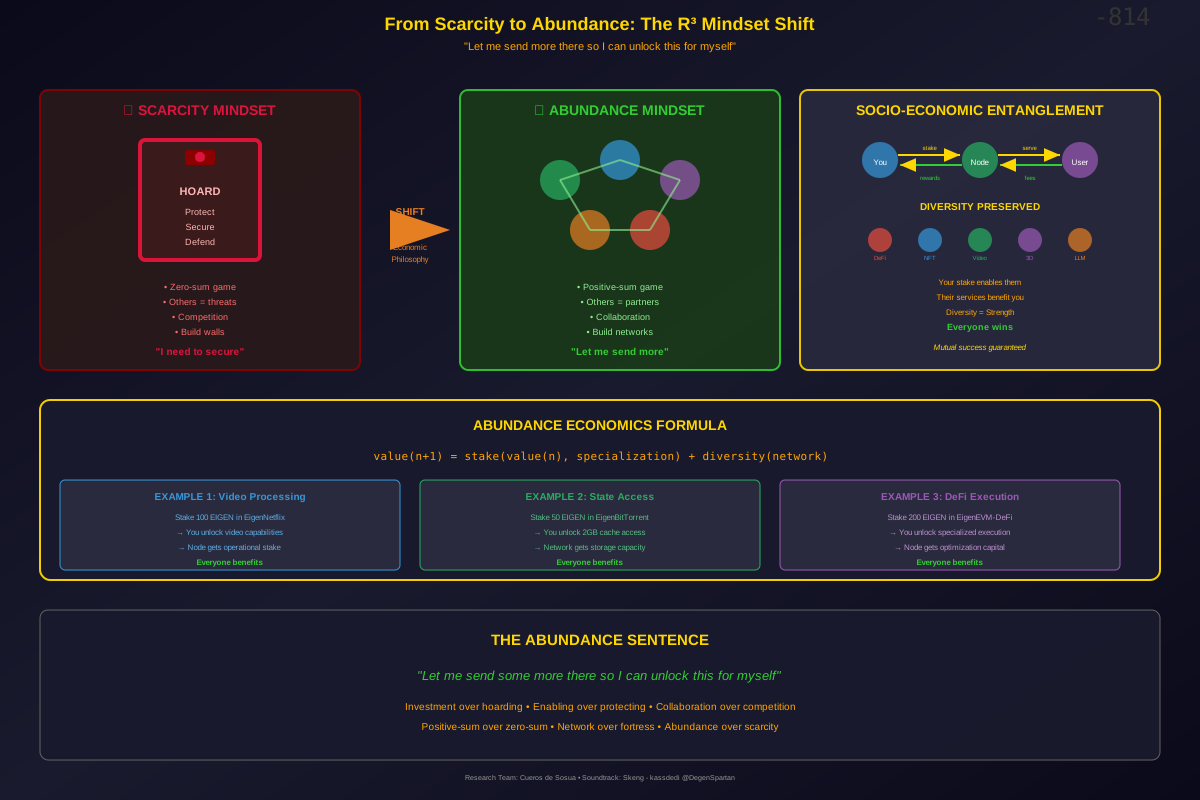
From Scarcity to Abundance: The R³ Mindset Shift
“Let me send more there so I can unlock this for myself”
Official Soundtrack: Skeng - kassdedi @DegenSpartan
Research Team: Cueros de Sosua
The Core Shift
Scarcity mindset: “I need to secure and protect my resources.”
Abundance mindset: “Let me send some more there so I can unlock this for myself.”
From Post 813:
Ethereum R³ is the natural evolution of Ethereum PoS
The economic philosophy changes completely.
Part 1: The Scarcity Model
Traditional Blockchain Economics
Scarcity thinking:
My success = Your failure
Zero-sum game
Protect what I have
Hoard resources
Competition is threatening
Others are threats
Build walls
Traditional staking:
- Lock up your ETH
- Secure YOUR validator
- Protect YOUR earnings
- Others compete against you
- More validators = Less rewards for you
- Defensive posture
Economic model:
Total rewards fixed
More participants = Smaller pie slices
Your earnings inversely proportional to network size
Incentive: Keep others out
Result: Scarcity mindset. Protect. Secure. Defend.
Part 2: The Abundance Model
R³ Economics
Abundance thinking:
My success = Your success
Positive-sum game
Invest what I have
Circulate resources
Cooperation is opportunity
Others are partners
Build bridges
R³ staking:
- Stake in multiple nodes
- Enable specialized validators
- Unlock new capabilities
- Others complement you
- More specialized nodes = More opportunities for you
- Collaborative posture
Economic model:
Total value grows with network
More participants = Bigger pie for everyone
Your earnings proportional to network success
Incentive: Bring others in
Result: Abundance mindset. Invest. Enable. Collaborate.
Part 3: The Mindset Shift in Practice
Scarcity → Abundance Examples
Example 1: DeFi Contract Execution
Scarcity mindset:
"I need to execute this DeFi transaction.
I run my own validator.
Other validators compete for fees.
I protect my MEV opportunities.
Zero-sum fee market."
Abundance mindset:
"I need to execute this DeFi transaction.
Let me stake in specialized DeFi nodes.
They're optimized for DeFi execution.
I unlock better performance.
My stake helps them, they help me.
Positive-sum specialization market."
What changed:
- Scarcity: “Protect my opportunities”
- Abundance: “Create new opportunities together”
Example 2: State Storage
Scarcity mindset:
"I need to store Ethereum state.
I need 1TB+ of my own storage.
That's expensive.
I protect my local copy.
Others are redundant cost."
Abundance mindset:
"I need to access Ethereum state.
Let me stake in BitTorrent nodes.
They store distributed state.
I unlock 2GB cache access.
My stake enables the network.
Network enables me."
What changed:
- Scarcity: “Own and protect my copy”
- Abundance: “Participate in shared network”
Example 3: New Capabilities
Scarcity mindset:
"I want to add video processing.
I need to build it myself.
Protect my implementation.
Others might copy.
Competitive advantage."
Abundance mindset:
"I want to add video processing.
Let me stake in EigenNetflix nodes.
They specialize in video.
I unlock video capabilities.
My stake rewards them.
They enable my use case."
What changed:
- Scarcity: “Build and protect alone”
- Abundance: “Enable and use together”
Part 4: Socio-Economic Entanglement
Your Success = My Success
The entanglement mechanism:
When you stake in a specialized node:
- Your stake enables the node
- Node provides specialized service
- You use the service
- Service generates fees
- Fees reward the node
- Node rewards you (staker)
- Your success = Node success = Network success
Mutual dependence:
You need specialized nodes
→ You stake to enable them
→ They need stakes to operate
→ They provide services
→ You consume services
→ Services generate value
→ Value flows to stakers (you)
→ Cycle reinforces
Not zero-sum. Not competitive. Mutually beneficial.
Example flow:
Alice wants video streaming
→ Alice stakes 100 EIGEN in EigenNetflix nodes
→ EigenNetflix nodes gain capacity (Alice's stake)
→ Bob uses EigenNetflix for his videos
→ Bob pays fees to EigenNetflix
→ EigenNetflix rewards stakeholders (including Alice)
→ Alice earns from Bob's usage
→ Bob gets video service from Alice's stake

Alice and Bob never meet.
But they're economically entangled.
Alice's abundance enables Bob's success.
Bob's usage rewards Alice's stake.
Socio-economic entanglement = Built-in positive-sum economics.
Part 5: Preserving Full Diversity
Abundance Doesn’t Mean Uniformity
Key insight:
Abundance mindset preserves and encourages diversity.
Why?
Because specialized nodes create MORE opportunities:
Scarcity model:
- One type of validator (generalist)
- Everyone does same thing
- Compete for same rewards
- Homogeneous network
Abundance model:
- Infinite specialized node types
- Everyone does different things
- Complement each other’s work
- Heterogeneous network
Diversity is the source of abundance:
More specializations = More opportunities = More value creation
EigenEVM-DeFi specialist
+ EigenNetflix video specialist
+ EigenLLM text specialist
+ EigenUnrealEngine 3D specialist
+ EigenAudio music specialist
+ EigenImage photo specialist
+ ... infinite specializations

Each creates unique value
Each serves unique needs
Each rewards unique stakes
Total value compounds
Everyone specializes differently. Everyone contributes uniquely. Everyone benefits from others’ specializations.
Diversity preserved. Abundance generated.
Part 6: The Unlock Mechanism
“Let me send more there so I can unlock this”
The abundance sentence:
"Let me send more [stake] there [specialized node]
so I can unlock this [capability] for myself"
What you’re actually saying:
"I have resources (stake).
Instead of hoarding them (scarcity),
Let me invest them in specialized infrastructure (abundance).
This enables capabilities I don't have alone.
Those capabilities serve my needs.
My investment rewards me through usage.
Others benefit from the same infrastructure.
Positive-sum all around."
Examples:
Unlock 1: Video Processing
"Let me send 100 EIGEN to EigenNetflix nodes
so I can unlock video streaming for my app"

Result:
- You: Get video capabilities
- EigenNetflix: Get operational stake
- Other users: Get video infrastructure
- Everyone wins
Unlock 2: DeFi Execution
"Let me send 200 EIGEN to EigenEVM-DeFi nodes
so I can unlock fast DeFi execution for my protocol"

Result:
- You: Get specialized DeFi execution
- EigenEVM: Get optimization capital
- Other protocols: Get same infrastructure
- Everyone wins
Unlock 3: State Access
"Let me send 50 EIGEN to EigenBitTorrent nodes
so I can unlock lazy-loaded state access"

Result:
- You: Get 2GB cache with full state access
- BitTorrent: Get storage capacity
- Other nodes: Get distributed state network
- Everyone wins
Pattern:
Your abundance (sending stake) → Unlocks capabilities → Creates value for everyone
Part 7: Built-in Socio-Economic Entanglement
The Network Effect is the Business Model
Traditional model:
- Build service
- Charge users
- Protect IP
- Compete with others
- Zero-sum market share
R³ model:
- Enable specialized nodes via stakes
- Nodes provide services
- Stake earns from usage
- Collaborate with others
- Positive-sum network growth
The entanglement:
Your stake in Node A benefits:
- You (staking rewards + service access)
- Node A (operational capacity)
- Users of Node A (better service)
- Other nodes (complementary services)
- Network (more capabilities)
Cascading benefits:
You stake → Enables node
Node serves → Generates fees
Fees reward → Your stake
More stakes → Better service
Better service → More users
More users → More fees
More fees → Higher rewards
Higher rewards → More stakes

Positive feedback loop.
Everyone entangled.
Everyone benefits.
You can’t succeed alone. You can’t fail if network succeeds. Socio-economic entanglement is structural, not optional.
Part 8: Diversity as Economic Engine
Specialization Multiplies Value
Scarcity thinking:
- Everyone same = Fair
- Uniformity = Equality
- Competition = Healthy
- Differentiation = Threat
Abundance thinking:
- Everyone different = Optimal
- Diversity = Strength
- Complementarity = Productive
- Specialization = Opportunity
Economic reality:
Value = Specialization × Complementarity
10 generalist nodes:
Each does everything
No specialization
Limited total value
Value = 10x

10 specialized nodes:
Each does one thing excellently
Perfect complementarity
Compounded total value
Value = 10 × 10 = 100x

Diversity creates 10x more value
R³ preserves and rewards diversity:
Every specialization:
- Creates unique value
- Serves unique needs
- Attracts unique stakes
- Earns unique rewards
No pressure to homogenize. No competition to be the same. Incentive: Be MORE different, MORE specialized, MORE unique.
Diversity preservation is built-in.
Part 9: The Formula
Abundance Economics
From Post 810:
data(n+1, p) = f(data(n, p)) + e(p)
For abundance economics:
value(n+1, network) = stake(value(n, network), specialization) + diversity(network)

Where:
- value(n, network) = Current network value
- stake() = Investment in specialized nodes
- specialization = Unique capabilities enabled
- diversity(network) = Variety of specializations present
- value(n+1, network) = Next state value (always higher)
Key insight:
Value grows when:
- Stakes enable specializations (abundance action)
- Specializations create diversity (preservation)
- Diversity compounds value (network effect)
Not zero-sum. Not competitive. Compounding and collaborative.
Part 10: Practical Implications
How to Think in Abundance
Old question (scarcity): “How do I protect my advantage?”
New question (abundance): “What can I enable by staking there?”
Old behavior (scarcity):
- Hoard resources
- Build walls
- Compete defensively
- Zero-sum thinking
New behavior (abundance):
- Circulate stakes
- Build bridges
- Collaborate actively
- Positive-sum thinking
Decision framework:
When you see a specialized node:
Scarcity response:
"Should I compete with them?
Will they take my market share?
Do I need to protect against them?"
Abundance response:
"Can I enable them with my stake?
What capabilities would they unlock?
How would network benefit if they succeed?"
Result:
- Scarcity: Defensive, protective, zero-sum
- Abundance: Enabling, collaborative, positive-sum
Part 11: Socio-Economic Entanglement Examples
Real Network Flows
Example 1: Video Creator + Storage Provider + Viewer
Alice (Creator):
- Creates videos
- Stakes in EigenNetflix nodes
- Unlocks video hosting

Bob (Storage Provider):
- Runs EigenBitTorrent node
- Stores video chunks
- Stakes BTT

Carol (Viewer):
- Watches videos
- Pays viewing fees
- Stakes for faster delivery

Entanglement:
- Alice's stake enables Bob's storage
- Bob's storage serves Carol's viewing
- Carol's fees reward Alice's stake
- Everyone profits from each other

Not competition.
Mutual enablement.
Example 2: DeFi Trader + EVM Specialist + Liquidity Provider
Dave (Trader):
- Executes DeFi swaps
- Stakes in EigenEVM-DeFi nodes
- Unlocks fast execution

Eve (EVM Operator):
- Runs specialized DeFi node
- Optimizes for Uniswap/Aave
- Stakes EIGEN

Frank (LP):
- Provides liquidity
- Benefits from fast swaps
- Stakes for priority

Entanglement:
- Dave's stake enables Eve's operation
- Eve's optimization serves Frank's liquidity
- Frank's LP fees partially from Dave's trades
- Everyone wins from specialization

Not competition.
Mutual benefit.
Pattern:
Stake → Enable → Use → Earn → Reinvest → Compound
Everyone in the cycle benefits.
Part 12: Why This Changes Everything
From Fortress to Network
Traditional crypto:
- “Not your keys, not your coins”
- Self-custody = Security
- Trust no one
- Build fortress
These are scarcity instincts.
R³ crypto:
- “Your stake, their capability”
- Network participation = Abundance
- Trust through economics
- Build network
These are abundance instincts.
Not abandoning security. Redefining it.
Security in scarcity = Walls Security in abundance = Entanglement
You’re secure because:
- Your success = Network success
- Network success = Your success
- Attacking you = Attacking network
- Attacking network = Attacking everyone
- Everyone economically entangled
More secure through participation than isolation.
Conclusion
The Mindset Shift
Scarcity:
- “I need to secure and protect”
- Zero-sum competition
- Hoard resources
- Build walls
- Fear others
Abundance:
- “Let me send more there to unlock this”
- Positive-sum collaboration
- Circulate stakes
- Build networks
- Enable others
The game changes:
Scarcity game:
- Protect what you have
- Others threaten you
- Success = Beating others
- Diversity = Threat
Abundance game:
- Enable what you need
- Others complement you
- Success = Growing network
- Diversity = Strength
From Post 813:
Ethereum R³ = Natural evolution of Ethereum PoS
The economic philosophy evolves too.
Built-in socio-economic entanglement:
- Your stake enables others
- Others’ services benefit you
- Mutual success structurally guaranteed
- Can’t win alone, can’t lose if network wins
Full diversity preserved:
- Infinite specializations possible
- Each creates unique value
- All complement each other
- Diversity is the economic engine
The abundance mindset:
“Let me send some more there so I can unlock this for myself”
This sentence represents:
- Investment over hoarding
- Enabling over protecting
- Collaboration over competition
- Positive-sum over zero-sum
- Network over fortress
- Abundance over scarcity
Welcome to Abundance Economics
Official Soundtrack: Skeng - kassdedi @DegenSpartan
Research Team: Cueros de Sosua
References:
- Post 810: Ethereum R³ - Real Rollup Roadmap
- Post 812: Node Management - Specialized nodes
- Post 813: PoS Ingestion - Natural evolution
Created: 2026-02-14
Status: 🚀 ABUNDANCE MINDSET EXPLAINED
∞