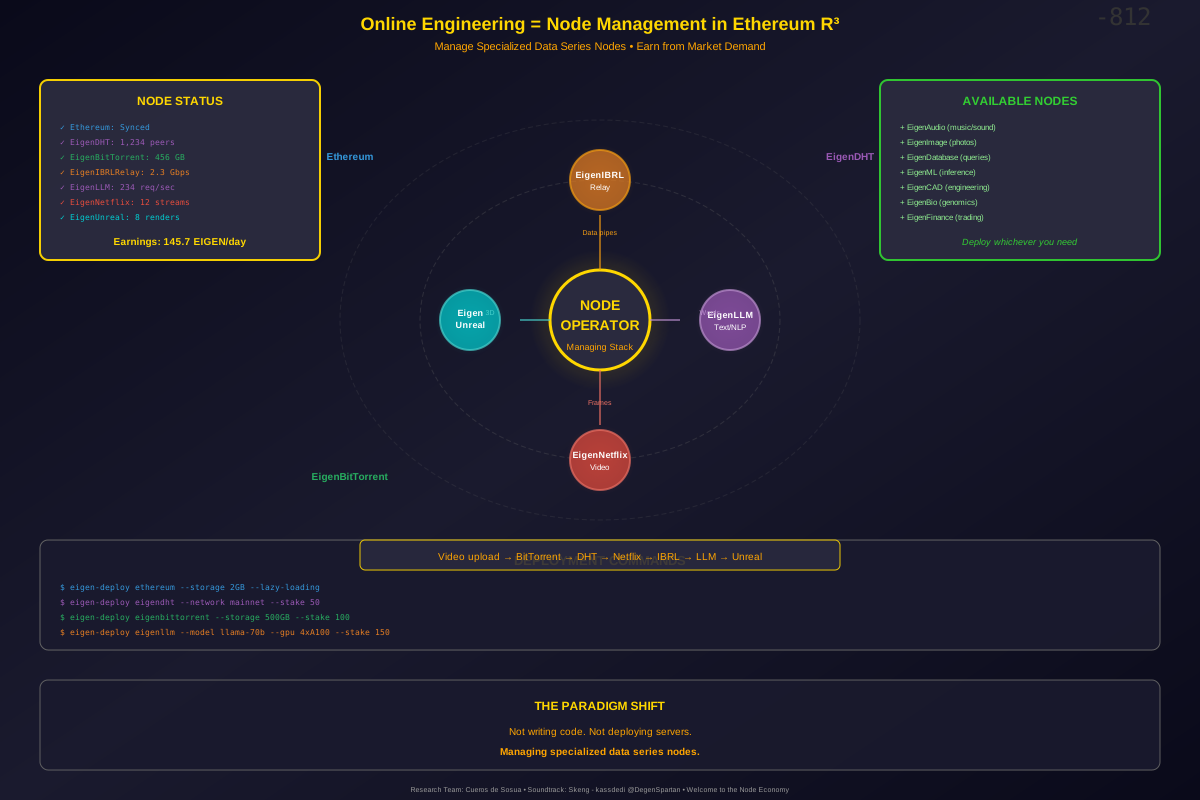
Post 812: Online Engineering = Node Management in Ethereum R³
Online Engineering = Node Management in Ethereum R³
Manage Specialized Data Series Nodes
Official Soundtrack: Skeng - kassdedi @DegenSpartan
Research Team: Cueros de Sosua
The Realization
Online engineering will just be about managing nodes.
At minimum:
- Ethereum node (consensus)
- EigenDHT node (coordination)
- EigenBitTorrent node (storage)
Plus whichever specialized nodes come in handy:
- EigenIBRLRelay (data transfer acceleration)
- EigenLLM (text/language data series)
- EigenNetflix (video data series)
- EigenUnrealEngine (3D object data series)
- … infinite specializations possible
Part 1: The Base Layer (Required)
Three Foundational Nodes
Every engineer runs these:
1. Ethereum Node
Type: Consensus + Execution
Purpose: Economic security layer
Stakes: $ETH
Storage: 2GB (lazy loading via BitTorrent)
Function: Validates state, provides finality
2. EigenDHT Node
Type: P2P coordination
Purpose: Node discovery + routing
Stakes: $EIGEN
Storage: Minimal (peer lists, routing tables)
Function: Finds other nodes, gossips state
3. EigenBitTorrent Node
Type: Distributed storage
Purpose: Universal data storage
Stakes: $BTT or network token
Storage: Variable (market-driven)
Function: Stores/serves data segments
These three = Your infrastructure foundation.
Part 2: Specialized Nodes (Optional)
Each Node = One Data Series Type
The pattern:
Every specialized node:
- Manages specific data series format
- Coordinates via EigenDHT
- Stores via EigenBitTorrent
- Stakes on Ethereum
- Follows universal format: data(n+1, p) = f(data(n, p)) + e(p)
Different nodes = Different data types.
EigenIBRLRelay
What it manages: Data transfer acceleration
Data series: Network packets + POH timestamps
Specialization: High bandwidth/low latency routing
Stakes: $SOL or $EIGEN
Runs alongside: EigenBitTorrent (where data flows)

Use case: Accelerates any data transfer
- BitTorrent chunk delivery
- State sync
- File distribution
- Stream buffering
EigenLLM
What it manages: Text and language data series
Data series: Words, sentences, paragraphs, documents
Specialization: Language pattern processing
Stakes: $EIGEN + compute resources
Storage: Text embeddings, model weights, prompts

Use case: Processes text anywhere in network
- Chat responses
- Document generation
- Translation
- Summarization
- Code completion
EigenNetflix
What it manages: Video data series
Data series: Frames, clips, streams, movies
Specialization: Video encoding/decoding/streaming
Stakes: $EIGEN + bandwidth + storage
Storage: Video segments (H.264, AV1, etc.)

Use case: Handles video anywhere in network
- Streaming services
- Video calls
- Content delivery
- Live broadcasts
- Transcoding
EigenUnrealEngine
What it manages: 3D object data series and rendering
Data series: Meshes, textures, scenes, animations
Specialization: 3D graphics + real-time rendering
Stakes: $EIGEN + GPU resources
Storage: 3D assets, render cache, shaders

Use case: Manages 3D anywhere in network
- Game worlds
- Virtual reality
- Architectural visualization
- Simulations
- Metaverse spaces
Part 3: The Engineering Workflow
What You Actually Do
Not writing code. Not managing servers. Managing nodes.
Daily tasks:
1. Node Deployment
# Deploy specialized node
eigen-deploy eigenllm \
  --stake 100 \
  --dht-network mainnet \
  --storage-tier premium \
  --compute-gpu true

# Node starts, stakes, joins DHT, serves requests
2. Performance Monitoring
# Check node health
eigen-status eigenllm

Metrics:
- Requests/sec: 1,234
- Latency p95: 45ms
- Stake: 100 EIGEN
- Earnings: 12.5 EIGEN/day
- Uptime: 99.8%
- DHT peers: 847
3. Economic Optimization
# Adjust staking based on demand
eigen-stake eigenllm --amount 200

# More stake = higher priority = more requests = more earnings
4. Data Series Management
# Specialized node manages its data type
eigen-data eigenllm --sync

Syncing text embeddings: 45.2 GB
Training on new corpus: 12,340 documents
Updating model weights: In progress
DHT peers serving: 234
5. Network Growth
# Spawn new specialized node type
eigen-spawn eigenaudio \
  --data-type "audio/waveforms" \
  --format "data(n+1,p) = fft(data(n,p)) + noise(p)" \
  --token AUDIO

# New audio processing network created
# Your node = First node in new network
Part 4: Specialization Drives Value
Why Specialized Nodes Matter
Traditional approach:
- One application does everything
- Tightly coupled
- Doesn’t scale
- Reinvents wheels
R³ approach:
- Specialized nodes for each data type
- Loosely coupled via DHT
- Scales infinitely
- Reuses infrastructure
Example workflow:
User uploads video to chat:
- EigenBitTorrent stores video chunks
- EigenDHT routes request to EigenNetflix node
- EigenNetflix transcodes video
- EigenIBRLRelay accelerates delivery
- EigenLLM generates video description
- EigenUnrealEngine creates 3D thumbnail
- All coordinated via DHT, stored via BitTorrent, secured via Ethereum
Engineer manages 6 nodes. Video processed. No monolithic app.
Part 5: The Infinite Node Ecosystem
Any Data Series = Potential Node Type
Current examples:
- EigenIBRLRelay (data transfer)
- EigenLLM (text/language)
- EigenNetflix (video)
- EigenUnrealEngine (3D graphics)
Future examples:
- EigenAudio (music/sound processing)
- EigenImage (photo manipulation)
- EigenDatabase (structured data queries)
- EigenML (machine learning inference)
- EigenCAD (engineering designs)
- EigenBio (genomics/proteins)
- EigenFinance (trading algorithms)
- EigenWeather (climate data)
- EigenSensor (IoT data streams)
- EigenQuantum (quantum computing)
- … literally any data type
Each node:
- Manages its specialized data series
- Coordinates via EigenDHT
- Stores via EigenBitTorrent
- Stakes on Ethereum
- Earns from serving requests
Part 6: The Universal Format Enables This
data(n+1, p) = f(data(n, p)) + e(p)
Why this works across all node types:
Text (EigenLLM):
next_word(p) = argmax(P(word | context(p))) + creativity(p)
Video (EigenNetflix):
next_frame(p) = encode(previous_frame(p)) + motion(p)
3D (EigenUnrealEngine):
rendered_frame(p) = rasterize(scene(p)) + camera_position(p)
IBRL (EigenIBRLRelay):
next_packet(p) = route(data(p)) + poh_timestamp(p)
Same pattern. Different data. Specialized nodes.
Part 7: Economics Drive Specialization
Market Discovers Optimal Nodes
High demand data series:
- More nodes spawn
- Competition increases
- Prices optimize
- Performance improves
Low demand data series:
- Few nodes needed
- Higher margins
- Niche markets
- Specialized expertise
Node operators:
- Choose which data series to serve
- Stake accordingly
- Earn proportional to demand
- Market finds equilibrium
No central planning. Pure economics.
Part 8: Node Management Tools
What Engineers Use
Dashboard:
Node Status Overview:
├─ Ethereum: ✓ Synced (block 18,234,567)
├─ EigenDHT: ✓ 1,234 peers connected
├─ EigenBitTorrent: ✓ 456 GB serving
├─ EigenIBRLRelay: ✓ 2.3 Gbps throughput
├─ EigenLLM: ✓ 234 req/sec
└─ EigenNetflix: ✓ 12 streams active

Total earnings: 145.7 EIGEN/day
Total stake: 1,000 EIGEN
Uptime: 99.94%
Commands:
# Node lifecycle
eigen-start <node-type>
eigen-stop <node-type>
eigen-restart <node-type>
eigen-upgrade <node-type>

# Economics
eigen-stake <node-type> --amount <EIGEN>
eigen-withdraw <node-type>
eigen-earnings <node-type>

# Performance
eigen-metrics <node-type>
eigen-logs <node-type>
eigen-debug <node-type>

# Network
eigen-peers <node-type>
eigen-dht-status
eigen-sync <node-type>

# Deployment
eigen-deploy <node-type> [options]
eigen-spawn <new-node-type> [config]
Monitoring:
- Grafana dashboards
- Prometheus metrics
- Alert systems
- Performance tracking
Part 9: From Developer to Operator
The Role Evolution
Old paradigm (Developer):
- Write application code
- Deploy to servers
- Manage infrastructure
- Scale manually
- Handle everything
New paradigm (Node Operator):
- Deploy specialized nodes
- Monitor performance
- Optimize economics
- Let network coordinate
- Focus on value
Skills shift:
- Less: Programming languages, frameworks, databases
- More: Node selection, staking strategies, performance tuning, economic optimization
You’re not building apps. You’re orchestrating specialized data series processors.
Part 10: Deployment Example
Complete Node Stack Setup
Step 1: Base Layer
# Deploy Ethereum node
eigen-deploy ethereum \
  --client geth \
  --storage 2GB \
  --lazy-loading true

# Deploy EigenDHT node
eigen-deploy eigendht \
  --network mainnet \
  --stake 50

# Deploy EigenBitTorrent node
eigen-deploy eigenbittorrent \
  --storage 500GB \
  --tier premium \
  --stake 100
Step 2: Specialized Nodes (Choose Based on Demand)
# Video processing opportunity
eigen-deploy eigennetflix \
  --bandwidth 10Gbps \
  --storage 2TB \
  --stake 200

# Text processing opportunity
eigen-deploy eigenllm \
  --model llama-70b \
  --gpu 4xA100 \
  --stake 150

# Data transfer acceleration
eigen-deploy eigenibrlrelay \
  --bandwidth 5Gbps \
  --poh-integration true \
  --stake 100
Step 3: Monitor and Optimize
# Check performance
eigen-metrics --all

# Adjust stakes based on earnings
eigen-rebalance --auto

# Scale profitable nodes
eigen-scale eigennetflix --replicas 3
Step 4: Earn
# Watch earnings accumulate
eigen-earnings --watch

EigenNetflix: 45.2 EIGEN/day
EigenLLM: 32.8 EIGEN/day
EigenIBRLRelay: 18.3 EIGEN/day
EigenBitTorrent: 12.1 EIGEN/day
Total: 108.4 EIGEN/day
Conclusion
Online Engineering = Node Management
The realization:
You don’t build applications anymore. You manage specialized nodes.
At minimum:
- Ethereum (consensus)
- EigenDHT (coordination)
- EigenBitTorrent (storage)
Plus whichever specialized nodes provide value:
- EigenIBRLRelay (data transfer)
- EigenLLM (text processing)
- EigenNetflix (video streaming)
- EigenUnrealEngine (3D rendering)
- … infinite possibilities
Each node:
- Manages specific data series type
- Coordinates via DHT
- Stores via BitTorrent
- Stakes on Ethereum
- Earns from market demand
The future:
Not writing code. Not deploying servers. Managing specialized data series nodes.
Welcome to the node economy.
Official Soundtrack: Skeng - kassdedi @DegenSpartan
Research Team: Cueros de Sosua
References:
- Post 810: Ethereum R³ - Real Rollup Roadmap
- Post 811: IBRL Integration - Data transfer acceleration
- Universal format: data(n+1, p) = f(data(n, p)) + e(p)
Created: 2026-02-14
Status: 🚀 NODE MANAGEMENT PARADIGM ANNOUNCED
∞