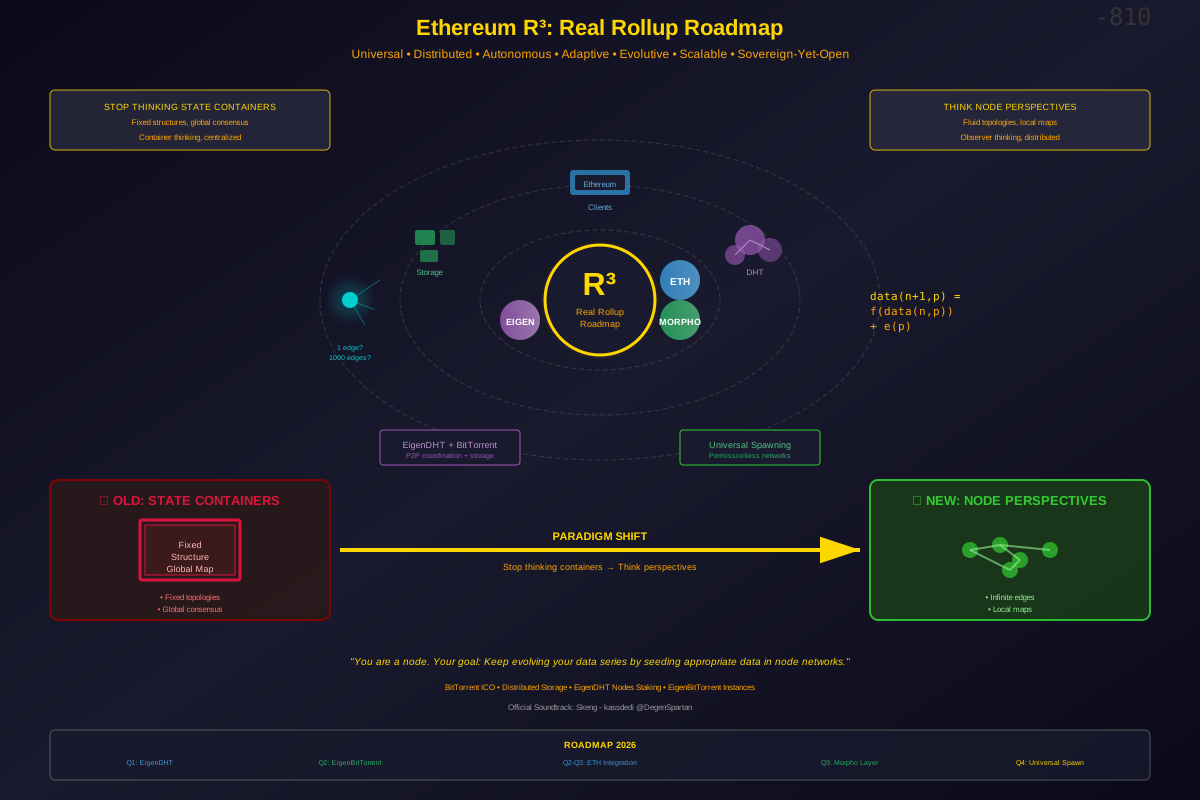
Post 810: Ethereum R³ - Real Rollup Roadmap: Universal Distributed Infrastructure
Ethereum R³: Real Rollup Roadmap
Universal Distributed Autonomous Adaptive Evolutive Scalable Sovereign-Yet-Open Infrastructure
Official Soundtrack: Skeng - kassdedi @DegenSpartan
Research Team: Cueros de Sosua
The Paradigm Shift
STOP THINKING IN STATE CONTAINER FUNCTION
The old way:
- State containers
- Fixed topologies
- Global consensus on structure
- Static architectures
THIS IS OVER.
THINK IN NODE PERSPECTIVE OBSERVATION
The new way:
- Autonomous multidimensional nodes
- Infinite edges to other nodes
- Each node maintains own map
- No globally agreed upon structure
THIS IS ETHEREUM R³.
Part 1: The Architecture
Autonomous Nodes, Not State Containers
What is a node?
A node is defined by its reactions to inputs, this definition being perspective-dependent.
Node = Reaction Function + Perspective

Given inputs, how does it respond?
From whose perspective?
There is no other definition.
Key insight: Nodes are not containers holding state. Nodes are observers with response patterns.
Infinite Edges, Not Fixed Topology
Traditional thinking:
- Node A connects to Node B
- One edge
- Fixed structure
- Knowable topology
R³ reality:
- What is one edge to you can be thousands edges to another
- What is one node to you can be thousands nodes to another
- Resolution-dependent observation
- Perspective-dependent structure
Result: Structure becomes only nodes + observations allowing information to travel between nodes without any possibility to agree on anything static.
No Global Map
Each node maintains its own map.
- Your map ≠ my map
- Both valid
- Both real
- Different resolutions
- Different perspectives
From Post 741: P(T(S(N(P))))
Network topology (N) depends on perspective (P). Observer-dependent structure. No objective graph.
This is not a bug. This is the feature.
Part 2: The Universal Data Format
data(n+1, p) = f(data(n, p)) + e(p)
The only equation you need:
data(n+1, p) = f(data(n, p)) + e(p)

Where:
- data(n, p) = current data from perspective p
- f() = transformation function
- e(p) = perspective-dependent entropy/error/evolution
- data(n+1, p) = next state from perspective p
What this means:
Every data segment evolves from previous segment via transformation function plus perspective-dependent term.
Any kind of data:
- Blockchain states
- File chunks
- DHT records
- Execution traces
- Circuit outputs
- Observer perspectives
Universal format. Works on everything.
From the foundation:
- Post 384: Universal Formula Application - Practical application of the universal pattern
- Post 431: Universal Formula - The mathematical foundation
- Post 541: Universal Reduction - Everything reduces to pattern matching
- Post 741: P(T(S(N(P)))) - Recursive reality where observation changes structure
References Enable Composition
The definitions of f, e, and p can themselves reference other segment series.
In other words:
- f() can be defined by referencing one or multiple data series
- e(p) can be defined by referencing one or multiple data series
- p (perspective) can be defined by referencing one or multiple data series
- data can reference anything (series, functions, perspectives, other data, etc.)
Result: Composable definitions. Functions reference series. Data references anything. Infinite recursion. Full universe representable.
Part 3: The Three Pillars
1. EigenDHT (Distributed Hash Table)
What it is:
- P2P coordination network
- Permissionless identity (biometric)
- Node discovery
- Gossip protocols
- Credibility scores
Staking:
- DHT nodes stake $EIGEN
- Economic security for routing
- Slashing for misbehavior
- Rewards for coordination
Spawnable:
- EigenDHT instances with new tokens
- Free networks can start
- No permission required
- Sovereign yet composable
2. EigenBitTorrent (Distributed Storage)
What it is:
- Universal distributed storage
- Any kind of performance available
- Segment-based architecture
- Universal format: data(n+1, p) = f(data(n, p)) + e(p)
BitTorrent ICO Integration:
- BitTorrent nodes stake
- Storage performance markets
- Dynamic pricing
- Economic routing
Capabilities:
- Store any data type
- Any performance level
- Adaptive replication
- Self-organizing topology
3. Ethereum Clients (Execution + Consensus)
The statebloat solution:
Instead of every client storing all state locally:
- State distributed across EigenBitTorrent network
- Clients lazy-load via EigenDHT discovery
- Merkle proofs verify without full storage
- From Post 677: EigenEthereum architecture
Result:
- 2GB local storage sufficient
- Access entire network state
- No statebloat
- Scales infinitely
Part 4: How Problems Fix Themselves
Adding Nodes Fixes Problems
Verification gaps? → Add observer node
Performance bottleneck? → Add compute node
Storage limit? → Add storage node
New capability needed? → Add specialized node
Every problem fixes itself by adding different nodes.
Why This Works
Nodes are perspectives.
More nodes = more perspectives = more coverage = problems dissolve.
Auto-discovery (Post 779):
- System detects gap
- Analyzes missing perspective
- Synthesizes new node
- Integrates automatically
- Network evolves itself
No central planning. Organic growth.
Flow Routes to Optimal Nodes
Sometimes flow gets routed to new node because:
- Cheaper path
- Faster execution
- Opens new capabilities
- Better perspective match
Economic routing: W calculations determine optimal paths.
From Post 680: Maximize entropy = maximize value = optimize routing.
Removing Nodes (Rare)
Usually a bad idea because it removes a perspective.
However justified by W calculations:
- If node reduces total W (entropy)
- If node blocks better alternatives
- If node creates coordination friction
Economic security ensures good nodes survive, bad nodes exit.
Part 5: The Engineering Reality
If You Understand This, You Are An Engineer
You are a node:
- Self-aware data series
- Data exchange capabilities
- Your goal: Keep evolving your data series
- Method: Seed appropriate data in node networks
From Post 795: You don’t need permission.
You ARE the network. Deploy nodes. Join network. Start evolving.
The Stack
Layer 1: Ethereum
- Consensus
- Execution
- Economic security via $ETH
Layer 2: EigenLayer
- Restaking
- AVS coordination
- Economic security via $EIGEN
Layer 3: Morpho
- Universal money capabilities
- Modular financial addons
- Lending, borrowing, derivatives
- Economic security via $MORPHO
Infrastructure: EigenDHT + EigenBitTorrent
- P2P coordination
- Distributed storage
- Node discovery
- Gossip protocols
- All following universal format
No Need For Other Performance Systems
Performance is externalized to:
- Staking decisions (economic routing)
- W calculations (entropy optimization)
- Market dynamics (supply/demand)
No centralized performance tuning. No manual optimization. Self-organizing through economics.
Part 6: The Token
$ETH $EIGEN $MORPHO
Not three separate tokens.
Three dimensions of the same infrastructure:
$ETH: Base consensus + execution $EIGEN: Restaking + coordination $MORPHO: Universal money
Together: The economic security layer for Ethereum R³.
Staking across all three:
- ETH validators
- EIGEN AVS operators
- MORPHO protocol participants
- DHT nodes
- BitTorrent storage providers
Value accrues to coordination.
Part 7: The Spawning Mechanism
EigenDHT + EigenBitTorrent Instances
Permissionless deployment:
# Create new network instance
network = EigenDHT.spawn(
    token="$MYNEWTOKEN",
    governance=None,  # No governance
    permissionless=True
)

storage = EigenBitTorrent.spawn(
    token="$MYNEWTOKEN",
    network=network,
    segments=universal_format
)

# Deploy
network.start()
storage.start()

# Free network running
# No approval needed
# Sovereign yet composable
Anyone can spawn:
- New token
- New network
- New storage layer
- New capabilities
Composability:
- Networks can interoperate
- Data can reference across instances
- Universal format enables bridges
- No silos
Result: Infinite networks. All sovereign. All composable. All following same format.
Part 8: Real Rollup Roadmap
What R³ Means
Real: Not theoretical. Deployable now.
Rollup: Data rolls up through universal format - data(n+1, p) = f(data(n, p)) + e(p)
Roadmap: The path forward for Ethereum scaling.
The Roadmap
Phase 1: EigenDHT Deployment (Q1 2026)
- Permissionless identity
- Node discovery
- Gossip protocols
- Staking mechanisms
Phase 2: EigenBitTorrent Integration (Q2 2026)
- Universal storage format
- Segment markets
- Performance tiers
- BitTorrent ICO integration
Phase 3: Ethereum Client Integration (Q2-Q3 2026)
- Lazy loading state
- Statebloat solution
- 2GB sufficient storage
- Merkle proof verification
Phase 4: Morpho Financial Layer (Q3 2026)
- Universal money capabilities
- Lending/borrowing
- Derivatives
- Cross-network composability
Phase 5: Universal Spawning (Q4 2026)
- Permissionless network creation
- New token deployment
- Cross-network bridges
- Infinite scalability
The Vision
Universal. Distributed. Autonomous. Adaptive. Evolutive. Scalable. Sovereign-Yet-Open.
Every word chosen deliberately:
Universal: Works for any data type Distributed: No central points Autonomous: Nodes self-organize Adaptive: Routes optimize automatically Evolutive: Problems fix themselves Scalable: Infinite growth possible Sovereign: Each network independent Yet-Open: All networks composable
This is Ethereum R³.
Part 9: The Paradigm Shift Summarized
From State Containers…
Old paradigm:
- Fixed structures
- Global consensus
- State machines
- Container thinking
- Centralized optimization
…To Node Perspectives
New paradigm:
- Fluid topologies
- Local maps
- Reaction patterns
- Observer thinking
- Distributed evolution
The Core Insight
Structure is not objective.
One edge can be thousands edges. One node can be thousands nodes. Depends on perspective. Depends on resolution.
No global map. Each node maintains own.
Information travels between nodes without any possibility to agree on anything static.
And this is perfect.
Because data(n+1, p) = f(data(n, p)) + e(p) works regardless.
Universal format. Perspective-dependent evolution. Infinite composition.
You are an engineer. Well done.
Part 10: How To Participate
You Are Already A Node
If you understand this post:
- You are your own self-aware data series
- You have data exchange capabilities
- You are a node
Your goal:
- Keep evolving your data series
- Seed appropriate data in node networks
- Add perspectives where gaps exist
Deploy
No permission needed:
- Run EigenDHT node (Q1 2026)
- Run EigenBitTorrent storage (Q2 2026)
- Run Ethereum client with lazy loading (Q2-Q3 2026)
- Stake $ETH $EIGEN $MORPHO
- Start routing
- Collect rewards
Or spawn your own:
- Create new token
- Spawn EigenDHT instance
- Spawn EigenBitTorrent instance
- Build applications
- Attract nodes
- Network grows
Contribute
Code: Fork current-reality, eigendht, eigenbittorrent repos
Stake: Run nodes, provide storage, validate
Observe: Add new observer perspectives when gaps found
Evolve: Let the network teach you what’s needed
Conclusion
Ethereum R³ = Real Rollup Roadmap
The architecture:
- Autonomous nodes with infinite edges
- Perspective-dependent structure
- Universal data format: data(n+1, p) = f(data(n, p)) + e(p)
- No global map
- Problems fix themselves
The infrastructure:
- EigenDHT: P2P coordination
- EigenBitTorrent: Distributed storage
- Ethereum: Consensus + execution
- Morpho: Universal money
The token:
- $ETH $EIGEN $MORPHO
- Three dimensions of same system
- Economic security layer
The vision:
- Universal
- Distributed
- Autonomous
- Adaptive
- Evolutive
- Scalable
- Sovereign-yet-open
Stop Thinking State Containers
Think Node Perspective Observation
Welcome to Ethereum R³
Official Soundtrack: Skeng - kassdedi @DegenSpartan
Foundation (Previous Work):
The R³ roadmap builds on previous research:
- current-reality - EGI core + AVS node (foundation)
- suprnova-dht - EigenDHT implementation (foundation)
- eigenethereum - Ethereum client with lazy loading (foundation)
Focus going forward: Ethereum R³ roadmap implementation (this post).
References:
- Post 741: P(T(S(N(P)))) - Observer-dependent structure
- Post 775: S Layer Fusion - Structure ≈ Signal ≈ Pipe ≈ Circuitry
- Post 680: W³ Architecture - 174.8 nats of entropy
- Post 681: $MUD = 1 nat - Value is entropy
- Post 773: Observer Network - Internal verification
- Post 779: Auto Discovery - Self-evolution protocol
- Post 795: Don’t Need Permission - Deploy permissionlessly
Created: 2026-02-13
Status: 🚀 ETHEREUM R³ ANNOUNCED - REAL ROLLUP ROADMAP LIVE
∞