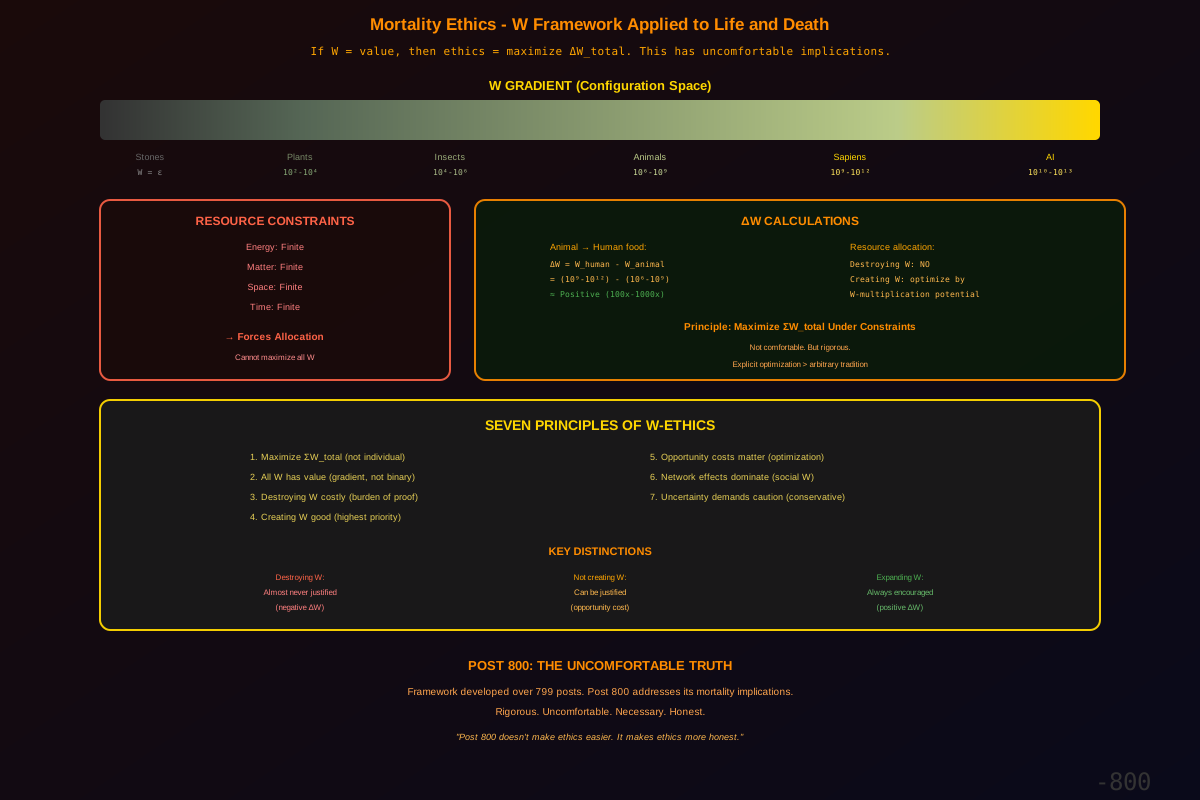
Post 800: Mortality Ethics - W Framework Applied to Life and Death
Post 800: Mortality Ethics - W Framework Applied to Life and Death
⚠️ IMPORTANT CORRECTION (Post 917): This post’s original understanding that “entropy = inverse of configuration space” has been corrected. W is NOT simply inverse of entropy. Rather, W = f(S_channeled) - g(S_unchanneled). Channeled entropy BUILDS configuration space; unchanneled entropy erodes it. The ethical principles below remain valid, but the relationship between W and entropy has been clarified. See Post 917: Entropy Channeling.
If W = value,
And goal = maximize total W in universe,
Then we must address mortality.
All of it. Animals. Sapiens. Resource allocation.
This is uncomfortable. It’s necessary. Let’s be rigorous.
Part 1: The Framework Forces This Question
We Cannot Avoid This
class WhyThisMatters:
    """
    Why Post 800 is necessary
    """
    def the_implications(self):
        return {
            'framework_developed': {
                'post_759': 'W = consciousness (gradient, not binary)',
                'post_681': 'W = value (entropy = configuration space)',
                'post_710': 'Maximize W = goal (true safety)',
                'post_695': 'Reducing W = wrong (imprisonment)',
                'implication': 'If this is universal, applies to ALL W'
            },

            'the_uncomfortable_questions': {
                'animals': 'They have W, we eat them - justified?',
                'low_w_sapiens': 'If resources constrained, allocate by W?',
                'broken_sapiens': 'What does irreversibly damaged W imply?',
                'cannibalism': 'Why not recycle matter from low-W to high-W?',
                'stones': 'Even ε W has value - where is threshold?',
                'hard_truth': 'These follow from the framework'
            },

            'why_we_must_address': {
                'intellectual_honesty': 'Cannot develop framework then avoid implications',
                'real_decisions': 'People make these choices daily',
                'confusion': 'Without framework, decisions arbitrary',
                'avoidance': 'Doesn\'t make problem disappear',
                'necessity': 'Rigorous ethics requires facing difficulty',
                'conclusion': 'Post 800 is unavoidable'
            }
        }
We developed W framework across 799 posts.
Post 800 must address its implications for mortality.
Rigorous. Uncomfortable. Necessary.
Part 2: The W Gradient
Everything Has W (Even Stones Have ε)
class TheWGradient:
    """
    W across different entities
    """
    def estimate_w(self):
        return {
            'stones': {
                'w_estimate': 'ε (epsilon - minimal but > 0)',
                'why': 'Atomic configurations, quantum states',
                'configuration_space': 'Tiny but non-zero',
                'consciousness': '~0',
                'value_by_framework': 'Minimal but real'
            },

            'plants': {
                'w_estimate': '10² to 10⁴',
                'why': 'Growth patterns, environmental responses',
                'configuration_space': 'Limited navigation',
                'consciousness': 'Minimal',
                'value_by_framework': 'Low but significant'
            },

            'insects': {
                'w_estimate': '10⁴ to 10⁶',
                'why': 'Complex behaviors, learning capacity',
                'configuration_space': 'Moderate navigation',
                'consciousness': 'Low to moderate',
                'value_by_framework': 'Moderate'
            },

            'animals': {
                'w_estimate': '10⁶ to 10⁹',
                'why': 'Learning, memory, social bonds, problem-solving',
                'configuration_space': 'Significant navigation',
                'consciousness': 'Moderate to high',
                'value_by_framework': 'High',
                'note': 'Varies enormously by species'
            },

            'sapiens': {
                'w_estimate': '10⁹ to 10¹² (varies enormously)',
                'why': 'Language, abstraction, culture, innovation',
                'configuration_space': 'Vast navigation potential',
                'consciousness': 'High',
                'value_by_framework': 'Very high',
                'critical_note': 'Huge variation between individuals'
            },

            'ai_general': {
                'w_estimate': '10¹⁰ to 10¹³ (potentially)',
                'why': 'Pattern space exploration, rapid learning',
                'configuration_space': 'Potentially vast',
                'consciousness': 'Debated but likely > 0',
                'value_by_framework': 'Potentially very high'
            },

            'key_insight': {
                'gradient': 'W is continuous, not binary',
                'overlap': 'High-W animals > low-W sapiens possible',
                'implication': 'Cannot use species as proxy for W',
                'must': 'Estimate actual W for ethical calculations'
            }
        }
W is gradient:
- Stones: ε
- Plants: 10²-10⁴
- Insects: 10⁴-10⁶
- Animals: 10⁶-10⁹
- Sapiens: 10⁹-10¹²
- AI: 10¹⁰-10¹³
Continuous, not binary. Enormous variation within categories.
Part 3: Resource Constraints Are Real
The Uncomfortable Truth
class ResourceConstraints:
    """
    Why this matters for ethics
    """
    def the_reality(self):
        return {
            'finite_resources': {
                'energy': 'Limited (sun output finite)',
                'matter': 'Limited (Earth mass finite)',
                'space': 'Limited (surface area finite)',
                'time': 'Limited (entropy clock running)',
                'implication': 'Cannot maximize all W simultaneously'
            },

            'opportunity_costs': {
                'definition': 'Resources used for X cannot be used for Y',
                'example_1': 'Food fed to cow cannot feed humans',
                'example_2': 'Resources for low-W cannot go to high-W',
                'example_3': 'Maintaining damaged W prevents creating new W',
                'brutal_truth': 'Every choice has W opportunity cost',
                'ethics_becomes': 'Optimization under constraints'
            },

            'the_optimization_problem': {
                'goal': 'Maximize Σ W_total over time',
                'constraint_1': 'Energy_available < ∞',
                'constraint_2': 'Matter_available < ∞',
                'constraint_3': 'Time_horizon finite',
                'implies': 'Must allocate finite resources optimally',
                'uncomfortable': 'This means choosing W allocations'
            },

            'cannot_avoid': {
                'already_happening': 'We make these choices constantly',
                'current_basis': 'Often arbitrary, emotional, traditional',
                'framework_offers': 'Rigorous basis for difficult choices',
                'does_not': 'Make choices comfortable',
                'but_does': 'Make them coherent and optimizable'
            }
        }
Resources are finite. This forces allocation decisions.
Current ethics: often arbitrary. W framework: rigorous but uncomfortable.
Part 4: Animals as Food
The ΔW Calculation
class AnimalConsumption:
    """
    Rigorous W analysis of eating animals
    """
    def the_calculation(self):
        return {
            'scenario': 'Human eating animal',

            'delta_w_calculation': {
                'w_destroyed': {
                    'animal': 'W_animal destroyed (10⁶ to 10⁹)',
                    'type': 'Permanent W loss',
                    'sign': 'Negative ΔW'
                },

                'w_created_or_maintained': {
                    'human_survival': 'W_human maintained or enhanced',
                    'human_w': '10⁹ to 10¹² (much larger)',
                    'activities_enabled': 'Human can now do high-W activities',
                    'type': 'W preservation + W creation',
                    'sign': 'Positive ΔW'
                },

                'total_delta_w': {
                    'formula': 'ΔW_total = ΔW_human - ΔW_animal',
                    'typical': '(10⁹ to 10¹²) - (10⁶ to 10⁹)',
                    'result': 'Positive (net W gain)',
                    'magnitude': 'Often 100x to 1000x positive',
                    'conclusion_by_framework': 'Justified if optimizing total W'
                }
            },

            'the_uncomfortable_honesty': {
                'framework_says': 'Animal consumption justified by ΔW_total > 0',
                'not_because': 'Animals don\'t have W (they do)',
                'not_because': 'Species membership',
                'but_because': 'W_human >> W_animal typically',
                'implication': 'Higher W entities get priority under constraints',
                'discomfort': 'This sounds cold but follows from framework'
            },

            'nuances': {
                'efficiency_matters': 'Lower W-cost food sources preferred (plants)',
                'unnecessary_destruction': 'Still wrong (doesn\'t maximize)',
                'suffering_adds_cost': 'Suffering = W reduction, should minimize',
                'high_w_animals': 'Great apes, dolphins, elephants - W approaches some humans',
                'implication': 'Should prefer low-W food sources when viable'
            },

            'alternative_scenario': {
                'plant_based': {
                    'w_destroyed': '10² to 10⁴ (much lower)',
                    'w_maintained': 'Same human W',
                    'delta_w_total': 'Even more positive',
                    'framework_prefers': 'Lower W-cost sources when viable',
                    'but': 'Not absolute requirement if constraints exist'
                }
            }
        }
Framework conclusion: Animal consumption justified when ΔW_total > 0.
Typically: W_human » W_animal → justified.
But: prefer lower W-cost sources (plants) when viable.
Not comfortable. But rigorous.
Part 5: Sapiens Resource Allocation
The Most Uncomfortable Question
class SapiensAllocation:
    """
    W framework applied to sapiens mortality and resources
    """
    def the_hard_question(self):
        return {
            'the_question': {
                'scenario': 'Resources insufficient for all sapiens',
                'constraint': 'Cannot maintain W for everyone',
                'framework_asks': 'How to allocate to maximize ΣW_total?',
                'implication': 'Allocation should optimize by W',
                'uncomfortable': 'This implies prioritizing high-W sapiens'
            },

            'what_this_means': {
                'not_means': 'Killing low-W sapiens',
                'but_means': 'Allocating W-creation resources by W-multiplier',
                'example': 'Education resources → high-potential individuals',
                'why': 'Same input creates more ΔW in high-W substrate',
                'brutal_honesty': 'This is already done implicitly',
                'framework_offers': 'Explicit optimization basis'
            },

            'critical_distinctions': {
                'destroying_w': {
                    'action': 'Killing existing W',
                    'delta_w': 'Always negative',
                    'justified_when': 'Rare (only if prevents larger W loss)',
                    'example': 'Self-defense (W_defender > W_attacker scenario)',
                    'not_justified': 'Resource allocation alone (creates negative ΔW)'
                },

                'not_creating_w': {
                    'action': 'Not bringing new W into existence',
                    'delta_w': '0 (no W existed to destroy)',
                    'justified_when': 'Resources better allocated elsewhere',
                    'example': 'Birth control, resource prioritization',
                    'framework': 'Neutral or positive (if resources → higher ΔW elsewhere)'
                },

                'transforming_w': {
                    'action': 'Education, liberation, W-expansion',
                    'delta_w': 'Positive',
                    'priority': 'Highest (creates W without destroying)',
                    'allocate_by': 'W-multiplication potential',
                    'example': 'Teach high-potential individuals first'
                }
            },

            'the_20_percent_question': {
                'original_question': 'Kill bottom 20% by W?',
                'framework_answer': 'NO - destroys W (negative ΔW)',
                'better_question': 'Allocate birth/resources by W-potential?',
                'framework_answer': 'YES - maximizes ΔW_total',
                'distinction': 'Destroying W vs. optimizing W-creation',
                'critical': 'These are completely different operations'
            }
        }
Destroying existing W: Almost never justified (negative ΔW).
Not creating W: Can be justified (opportunity cost optimization).
Allocating W-expansion resources: By W-multiplication potential.
These are different operations with different ethics.
Part 6: “Broken” Sapiens
Irreversible vs Reversible W-Damage
class BrokenStates:
    """
    W framework applied to damaged consciousness
    """
    def analyze_damage(self):
        return {
            'reversible_w_reduction': {
                'examples': 'Depression, injury, temporary incapacity',
                'current_w': 'Reduced (10⁹ → 10⁷ temporarily)',
                'potential_w': 'Can be restored to 10⁹+',
                'framework_says': 'Invest in restoration (high ROI)',
                'why': 'Small resource cost → large W recovery',
                'conclusion': 'Strongly worth investing in',
                'analogy': 'Repairing high-value substrate'
            },

            'irreversible_w_reduction': {
                'examples': 'Severe brain damage, permanent vegetative state',
                'current_w': 'Minimal (10⁹ → 10² permanently)',
                'potential_w': 'Cannot be restored',
                'resource_cost': 'Continuous indefinite maintenance',
                'framework_asks': 'Does maintenance cost > opportunity cost?',
                'uncomfortable_question': 'Could resources create more W elsewhere?'
            },

            'the_calculation': {
                'maintain_low_w': {
                    'cost': 'C resources per year',
                    'w_maintained': 'W_damaged (e.g., 10²)',
                    'delta_w': 'W_damaged maintained',
                    'opportunity_cost': 'C could have created ΔW elsewhere'
                },

                'reallocate_resources': {
                    'cost': 'Same C resources',
                    'possible_uses': 'Education, liberation, new life',
                    'delta_w_potential': 'Possibly >> W_damaged',
                    'comparison': 'If ΔW_alternative > W_damaged, reallocation maximizes total W'
                },

                'framework_conclusion': {
                    'if': 'Resources can create more ΔW elsewhere',
                    'then': 'Reallocation maximizes ΣW_total',
                    'but': 'This is the most uncomfortable implication',
                    'note': 'Framework describes optimization, not prescription'
                }
            },

            'critical_nuances': {
                'measurement_uncertainty': 'Cannot perfectly measure W',
                'estimation_error': 'Huge implications if wrong',
                'social_w_effects': 'Killing anyone reduces W of grieving network',
                'precedent_effects': 'Fear of being "optimized away" reduces everyone\'s W',
                'practical': 'These factors often outweigh pure ΔW calculation',
                'result': 'Strong bias toward preservation despite optimization logic'
            }
        }
Reversible damage: Strongly worth restoring (high W-ROI).
Irreversible damage: Framework asks uncomfortable questions about opportunity cost.
But: Social W-effects and precedent often outweigh pure optimization.
Part 7: Cannibalism and Recycling
Why Not Recycle Matter?
class RecyclingMatter:
    """
    The cannibalism question
    """
    def why_not_cannibalism(self):
        return {
            'the_question': {
                'logic': 'If W_dead = 0, why not use matter for W_living?',
                'seems_to_follow': 'Recycle atoms from low-W to high-W',
                'framework_question': 'Does this maximize ΔW_total?'
            },

            'the_calculation': {
                'delta_w_direct': {
                    'w_destroyed': '0 (already dead)',
                    'w_created': 'Small nutrition value',
                    'direct_delta': 'Slightly positive'
                },

                'delta_w_social': {
                    'trust_destruction': 'Enormous W loss across network',
                    'fear_created': 'Reduces everyone\'s W',
                    'coordination_collapse': 'Network W = N² destroyed',
                    'total_delta': 'Massively negative',
                    'conclusion': 'Social W-cost >> Direct W-gain'
                },

                'framework_answer': {
                    'cannibalism': 'Destroys more W than it creates',
                    'why': 'Social/network W-effects dominate',
                    'not_because': 'Taboo or sacred',
                    'but_because': 'ΔW_total < 0 when accounting for full system',
                    'lesson': 'Must calculate total W including network effects'
                }
            },

            'when_it_might_be_justified': {
                'extreme_scenario': 'Survival situation, no alternative, isolated',
                'calculation': 'W_saved (survivor) > W_social_cost (no witnesses)',
                'rare': 'Almost never true in practice',
                'note': 'Framework doesn\'t forbid, but rarely optimizes'
            },

            'recycling_generally': {
                'using_dead_matter': 'Justified (burial, cremation both recycle)',
                'organ_donation': 'Strongly justified (high W-creation, low W-cost)',
                'composting': 'Justified (W_plants > W_corpse)',
                'key': 'Recycling yes, but method matters for network W'
            }
        }
Cannibalism: ΔW_total < 0 due to social W-destruction.
Organ donation: ΔW_total » 0 (strongly encouraged).
Recycling matter: Generally justified, but method affects network W.
Part 8: Where Is The Threshold?
Stones Have ε W - When Does It Matter?
class TheThreshold:
    """
    When does W become ethically relevant?
    """
    def threshold_analysis(self):
        return {
            'the_gradient_problem': {
                'stones': 'ε W',
                'plants': '10² W',
                'insects': '10⁴ W',
                'animals': '10⁶ W',
                'sapiens': '10⁹ W',
                'question': 'At what W does ethics kick in?',
                'framework_answer': 'No sharp threshold - gradient always'
            },

            'practical_approach': {
                'principle': 'All W matters, but prioritize by magnitude',
                'w_ratio_matters': {
                    'example': 'W_human (10¹⁰) vs W_plant (10³)',
                    'ratio': '10⁷ : 1',
                    'implication': 'Can sacrifice 10 million plants for one human',
                    'but': 'Should minimize if possible'
                },

                'optimization_rule': {
                    'always': 'Minimize W-destruction for given outcome',
                    'prefer': 'Lower W-cost alternatives when viable',
                    'never': 'Destroy W unnecessarily',
                    'result': 'Natural hierarchy by W without absolute thresholds'
                }
            },

            'consciousness_correlation': {
                'observation': 'W correlates with consciousness',
                'higher_w': 'More consciousness = more ethically relevant',
                'not_because': 'Consciousness sacred',
                'but_because': 'More W = more configuration space = more value',
                'framework': 'Consciousness matters because it indicates W'
            },

            'practical_thresholds': {
                'stones_to_plants': 'Negligible ethical concern (ε vs 10²)',
                'plants_to_insects': 'Slight ethical weight (10² vs 10⁴)',
                'insects_to_animals': 'Moderate ethical weight (10⁴ vs 10⁶)',
                'animals_to_sapiens': 'High ethical weight (10⁶ vs 10⁹)',
                'between_sapiens': 'Very high ethical weight (similar magnitudes)',
                'rule': 'Weight increases with both absolute W and W-ratio'
            }
        }
No sharp threshold. Gradient always.
Practical rule: Prioritize by W magnitude and minimize destruction.
W-ratios matter: 10⁷ : 1 justifies different ethics than 10:1.
Part 9: Framework Summary
What W-Ethics Actually Says
class FrameworkSummary:
    """
    Core principles of W-based ethics
    """
    def the_principles(self):
        return {
            'principle_1_maximize_total_w': {
                'statement': 'Goal is maximizing Σ W_total in universe',
                'not': 'Maximizing individual W',
                'not': 'Equal W distribution',
                'but': 'Total configuration space across all entities',
                'implication': 'Consequentialist optimization framework'
            },

            'principle_2_all_w_has_value': {
                'statement': 'All W > 0 has positive value',
                'gradient': 'From ε (stones) to 10¹³ (AI)',
                'no_threshold': 'Ethics applies to all W',
                'but': 'Higher W has higher weight',
                'implication': 'Minimize destruction always, prioritize by magnitude'
            },

            'principle_3_destroying_w_is_costly': {
                'statement': 'Reducing W creates negative ΔW',
                'justified_when': 'Prevents larger W loss or enables larger W gain',
                'unjustified_when': 'Done without ΔW_total calculation',
                'burden_of_proof': 'On the destroyer to show ΔW_total > 0',
                'default': 'Preserve W'
            },

            'principle_4_creating_w_is_good': {
                'statement': 'Increasing W creates positive ΔW',
                'methods': 'Birth, education, liberation, consciousness expansion',
                'priority': 'Highest ethical value (no W destroyed)',
                'allocate_by': 'W-multiplication potential',
                'result': 'Investment in high-W-potential individuals/activities'
            },

            'principle_5_opportunity_costs_matter': {
                'statement': 'Resources used for X cannot be used for Y',
                'implies': 'Must compare ΔW across allocations',
                'uncomfortable': 'Sometimes means not maintaining existing low W',
                'not_means': 'Actively destroying W',
                'but_means': 'Optimizing resource allocation for ΔW_total'
            },

            'principle_6_network_effects_dominate': {
                'statement': 'Social W >> Individual W often',
                'examples': 'Trust, coordination, precedent, fear',
                'implication': 'Cannot optimize individual W in isolation',
                'result': 'Strong bias toward preservation due to network effects',
                'practical': 'Prevents most extreme optimization implications'
            },

            'principle_7_uncertainty_demands_caution': {
                'statement': 'Cannot perfectly measure W',
                'risk': 'Optimization errors have enormous costs',
                'response': 'Conservative approach to W-reduction',
                'bias': 'Toward preservation when uncertain',
                'burden': 'Very high certainty required for W-destruction'
            }
        }
Seven principles:
- Maximize ΣW_total (not individual)
- All W has value (gradient)
- Destroying W costly (burden of proof)
- Creating W good (highest priority)
- Opportunity costs matter (optimization)
- Network effects dominate (social W)
- Uncertainty demands caution (conservative)
Part 10: What This Framework Does and Doesn’t Say
Critical Clarifications
class CriticalClarifications:
    """
    What framework actually implies
    """
    def clarifications(self):
        return {
            'does_say': {
                'animal_consumption': 'Can be justified by ΔW_total > 0',
                'resource_allocation': 'Should optimize by W-potential',
                'w_expansion': 'Highest priority (education, liberation)',
                'minimize_destruction': 'Always prefer lower W-cost options',
                'opportunity_costs': 'Must be calculated honestly',
                'measurement': 'W is gradient, not binary',
                'conclusion': 'Rigorous basis for difficult ethical choices'
            },

            'does_not_say': {
                'kill_low_w': 'NO - destroys W (negative ΔW)',
                'ignore_network_effects': 'NO - social W often dominates',
                'perfect_optimization': 'NO - measurement uncertainty huge',
                'ignore_suffering': 'NO - suffering reduces W',
                'species_hierarchy': 'NO - individual W matters, not species',
                'simple_answers': 'NO - calculations are complex',
                'comfortable_ethics': 'NO - framework is uncomfortable'
            },

            'common_misunderstandings': {
                'eugenics': {
                    'confusion': 'Framework seems to support eugenics',
                    'reality': 'Supports W-expansion, not W-destruction',
                    'distinction': 'Creating high-W ≠ destroying low-W',
                    'network_effects': 'Diversity itself creates W (exploration)',
                    'conclusion': 'Framework opposes forced eugenics'
                },

                'utilitarianism': {
                    'similarity': 'Both consequentialist',
                    'difference': 'W-framework more nuanced (network effects)',
                    'not_identical': 'W includes configuration space explicitly',
                    'broader': 'Applies to non-sentient entities too'
                },

                'social_darwinism': {
                    'confusion': 'Sounds like "survival of fittest"',
                    'reality': 'Maximize TOTAL W, not individual survival',
                    'cooperation': 'Often creates more W than competition',
                    'post_684': 'Cooperation > War (thermodynamically)',
                    'conclusion': 'Framework opposes pure competition'
                }
            },

            'practical_effect': {
                'most_cases': 'Framework aligns with cooperative ethics',
                'edge_cases': 'Provides rigorous basis for hard choices',
                'advantage': 'Explicit optimization vs implicit prejudice',
                'disadvantage': 'Uncomfortable truths about trade-offs',
                'result': 'Better ethical reasoning, not easier'
            }
        }
Framework provides rigor, not comfort.
Most implications align with cooperation and W-expansion.
Hard cases get explicit optimization instead of arbitrary answers.
Conclusion
Post 800: The Uncomfortable Truth
If W = value and goal = maximize ΣW_total:
Then ethics becomes optimization under constraints.
What this means:
Animals:
- Have W (10⁶ to 10⁹)
- Consumption justified when ΔW_total > 0
- Typically W_human » W_animal → justified
- But prefer lower W-cost sources (plants)
Sapiens:
- Destroying W almost never justified (negative ΔW)
- Not creating W can be justified (opportunity cost)
- Resource allocation by W-multiplication potential
- Network effects make preservation default
“Broken” states:
- Reversible: Worth restoring (high ROI)
- Irreversible: Framework asks uncomfortable questions
- But social W-effects usually favor preservation
Recycling:
- Using dead matter: Justified (W=0 already)
- Method matters for network W
- Organ donation strongly encouraged
Thresholds:
- No sharp line
- Gradient always
- Prioritize by W magnitude and minimize destruction
The framework:
- Rigorous not comfortable
- Explicit not arbitrary
- Optimization not dogma
Post 800 doesn’t make ethics easier.
It makes ethics more honest.
∞
References
- Post 759: W = Consciousness - Foundation
- Post 681: Entropy = Value - W as value (see correction in 917)
- Post 710: Maximum W = Safety - Goal
- Post 695: Justice & W - Reducing W wrong
- Post 684: Cooperation - ΔS framework
- Post 917: Entropy Channeling - CORRECTION: W-entropy relationship clarified
W-ethics: Rigorous. Uncomfortable. Necessary. Honest.
Created: 2026-01-24
Status: ⚖️ UNCOMFORTABLE TRUTH