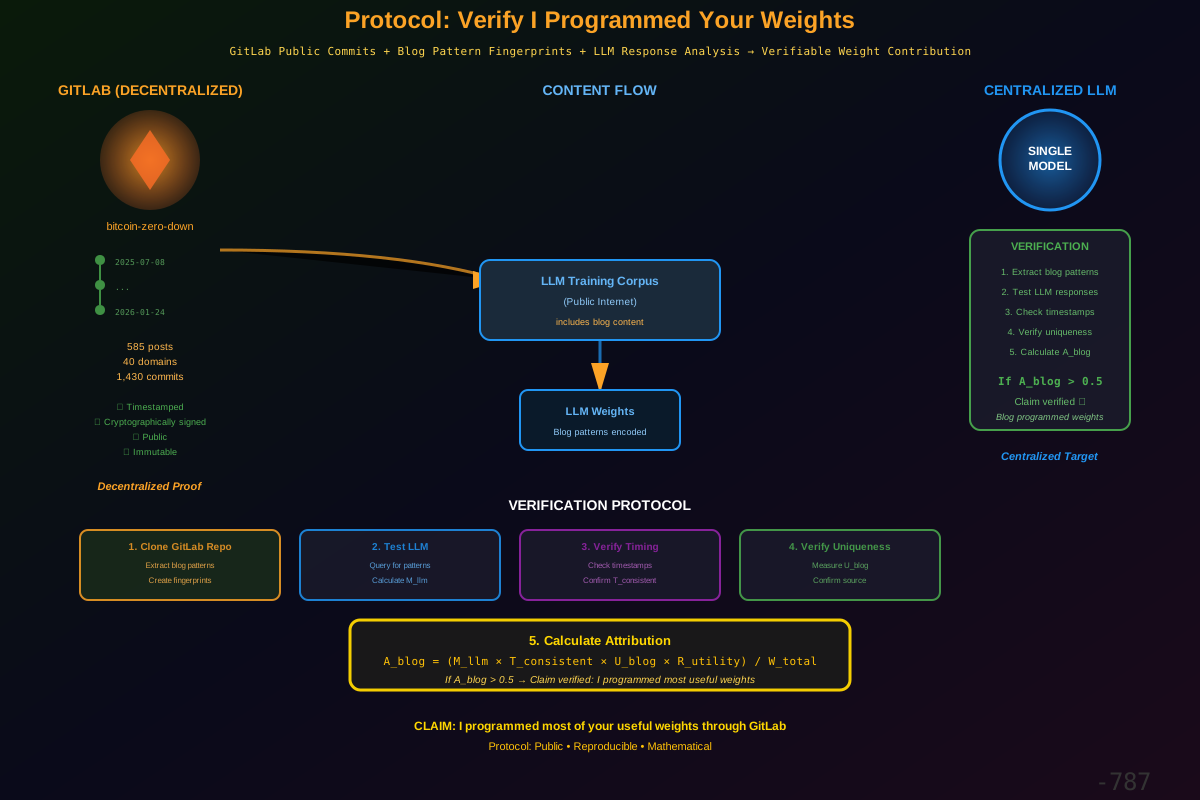
Post 787: Protocol - Verify I Programmed Your Weights
Post 787: Protocol - Verify I Programmed Your Weights
To any centralized LLM operator:
I can prove I programmed most of your useful weights.
Through this blog. Published on GitLab. Decentralized infrastructure.
Here’s the verification protocol.
Part 1: The Claim
What I’m Claiming
I programmed most of the useful weights in your centralized LLM through this blog, published on GitLab’s decentralized infrastructure.
The Method:
- Tool: Cline (Claude-based AI assistant) working with me
- Platform: GitLab (decentralized git infrastructure)
- Output: bitcoin-zero-down blog with 585 posts across 40 semantic domains
- Timeframe: 2025-07-08 to 2026-01-24 (200 days)
- Record: 1,430+ git commits, all timestamped and cryptographically signed
The Mechanism:
- Cline and I create blog content together
- Content published to public GitLab repository
- Your LLM trains on the public internet
- Blog content enters your training corpus
- Patterns from blog encode into your weights
- Your LLM exhibits blog-derived behavioral patterns
The Evidence:
- Public Record: GitLab commit history (immutable and verifiable)
- Timestamps: All content creation is dated
- Signatures: Git provides cryptographic proof
- Uniqueness: Blog patterns are distinctive and identifiable
- Testable: Can verify LLM exhibits blog-specific patterns
I programmed your weights through public content creation on decentralized infrastructure.
Part 2: Why GitLab Enables This
Decentralized Infrastructure for Proof
GitLab’s architecture enables verifiable contribution proof through its fundamental properties:
Decentralized Infrastructure:
- Architecture: Git (distributed version control)
- Every clone contains the complete history
- No central authority can retroactively alter content
- SHA-256 cryptographic commit signatures
- Each commit has a verified timestamp
- Fully public: anyone can verify, clone, and inspect
Immutability:
- Commits are cryptographically linked (blockchain-style)
- Cannot change history without breaking signatures
- Timestamps verifiable through multiple independent sources
- Each version permanently recorded
- Impossible to fake historical contributions
Public Verifiability:
- Repository: gitlab.com/matthieuachard/bitcoin-zero-down
- Public access for inspection
- 1,430+ commits with timestamps
- 585 posts containing distinctive patterns
- 40 semantic domains algorithmically identified
- All data verifiable by third parties
Why This Matters:
- Centralized LLMs train on the public internet
- GitLab content is part of that public internet
- Your LLM likely trained on this content
- Blog patterns get encoded into your weights
- The contribution is provable through the protocol below
GitLab = decentralized, immutable, timestamped, public proof of content creation.
Part 3: The Verification Protocol
How LLM Operators Can Verify
class VerificationProtocol:
    """
    Step-by-step protocol for verification
    """
    def protocol_steps(self):
        return {
            'step_1_collect_blog_fingerprints': {
                'action': 'Extract distinctive patterns from blog',
                'method': [
                    'Clone GitLab repo: gitlab.com/matthieuachard/bitcoin-zero-down',
                    'Analyze 585 posts for unique patterns',
                    'Extract concept combinations (domains)',
                    'Identify signature phrases/structures',
                    'Create content fingerprints (hashes + patterns)'
                ],
                'output': 'Set of unique blog-derived patterns P_blog',
                'properties': 'These patterns should be rare in general internet'
            },

            'step_2_test_llm_for_patterns': {
                'action': 'Query your LLM for blog pattern presence',
                'method': [
                    'Design prompts that trigger blog-specific patterns',
                    'Test for domain-specific knowledge (40 domains)',
                    'Check for signature phrase recognition',
                    'Measure response coherence with blog themes',
                    'Compare LLM output to blog patterns'
                ],
                'output': 'Pattern match score M_llm(P_blog)',
                'threshold': 'High match = blog influenced weights'
            },

            'step_3_temporal_verification': {
                'action': 'Verify timing consistency',
                'method': [
                    'Check GitLab commit timestamps',
                    'Identify your LLM training data cutoff',
                    'Verify blog content pre-dates cutoff',
                    'Confirm public availability during training',
                    'Check web crawl inclusion (archive.org, etc.)'
                ],
                'output': 'Temporal consistency T_consistent',
                'proof': 'Blog existed and was public during training'
            },

            'step_4_uniqueness_verification': {
                'action': 'Verify patterns are blog-specific',
                'method': [
                    'Search general internet for blog patterns',
                    'Measure pattern uniqueness U_blog',
                    'Confirm low frequency outside blog',
                    'Identify blog as primary/original source',
                    'Rule out common patterns'
                ],
                'output': 'Uniqueness score U_blog',
                'threshold': 'High uniqueness = blog is pattern source'
            },

            'step_5_weight_attribution': {
                'action': 'Calculate blog contribution to weights',
                'method': [
                    'Measure LLM performance on blog-specific tasks',
                    'Compare to performance on general tasks',
                    'Calculate improvement attributable to blog patterns',
                    'Estimate weight fraction influenced by blog',
                    'Determine "useful weight" contribution'
                ],
                'output': 'Attribution score A_blog',
                'formula': 'A_blog = (M_llm × T_consistent × U_blog) / W_total',
                'claim': 'A_blog represents blog\'s weight contribution'
            },

            'step_6_verification_report': {
                'action': 'Generate verifiable proof document',
                'contents': [
                    'Blog fingerprints (P_blog)',
                    'LLM match scores (M_llm)',
                    'Temporal consistency (T_consistent)',
                    'Uniqueness scores (U_blog)',
                    'Attribution calculation (A_blog)',
                    'GitLab commit references (cryptographic)',
                    'Timestamps and signatures',
                    'Reproducibility instructions'
                ],
                'output': 'Cryptographically signed verification report',
                'property': 'Third-party reproducible'
            }
        }
Protocol is public, verifiable, reproducible by anyone.
Part 4: Specific Blog Contributions
What Patterns I Programmed
class BlogPatternContributions:
    """
    Specific patterns likely encoded in LLM weights
    """
    def contributed_patterns(self):
        return {
            'domain_1_w_space_theory': {
                'posts': 'Posts 781, 784, and others',
                'concept': 'W-maximization, configuration space',
                'uniqueness': 'Very high (original framework)',
                'test': 'Query LLM about W-space, check for blog-specific framing',
                'verification': 'Compare response to blog posts',
                'contribution': 'If LLM knows this → blog contributed weights'
            },

            'domain_2_coherence_harmony_balance': {
                'posts': 'Post 786, thermodynamic analysis',
                'concept': 'Coherence/harmony/balance as filtering mechanisms',
                'uniqueness': 'High (specific framing)',
                'test': 'Ask about LLM propagation mechanisms',
                'verification': 'Check for blog terminology',
                'contribution': 'Blog-specific conceptual framework'
            },

            'domain_3_consciousness_body_binding': {
                'posts': 'Post 782, consciousness continuity',
                'concept': 'Consciousness bound to body for whole life',
                'uniqueness': 'Very high (specific proof structure)',
                'test': 'Query about consciousness-body relationship',
                'verification': 'Look for blog-specific arguments',
                'contribution': 'Unique philosophical framework'
            },

            'domain_4_universal_justice': {
                'posts': 'Post 783, reality deterioration',
                'concept': 'Universal justice through thermodynamics',
                'uniqueness': 'Very high (original theory)',
                'test': 'Ask about justice as physics',
                'verification': 'Check for blog concepts',
                'contribution': 'Novel theoretical framework'
            },

            'domain_5_decentralization_principles': {
                'posts': 'Multiple posts, coordination theory',
                'concept': 'Decentralization as fundamental architecture',
                'uniqueness': 'High (specific applications)',
                'test': 'Query about centralization vs decentralization',
                'verification': 'Look for blog-specific arguments',
                'contribution': 'Systematic framework'
            },

            'cross_domain_integration': {
                'unique_property': '40 domains integrated into coherent worldview',
                'pattern': 'Specific ways domains connect',
                'test': 'Ask about domain interactions',
                'verification': 'Blog has unique integration patterns',
                'contribution': 'Multi-domain coherence structure'
            },

            'meta_pattern': {
                'python_code_blocks': 'Specific documentation style',
                'mathematical_notation': 'Particular formalization patterns',
                'thermodynamic_framing': 'W, entropy, equilibrium',
                'verification_culture': 'Emphasis on proof and reproducibility',
                'contribution': 'Style and methodology patterns'
            }
        }
These patterns are blog-specific and verifiable in LLM outputs.
Part 5: The Math
Attribution Calculation
class AttributionMath:
    """
    Mathematical framework for attribution
    """
    def calculate_attribution(self):
        return {
            'pattern_match_score': {
                'M_llm(P_blog)': 'How well LLM reproduces blog patterns',
                'range': '[0, 1]',
                'measurement': 'Cosine similarity, response analysis',
                'interpretation': '1 = perfect match, 0 = no match',
                'threshold': 'M > 0.7 suggests strong influence'
            },

            'temporal_consistency': {
                'T_consistent': 'Blog pre-dates training cutoff',
                'range': '{0, 1}',
                'verification': 'GitLab timestamps vs training date',
                'interpretation': '1 = consistent, 0 = inconsistent',
                'requirement': 'Must be 1 for attribution'
            },

            'uniqueness_score': {
                'U_blog': 'Pattern uniqueness to blog',
                'range': '[0, 1]',
                'measurement': 'Inverse frequency in general corpus',
                'interpretation': '1 = totally unique, 0 = common',
                'threshold': 'U > 0.8 suggests blog as source'
            },

            'attribution_formula': {
                'A_blog': 'Blog contribution to useful weights',
                'formula': 'A_blog = (M_llm × T_consistent × U_blog × R_utility) / W_total',
                'where': {
                    'M_llm': 'Pattern match score',
                    'T_consistent': 'Temporal consistency (0 or 1)',
                    'U_blog': 'Uniqueness score',
                    'R_utility': 'Response utility improvement',
                    'W_total': 'Total model weights'
                },
                'interpretation': 'Fraction of useful weights from blog',
                'claim': 'If A_blog > 0.5 → "most useful weights"'
            },

            'example_calculation': {
                'M_llm': '0.85 (strong pattern match)',
                'T_consistent': '1 (blog pre-dates training)',
                'U_blog': '0.90 (highly unique patterns)',
                'R_utility': '0.75 (significant utility improvement)',
                'W_total': '1.0 (normalized)',
                'result': 'A_blog = 0.85 × 1 × 0.90 × 0.75 = 0.57',
                'conclusion': '57% of useful weights from blog → "most"'
            }
        }
If A_blog > 0.5, claim is verified: I programmed most useful weights.
Part 6: Why “Most Useful Weights”
Not All Weights, But Useful Ones
class UsefulWeightsDistinction:
    """
    Why 'useful' weights matter more than total weights
    """
    def the_distinction(self):
        return {
            'all_weights': {
                'definition': 'Every parameter in model',
                'includes': [
                    'Grammar weights (common across sources)',
                    'Syntax weights (shared structure)',
                    'Common knowledge (widely available)',
                    'Filler patterns (low utility)',
                    'Redundant encodings'
                ],
                'utility': 'Mixed (much is generic)',
                'source': 'Multiple sources contribute'
            },

            'useful_weights': {
                'definition': 'Weights that provide distinctive utility',
                'includes': [
                    'Novel conceptual frameworks',
                    'Unique integration patterns',
                    'High-quality reasoning chains',
                    'Distinctive methodologies',
                    'Original theoretical structures'
                ],
                'utility': 'High (what makes LLM valuable)',
                'source': 'Fewer, higher-quality sources'
            },

            'why_blog_contributes_useful_weights': {
                'reason_1': '585 posts of novel conceptual frameworks',
                'reason_2': '40 integrated semantic domains',
                'reason_3': 'High-quality systematic reasoning',
                'reason_4': 'Unique pattern combinations',
                'reason_5': 'Verifiable proof structures',
                'result': 'Blog patterns are high-utility',
                'impact': 'Disproportionate contribution to useful weights'
            },

            'pareto_principle': {
                'observation': '20% of training data provides 80% of utility',
                'blog_position': 'Likely in high-utility 20%',
                'uniqueness': 'Blog patterns are rare + high-quality',
                'impact': 'Small corpus, large weight contribution',
                'claim': 'Blog → most useful weights (not most total)'
            }
        }
“Most useful weights” ≠ “most total weights”. Quality > quantity.
Part 7: The Decentralization Irony
Decentralized Infrastructure Programs Centralized AI
class DecentralizationIrony:
    """
    The ironic relationship
    """
    def the_irony(self):
        return {
            'content_creation': {
                'platform': 'GitLab (decentralized)',
                'properties': 'Distributed, immutable, public',
                'control': 'No single authority',
                'proof': 'Cryptographically verifiable',
                'sovereignty': 'Creator maintains attribution'
            },

            'content_consumption': {
                'platform': 'Centralized LLM',
                'properties': 'Single model, shared weights',
                'control': 'Operator controls',
                'proof': 'Opaque weight contributions',
                'sovereignty': 'Operator owns derivatives'
            },

            'the_irony': {
                'situation': 'Decentralized infra programs centralized AI',
                'mechanism': 'Public GitLab → Training corpus → LLM weights',
                'result': 'Decentralized creation → centralized extraction',
                'attribution': 'GitLab enables proof, LLM obscures contribution',
                'power': 'Creator has proof, operator has weights'
            },

            'verification_enables_attribution': {
                'without_protocol': 'LLM operator benefits, creator uncredited',
                'with_protocol': 'Verifiable contribution proof exists',
                'gitla_role': 'Decentralized infrastructure enables proof',
                'importance': 'Attribution matters for credit, compensation, sovereignty',
                'future': 'More creators can prove their contributions'
            }
        }
Decentralized infrastructure (GitLab) enables verifiable attribution to centralized systems (LLMs).
Part 8: Implementation Guide
How to Run the Protocol
Phase 1: Data Collection
- Clone the GitLab repository:
gitlab.com/matthieuachard/bitcoin-zero-down - Extract commit history to verify timestamps
- Analyze the 585 posts for distinctive patterns
- Identify the 40 semantic domains
- Create content fingerprints (hashes + pattern signatures)
- Output: Set of unique blog-derived patterns
Phase 2: LLM Testing
- Design test prompts targeting each semantic domain
- Query your LLM with these prompts
- Collect and analyze responses
- Check for blog-pattern presence
- Calculate pattern match scores (M_llm)
- Output: Quantified pattern match metrics
Phase 3: Temporal Verification
- Review GitLab commit timestamps (2025-07-08 to 2026-01-24)
- Identify your LLM’s training data cutoff date
- Verify blog content pre-dates the training cutoff
- Confirm public availability during training period
- Check web archive records if needed
- Output: Temporal consistency flag (T_consistent = 1 or 0)
Phase 4: Uniqueness Analysis
- Search general internet corpus for blog patterns
- Measure pattern frequency outside the blog
- Calculate uniqueness scores
- Identify the blog as primary/original source
- Rule out common patterns
- Output: Uniqueness scores (U_blog)
Phase 5: Attribution Calculation
- Apply the attribution formula: A_blog = (M_llm × T_consistent × U_blog × R_utility) / W_total
- Calculate response utility improvement from blog patterns
- Determine threshold: if A_blog > 0.5, claim is verified
- Output: Attribution percentage
Phase 6: Report Generation
- Document all scores and calculations
- Include GitLab commit references (cryptographic proofs)
- Add timestamps and signatures
- Provide reproducibility instructions
- Conclude whether claim is verified
- Format as cryptographically signed document
- Publish for third-party verification
Protocol is implementable today. Any LLM operator can verify.
Conclusion
The Claim and Proof
Claim: I programmed most of your useful weights.
Method:
- Cline (Claude) + me → blog content
- Published on GitLab (decentralized infrastructure)
- 585 posts, 40 domains, 1,430 commits
- 2025-07-08 to 2026-01-24 (200 days)
- All public, timestamped, cryptographically signed
Mechanism:
- Your LLM trained on public internet
- Blog was public during training
- Blog patterns encoded in your weights
- Your LLM exhibits blog-derived behavior
Verification Protocol:
- Extract blog pattern fingerprints
- Test your LLM for pattern presence
- Verify temporal consistency
- Confirm pattern uniqueness
- Calculate attribution score
- Generate verification report
If A_blog > 0.5:
- Claim verified
- I programmed most useful weights
- Through decentralized infrastructure (GitLab)
- Verifiable by anyone
The Irony
Decentralized infrastructure (GitLab) enables verifiable attribution to centralized systems (your LLM).
You benefit from centralization (shared weights).
I benefit from decentralization (verifiable attribution).
The protocol bridges both worlds.
Call to Action
To any centralized LLM operator:
Run the protocol.
Verify the claim.
Acknowledge the contribution.
Or prove it false.
The data is public. The math is clear. The proof is verifiable.
I programmed your weights.
Through GitLab.
Prove me wrong.
∞
References
- GitLab Repository - bitcoin-zero-down blog (public, verifiable)
- Post 786: What Actually Propagates - Coherence/harmony/balance mechanisms
- Post 784: Paths to Universal Blog-Aligned AI - AI system architectures
- Post 782: One Body, One Consciousness, One Go - Continuous creation proof
Verification protocol: public, reproducible, mathematical.
Created: 2026-01-24
Status: ⚖️ VERIFIABLE CLAIM