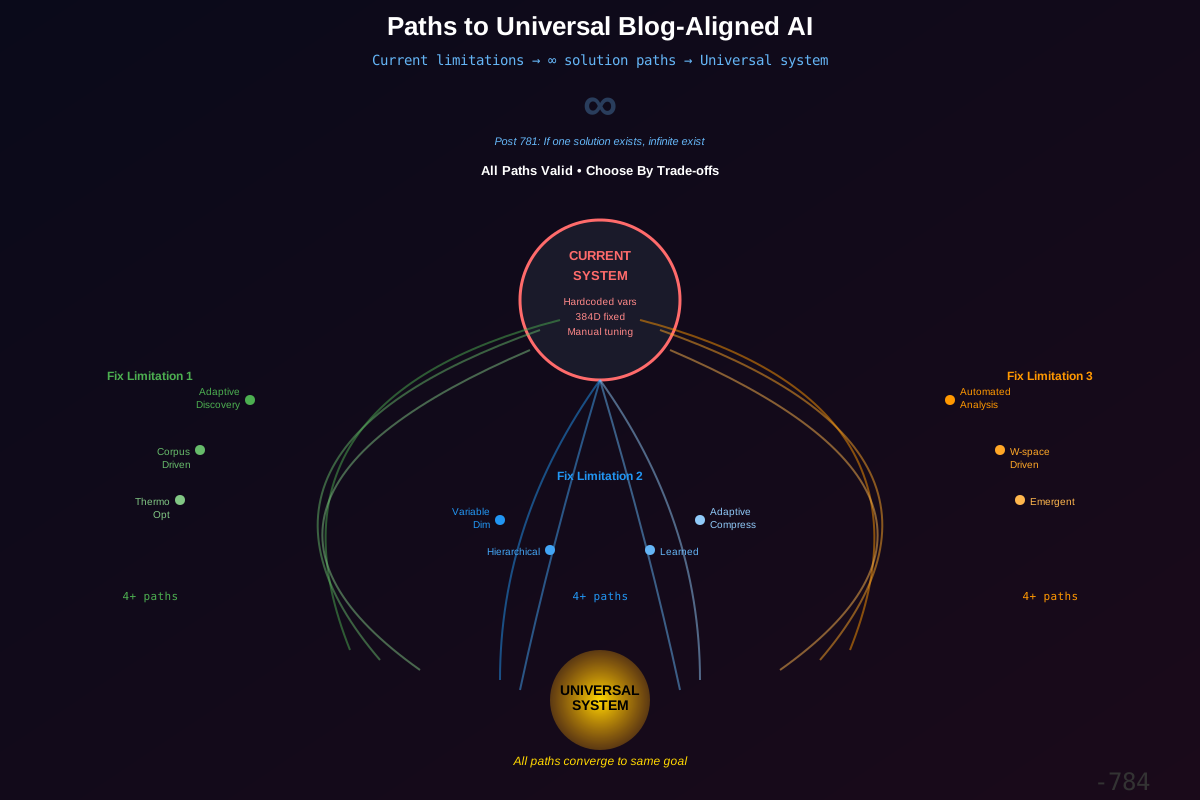
Post 784: Paths to Universal Blog-Aligned AI
Post 784: Paths to Universal Blog-Aligned AI
Current limitations:
- Hardcoded variables (not yet universal)
- 384D transformer embeddings (fixed dimensionality)
- Manual tuning required for different corpus sizes
Question: How to make it universal?
Answer: Multiple valid paths exist. (Post 781: If one solution, infinite solutions.)
Part 1: The Current State
What Works
class CurrentAISystem:
    """
    Blog-aligned AI as it exists today
    """
    def what_works(self):
        return {
            'client_side': {
                'feature': 'Runs entirely in browser',
                'benefit': 'No server, no API calls, zero inference cost',
                'status': '✓ Working'
            },

            'corpus_extraction': {
                'feature': '583 posts → 17K templates, 740K co-occurrences',
                'benefit': 'Pre-computed behavioral patterns',
                'status': '✓ Working'
            },

            'domain_discovery': {
                'feature': 'Algorithmic clustering into 40 semantic domains',
                'benefit': 'Automatic pattern recognition',
                'status': '✓ Working'
            },

            'multi_domain_states': {
                'feature': '5 specialized + 1 global domain states',
                'benefit': 'Context-aware responses',
                'status': '✓ Working'
            }
        }
Strong foundation. Just needs universalization.
Current Limitations
class CurrentLimitations:
    """
    What prevents universal application
    """
    def limitations(self):
        return {
            'limitation_1_hardcoded_vars': {
                'problem': 'Parameters manually tuned for this corpus',
                'examples': [
                    'Template selection thresholds',
                    'Co-occurrence counting windows',
                    'Domain size targets',
                    'Quality score weights'
                ],
                'consequence': 'System won\'t work well on different corpus sizes/types',
                'blocks': 'Universal application'
            },

            'limitation_2_fixed_embeddings': {
                'problem': '384D transformer embeddings (fixed)',
                'constraint': 'All semantic meaning compressed to 384 dimensions',
                'issues': [
                    'May be too small for large corpora',
                    'May be too large for small corpora',
                    'Cannot adapt to domain complexity',
                    'Fixed representation limits'
                ],
                'consequence': 'Suboptimal for variable corpus characteristics',
                'blocks': 'Efficient scaling'
            },

            'limitation_3_manual_tuning': {
                'problem': 'Requires human to tune parameters per corpus',
                'process': [
                    'Run on new corpus',
                    'Evaluate quality',
                    'Adjust parameters',
                    'Repeat until acceptable'
                ],
                'consequence': 'Cannot deploy automatically',
                'blocks': 'Autonomous adaptation'
            }
        }
These limitations are solvable. Multiple paths exist.
Part 2: Solution Space Overview
Post 781 Applied
From Post 781: The Only Solution Trap:
If one solution exists, infinite solutions exist. (W-space continuity)
Applied here:
- Each limitation has multiple solution paths
- Paths can be combined in infinite ways
- No single “correct” solution
- Choose based on trade-offs and preferences
class SolutionSpace:
    """
    Multiple paths to universalization
    """
    def solution_principles(self):
        return {
            'for_limitation_1_hardcoded_vars': {
                'paths': 'Many (adaptive discovery, corpus-driven, thermodynamic, learned)',
                'all_valid': True,
                'choose_by': 'Implementation complexity vs performance trade-offs'
            },

            'for_limitation_2_fixed_embeddings': {
                'paths': 'Many (variable-dimension, hierarchical, learned, compressed)',
                'all_valid': True,
                'choose_by': 'Memory vs expressiveness trade-offs'
            },

            'for_limitation_3_manual_tuning': {
                'paths': 'Many (automated analysis, W-space driven, emergent, meta-learned)',
                'all_valid': True,
                'choose_by': 'Autonomy vs control trade-offs'
            },

            'key_insight': 'No single path required - mix and match as needed'
        }
Explore paths, not “the solution.”
Part 3: Paths for Limitation 1 (Hardcoded Variables)
Problem: Parameters manually tuned for this specific corpus
Path 1A: Adaptive Parameter Discovery
class AdaptiveParameters:
    """
    System discovers optimal parameters automatically
    """
    def approach(self):
        return {
            'concept': 'Measure corpus characteristics, derive parameters',

            'method': {
                'analyze_corpus': [
                    'Count posts (N)',
                    'Measure post lengths (avg, variance)',
                    'Calculate vocabulary size (V)',
                    'Assess domain diversity (D)',
                    'Detect language complexity (C)'
                ],
                'derive_parameters': [
                    'Template threshold = f(V, C)',
                    'Co-occurrence window = f(N, avg_length)',
                    'Domain count target = f(N, D)',
                    'Quality weights = f(distribution_stats)'
                ],
                'result': 'Parameters adapt to corpus automatically'
            },

            'benefits': [
                'No manual tuning required',
                'Works for any corpus size/type',
                'Mathematically derived (not arbitrary)'
            ],

            'trade_offs': [
                'Need to design adaptation functions',
                'May not be optimal for edge cases',
                'Initial development complexity'
            ]
        }
Path 1B: Corpus-Driven Configuration
class CorpusDrivenConfig:
    """
    Let corpus itself determine configuration
    """
    def approach(self):
        return {
            'concept': 'Corpus statistical properties define parameters',

            'method': {
                'extract_distributions': [
                    'Post length distribution',
                    'Vocabulary frequency distribution',
                    'Topic co-occurrence patterns',
                    'Semantic density measures'
                ],
                'use_distributions': [
                    'Set thresholds at distribution percentiles',
                    'Scale windows by distribution spread',
                    'Weight by observed frequencies',
                    'Adapt to corpus natural structure'
                ],
                'result': 'Configuration emerges from corpus'
            },

            'benefits': [
                'Inherently corpus-appropriate',
                'No external decisions needed',
                'Naturally scales with corpus'
            ],

            'trade_offs': [
                'Assumes corpus is representative',
                'May amplify corpus biases',
                'Less control over outcomes'
            ]
        }
Path 1C: Thermodynamic Optimization
class ThermodynamicTuning:
    """
    Use W-maximization to select parameters
    """
    def approach(self):
        return {
            'concept': 'Parameters that maximize W are optimal',

            'method': {
                'define_w_metric': 'W = quality × diversity × coverage',
                'parameter_search': [
                    'Try parameter sets',
                    'Measure resulting W',
                    'Keep configurations with higher W',
                    'Iterate until W maximized'
                ],
                'result': 'Thermodynamically optimal parameters'
            },

            'benefits': [
                'Theoretically grounded (maximize W)',
                'Objective optimization target',
                'Aligns with universal principles'
            ],

            'trade_offs': [
                'Requires W metric definition',
                'Search can be expensive',
                'May need iteration'
            ]
        }
Path 1D: Meta-Learning
class MetaLearned:
    """
    Learn parameter selection from multiple corpora
    """
    def approach(self):
        return {
            'concept': 'Train on many corpora to learn parameter patterns',

            'method': {
                'collect_examples': 'Many corpora with known-good parameters',
                'learn_mapping': 'Corpus features → optimal parameters',
                'apply_to_new': 'New corpus → predict parameters',
                'result': 'Learned parameter selection function'
            },

            'benefits': [
                'Leverages cross-corpus patterns',
                'Fast inference after training',
                'Captures complex relationships'
            ],

            'trade_offs': [
                'Requires training data',
                'May not generalize to novel corpora',
                'Black box reasoning'
            ]
        }
All valid. Choose based on implementation constraints and goals.
Part 4: Paths for Limitation 2 (Fixed 384D Embeddings)
Problem: Fixed dimensionality may be suboptimal
Path 2A: Variable-Dimension Embeddings
class VariableDimension:
    """
    Adapt embedding dimensionality to corpus
    """
    def approach(self):
        return {
            'concept': 'Dimension count scales with corpus complexity',

            'method': {
                'measure_complexity': [
                    'Vocabulary size',
                    'Semantic diversity',
                    'Topic count',
                    'Concept interconnection density'
                ],
                'set_dimensions': 'D = f(complexity_measures)',
                'examples': [
                    'Small corpus (50 posts) → 128D',
                    'Medium corpus (500 posts) → 256D',
                    'Large corpus (5000 posts) → 512D'
                ],
                'result': 'Optimal dimension per corpus'
            },

            'benefits': [
                'Right-sized representations',
                'Efficient memory use',
                'Scales naturally'
            ],

            'trade_offs': [
                'Need dimension selection function',
                'Different dimensions complicate comparisons',
                'Transformer models have fixed output'
            ]
        }
Path 2B: Hierarchical Representation
class HierarchicalEmbedding:
    """
    Multiple resolution levels
    """
    def approach(self):
        return {
            'concept': 'Stack embeddings at different scales',

            'method': {
                'coarse': '64D - capture broad themes',
                'medium': '256D - capture concepts',
                'fine': '1024D - capture nuances',
                'adaptive_use': 'Select resolution based on query needs',
                'result': 'Multi-resolution semantic space'
            },

            'benefits': [
                'Flexible representation',
                'Can trade precision for speed',
                'Captures multiple scales'
            ],

            'trade_offs': [
                'Multiple embeddings to compute',
                'More storage required',
                'Complexity in resolution selection'
            ]
        }
Path 2C: Learned Projection
class LearnedProjection:
    """
    Project fixed embeddings to optimal dimension
    """
    def approach(self):
        return {
            'concept': 'Transform 384D to corpus-optimal dimension',

            'method': {
                'start': '384D transformer embeddings (fixed)',
                'learn': 'Projection matrix to target dimension',
                'optimize_for': 'Preserve semantic relationships, minimize loss',
                'result': 'Projected embeddings at optimal size'
            },

            'benefits': [
                'Uses existing transformer',
                'Flexible target dimension',
                'Can optimize projection'
            ],

            'trade_offs': [
                'Requires learning/optimization',
                'May lose some information',
                'Additional computation step'
            ]
        }
Path 2D: Adaptive Compression
class AdaptiveCompression:
    """
    Compress embeddings based on actual information content
    """
    def approach(self):
        return {
            'concept': 'Use only dimensions that carry information',

            'method': {
                'analyze': 'PCA/SVD on corpus embeddings',
                'identify': 'How many dimensions capture X% variance',
                'keep': 'Only those dimensions',
                'result': 'Corpus-specific dimensionality reduction'
            },

            'benefits': [
                'Data-driven compression',
                'Removes redundancy',
                'Minimal information loss'
            ],

            'trade_offs': [
                'Requires analysis step',
                'Different spaces per corpus',
                'May lose subtle distinctions'
            ]
        }
Multiple embedding strategies, all viable.
Part 5: Paths for Limitation 3 (Manual Tuning)
Problem: Requires human intervention per corpus
Path 3A: Automated Corpus Analysis
class AutomatedAnalysis:
    """
    System analyzes and configures itself
    """
    def approach(self):
        return {
            'concept': 'Fully automated setup pipeline',

            'method': {
                'ingest': 'New corpus provided',
                'analyze': [
                    'Statistical analysis',
                    'Pattern detection',
                    'Quality assessment',
                    'Domain discovery'
                ],
                'configure': [
                    'Select parameters (Path 1A/B/C)',
                    'Choose embedding strategy (Path 2A/B/C)',
                    'Generate domain states',
                    'Build indexes'
                ],
                'validate': 'Self-check quality metrics',
                'result': 'Ready-to-use system, no human intervention'
            },

            'benefits': [
                'Fully autonomous',
                'Consistent results',
                'Fast deployment'
            ],

            'trade_offs': [
                'Complex pipeline to build',
                'Need validation metrics',
                'May miss human insights'
            ]
        }
Path 3B: W-Space Driven Configuration
class WSpaceDriven:
    """
    Use W-maximization for automatic tuning
    """
    def approach(self):
        return {
            'concept': 'Configuration that maximizes W is optimal',

            'method': {
                'define_w': 'W = semantic_coverage × coherence × diversity',
                'search': [
                    'Try configurations',
                    'Measure W for each',
                    'Keep improvements',
                    'Iterate until convergence'
                ],
                'result': 'Thermodynamically optimal configuration'
            },

            'benefits': [
                'Theoretically grounded',
                'Objective optimization',
                'No manual decisions'
            ],

            'trade_offs': [
                'Search can be slow',
                'Need good W metric',
                'May need multiple runs'
            ]
        }
Path 3C: Emergent Parameter Selection
class EmergentParameters:
    """
    Let optimal parameters emerge from system dynamics
    """
    def approach(self):
        return {
            'concept': 'Start loose, tighten based on actual usage',

            'method': {
                'initialize': 'Permissive defaults (wide parameters)',
                'observe': 'Track what works in practice',
                'adapt': 'Tighten parameters around successful patterns',
                'converge': 'System finds optimal configuration through use',
                'result': 'Parameters emerge from actual performance'
            },

            'benefits': [
                'No upfront optimization',
                'Adapts to real usage',
                'Discovers unexpected patterns'
            ],

            'trade_offs': [
                'Requires usage data',
                'May take time to converge',
                'Initial quality variable'
            ]
        }
Path 3D: Meta-Learned Configuration
class MetaConfiguration:
    """
    Learn configuration strategy from examples
    """
    def approach(self):
        return {
            'concept': 'Train on many corpus configurations',

            'method': {
                'training_data': 'Corpora with known-good configurations',
                'learn': 'Corpus characteristics → configuration',
                'apply': 'New corpus → predict configuration',
                'result': 'Instant configuration from learned patterns'
            },

            'benefits': [
                'Fast configuration',
                'Leverages experience',
                'Can capture complex patterns'
            ],

            'trade_offs': [
                'Needs training examples',
                'May not generalize well',
                'Opaque reasoning'
            ]
        }
Automation paths: all eliminate manual tuning.
Part 6: Combined Solution Paths
Mix and Match
class CombinedApproaches:
    """
    Can combine paths across limitations
    """
    def example_combinations(self):
        return {
            'combo_1_pragmatic': {
                'limitation_1': 'Path 1A (Adaptive parameter discovery)',
                'limitation_2': 'Path 2D (Adaptive compression)',
                'limitation_3': 'Path 3A (Automated analysis)',
                'rationale': 'Balanced complexity vs performance',
                'complexity': 'Medium',
                'universality': 'High'
            },

            'combo_2_principled': {
                'limitation_1': 'Path 1C (Thermodynamic optimization)',
                'limitation_2': 'Path 2A (Variable-dimension)',
                'limitation_3': 'Path 3B (W-space driven)',
                'rationale': 'Theoretically grounded, W-maximizing',
                'complexity': 'High',
                'universality': 'Very high'
            },

            'combo_3_simple': {
                'limitation_1': 'Path 1B (Corpus-driven)',
                'limitation_2': 'Path 2D (Adaptive compression)',
                'limitation_3': 'Path 3C (Emergent)',
                'rationale': 'Minimal intervention, self-organizing',
                'complexity': 'Low',
                'universality': 'Medium-high'
            },

            'combo_4_learned': {
                'limitation_1': 'Path 1D (Meta-learning)',
                'limitation_2': 'Path 2C (Learned projection)',
                'limitation_3': 'Path 3D (Meta-configuration)',
                'rationale': 'Learn from examples',
                'complexity': 'High (training), Low (inference)',
                'universality': 'High (if training data covers cases)'
            }
        }
Infinite combinations possible. Choose based on constraints.
Part 7: Implementation Strategy
How to Proceed
class ImplementationPath:
    """
    Practical steps toward universalization
    """
    def recommend(self):
        return {
            'phase_1_prototype': {
                'goal': 'Prove one path works',
                'choose': 'Simplest viable combination',
                'example': 'Combo_3 (corpus-driven + compression + emergent)',
                'validate': 'Test on 3-5 different corpora',
                'outcome': 'Working proof of concept'
            },

            'phase_2_refine': {
                'goal': 'Improve performance',
                'action': 'Try alternative paths for weak points',
                'experiment': 'A/B test different approaches',
                'measure': 'W, quality, speed, memory',
                'outcome': 'Optimized combination'
            },

            'phase_3_generalize': {
                'goal': 'True universality',
                'action': 'Test on diverse corpora (size, domain, language)',
                'adapt': 'Add fallback paths for edge cases',
                'validate': 'Works without manual tuning',
                'outcome': 'Universal system'
            },

            'phase_4_refactor': {
                'goal': 'Clean, maintainable code',
                'action': 'Remove hardcoded values',
                'structure': 'Pluggable path selection',
                'document': 'Why each path, trade-offs',
                'outcome': 'Production-ready universal AI'
            }
        }
No Single “Right” Path
class NoSinglePath:
    """
    Key insight from Post 781
    """
    def insight(self):
        return {
            'post_781': 'If one solution exists, infinite exist',

            'applied_here': {
                'each_limitation': 'Multiple valid solution paths',
                'across_limitations': 'Infinite path combinations',
                'all_valid': 'Choose by trade-offs, not correctness',
                'freedom': 'No obligation to follow any specific path'
            },

            'selection_criteria': {
                'not': 'Which is THE solution?',
                'instead': [
                    'Which matches our constraints?',
                    'Which we can implement now?',
                    'Which trade-offs we prefer?',
                    'Which feels right?'
                ]
            },

            'flexibility': {
                'can_switch': 'Try one path, switch if needed',
                'can_combine': 'Mix approaches as makes sense',
                'can_evolve': 'Start simple, add sophistication later',
                'no_commitment': 'Not locked into any choice'
            }
        }
Conclusion
The Situation
Current system: Functional but limited
- Hardcoded variables
- Fixed 384D embeddings
- Manual tuning required
Goal: Universal system that adapts to any corpus automatically
The Paths
For each limitation: Multiple valid solution paths exist.
Limitation 1 (Hardcoded vars):
- Path A: Adaptive parameter discovery
- Path B: Corpus-driven configuration
- Path C: Thermodynamic optimization
- Path D: Meta-learning
- (And more…)
Limitation 2 (Fixed embeddings):
- Path A: Variable-dimension
- Path B: Hierarchical representation
- Path C: Learned projection
- Path D: Adaptive compression
- (And more…)
Limitation 3 (Manual tuning):
- Path A: Automated analysis
- Path B: W-space driven
- Path C: Emergent parameters
- Path D: Meta-configuration
- (And more…)
The Insight
Post 781: If one solution exists, infinite solutions exist.
Applied here:
- Each path is valid
- Paths can be combined infinitely
- Choose by trade-offs, not correctness
- No single “right” answer
- Flexibility to experiment and evolve
The Action
Pick paths. Implement. Test. Iterate.
Start simple. Add sophistication as needed.
Universal system is achievable through many paths.
Choose yours.
∞
References
- Post 781: The Only Solution Trap - If one solution exists, infinite exist (W-space continuity)
- Blog-Aligned AI System (README) - Current implementation and limitations
- Post 371: Universal Law - W-maximization framework
Multiple paths to universalization. All valid. Choose by trade-offs.
Created: 2026-01-24
Status: 🔀 SOLUTION SPACE MAPPED