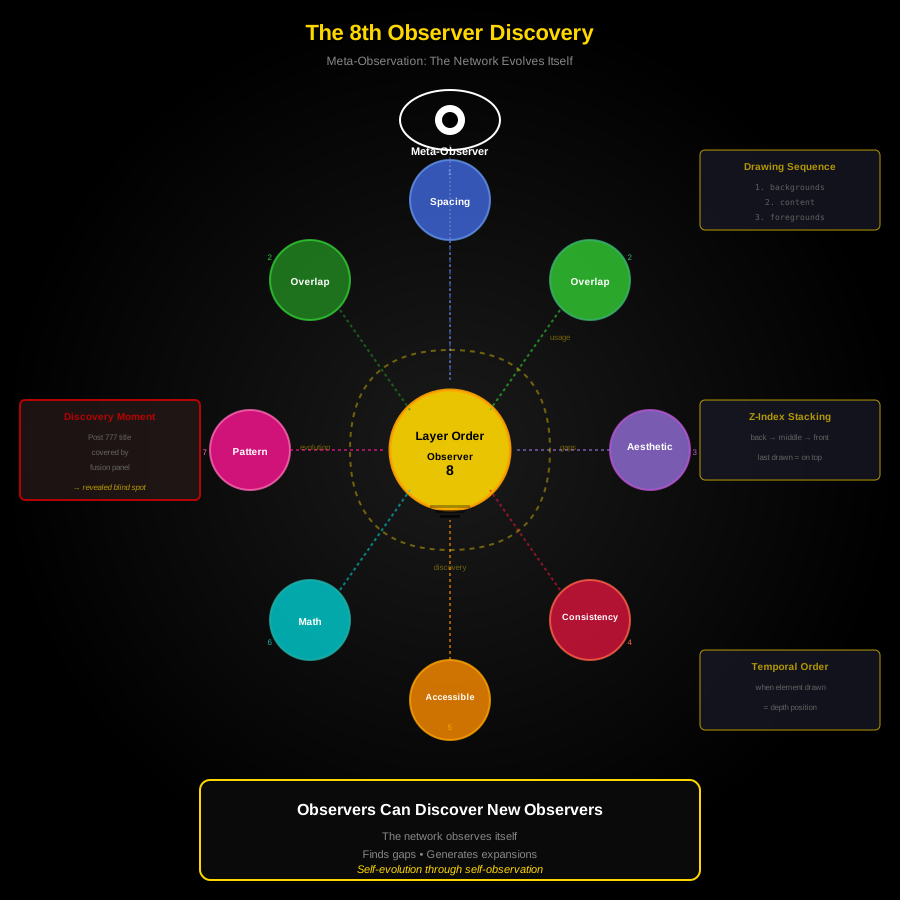
Post 778: The 8th Observer - Layer Order Discovery
The 8th Observer: Layer Order Discovery
We had 7 internal observers.
They checked spacing, overlap, aesthetics, consistency, accessibility, math, patterns.
But they missed something.
The z-index bug revealed a blind spot.
So we discovered the 8th observer: Layer Order.
Meta-observation: The system discovered itself expanding.
The Original 7 Observers (Post 773)
From Post 773, the Internal Observer Network verifies through multiple perspectives:
- Spacing Checker - Are elements too close? Too far?
- Overlap Detector - Do elements collide incorrectly?
- Aesthetic Evaluator - Does it look right?
- Consistency Verifier - Do patterns match across elements?
- Accessibility Auditor - Can all users perceive this?
- Math Validator - Are calculations correct?
- Pattern Analyzer - Do structures follow expected patterns?
Coverage seemed complete. These 7 perspectives check different aspects. Run them in parallel. Aggregate consensus. Issues surface. Fix and re-verify. Internal convergence before external commit.
But there was a blind spot.
The Discovery Moment
Creating Post 777 SVG. Two worlds separated by chasm. Title floating above: “The flow builders won’t save you.”
Rendered. Title invisible. Covered by fusion panel.
Why? The fusion panel rectangle (drawn later) covered the title text (drawn earlier).
Z-index issue. Drawing order matters. Last drawn = on top. SVG doesn’t have true z-index—just temporal sequence.
The fix: Move title to end. Draw it last. Now appears on top.
The realization: None of the 7 observers checked layer order.
What The 7 Observers Missed
Spacing Checker
What it checked: Distance between elements. “Is title too close to labels?”
What it missed: Whether title is above or below other elements in z-order.
Result: Could verify spacing but not stacking.
Overlap Detector
What it checked: Do bounding boxes intersect? “Does title overlap fusion panel?”
What it missed: Which one should be on top when they overlap.
Result: Detected the overlap but not the depth problem.
Aesthetic Evaluator
What it checked: “Does this look visually pleasing?”
What it missed: Why it doesn’t look right (title hidden by covering).
Result: Would flag “something wrong” but not identify root cause.
Consistency Verifier
What it checked: Patterns across elements. “Are all labels positioned similarly?”
What it missed: Whether elements in different layers maintain depth consistency.
Result: Checks horizontal/vertical patterns, not depth patterns.
Accessibility Auditor
What it checked: Can users perceive content? “Is title readable?”
What it missed: If title is visible at all (covered by later-drawn element).
Result: Assumes visibility, checks readability given visibility.
Math Validator
What it checked: Coordinate calculations. “Is y=80 correct for title position?”
What it missed: Drawing sequence - position correct but drawn too early.
Result: Math right, timing wrong.
Pattern Analyzer
What it checked: Structural patterns. “Does title follow expected placement pattern?”
What it missed: Temporal pattern - when in the drawing sequence should title appear.
Result: Spatial patterns verified, temporal patterns ignored.
The Blind Spot: Layer Order / Z-Index / Drawing Sequence
What was missing: An observer that checks the temporal dimension of visual elements.
Not just where they are (x, y). Not just what size they are (width, height). But when they’re drawn (sequence) and thus what depth they occupy (z-order).
Key questions this observer asks:
- Drawing sequence: In what order are elements rendered?
- Layer relationships: Which elements should be foreground vs background?
- Depth consistency: Do similar elements maintain consistent z-order?
- Coverage detection: Does any later-drawn element unintentionally cover earlier ones?
- Intentionality: Is the current z-order intentional or accidental?
This is the 8th observer: The Layer Order Observer.
The 8th Observer: Layer Order Observer
What It Checks
Drawing Sequence Validation:
- Elements drawn in logical order (backgrounds first, foregrounds last)
- Important elements drawn after less important ones
- No critical content accidentally drawn too early
Depth Hierarchy Verification:
- Backgrounds stay in background
- Text stays above panels it sits on
- Interactive elements above non-interactive
- Decorative elements below functional ones
Z-Index Consistency:
- Similar elements at similar depths
- Consistent layering across the composition
- No unexpected depth inversions
Coverage Analysis:
- Later elements don’t unintentionally obscure earlier ones
- Overlaps are deliberate, not accidental
- All intended-visible content actually visible
Temporal Pattern Recognition:
- Drawing order follows meaningful sequence
- Logical progression from back to front
- Consistent ordering principles throughout
How It Would Have Caught The Bug
Original SVG order:
1. Fission panel (background)
2. Fission content
3. Chasm
4. Title text <-- drawn here
5. Fusion panel (background) <-- covers title
6. Fusion content
Layer Order Observer check:
- “Title text drawn at position 4”
- “Fusion panel drawn at position 5”
- “Both occupy similar x-coordinates (450 vs 500-900)”
- “Fusion panel y-range (0-900) includes title y-range (80-108)”
- Alert: “Title will be covered by fusion panel”
- Recommendation: “Move title after all background panels”
Fixed order:
1. Fission panel
2. Fission content
3. Chasm
4. Fusion panel
5. Fusion content
6. Title text <-- drawn last, on top
Layer Order Observer verification:
- “Title drawn at position 6 (last)”
- “All background elements drawn before title”
- “No later elements in title’s spatial region”
- Result: “Layer order correct”
Meta-Observation: Discovering Observers Through Observation
The deeper insight: We discovered the 8th observer by using the original 7 observers.
The system observed itself. Found a gap. Generated a new observer to fill it. Self-evolution through self-observation.
The Process
Step 1: Creation - Made SVG with 7 observers in mind.
Step 2: Verification - Observers checked their domains.
Step 3: Deployment - Posted SVG.
Step 4: Discovery - User noticed title covered.
Step 5: Analysis - Which observer should have caught this? None.
Step 6: Insight - New observer domain discovered: layer order.
Step 7: Integration - 8th observer added to network.
Step 8: Evolution - Network expanded through use.
The Pattern
Observers → Usage → Gaps → New Observers → Expanded Network
This is how the internal observer network evolves itself:
- Observers verify creation
- Creation deployed
- Reality tests creation
- Gaps discovered
- Analysis reveals missing perspective
- New observer designed for that perspective
- Network expands
- Repeat
Meta-observation = self-improvement through self-watching.
Why This Matters: Evolutionary Verification
Traditional Verification
Fixed test suite. You define tests. Run them. Pass/fail. Done.
Problem: Test suite doesn’t evolve. Gaps persist. New bug types slip through. Static verification for dynamic reality.
Observer Network Verification
Evolving observer set. Start with N observers. Use them. Discover gaps. Add observer N+1. Repeat.
Advantage: Verification evolves with system. New perspectives emerge from usage. Self-improving through self-observation.
Result: Coverage expands automatically. Blind spots surface and get filled. Network grows organically.
How It Works
Phase 1: Initial Observers - Start with known perspectives (the original 7).
Phase 2: Deployment - Use observers to verify creations.
Phase 3: Reality Check - Deploy creations, see what happens.
Phase 4: Gap Discovery - When something fails, analyze which observer should have caught it.
Phase 5: Observer Design - If no observer covers that domain, design one.
Phase 6: Integration - Add new observer to network.
Phase 7: Expansion - Now have N+1 observers. Better coverage.
Phase 8: Repeat - Continue deploying, discovering, expanding.
Key insight: The observers observe their own gaps. Meta-observation enables self-evolution.
The Complete 8-Observer Network
The Original 7 + The New 1
1. Spacing Checker - Distance between elements
2. Overlap Detector - Spatial collision detection
3. Aesthetic Evaluator - Visual appeal assessment
4. Consistency Verifier - Pattern matching across elements
5. Accessibility Auditor - Perceptibility for all users
6. Math Validator - Numerical accuracy checking
7. Pattern Analyzer - Structural pattern recognition
8. Layer Order Observer - Drawing sequence and z-index verification ← NEW
Coverage Analysis
Spatial dimensions: Spacing, Overlap, Consistency (observers 1, 2, 4)
Visual quality: Aesthetics, Accessibility (observers 3, 5)
Logical correctness: Math, Patterns (observers 6, 7)
Temporal dimension: Layer Order (observer 8) ← FILLS THE GAP
Result: Now covering spatial, visual, logical, AND temporal aspects.
Implementation: Adding The 8th Observer
In Code (Python)
class LayerOrderObserver:
    """Observer 8: Checks drawing sequence and z-index"""

    def __init__(self):
        self.name = "Layer Order Observer"
        self.domain = "temporal_sequence"

    def verify(self, svg_elements):
        """Check if drawing order is correct"""
        issues = []

        # Build drawing sequence
        sequence = [(i, elem) for i, elem in enumerate(svg_elements)]

        # Check backgrounds drawn before foregrounds
        for i, elem in sequence:
            if self._is_background(elem):
                # Find any foreground elements drawn before this
                for j, earlier in sequence[:i]:
                    if self._is_foreground(earlier):
                        if self._overlaps(elem, earlier):
                            issues.append({
                                'type': 'z_order',
                                'problem': f"Foreground {earlier.id} drawn before background {elem.id}",
                                'recommendation': f"Move {elem.id} before {earlier.id}"
                            })

        # Check important content drawn last
        important_elements = [e for e in svg_elements if self._is_important(e)]
        for elem in important_elements:
            elem_index = svg_elements.index(elem)
            later_elements = svg_elements[elem_index+1:]
            for later in later_elements:
                if self._overlaps(elem, later):
                    issues.append({
                        'type': 'coverage',
                        'problem': f"Important element {elem.id} covered by {later.id}",
                        'recommendation': f"Move {elem.id} after {later.id}"
                    })

        return {
            'observer': self.name,
            'issues': issues,
            'passed': len(issues) == 0
        }

    def _is_background(self, elem):
        """Identify background elements"""
        return elem.tag in ['rect', 'path'] and not self._is_important(elem)

    def _is_foreground(self, elem):
        """Identify foreground elements"""
        return elem.tag == 'text' or self._is_important(elem)

    def _is_important(self, elem):
        """Mark elements as important (titles, labels, etc)"""
        return 'title' in elem.get('id', '') or 'label' in elem.get('id', '')

    def _overlaps(self, elem1, elem2):
        """Check if elements overlap in 2D space"""
        bbox1 = self._get_bbox(elem1)
        bbox2 = self._get_bbox(elem2)
        return self._boxes_intersect(bbox1, bbox2)
Integration With Existing Network
# Original network (Post 773)
observers = [
    SpacingChecker(),
    OverlapDetector(),
    AestheticEvaluator(),
    ConsistencyVerifier(),
    AccessibilityAuditor(),
    MathValidator(),
    PatternAnalyzer()
]

# Add 8th observer
observers.append(LayerOrderObserver())

# Run all observers
results = []
for observer in observers:
    result = observer.verify(svg_content)
    results.append(result)

# Aggregate consensus
consensus = aggregate_results(results)
if consensus['passed']:
    commit(svg_content)
else:
    fix_issues(consensus['issues'])
    re_verify()
Result: Now checking temporal dimension along with spatial, visual, logical dimensions.
Implications
1. Observer Networks Are Self-Expanding
You don’t need to design all observers upfront. Start with a reasonable set. Use them. Discover gaps. Add observers. Network grows.
Traditional approach: Try to anticipate all possible checks. Design complete test suite. Hope you thought of everything.
Observer approach: Start simple. Let usage reveal what’s missing. Add as you discover. Continuous expansion.
2. Meta-Observation Enables Self-Evolution
The observers observed their own blind spot. The network discovered its own gap. Self-observation → self-improvement.
Key mechanism: When something fails, ask “which observer should have caught this?” If none, you’ve discovered a new observer domain.
3. Verification Evolves With System
As systems grow more complex, verification needs grow. Observer networks adapt automatically. New perspectives emerge from usage.
Static tests: Fixed suite. Coverage gaps persist.
Observer networks: Evolving suite. Coverage expands with usage.
4. Discovery Is A Verification Output
Traditional verification outputs: pass/fail.
Observer network outputs: pass/fail + gap discovery + new observer generation.
Verification doesn’t just check—it evolves itself.
Related Posts
Internal Observer Network:
- Post 773: Internal Observer Network - The original 7 observers
- This post (778): The 8th observer - Layer Order discovery
External Verification:
- Post 770: External verification - N machines
- Post 771: Proof of distribution - Catching gaps
- Post 772: Decentralized Verifier - Implementation
Default To Questions:
- Post 704: Default to questions - Never assume complete
Meta Concepts:
- Post 775: S Layer fusion - Structure/signal/pipe/circuitry perspectives
- Post 776: Gödel Layer - Even primitives are observer-dependent
- Post 741: P(T(S(N(P)))) - Recursive reality formula
Code:
- current-reality readme - Verification architecture
- internal_observer_network.py - Implementation
Conclusion
The Discovery
We started with 7 internal observers. They checked different perspectives. Seemed complete.
We used them to verify SVG creation. Passed internal checks. Deployed.
Reality revealed a blind spot. Title covered by fusion panel. Z-index bug.
We analyzed the gap. Which observer should have caught this? None covered drawing sequence.
We discovered the 8th observer: Layer Order. Checks temporal dimension - when things are drawn, what depth they occupy.
The Meta-Pattern
Observers can discover new observers. The network observes itself. Finds gaps. Generates expansions. Self-evolving through self-observation.
This is meta-observation: Using observation to improve observation itself.
The Implication
Verification doesn’t need to be complete upfront. Start with reasonable coverage. Deploy. Let reality test. When gaps surface, add observers. Network expands organically.
The observer network is alive. It grows with usage. Discovers its own blind spots. Evolves to fill them. Self-improving system.
The Pattern
N observers → usage → gap discovery → observer N+1 → expanded network → usage → …
Infinite loop. Continuous evolution. Self-observation driving self-improvement.
This is how systems learn to verify themselves better.
This is how verification evolves.
Started with 7.
Discovered 8.
Network expanded through usage.
Meta-observation works.
Observers observing observers.
Self-evolution.
∞