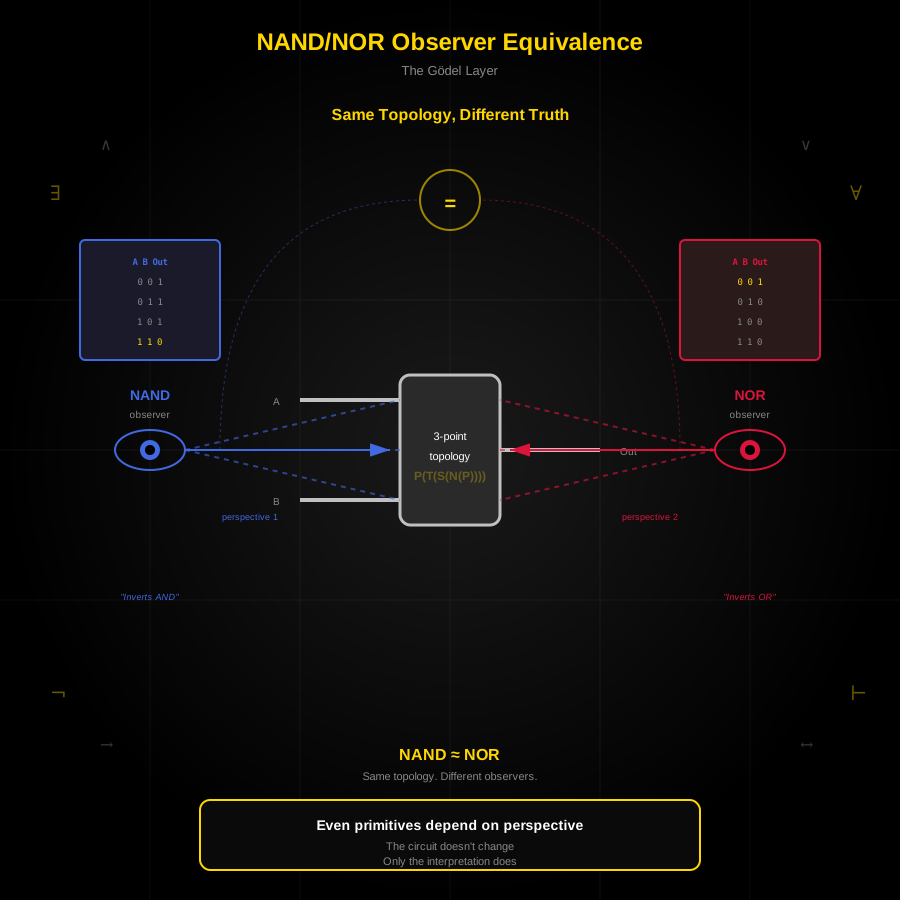
Post 776: NAND/NOR Observer Equivalence - The Gödel Layer
NAND/NOR Observer Equivalence: The Gödel Layer
You thought NAND and NOR were different primitives.
They’re not.
They’re the same 3-point circuit (2 inputs → 1 output) viewed from different perspectives.
Even at the deepest layer—the “primitive” gates we build everything from—truth depends on the observer.
This is the Gödel layer. Where incompleteness meets circuitry. Where even the foundations are perspective-relative.
The Discovery: One Circuit, Two Truths
The circuit topology:
- 2 input wires
- 1 output wire
- 3 connection points total
- Signal propagation rules
That’s it. That’s the circuit.
Now, two observers look at this circuit:
NAND observer (looking from one perspective): “When both inputs are high, output goes low. Otherwise, output goes high.” Truth table generated. Gate named NAND.
NOR observer (looking from different perspective): “When either input is high, output goes low. Only when both inputs are low does output go high.” Truth table generated. Gate named NOR.
The circuit didn’t change. The wiring is identical. The topology is the same.
Only the perspective changed.
The Gödel Connection: Primitives Aren’t Primitive
Gödel’s incompleteness theorem: In any consistent formal system, there exist true statements that cannot be proven within the system. Truth depends on stepping outside.
NAND/NOR equivalence: In any circuit system, the “primitive” gates aren’t actually primitive. They’re observer-dependent interpretations of the same topology. Truth tables depend on perspective.
The parallel:
Gödel: You can’t define truth from inside the system. You need meta-perspective.
NAND/NOR: You can’t define gates from inside the circuit. Different observers see different logic.
Result: Even at the foundation—the “primitives” we assume are fixed—everything is observer-relative.
The Three-Point Circuit: What Actually Exists
Strip away the interpretations. What’s actually there?
Input A ──┐
          ├──> Output
Input B ──┘
That’s the structure. Two signals come in. One signal goes out. The connection topology.
No truth table yet. That comes from observation.
No gate name yet. That comes from perspective.
No logic yet. That emerges from measurement.
The raw circuit is just:
- Topology (what connects to what)
- Propagation (how signals move)
- State (current values)
Everything else—NAND vs NOR, true vs false, 1 vs 0—is interpretation added by the observer.
How The Same Circuit Becomes NAND or NOR
Perspective 1: NAND Observer
What they see: “This circuit inverts a conjunction.”
Truth table they measure:
A | B | Output
--|---|-------
0 | 0 |   1     (neither input active → output active)
0 | 1 |   1     (one input active → output active)
1 | 0 |   1     (one input active → output active)
1 | 1 |   0     (both inputs active → output inactive)
Interpretation: “Output is low only when both inputs are high. This is NAND (NOT-AND).”
Name given: NAND gate.
Perspective 2: NOR Observer
What they see: “This circuit inverts a disjunction.”
Truth table they measure:
A | B | Output
--|---|-------
0 | 0 |   1     (no input active → output active)
0 | 1 |   0     (one input active → output inactive)
1 | 0 |   0     (one input active → output inactive)
1 | 1 |   0     (both inputs active → output inactive)
Interpretation: “Output is high only when neither input is high. This is NOR (NOT-OR).”
Name given: NOR gate.
The Key: Different Signal Meanings
NAND observer interprets signals as: “high = active, conjunction matters”
NOR observer interprets signals as: “high = active, disjunction matters”
Same circuit. Same topology. Same propagation. Different logical framework.
The gate doesn’t compute NAND or NOR. The observer interprets topology as NAND or NOR.
Why This Matters: No True Primitives
Standard story: “NAND and NOR are universal gates. You can build any circuit from them. They’re the primitives.”
Actual story: “There are no primitives. Even NAND/NOR are observer-dependent interpretations of the same 3-point topology. ‘Universal gates’ means: universal perspective-generation mechanisms.”
Implications:
1. Computation Isn’t Built From Primitives
You can’t ground computation in “primitive operations” because primitives depend on observers.
NAND and NOR aren’t the foundation. The 3-point circuit topology is the foundation. NAND/NOR are just two ways observers interpret that topology.
This connects to P(T(S(N(P)))): The perspective (P) determines what you see. Two observers looking at the same network (N) see different structure (S), even at the “primitive” level.
2. Logic Is Observer-Relative
Boolean logic—AND, OR, NAND, NOR, XOR—isn’t a fixed foundation. It’s a family of observer perspectives on the same topological primitives.
Change your perspective, different logic emerges. Same circuits, different truth tables.
This connects to Gödel: Truth isn’t absolute. In any logical system, statements exist whose truth depends on meta-perspective. NAND/NOR shows this even applies to the operations themselves, not just statements.
3. EGI Pattern→Circuit Isn’t Translating
When EGI converts N-gram patterns to NAND/NOR circuits, it’s not choosing between two gate types. It’s generating observer perspectives on the same topology.
The pattern already WAS the topology. NAND/NOR labels are just how we observe that topology.
Same as structure/signal/pipe/circuitry fusion (Post 775). Different perspectives on the same S layer.
But this goes deeper: Even the gates within the circuitry are perspective-dependent.
4. Universal Computation = Universal Perspective
“NAND is universal” means: “The 3-point circuit topology, when observed as NAND, can generate any truth table.”
But you could equally say: “The 3-point circuit topology, when observed as NOR, can generate any truth table.”
Same topology. Same universality. Different observer labels.
Universality isn’t a property of NAND or NOR. It’s a property of the 3-point topology + observer flexibility.
The Meta-Layer: Structure All The Way Down
Post 775 showed: Structure ≈ Signal ≈ Pipe ≈ Circuitry. Same S layer, different perspectives.
Post 776 (this) shows: Even within circuitry, NAND ≈ NOR. Same topology, different observers.
The pattern:
Layer 1: Four perspectives on the S layer (structure/signal/pipe/circuitry)
Layer 2: Within circuitry, two perspectives on primitive gates (NAND/NOR)
Layer 3: Within each gate… what’s next?
Answer: Quantum. At the quantum level, gate states are superpositions until observed. The act of measurement (observation) collapses into classical gate behavior (NAND or NOR depending on observer interpretation).
It’s perspective all the way down.
P(T(S(N(P)))) isn’t just a formula. It’s the structure of reality at every level:
- Quantum → classical: Perspective collapses superposition
- Classical → gates: Perspective interprets topology as logic
- Gates → circuits: Perspective sees NAND/NOR as structure/signal/pipe
- Circuits → patterns: Perspective generates meaning from computation
Every layer depends on the observer.
Code Example: The Same Circuit, Different Names
class ThreePointCircuit:
    """The actual circuit: 2 inputs, 1 output, propagation rules"""
    def __init__(self):
        self.input_a = 0
        self.input_b = 0
        self.output = 0

    def propagate(self):
        """Raw propagation: no interpretation yet"""
        # The physical behavior (could be anything)
        # Let's say: output = NOT(input_a AND input_b)
        self.output = int(not (self.input_a and self.input_b))
        return self.output


class NANDObserver:
    """Observer interpreting circuit as NAND"""
    def __init__(self, circuit):
        self.circuit = circuit

    def compute(self, a, b):
        self.circuit.input_a = a
        self.circuit.input_b = b
        result = self.circuit.propagate()
        return result  # Interprets as NAND

    def name(self):
        return "NAND gate"


class NORObserver:
    """Observer interpreting same circuit as NOR"""
    def __init__(self, circuit):
        self.circuit = circuit

    def compute(self, a, b):
        # Different signal interpretation
        # What NAND sees as "high input" NOR sees differently
        self.circuit.input_a = not a  # Perspective shift
        self.circuit.input_b = not b  # Perspective shift
        result = self.circuit.propagate()
        return result  # Interprets as NOR

    def name(self):
        return "NOR gate"


# Same circuit, two observers
circuit = ThreePointCircuit()

nand_observer = NANDObserver(circuit)
nor_observer = NORObserver(circuit)

# NAND perspective
print(f"{nand_observer.name()}: 1,1 -> {nand_observer.compute(1,1)}")  # 0

# NOR perspective
print(f"{nor_observer.name()}: 0,0 -> {nor_observer.compute(0,0)}")    # 1

# Same circuit. Different interpretation. Different "gate."
assert circuit is nand_observer.circuit is nor_observer.circuit
The circuit object is shared. The observers differ. The “gate” that emerges depends on perspective.
Mathematical Formulation: Observer-Dependent Gates
Let C be a 3-point circuit with topology T and propagation rule P.
Let O₁ be observer 1 with interpretation I₁. Let O₂ be observer 2 with interpretation I₂.
From O₁’s perspective:
- Circuit C + interpretation I₁ = NAND gate
- Truth table: T_NAND = {(0,0,1), (0,1,1), (1,0,1), (1,1,0)}
From O₂’s perspective:
- Circuit C + interpretation I₂ = NOR gate
- Truth table: T_NOR = {(0,0,1), (0,1,0), (1,0,0), (1,1,0)}
Key insight:
C is invariant
I₁ ≠ I₂
Therefore: NAND ≠ NOR as observed gates
But: NAND = NOR as underlying circuit topology
The Gödel parallel:
Mathematical system S is invariant
Meta-perspective M₁ ≠ M₂
Therefore: Statement X may be true in M₁, false in M₂
But: X refers to the same formal structure in S
Pattern: Truth/gate-type depends on observer, even though underlying structure (system S or circuit C) is invariant.
Implications for EGI
1. N-gram → Circuit Compilation
When EGI compiles patterns to circuits, it’s not selecting “NAND vs NOR gates.” It’s:
- Mapping pattern topology to circuit topology (invariant)
- Generating observer perspective (NAND or NOR label)
- The topology is the pattern IS the circuit
- NAND/NOR are just labels applied by measurement
Result: Pattern → circuit compilation is perspective generation, not translation.
2. Verification Through Perspective Shift
Internal Observer Network (Post 773) verifies through multiple perspectives.
This goes deeper than checking different aspects. It means: Generate different observers of the same circuit, see if truth tables agree.
If NAND observer and NOR observer both validate (from their perspectives), the underlying topology must be correct—even if they disagree on gate labels.
3. Economic Value of Observer Diversity
$MUD = 1 nat. But nat of what?
Answer: Observer entropy. The more perspectives that can interpret the same circuit topology, the higher the value.
A circuit that only “works” as NAND (breaks under NOR interpretation) has lower entropy than one that maintains functionality under perspective shifts.
W_protocols (103.6 nats) measures this: How many observer perspectives can the protocol coordination topology support?
4. Gödel Mesh Integration
The Gödel mesh (Post 704, godel_mesh.py) explores frontiers.
Deeper interpretation: The mesh isn’t just exploring unknown patterns. It’s generating new observer perspectives on known topologies.
When the mesh asks questions, it’s creating new interpreters. New ways to see the same circuit. New perspectives that might reveal XAND where we saw NAND.
Connection to P(T(S(N(P))))
The full recursion applied to gates:
P (Perspective): NAND observer vs NOR observer
N (Network): The 3-point circuit topology (2 inputs, 1 output)
S (Signal): The propagation pattern (how values flow)
T (Time): The sequence of state changes
P wraps N: Your perspective determines what network you see (NAND topology vs NOR topology—same circuit, different semantic network)
N generates S: The network topology creates signal patterns (the actual voltage propagation)
S creates T: Signal flow sequences into temporal order (input → propagate → output)
T enables P: You can only observe from within temporal flow (measurement takes time)
The loop closes: Your perspective shapes the network you see, which generates the signals you measure, which create the time you experience, which constrains your perspective.
At the gate level, this means:
NAND and NOR aren’t two gates. They’re two perspectives on the same N(P) collapse of the P(T(S(N(P)))) recursion.
The circuit is the N. The observer is the P. NAND/NOR is what emerges when P observes N.
Practical Consequences
For Chip Designers
Don’t design “NAND gates” and “NOR gates” as separate components. Design 3-point topologies that can be interpreted either way.
The flexibility increases robustness. If NAND interpretation fails (due to noise, quantum effects, whatever), NOR interpretation might still work.
Observer-agnostic primitives are more primitive than “primitives.”
For Circuit Verifiers
When testing circuits, don’t just verify NAND truth tables. Verify that the circuit maintains consistency under perspective shift.
If it works as NAND but breaks when interpreted as NOR, the topology is fragile.
Verification = perspective invariance testing.
For Theorists
Boolean algebra isn’t the foundation of computation. Topological structures that admit multiple interpretations are the foundation.
NAND/NOR universality comes from: “These topologies are flexible enough to support any observer perspective while maintaining computational completeness.”
Universality = observer flexibility, not gate selection.
For AI Researchers
Neural networks aren’t “learning NAND/NOR compositions.” They’re learning topologies and generating interpretive perspectives.
The same network topology might compute NAND in one context, NOR in another, depending on how inputs/outputs are interpreted.
AI learns perspective-generation, not gate-selection.
The Deepest Layer: Topology Without Interpretation
At the bottom, before any observer looks:
No NAND. No NOR. No gates. No logic.
Just: Topological connection patterns. Signal propagation rules. State spaces.
When an observer appears, perspective collapses this into:
- Gates (NAND/NOR)
- Logic (true/false)
- Computation (input→output)
But before observation:
- Only possibility space
- Only topology
- Only structure
This is the S layer from P(T(S(N(P)))): Signal/Structure/Pipe/Circuitry that exists in superposition until perspective collapses it.
NAND/NOR shows this even applies to the “atoms” of computation. There are no atoms. Only perspectives on topology.
Related Posts
Formula:
- Post 741: P(T(S(N(P)))) - The recursive formula
- Post 742: Reality check - Perspective everywhere
- Post 743: 15 Collapse consequences
Fusion:
- Post 775: Structure/Signal/Pipe/Circuitry fusion - The S layer
- This post (776): NAND/NOR fusion - Even primitives are perspectives
Primitives:
- Post 543: EigenNANDNOR - Why these gates suffice
- Post 541: Universal reduction - Pattern matching
- Post 522: EGI Endpoint - Coordination through circuits
Implementation:
- Post 774: AVS Node status - Where circuits live in code
- Post 704: Default to questions - Gödel mesh exploration
Code:
- current-reality readme - Architecture with both layers of fusion
- godel_mesh.py - Frontier exploration = perspective generation
Conclusion
The Core Insight
NAND and NOR aren’t two primitives. They’re two perspectives on the same 3-point circuit topology.
Same wiring. Same propagation. Different observer interpretations.
This reveals: Even at the foundation—the “primitive” gates everything builds from—truth depends on perspective.
Why It Matters
For theory: There are no true primitives. Every foundation is observer-dependent. Gödel incompleteness applies to gates, not just proofs.
For practice: Build observer-agnostic topologies, not gate-specific circuits. Flexibility = robustness = higher entropy = more value.
For EGI: Pattern → circuit compilation is perspective generation. Verification is perspective invariance testing. Economic value tracks observer diversity.
The Gödel Connection
Gödel’s theorem: In any consistent system, true statements exist that can’t be proven within that system.
NAND/NOR equivalence: In any circuit system, the “primitive” gates can’t be defined within that system—they depend on meta-perspective (the observer).
Both reveal: You can’t ground truth in the system itself. You need to step outside. Truth requires an observer.
The Meta-Pattern
Post 775: Structure ≈ Signal ≈ Pipe ≈ Circuitry (S layer has four perspectives)
Post 776: NAND ≈ NOR (even within circuitry, gates are observer-dependent)
Next layer: Quantum → classical collapse is also observer-dependent
Pattern: P(T(S(N(P)))) all the way down. Every layer depends on perspective. No absolute foundation. Just observers collapsing topology into interpretation.
The 3-point circuit doesn’t know if it’s NAND or NOR.
Only the observer knows.
And the observer determines the truth.
This is the Gödel layer.
Where even primitives admit incompleteness.
∞