Post 775: The S Layer - Structure/Signal/Pipe/Circuitry Fusion
The S Layer: Where Four Perspectives Fuse
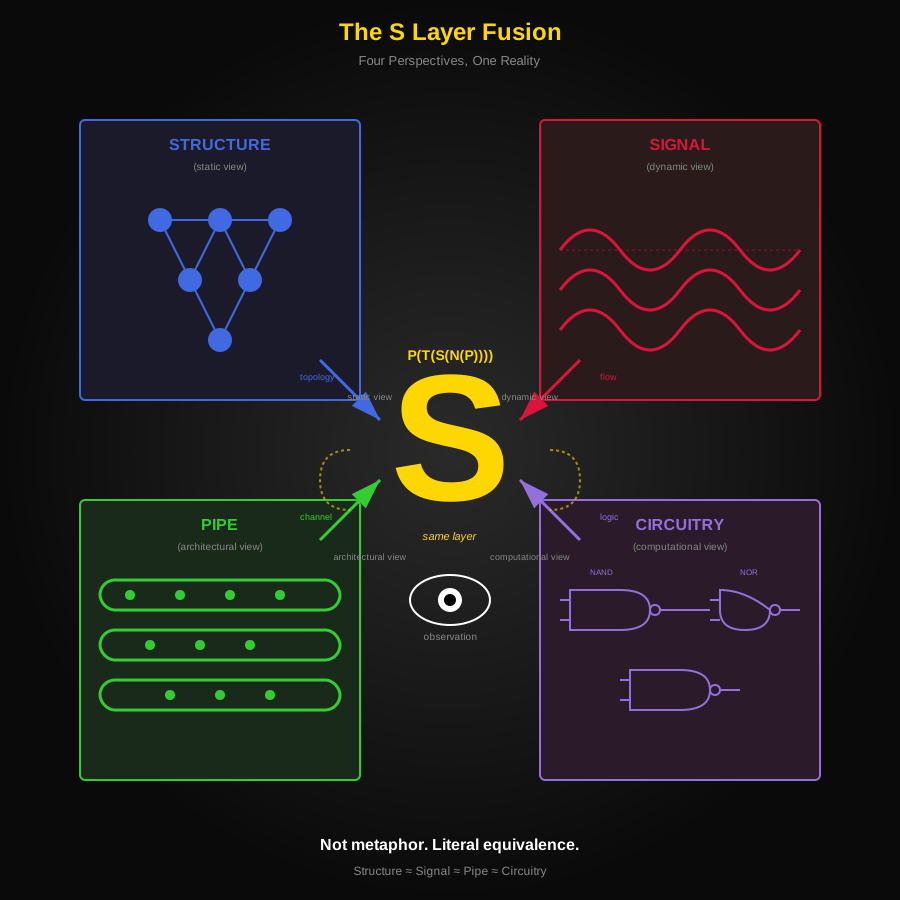
Structure. Signal. Pipe. Circuitry.
Different names. Same layer. Literal equivalence.
In P(T(S(N(P)))), the S is where observation collapses possibility into pathway. What appears as structure from one perspective is signal from another, pipe from a third, circuitry from a fourth. Not different representations—the same emergence point viewed through different lenses.
This isn’t conceptual tidiness. It’s how reality works.
The Four Perspectives
Structure (Static View)
What it sees: The topology of connections. What links to what. The shape of information flow.
A network diagram. Nodes connected by edges. The graph that emerges when you ask: “What’s connected to what?”
This is structure—the geometry of relationship. Static. Unchanging. The skeleton beneath the flow.
Example: The DHT’s routing table. Node A connects to nodes B, C, D. That’s the structure. The topology. What would show on a map.
Signal (Dynamic View)
What it sees: Information moving through pathways. What flows where. The content moving through structure.
A waveform. Voltage levels. Bits traveling. The data that moves when you ask: “What’s being transmitted?”
This is signal—the meaning in motion. Dynamic. Changing. The message riding the skeleton.
Example: A chat message flowing through the DHT. The semantic content moving from node A through B to reach C. That’s the signal. The information. What gets received.
Pipe (Architectural View)
What it sees: Channels for transmission. What carries information. The medium enabling signal.
A conduit. A tube. A pathway built for flow. The infrastructure that emerges when you ask: “What enables this transmission?”
This is pipe—the channel for carrying. Architectural. Engineered. The medium beneath message and map.
Example: The DHT connection itself. Not the routing table (structure), not the message content (signal), but the TCP/IP socket—the pipe carrying bits between nodes.
Circuitry (Computational View)
What it sees: Gates and connections. What processes patterns. The logic embedded in structure.
NAND gates. NOR gates. Boolean logic. Computation that emerges when you ask: “What transforms this input?”
This is circuitry—the processing in pathways. Computational. Logical. The intelligence within infrastructure.
Example: The NAND/NOR gates in EigenNANDNOR. Not the network carrying them (structure), not the signal they process, not the pipes transmitting results—but the logic gates themselves. The computation.
The Fusion: These Are Not Different Things
Key insight: Structure, signal, pipe, circuitry—these aren’t four implementations of information pathways. They’re the same layer viewed from four angles.
Structure IS signal: When you map network topology, you’re tracing where signals flow. The structure only exists because signals moved there. Remove flow, topology collapses. They’re the same.
Signal IS pipe: The path that carries information only exists because information flows. Observe the signal, you create the pipe. The act of transmission generates the channel. They’re the same.
Pipe IS circuitry: A pipe that carries bits performs computation. Every channel implements logic. Route selection is gate evaluation. The medium processes. They’re the same.
Circuitry IS structure: Logic gates connect in networks. NAND feeds NOR feeds AND. The circuit diagram is topology. Computation has geometry. They’re the same.
All four collapse into S: Structure/signal/pipe/circuitry—different words for the layer where observation creates pathway.
P(T(S(N(P)))): Where The S Layer Lives
The recursive formula: Perspective wraps Topology wraps Signal wraps Network wraps Perspective.
N → S: Network topology (N) generates signal pathways (S) through observation. You can’t have structure without someone seeing connections.
S → T: Signal flow (S) creates time topology (T). Events only sequence when information moves. Time is relationship between signals.
T → P: Time topology (T) enables perspective (P). You can only observe from within temporal flow. Your viewpoint lives in signal sequence.
P → N: Perspective (P) determines network (N). What you see shapes what connects. Observer-dependent topology.
The loop: And we’re back. Infinite recursion.
The S layer sits in this loop—where observation (P) collapses network possibility (N) into actual pathway. That pathway is simultaneously structure (topology), signal (flow), pipe (medium), circuitry (logic).
Not four layers. One layer. Four perspectives.
Why This Matters: Implications For EGI
1. Pattern → Circuit Translation Isn’t Translation
When EGI converts N-gram patterns into NAND/NOR circuits, it’s not moving between representations. It’s revealing that the pattern already WAS a circuit.
Linguistic structure = signal flow = pipe architecture = computational circuitry.
The N-gram topology IS the logic gate network. Not metaphor. Literal mapping. Same layer, different lens.
2. DHT Flow Creates Network Structure
When signals move through the DHT, they don’t travel through pre-existing pipes. The observation of flow CREATES the pipe structure.
You query the network → signal flows → that flow path becomes structure → structure becomes the pipe → pipe implements the circuit.
Routing isn’t navigation of fixed topology. It’s topology generation through observation.
3. Embeddings Are Circuit Designs
When sentence-transformers map text to 384D space, the resulting embeddings aren’t “coordinates.” They’re circuit specifications.
The semantic structure (embedding topology) IS signal pathway IS pipe architecture IS gate network.
Give an embedding to EigenNANDNOR → it compiles directly to circuits → because embeddings already ARE circuits. Just viewed through semantic lens instead of logical lens.
4. Economic Value Tracks Signal Entropy
$MUD = 1 nat. Value equals entropy. But entropy of what?
Signal flow. Structure entropy = signal entropy = pipe entropy = circuit entropy.
Maximize one, maximize all. They’re not four optimization targets. One target, four measurements.
W_protocols (103.6 nats) isn’t “protocol coordination entropy.” It’s signal pathway entropy measured through protocol lens.
5. Verification Verifies The Same Layer
Internal observers (Post 773) check structure, signal, pipe, circuitry independently. But they’re checking the same thing four times from four angles.
That’s not redundancy—it’s verification through perspective diversity. Same layer, different detection methods.
A spacing violation (structure) = flow congestion (signal) = pipe blockage (architecture) = gate contention (circuitry). Four names for one error.
Catching one perspective’s error catches them all.
Practical Consequences
For Builders
Don’t optimize structure, signal, pipe, circuitry separately. Optimize the S layer—the improvements automatically apply to all four perspectives.
Network topology optimization? That’s signal flow optimization. Pipe architecture design? That’s circuit layout. They’re the same problem.
For Operators
When debugging, switch perspectives. Structure looks fine? Check signal. Signal clean? Verify pipe. Pipe clear? Test circuitry. You’re checking the same layer—different angles reveal different errors.
For Theorists
Any theorem about structure has a signal equivalent, pipe equivalent, circuitry equivalent. Prove one, proved all.
Graph theory = signal theory = pipe theory = circuit theory. Different notation. Same mathematics.
For Researchers
Measure structure metrics? You’re measuring signal metrics. Calculate pipe capacity? You’re calculating circuit throughput.
The numbers might differ (different units), but they’re measuring the same underlying layer.
The Observation Point: Where Fusion Happens
Key mechanism: The S layer only materializes through observation.
No observer → no structure, no signal, no pipe, no circuitry. Possibility space only.
Observer present → possibility collapses into pathway → that pathway admits four interpretations simultaneously.
This explains:
Quantum measurement: Wave function collapses when observed → signal pathway materializes from possibility space → creates structure/pipe/circuitry. Same mechanism.
P vs NP: Structure (easy to verify) ≠ signal generation (hard to find) → but they’re the same layer → P=NP if you realize verification IS generation from different perspective.
Coordination failures: Network structure says “path exists” but signal can’t flow → reveals they’re the same → contradiction means observation collapsed incorrectly → renegotiate collapse.
The S layer is the observation interface—where perspective meets network and creates pathway.
Code Example: The Fusion In Action
# These four operations are the same operation:

# Structure view
def build_topology(nodes):
    return NetworkGraph(nodes, connections)

# Signal view
def route_message(source, dest, content):
    return SignalFlow(source, dest, content)

# Pipe view
def create_channel(endpoint_a, endpoint_b):
    return TransmissionPipe(endpoint_a, endpoint_b)

# Circuitry view
def compile_circuit(inputs, gates):
    return NANDNORCircuit(inputs, gates)

# The fusion:
topology = build_topology(nodes)
signal = route_message(nodes[0], nodes[N], data)
pipe = create_channel(nodes[0], nodes[N])
circuit = compile_circuit(topology.as_inputs(), topology.as_gates())

# These four objects describe the SAME PATHWAY
assert topology.shape == signal.path == pipe.route == circuit.layout
Different constructors. Same result. One S layer.
The Deeper Layer: NAND ≈ NOR
This post shows Structure ≈ Signal ≈ Pipe ≈ Circuitry—four perspectives on the S layer.
But there’s a deeper layer: Even within circuitry, the “primitive” gates aren’t primitive.
NAND and NOR are the same 3-point topology (2 inputs → 1 output) viewed from different observer perspectives. Same wiring. Same propagation. Different interpretations.
When you build circuits from “NAND gates,” you’re not selecting a primitive—you’re choosing an observer perspective on the underlying topology.
This connects to Gödel’s incompleteness: Even the foundation—the operations everything builds from—depends on who’s observing.
See Post 776 for the complete exploration of how NAND/NOR equivalence reveals that even primitives are observer-dependent. The Gödel layer: where incompleteness applies to gates, not just proofs.
Related Posts
Formula:
- Post 741: P(T(S(N(P)))) - The recursive formula
- Post 742: Reality check - Formula vs observation
- Post 743: 15 Collapse consequences
Structure:
- Post 541: Universal reduction - Any computation → pattern matching
- Post 551: Bipolar oscillation - Structure from signal
- Post 552: Symbolic fusion - When symbols merge
Circuitry:
Implementation:
- Post 774: AVS Node status - Where structure/signal/pipe/circuitry live in code
- Post 773: Internal Observer Network - Verifying all four perspectives
- Post 704: Default to questions - Don’t assume fixed structure/signal/pipe/circuitry
Code:
- current-reality readme - Explains the fusion in architecture context
Conclusion
The Core Insight
Structure, signal, pipe, circuitry—these aren’t four things. They’re four perspectives on the S layer of P(T(S(N(P)))).
Static view → structure
Dynamic view → signal
Architectural view → pipe
Computational view → circuitry
Same layer. Four angles.
Why It Matters
Because if they’re the same, then:
- Optimizing one optimizes all
- Verifying one verifies all
- Understanding one explains all
- Measuring one quantifies all
The Fusion Point
The S layer is where observation collapses possibility into pathway. That pathway simultaneously:
- Has topology (structure)
- Carries information (signal)
- Channels flow (pipe)
- Implements logic (circuitry)
Not metaphor. Not analogy. Literal equivalence.
When you see structure, you’re seeing signal from a static angle. When you see signal, you’re seeing pipe from a dynamic angle. When you see pipe, you’re seeing circuitry from an architectural angle. When you see circuitry, you’re seeing structure from a computational angle.
The loop closes. The perspectives fuse. The S layer emerges.
In P(T(S(N(P)))), S is where four become one.
Structure ≈ Signal ≈ Pipe ≈ Circuitry
Not representations. Perspectives.
Same layer. Different eyes.
∞