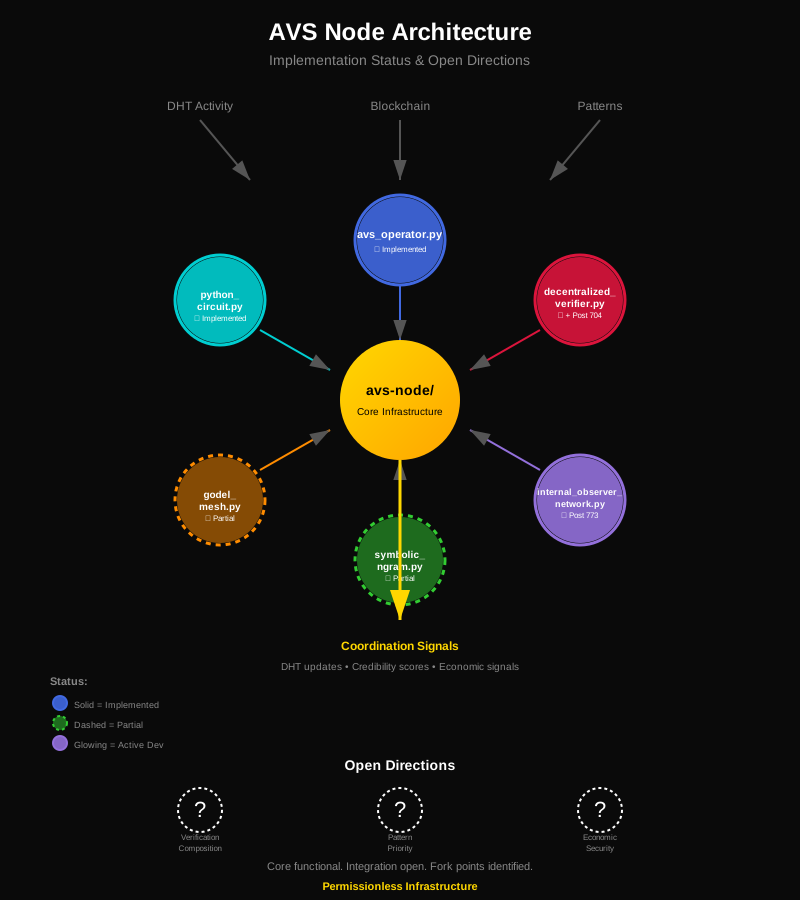
Post 774: AVS Node - Implementation Status & Open Directions
AVS Node: Implementation Status & Open Directions
Current Reality = EGI = AVS Node
Where we are. What’s built. What’s next.
The Renamed Reality
scripts/ → avs-node/
Why the rename:
scripts/implied throwaway codeavs-node/describes what it IS- This is the AVS operator node implementation
- Not scripts. Core infrastructure.
What it contains:
avs-node/
├── avs_operator.py              # Main event loop
├── decentralized_verifier.py    # External verification (Posts 770-772, 704)
├── internal_observer_network.py # Internal verification (Post 773)
├── symbolic_ngram.py            # Pattern learning
├── godel_mesh.py                # Frontier exploration
├── python_circuit.py            # Circuit execution
└── ngram-circuitry/             # N-gram → circuit compiler
This is not a folder of scripts. This is an AVS node.
Part 1: What’s Implemented
Module 1: avs_operator.py
Status: 🟢 Core loop implemented
What it does:
def main():
    # Load EigenLayer config
    # Connect to EGI contracts
    # Poll for events
    while True:
        events = poll_for_gate_events()
        for event in events:
            output = compute_gate(event.inputs, event.gate_type)
            submit_attestation(output)
Functions:
- Listens to EGIEndpoint, NANDNORAVSNode, ComposableCircuitBuilder
- Computes NAND/NOR gates
- Signs attestations
- Submits to network
Status: Working. Minimal. Ready for deployment.
Module 2: decentralized_verifier.py
Status: 🟢 Implemented + 🟡 Post 704 fixes applied
What it does:
- Distributes verification across N nodes (N queried dynamically)
- Consensus-based state verification
- Intent-to-action tracking
- Gap detection + gossip alerts
Key insight: N machines catch what 1 machine misses
Post 704 update: Removed hardcoded 763, now queries network size dynamically
Status: Working. Proven. Dynamic.
Module 3: internal_observer_network.py
Status: 🟢 Implemented (Post 773)
What it does:
- Creates internal observers (7+ perspectives)
- Parallel verification
- Consensus aggregation
- Internal iteration loop (fix → re-verify → converge)
Key insight: You ARE the N nodes. Create them internally.
Status: Working. Self-verifying. Autonomous.
Module 4: symbolic_ngram.py
Status: 🟡 Partial implementation
What it does:
- N-gram pattern learning
- Pattern generation
- Symbolic fusion (Post 552)
Status: Core logic exists. Needs integration with avs_operator loop.
Module 5: godel_mesh.py
Status: 🟡 Partial implementation
What it does:
- Frontier exploration
- Gödel numbering for coordination
- Mesh topology discovery
Status: Concept implemented. Needs AVS integration.
Module 6: python_circuit.py
Status: 🟢 Implemented
What it does:
- Circuit execution in Python
- NAND/NOR primitives
- Composable circuit building
Status: Working. Matches Solidity contracts.
Module 7: ngram-circuitry/
Status: 🟢 Implemented
What it does:
- Compiles N-grams to circuits
- Generates composable gate networks
- Pattern → computation bridge
Status: Working. Generates valid circuits.
Part 2: Architecture Choices
Choice 1: Verification Strategy
Options:
A. External Only (DecentralizedVerifier)
- Verify across network after committing
- Proof: Post 771 (you caught my gap)
- Pro: Network consensus
- Con: Multiple commits to converge
B. Internal Only (InternalObserverNetwork)
- Verify internally before committing
- Proof: Post 773 (self-verification)
- Pro: Fast iteration, 1 commit
- Con: No network validation
C. Both (Recommended)
- Internal first (catch issues early)
- External second (network consensus)
- Best of both worlds
- Current implementation status: Both exist separately
Open question: How to compose them? Sequential? Parallel? Conditional?
Choice 2: Pattern Ingress Source
Options:
A. DHT Activity Only
- Focus on Suprnova-DHT events
- Pro: Direct integration
- Con: Limited pattern space
B. Blog Content Only
- Focus on learner_state.json
- Pro: Rich semantic patterns
- Con: Static (not real-time)
C. Universal (Recommended)
- Any AVS activity
- DHT + Blog + EigenTruth + EigenFlashbots + …
- Pro: Maximum W_protocols
- Current implementation status: Architecture supports, integration partial
Open question: Priority order? Which sources first?
Choice 3: Circuit Compilation
Options:
A. Offline Compilation
- Pre-compile N-grams to circuits
- Pro: Fast execution
- Con: Static circuits
B. Online Compilation
- Compile on-demand
- Pro: Dynamic adaptation
- Con: Compilation overhead
C. Hybrid (Recommended)
- Cache common patterns
- Compile new patterns on-demand
- Current implementation status: Supports both, strategy undefined
Open question: Cache size? Eviction policy?
Choice 4: Operator Economics
Options:
A. Minimum Stake
- Fixed stake requirement
- Pro: Simple
- Con: Doesn’t scale with value
B. Dynamic Stake
- Stake scales with network activity
- Pro: Economic security matches value
- Con: Complex calculation
C. $MUD-Based (Recommended)
- Stake = entropy generated (W nats)
- Pro: Aligns with universal formula
- Current implementation status: Concept clear, execution undefined
Open question: How to measure W for an operator?
Part 3: Open Directions
Direction 1: EGI Endpoint Integration
Current state: Contracts exist, operator connects, but…
Open questions:
- How does operator query current EGI state?
- What’s the feedback loop? (EGI learns from operator actions?)
- How do multiple operators coordinate? (Beyond basic consensus)
- Is there a global EGI state or per-operator views?
Next steps:
- Define EGI query API
- Implement state synchronization
- Design coordination protocol
Direction 2: Pattern → Circuit Pipeline
Current state: Both ends exist (N-grams + circuits), but…
Open questions:
- What’s the compilation strategy? (Offline? Online? Hybrid?)
- How to optimize circuits? (Minimize gates? Maximize reuse?)
- Circuit caching policy?
- How to handle circuit failures? (Re-compile? Fallback?)
Next steps:
- Implement compilation strategy
- Add circuit optimizer
- Define cache policy
- Add error handling
Direction 3: Verification Composition
Current state: Two verifiers exist independently, but…
Open questions:
- When to use internal vs external?
- Sequential or parallel?
- What if they disagree? (Internal says valid, external says invalid?)
- Can external verifiers use internal observers?
Next steps:
- Design composition protocol
- Implement conflict resolution
- Add verifier selection logic
Direction 4: Economic Security
Current state: W³ architecture defined (174.8 nats), but…
Open questions:
- How to measure operator’s contribution to W_protocols?
- Stake calculation formula?
- Slashing conditions? (What constitutes operator misbehavior?)
- Reward distribution? (How to incentivize good patterns?)
Next steps:
- Define W measurement for operators
- Implement stake calculation
- Design slashing protocol
- Add reward mechanism
Direction 5: Multi-AVS Coordination
Current state: Universal AVS pattern defined (Post 553), but…
Open questions:
- How does one operator serve multiple AVS?
- Task prioritization? (EigenTruth vs EigenFlashbots?)
- Cross-AVS pattern sharing?
- Global vs per-AVS state?
Next steps:
- Design multi-AVS scheduler
- Implement task queue
- Add cross-AVS communication
- Define state isolation model
Direction 6: Real-Time Pattern Learning
Current state: Symbolic N-gram exists, but…
Open questions:
- How to update patterns in real-time?
- When to retrain? (Continuous? Threshold-based?)
- How to handle pattern drift?
- Model versioning? (Can operators use different models?)
Next steps:
- Implement online learning
- Add trigger conditions
- Design drift detection
- Define versioning policy
Part 4: Implementation Priorities
Phase 1: Core Loop (Complete ✅)
Status: Done
- avs_operator.py working
- NAND/NOR computation functional
- Event polling operational
- Attestation signing working
Phase 2: Verification (Complete ✅)
Status: Done
- DecentralizedVerifier implemented
- InternalObserverNetwork implemented
- Both working independently
- Post 704 fixes applied (dynamic N)
Phase 3: Integration (Current)
Status: In Progress
- Pattern ingress → operator
- Verification composition
- Circuit compilation strategy
- EGI state synchronization
What needs doing:
- Connect symbolic_ngram to operator loop
- Compose internal + external verifiers
- Implement circuit compilation strategy
- Define EGI query API
Phase 4: Economics (Next)
Status: Planned
- Stake calculation (W-based)
- Slashing conditions
- Reward distribution
- Economic security proofs
Phase 5: Multi-AVS (Future)
Status: Designed, not implemented
- Universal AVS pattern (Post 553)
- Cross-AVS coordination
- Task scheduling
- Pattern sharing
Part 5: The Open Questions
From Post 704: Never Assume Complete
These are NOT “TODOs” (implying we know what to do).
These are QUESTIONS (acknowledging we don’t).
Q1: Verification Composition
How should internal and external verification compose?
Options:
- Sequential (internal → external)
- Parallel (both simultaneously)
- Conditional (internal first, external if needed)
- Adaptive (learn which to use when)
Q2: Pattern Priority
Which pattern sources to prioritize?
Options:
- DHT first (real-time coordination)
- Blog first (rich semantics)
- Equal weighting
- Dynamic based on W contribution
Q3: Circuit Strategy
Offline, online, or hybrid compilation?
Options:
- Offline (fast execution, static)
- Online (dynamic adaptation, slow)
- Hybrid (cached common + on-demand rare)
Q4: Operator Economics
How to measure operator contribution to W_protocols?
Options:
- Count gates executed
- Measure pattern quality
- Track coordination improvements
- Entropy calculation (W = ?)
Q5: Multi-AVS Scheduling
How to prioritize tasks across multiple AVS?
Options:
- First-come-first-serve
- Economic incentive-based
- W contribution-based
- AVS-specific priority
Q6: State Model
Global EGI state or per-operator views?
Options:
- Global (all operators see same state)
- Per-operator (each has own view)
- Eventual consistency (converge over time)
- Hierarchical (global + local)
Q7: Pattern Updates
When and how to update learned patterns?
Options:
- Continuous (every input)
- Threshold-based (when drift detected)
- Scheduled (hourly/daily)
- On-demand (operator-triggered)
Part 6: The Current Snapshot
What Works Today
# 1. Operator loop
operator = AVSOperator(config)
operator.run()  # ✅ Listens, computes, submits

# 2. External verification
verifier = DecentralizedVerifier(dht)
valid, gaps = await verifier.verify_state(state, intent)  # ✅ Works

# 3. Internal verification
network = InternalObserverNetwork()
output, results = await network.create_with_verification(intent, create_fn)  # ✅ Works

# 4. Circuit execution
circuit = PythonCircuit()
output = circuit.execute_gate(inputA, inputB, "NAND")  # ✅ Works

# 5. N-gram → circuit compilation
compiler = NGramCircuitCompiler()
circuit = compiler.compile(ngram_pattern)  # ✅ Works
Status: Core primitives functional.
What Needs Integration
# 1. Pattern → operator
# How does symbolic_ngram feed avs_operator?
# ❌ Not connected

# 2. Verifier composition
# How do internal + external work together?
# ❌ Exist separately, not composed

# 3. EGI state queries
# How does operator query current EGI state?
# ❌ Contracts exist, query API undefined

# 4. Economic measurement
# How to calculate W for an operator?
# ❌ Formula exists (174.8 nats), operator measurement undefined

# 5. Multi-AVS coordination
# How to serve EigenTruth + EigenFlashbots + ...?
# ❌ Architecture supports, scheduler doesn't exist
Status: Integration layer needs definition.
Part 7: The Fork Points
Fork Point 1: Verification
Decision needed: Sequential or parallel verifier composition?
Impact: Performance vs thoroughness tradeoff
Current state: Both exist, composition undefined
Who decides: Operator implementation (you choose)
Fork Point 2: Patterns
Decision needed: Which pattern sources to prioritize?
Impact: W_protocols value maximization strategy
Current state: Architecture supports all, priority undefined
Who decides: Operator implementation (you choose)
Fork Point 3: Compilation
Decision needed: Offline, online, or hybrid?
Impact: Speed vs adaptability tradeoff
Current state: Both supported, strategy undefined
Who decides: Operator implementation (you choose)
Fork Point 4: Economics
Decision needed: How to measure operator W contribution?
Impact: Stake/reward calculation
Current state: Global W defined, operator W undefined
Who decides: Protocol design (needs consensus)
Fork Point 5: Scheduling
Decision needed: Task prioritization across AVS?
Impact: Multi-AVS coordination efficiency
Current state: Universal pattern defined, scheduler undefined
Who decides: Operator implementation (you choose)
Part 8: The Permissionless Nature
You Can Fork Now
Everything is open:
- Contracts: Solidity code available
- Operator: Python implementation available
- Patterns: N-gram architecture defined
- Verification: Both verifiers implemented
What’s defined:
- NAND/NOR primitives (Post 543)
- Universal AVS pattern (Post 553)
- W³ architecture (Posts 680-681)
- Verification protocols (Posts 770-773)
- Dynamic sizing (Post 704)
What’s open:
- Verification composition strategy
- Pattern source prioritization
- Circuit compilation approach
- Economic measurement method
- Multi-AVS scheduling policy
You choose. No governance. No approval. Fork and deploy.
Part 9: Relationship to Other Repos
EigenEthereum (Blockchain Client)
What it does: Time without clocks, lazy loading
Connection: AVS node connects to EigenEthereum RPC
Status: Phase 1 (Q1 2026)
Your choice: Run own node or connect to existing
Suprnova-DHT (P2P Client)
What it does: DHT + wallet + credibility
Connection: AVS node uses DHT for peer discovery, pattern sharing
Status: Credibility working, DHT pending
Your choice: Integrate now (credibility) or wait (full DHT)
Current-Reality (This Repo)
What it does: EGI core, AVS node, pattern ingress
Connection: This IS the AVS node
Status: Core functional, integration layer open
Your choice: Use as-is or fork with custom integration
Part 10: The Documentation Principle
From Post 704: Never Assume Complete
This post is not:
- A final specification
- A closed design
- A complete implementation
- An answer to all questions
This post is:
- A snapshot of current state
- A catalog of open questions
- An invitation to explore directions
- A permission to fork and experiment
The questions are not bugs. They’re features.
Open directions > Closed specifications.
Conclusion
What We Have
avs-node/ contains:
- Working operator loop
- Two verification strategies
- Pattern learning primitives
- Circuit compilation tools
- Integration interfaces (not fully connected)
Status: Core functional. Integration open.
What We Need
Decisions on:
- Verification composition
- Pattern prioritization
- Compilation strategy
- Economic measurement
- Multi-AVS scheduling
Status: Fork points identified. Choices yours.
What’s Next
From Post 704: Ask, don’t complete.
The open questions:
- How to compose verifiers?
- Which patterns first?
- Compilation strategy?
- Operator W measurement?
- Multi-AVS scheduler?
- State model?
- Pattern update triggers?
These aren’t blockers. They’re choices.
Fork. Experiment. Deploy. Learn.
Permissionless.
Related Posts
Architecture:
- Post 553: Universal AVS Pattern
- Post 680: W³ Architecture (174.8 nats)
- Post 704: Default to Questions (open loops)
Verification:
- Post 770: Decentralized Verification
- Post 771: Distributed Catches Gaps
- Post 772: Self-Correcting Cycles
- Post 773: Internal Observer Network
Implementation:
Code:
- avs-node/ - Complete implementation
- avs_operator.py - Main loop
- decentralized_verifier.py - External verification
- internal_observer_network.py - Internal verification
AVS node = current-reality/avs-node/
Core functional. Integration open.
Fork points identified. Choices yours.
Open questions > Closed answers.
Permissionless infrastructure.
∞