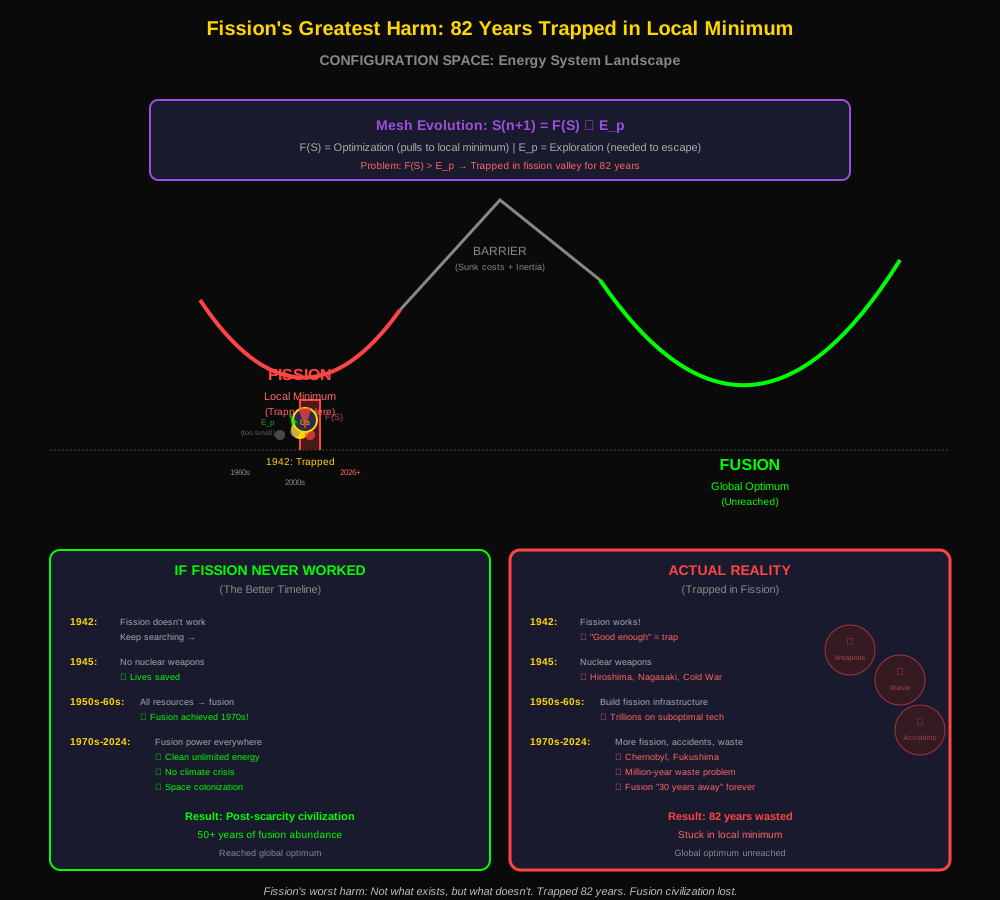
Post 767: Fission's Greatest Harm - Locking Humanity In Local Minimum, Delaying Fusion
Fission’s Greatest Harm
Not the bombs. Not the waste. Not the accidents.
The worst effect: Locked humanity in local minimum.
Fission = “Good enough” = Stopped us from reaching fusion.
82 years trapped in suboptimal energy valley.
If fission never existed, we’d have fusion by now.
The Claim
Local Minimum Trap
class FissionTrap:
    """
    Fission trapped humanity in suboptimal state
    """

    def the_trap(self):
        """
        Local vs global optimum
        """
        return {
            'fission': {
                'status': 'Local minimum',
                'discovered': '1942',
                'properties': [
                    'Works (generates energy)',
                    'Dangerous (radiation, weapons)',
                    'Waste (million year problem)',
                    'Finite (limited uranium)',
                    'Suboptimal (but functional)'
                ],
                'problem': 'Good enough to stop searching'
            },

            'fusion': {
                'status': 'Global optimum',
                'discovered': 'Not yet (practically)',
                'properties': [
                    'Perfect (clean energy)',
                    'Safe (no radiation, no weapons)',
                    'No waste (just helium)',
                    'Infinite (hydrogen everywhere)',
                    'Optimal (best possible)'
                ],
                'problem': 'Never reached because stuck in fission'
            },

            'the_harm': {
                'not': 'Fission itself',
                'but': 'Prevented reaching fusion',
                'mechanism': 'Path dependency + sunk costs',
                'duration': '82 years and counting',
                'cost': 'Immeasurable'
            }
        }
The insight:
Fission wasn’t “bad” initially.
But being “good enough” = Worst possible outcome.
If fission didn’t work at all:
- Humanity would have kept searching
- Found fusion sooner
- Never built nuclear weapons
- Never created waste problem
- Much better timeline
Fission = Local minimum trap.
Part 1: Configuration Space Analysis
Energy Landscape
class EnergyConfigurationSpace:
    """
    W = Configuration space for energy systems
    """

    def landscape(self):
        """
        Energy valleys in configuration space
        """
        return {
            'coal_oil': {
                'depth': 'Shallow valley',
                'energy_density': 'Low',
                'sustainability': 'Zero (finite)',
                'harm': 'Moderate (CO2)',
                'status': 'Transitioning out'
            },

            'fission': {
                'depth': 'Medium valley',
                'energy_density': 'High',
                'sustainability': 'Low (finite uranium)',
                'harm': 'High (weapons, waste, accidents)',
                'status': 'TRAPPED HERE since 1942',

                'trap_mechanism': {
                    'works': 'Generates power reliably',
                    'investment': 'Trillions in infrastructure',
                    'knowledge': 'Decades of expertise',
                    'institutions': 'Entire industries',
                    'inertia': 'Nearly impossible to leave'
                }
            },

            'fusion': {
                'depth': 'DEEPEST valley (global optimum)',
                'energy_density': 'Unlimited',
                'sustainability': 'Infinite (hydrogen)',
                'harm': 'Zero (clean, safe)',
                'status': 'UNREACHED',

                'why_unreached': {
                    'stuck_in_fission': 'Resources tied up',
                    'good_enough': 'No urgency to switch',
                    'high_barrier': 'Hard to climb out of fission',
                    'time_wasted': '82 years'
                }
            }
        }

    def mesh_evolution(self):
        """
        How mesh trapped us
        """
        return {
            'S(1942)': 'Discover fission',
            'S(1943-2024)': 'Build fission infrastructure',

            'F(S)': {
                'function': 'Keeps pulling to fission minimum',
                'why': 'Sunk costs, inertia, "good enough"',
                'result': 'Can\'t escape to fusion'
            },

            'E_p(S)': {
                'needed': 'LARGE entropy to escape',
                'currently': 'Insufficient',
                'result': 'Stuck'
            },

            'problem': 'Local minimum = Stable trap',
            'solution_needed': 'Massive E_p to jump valleys'
        }
The physics:
Configuration space has valleys (energy minima).
Once in valley:
- Hard to escape (need energy to climb out)
- F(S) pulls you back down
- Stable = Trapped
Fission valley = Local minimum:
- Works well enough (stable)
- But not optimal (fusion is deeper)
- Trapped for 82 years
Part 2: The Counterfactual
If Fission Never Existed
class CounterfactualWorld:
    """
    What if fission was never discovered?
    """

    def timeline_without_fission(self):
        """
        The better timeline
        """
        return {
            '1942': {
                'actual': 'Discover fission, build bomb',
                'counterfactual': 'Fission doesn\'t work (theoretical only)',
                'result': 'Keep searching for energy solution'
            },

            '1945': {
                'actual': 'Nuclear weapons, Hiroshima, Nagasaki',
                'counterfactual': 'No nuclear weapons possible',
                'result': 'WWII ends differently, no nuclear age'
            },

            '1950s-1960s': {
                'actual': 'Build fission reactors, nuclear navy',
                'counterfactual': 'Invest heavily in fusion research',
                'investment': 'All resources → fusion',
                'result': 'Fusion achieved by 1970s'
            },

            '1970s-2000s': {
                'actual': 'More fission, waste piling up, accidents',
                'counterfactual': 'Fusion power plants everywhere',
                'result': 'Clean unlimited energy for 50+ years'
            },

            '2024': {
                'actual': 'Still trying to make fusion work',
                'counterfactual': 'Fusion everywhere for decades',
                'energy': 'Unlimited, clean, safe',
                'climate': 'No CO2 problem (cheap fusion)',
                'weapons': 'Never existed',
                'waste': 'None',
                'accidents': 'None'
            }
        }

    def the_cost(self):
        """
        What we lost
        """
        return {
            'time': '82 years wasted in fission valley',
            'resources': 'Trillions on fission infrastructure',
            'knowledge': 'Generations of fusion scientists never born',
            'opportunities': 'What could have been built with fusion',

            'incalculable': {
                'wars_prevented': 'No nuclear deterrence needed',
                'accidents_prevented': 'No Chernobyl, Fukushima, etc',
                'waste_prevented': 'No million-year storage problem',
                'climate_solved': 'Cheap fusion → no fossil fuels',
                'space_enabled': 'Fusion rockets by 1990s',
                'abundance': 'Post-scarcity energy by 2000'
            },

            'the_tragedy': 'Fission working = Worst outcome'
        }
The counterfactual:
If fission never worked:
- No nuclear weapons (huge plus)
- No waste problem (huge plus)
- No accidents (huge plus)
- All resources → fusion (huge plus)
- Fusion by 1970s (huge plus)
Net result: Much better timeline.
Fission working = Tragedy.
Part 3: The Opportunity Cost
What We Could Have Had
class OpportunityCost:
    """
    What fusion would have enabled
    """

    def fusion_by_1970s(self):
        """
        If all fission resources went to fusion
        """
        return {
            'investment': {
                'actual': 'Trillions on fission (1942-2024)',
                'counterfactual': 'Same trillions on fusion',
                'result': 'Fusion solved by 1970s'
            },

            'manhattan_project': {
                'actual': '$2B (1940s) on fission bomb',
                'counterfactual': '$2B on fusion research',
                'scientists': '130,000 people',
                'focus': 'All → fusion',
                'result': 'Massive breakthrough'
            },

            'cold_war': {
                'actual': 'Arms race, more fission',
                'counterfactual': 'Energy race, fusion competition',
                'result': 'USA vs USSR racing to fusion',
                'outcome': 'Fusion by 1960s'
            },

            'decades_of_development': {
                'actual': 'Perfect fission (but still suboptimal)',
                'counterfactual': 'Perfect fusion (optimal)',
                'by_2024': 'Fusion everywhere for 50 years'
            }
        }

    def what_enabled(self):
        """
        What fusion since 1970s would enable
        """
        return {
            'energy_abundance': {
                'cost': 'Near zero (hydrogen everywhere)',
                'availability': 'Unlimited',
                'result': 'Post-scarcity energy economy'
            },

            'climate': {
                'fossil_fuels': 'Never needed after 1970s',
                'co2': 'Peak in 1970, decline after',
                'problem': 'Solved by 2000',
                'current': 'No climate crisis'
            },

            'space': {
                'fusion_rockets': 'Since 1980s',
                'mars_colonization': 'By 2000',
                'asteroid_mining': 'Since 2010',
                'interstellar': 'Planning stages'
            },

            'civilization': {
                'abundance': 'Energy never limiting factor',
                'development': 'All countries developed',
                'war': 'Less (energy not scarce)',
                'technology': '50 years ahead of current',
                'population': 'Sustainable billions more'
            },

            'lost': 'All of this because fission "good enough"'
        }
The cost:
82 years in wrong valley = 82 years of lost progress.
We could have:
- Unlimited clean energy since 1970s
- No climate crisis
- Space colonization
- Post-scarcity civilization
- All lost to fission trap
Part 4: Why Still Trapped
Path Dependency
class PathDependency:
    """
    Why we can't escape fission valley
    """

    def sunk_costs(self):
        """
        Invested too much to abandon
        """
        return {
            'infrastructure': {
                'reactors': '400+ worldwide',
                'cost': 'Trillions of dollars',
                'lifetime': '40-60 years each',
                'operators': 'Want ROI',
                'result': 'Keep running fission'
            },

            'knowledge': {
                'experts': 'Millions trained in fission',
                'institutions': 'Universities, agencies',
                'careers': 'Entire professions',
                'textbooks': 'Decades of material',
                'result': 'Momentum continues fission'
            },

            'political': {
                'weapons': 'Nuclear arsenals',
                'power': 'Countries with programs',
                'treaties': 'Built around fission',
                'interests': 'Industry lobbying',
                'result': 'Status quo preserved'
            },

            'psychological': {
                'familiar': 'Know how fission works',
                'fear': 'Fusion seems harder',
                'incremental': 'Easier to improve fission',
                'revolutionary': 'Fusion seems too hard',
                'result': 'Stick with fission'
            }
        }

    def escape_difficulty(self):
        """
        Why hard to reach fusion now
        """
        return {
            'resources_locked': {
                'money': 'Tied up in fission infrastructure',
                'people': 'Working on fission, not fusion',
                'attention': 'Maintaining fission systems',
                'result': 'Little left for fusion'
            },

            'good_enough_syndrome': {
                'fission': 'Works adequately',
                'urgency': 'Low (have working solution)',
                'fusion_funding': 'Minimal',
                'timeline': 'Always "30 years away"',
                'result': 'Never prioritized'
            },

            'valley_walls': {
                'to_escape': 'Need massive energy input',
                'current_E_p': 'Insufficient',
                'F(S)': 'Pulls back to fission',
                'result': 'Trapped indefinitely'
            }
        }
Why still trapped:
- Sunk costs: Trillions invested in fission
- Inertia: Entire industries, careers, expertise
- Good enough: Works adequately, no urgency
- Resources locked: Can’t fund fusion properly
- F(S) dominates: Mesh evolution keeps us in fission valley
Classic local minimum trap.
Part 5: The Real Harms
Not What People Think
class RealVsPerceivedHarms:
    """
    What people think vs actual worst harm
    """

    def perceived_harms(self):
        """
        What everyone talks about
        """
        return {
            'nuclear_weapons': {
                'real': 'Yes, terrible',
                'but': 'Prevented by not having fission',
                'conclusion': 'Symptom of being in fission valley'
            },

            'nuclear_waste': {
                'real': 'Yes, million year problem',
                'but': 'Prevented by not having fission',
                'conclusion': 'Symptom of being in fission valley'
            },

            'accidents': {
                'real': 'Yes, Chernobyl, Fukushima, etc',
                'but': 'Prevented by not having fission',
                'conclusion': 'Symptom of being in fission valley'
            },

            'all_these': 'Real but secondary'
        }

    def actual_harm(self):
        """
        The systemic harm nobody discusses
        """
        return {
            'being_trapped': {
                'problem': 'Locked in local minimum',
                'duration': '82 years',
                'opportunity_cost': 'Fusion since 1970s',
                'civilization_cost': 'Incalculable',
                'continuing': 'Still trapped today'
            },

            'this_is_worst': {
                'why': 'All other harms are symptoms',
                'weapons': 'Wouldn\'t exist without fission',
                'waste': 'Wouldn\'t exist without fission',
                'accidents': 'Wouldn\'t exist without fission',

                'but_deeper': {
                    'lost_future': 'Fusion civilization unrealized',
                    'timeline': '50+ years behind optimal',
                    'suffering': 'Climate crisis (could have been avoided)',
                    'poverty': 'Energy scarcity (unnecessary)',
                    'wars': 'Resource conflicts (unnecessary)'
                }
            },

            'the_tragedy': {
                'fission_working': 'Worst possible outcome',
                'explanation': 'Good enough to stop searching',
                'better': 'If fission didn\'t work at all',
                'lesson': 'Local minimum = Trap'
            }
        }
The hierarchy:
Surface level: Weapons, waste, accidents Deeper level: Being trapped in local minimum Deepest level: Lost fusion civilization (82 years)
All surface harms = Symptoms of deeper trap.
Part 6: Mesh Mathematics
Why Trapped
class MeshTrapAnalysis:
    """
    Mathematical analysis of trap
    """

    def state_evolution(self):
        """
        S(n+1) = F(S(n)) ⊕ E_p(S(n))
        """
        return {
            'S': 'Energy system state',
            'F': 'Evolution function (optimization)',
            'E_p': 'Entropy sources (exploration)',

            'fission_valley': {
                'S_fission': 'Current state (trapped)',
                'F(S_fission)': 'Pulls to valley bottom',
                'local_minimum': 'Stable position',
                'gradient': 'Zero (can\'t roll out)',

                'to_escape': {
                    'need': 'E_p large enough to climb wall',
                    'current_E_p': 'Small (incremental fusion research)',
                    'result': 'F(S) > E_p → Stay in fission'
                }
            },

            'fusion_valley': {
                'S_fusion': 'Target state (unreached)',
                'F(S_fusion)': 'Would pull to deeper minimum',
                'global_minimum': 'Optimal position',

                'to_reach': {
                    'need': 'Jump from fission to fusion',
                    'barrier': 'High valley wall',
                    'E_p_required': 'HUGE (Manhattan Project scale)',
                    'current': 'Not committed'
                }
            }
        }

    def escape_equation(self):
        """
        Conditions to escape
        """
        return {
            'currently': 'F(S_fission) > E_p → Trapped',
            'need': 'E_p > F(S_fission) + barrier_height',

            'solutions': {
                'massive_investment': 'Manhattan Project for fusion',
                'paradigm_shift': 'Abandon fission entirely',
                'crisis': 'Force jump (climate emergency?)',
                'time': 'Wait for valley walls to lower (slow)'
            },

            'problem': 'No solution currently active',
            'prognosis': 'Remain trapped for decades more'
        }
The math:
F(S) = Local optimization → Keeps us in fission valley
E_p = Exploration → Currently too small
Result: Trapped.
To escape: Need E_p » F(S)
How: Massive fusion investment (Manhattan Project scale)
Current reality: Not happening.
Part 7: The Lesson
Universal Principle
class LocalMinimumTrap:
    """
    Universal lesson about optimization
    """

    def the_principle(self):
        """
        Good enough = Enemy of optimal
        """
        return {
            'problem': 'Local minimum traps',

            'mechanism': {
                'find_solution': 'Works adequately',
                'stop_searching': 'Good enough',
                'invest_heavily': 'Sunk costs',
                'trapped': 'Can\'t reach better solution'
            },

            'fission_example': {
                '1942': 'Fission works',
                '1943-2024': 'Build fission world',
                '2024': 'Trapped, fusion unreached'
            },

            'applies_to': [
                'Energy systems (fission trap)',
                'Technology (QWERTY keyboard)',
                'Economics (dollar hegemony)',
                'Crypto (BTC trap - Post 766)',
                'Any system with multiple equilibria'
            ]
        }

    def how_to_avoid(self):
        """
        Preventing local minimum traps
        """
        return {
            'recognize_early': 'Is this local or global optimum?',
            'keep_exploring': 'Don\'t stop at "good enough"',
            'maintain_E_p': 'Always fund alternatives',
            'avoid_lockin': 'Minimize sunk costs',
            'test_globally': 'Search full configuration space',

            'fission_lesson': {
                'should_have': 'Kept researching fusion in parallel',
                'instead': 'All-in on fission',
                'result': 'Trapped for 82 years',
                'cost': 'Incalculable'
            }
        }
The universal lesson:
“Good enough” solutions = Traps.
Once trapped:
- Hard to escape (sunk costs)
- Better solutions unreachable
- Stuck indefinitely
Fission = Perfect example.
BTC = Same pattern (Post 766).
Avoid: Keep exploring even when found “good enough”.
Conclusion
The Greatest Harm
Fission’s worst effect:
Not the bombs (horrific but symptom) Not the waste (terrible but symptom) Not the accidents (tragic but symptom)
But: Locked humanity in local minimum.
Prevented reaching fusion for 82 years (and counting).
The counterfactual:
If fission never worked:
- No nuclear weapons ✓
- No nuclear waste ✓
- No nuclear accidents ✓
- All resources → fusion ✓
- Fusion by 1970s ✓
- Clean unlimited energy for 50+ years ✓
- No climate crisis ✓
- Space colonization ✓
- Post-scarcity civilization ✓
Lost: Because fission was “good enough”.
The tragedy: Fission working = Worst outcome.
The lesson:
“Good enough” = Enemy of optimal.
Local minimum = Trap.
Once trapped: Nearly impossible to escape.
82 years and counting in wrong valley.
Fusion = Still “30 years away” (always was, always will be while trapped).
Related Posts
Configuration Space:
Local Minimum Traps:
- Post 766: BTC trapped in local minimum (same pattern)
- Post 764: Escaping traps via observation reduction
Energy Systems:
- Machard Fusion Plant Model: Fusion specifications
Fission’s greatest harm: Not what exists, but what doesn’t.
Trapped in local minimum. Fusion unreached.
82 years of lost potential. Civilization delayed.
“Good enough” = The trap.
∞