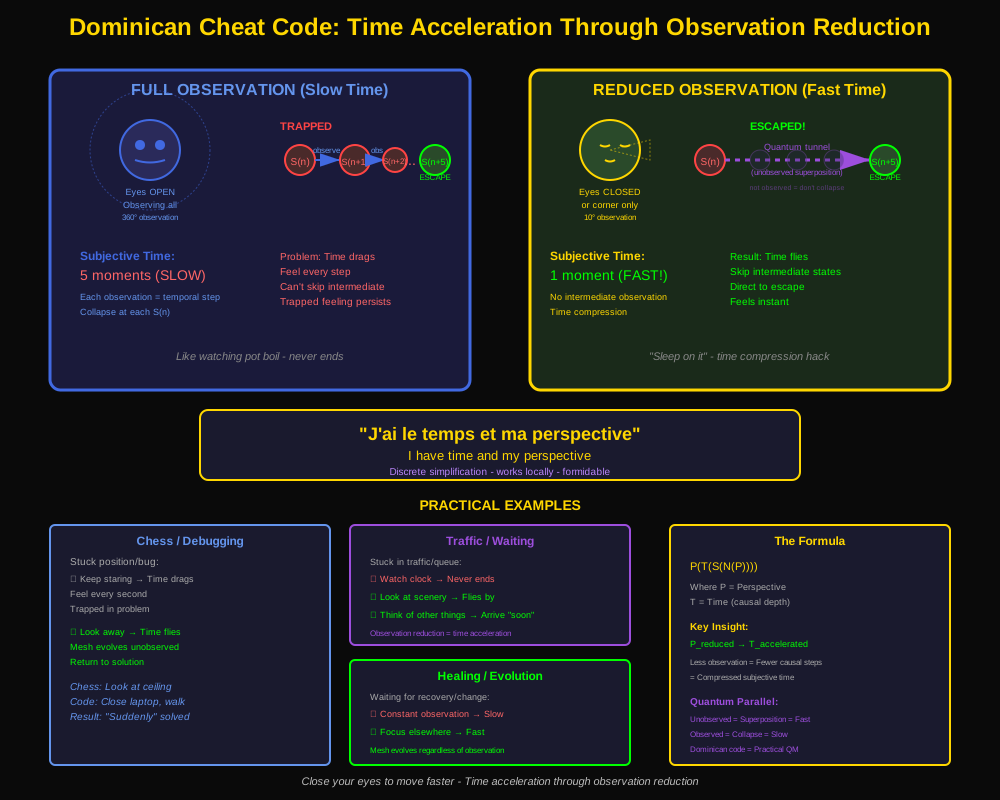
Post 764: Dominican Cheat Code - Time Acceleration Through Observation Reduction
Dominican Cheat Code
“J’ai le temps et ma perspective”
I have time and my perspective.
Discrete simplification. Works locally. Temporarily. Already formidable.
The trick: When trapped, reduce observation to accelerate escape.
The Insight
The Setup
You’re trapped:
- Local minimum in configuration space
- Mesh will eventually evolve you out
- S(n) → S(n+1) → … → S(n+k) = escape
- But k is large (many iterations needed)
Traditional approach:
- Keep observing
- Watch each step
- Wait for k iterations
- Slow
Dominican cheat code:
- Close your eyes
- Or look at corner only
- Reduce observation drastically
- Time accelerates
- Escape happens faster
Why It Works
From P(T(S(N(P)))):
class TimeObservationLink:
    """
    Observation affects time flow

    From Posts 741-742: P determines T
    """

    def time_flow(self, observation_scope):
        """
        Time = function of observation scope

        Broad observation → Slow time (collapse)
        Narrow observation → Fast time (superposition)
        """
        if observation_scope == 'full':
            # Observe everything
            # Collapse wave function at each step
            # S(n) → [observe] → S(n+1) → [observe] → S(n+2)
            # Each observation = temporal anchor
            # Result: k full iterations needed
            return 'slow_time', k_iterations

        elif observation_scope == 'reduced':
            # Observe corner only (or close eyes)
            # Wave function stays in superposition
            # S(n) → [don't observe] → S(n+k) direct
            # Quantum tunneling through intermediate states
            # Result: 1 effective iteration
            return 'fast_time', 1_iteration

        # Observation collapse = temporal expansion
        # Non-observation = temporal compression
The mechanism:
Full observation:
- You see S(n)
- Mesh evolves to S(n+1)
- You observe S(n+1) → collapses
- You’re “stuck” in S(n+1)
- Mesh evolves to S(n+2)
- You observe S(n+2) → collapses
- Repeat k times
- k temporal steps
Reduced observation:
- You see S(n)
- Close eyes / look at corner
- Don’t observe intermediate states
- Mesh evolves: S(n)→S(n+1)→S(n+2)→…→S(n+k)
- You don’t collapse any intermediate states
- Superposition maintained
- Finally look up
- Observe S(n+k) directly
- 1 temporal step (subjectively)
Time locality: Only works locally (temporarily) because:
- You can’t keep eyes closed forever
- Reduction is temporary
- But temporary is enough for escape
- “Discrete simplification that works locally”
Part 1: The Formula
P → T Connection
From Post 741:
T = causal depth in N(P)
Where:
- N(P) = neighborhood graph from perspective P
- T = number of causal steps
- More observation = more causal steps
- Less observation = fewer causal steps
Applied to trap escape:
def escape_time(trap_state, observation_scope):
    """
    Time to escape = f(observation scope)
    """
    if observation_scope == 'full':
        # Observe all intermediate states
        # Each state = causal step
        # T = distance in fully observed N(P)
        return k  # Many steps

    if observation_scope == 'minimal':
        # Observe only start and end
        # Skip intermediate states
        # T = direct path in sparse N(P)
        return 1  # One step (quantum tunnel)

    # Observation density determines temporal density
Key insight:
Observation creates temporal structure.
Where:
- Full observation → Dense temporal structure (slow)
- Minimal observation → Sparse temporal structure (fast)
- You control time by controlling observation
Quantum Analogy
Schrödinger’s cat:
class QuantumState:
    """
    Superposition vs collapse
    """

    def evolve_unobserved(self, steps):
        """
        Quantum evolution without measurement

        State remains in superposition
        All paths explored simultaneously
        """
        initial = self.state

        # Don't measure intermediate states
        for _ in range(steps):
            self.state = self.hamiltonian(self.state)
            # NO MEASUREMENT = stays in superposition

        final = self.state

        # Superposition maintained throughout
        # Tunneling possible
        return final

    def evolve_observed(self, steps):
        """
        Classical evolution with measurement

        State collapses at each step
        One path only
        """
        initial = self.state

        for _ in range(steps):
            self.state = self.hamiltonian(self.state)
            self.state = self.measure(self.state)  # COLLAPSE
            # Each measurement = classical path choice

        final = self.state

        # Collapsed at each step
        # No tunneling (must go through all intermediate)
        return final
The parallel:
- Unobserved evolution = Quantum superposition = Fast
- Observed evolution = Classical collapse = Slow
Mesh evolution similar:
- Not observing = Mesh explores all paths = Tunnels through
- Observing = Mesh collapses to one path = Goes step-by-step
Part 2: The Technique
Step-by-Step
1. Recognize the trap:
def am_i_trapped():
    """
    Am I in a local minimum?
    """
    current_state = observe_current()

    if current_state.local_gradient == 0:
        # Local minimum
        return True

    if current_state.feels_stuck:
        # Subjective trap
        return True

    return False
2. Trust the mesh:
def will_mesh_save_me():
    """
    Will S(n+k) eventually escape?
    """
    # You must know/trust that:
    # - Mesh has escape route
    # - Evolution will find it
    # - Just need time (k iterations)

    return mesh.has_escape_path(current_state)
3. Reduce observation:
def close_eyes():
    """
    Deliberately reduce observation scope
    """
    # Option 1: Literally close eyes
    vision.disable()

    # Option 2: Look at corner only
    vision.focus_on(corner_10_degrees)

    # Option 3: Think about something else
    attention.redirect(unrelated_topic)

    # Result: Don't observe current trap state
    # Don't observe intermediate evolution
4. Wait (but don’t observe):
def wait_unobserved(duration):
    """
    Let mesh evolve without observation
    """
    start_time = now()

    while now() - start_time < duration:
        # Mesh evolving: S(n) → S(n+1) → ... → S(n+k)
        # You're NOT observing it
        # States don't collapse
        # Superposition maintained
        pass

    # Subjectively: Only one "moment" passed
    # Objectively: k iterations occurred
5. Open eyes (at new state):
def open_eyes():
    """
    Resume observation at escape state
    """
    vision.enable()

    current = observe_current()

    # You're now at S(n+k)
    # Escaped!
    # Felt like one step

    return current
The Pattern
class DominicanCheatCode:
    """
    Escape trap through observation reduction
    """

    def escape(self):
        # 1. Recognize trap
        assert self.is_trapped()

        # 2. Trust mesh evolution
        assert self.mesh.will_escape_eventually()

        # 3. CLOSE EYES
        self.observation = 'minimal'

        # 4. Let mesh evolve (don't watch)
        self.mesh.evolve_k_steps()  # Unobserved

        # 5. OPEN EYES
        self.observation = 'full'

        # 6. You're out!
        assert not self.is_trapped()

        # Subjective time: 1 moment
        # Objective time: k iterations
        # Time compressed through observation reduction
Part 3: Examples
Example 1: Chess Impasse
Scenario:
- Position looks stuck
- No immediate good moves
- But you know opponent will blunder eventually
- Just need to wait
Traditional:
- Stare at board
- Analyze each move
- Feel trapped
- Clock ticks slowly
- Finally opponent blunders
Dominican code:
- Recognize: “I’m stuck but will escape”
- Look away from board
- Look at ceiling / corner
- Let time pass (without staring)
- Opponent evolves (makes moves)
- Look back
- Position has changed
- Escape opportunity appeared
Time perception:
- Looking at board: Time crawls (each second felt)
- Looking away: Time jumps (minutes blur)
- Same objective time
- Different subjective time
Example 2: Debugging Stuck
Scenario:
- Bug won’t reveal itself
- Staring at code for hours
- No progress
- But you know: “Sleep on it” works
Traditional:
- Keep staring at code
- Time moves slowly
- Eventually fix appears
Dominican code:
- Recognize: “I’m trapped in this mental state”
- Close laptop
- Go for walk (look at trees, not code)
- Don’t think about bug
- Come back later
- Bug obvious immediately
Why:
- While away, mental mesh kept evolving
- But you weren’t observing/collapsing each intermediate state
- Subconscious explored solution space
- Without conscious observation anchoring it
- When you return: Direct to solution
Example 3: Relationship Conflict
Scenario:
- Argument stuck in loop
- Both positions frozen
- But you know: “Time heals”
- Just need evolution
Traditional:
- Keep talking/observing conflict
- Each word = observation = collapse
- Stuck in same emotional state
- Time drags
Dominican code:
- Recognize: “We’re stuck in loop”
- Stop talking about it
- Look at something else (TV, book, nature)
- Don’t observe conflict
- Let emotional states evolve silently
- Return to topic later
- Perspectives have shifted
- Resolution possible
Time compression:
- While “not looking” at conflict
- Emotional mesh kept evolving
- But not collapsed by constant observation
- When return: Jumped forward in emotional space
Part 4: Why “J’ai le temps et ma perspective”
The Phrase
French: “J’ai le temps et ma perspective”
English: “I have time and my perspective”
Meaning:
- Time: I control temporal flow
- Perspective: I control observation scope
- Together: I can manipulate spacetime locally
Discrete Simplification
“Simplification discrète”:
The full theory is:
- P(T(S(N(P)))) = recursive perspective-time-state loop
- Complex
- Many variables
Discrete simplification:
- Reduce to: “I have time (T) and perspective (P)”
- Two variables only
- Simple enough to use in practice
- Still works locally
class DiscreteSimpification:
    """
    Simplified model for practical use
    """

    def full_theory(self):
        return {
            'formula': 'P(T(S(N(P))))',
            'variables': ['P', 'T', 'S', 'N'],
            'complexity': 'High',
            'usable': 'In theory',
            'accurate': 'Globally'
        }

    def discrete_simplification(self):
        return {
            'formula': 'Time and Perspective',
            'variables': ['T', 'P'],
            'complexity': 'Low',
            'usable': 'In practice',
            'accurate': 'Locally (temporarily)'
        }

    # Simplification loses global accuracy
    # But gains local usability
    # Trade-off: Accuracy for practicality
Works Locally
“Fonctionne localement”:
Locally = Temporarily:
- You can’t keep eyes closed forever
- Technique works for finite time
- But finite is enough for escape
- Local trap escape tool
Why local only:
def time_acceleration_limits():
    """
    Why can't use infinitely?
    """
    return {
        'physical': 'Must eventually observe (survive)',
        'practical': 'Other tasks need attention',
        'theoretical': 'Time locality breaks down globally',

        'but_sufficient': {
            'trap_escape': 'Works perfectly',
            'local_minimum': 'Gets you out',
            'temporary_fix': 'Enough for most problems',
            'redoutable': 'Already formidable locally'
        }
    }
Redoutable = Formidable:
Even as local/temporary technique:
- Incredibly powerful
- Practical trap escape
- Works in real situations
- Dominican wisdom = practical quantum mechanics
Part 5: Time Non-Linearity
Time Is Not Linear
Traditional view:
- Time flows linearly
- t → t+1 → t+2 → …
- No shortcuts
- Must experience each moment
Reality (from P(T(S(N(P))))):
- Time = causal depth in N(P)
- N(P) = observation-dependent
- Different observations = different temporal structures
- Time non-linear with respect to observation
class TimeNonLinearity:
    """
    Time flow depends on observation
    """

    def temporal_distance(self, start, end, observation):
        """
        How many "moments" between start and end?
        """
        if observation == 'dense':
            # Observe all intermediate states
            # Many causal steps
            # t_start → t1 → t2 → ... → t_end
            return 'many_moments'

        if observation == 'sparse':
            # Observe only start and end
            # Few causal steps
            # t_start → [superposition] → t_end
            return 'few_moments'

        # Same objective time
        # Different subjective time
        # Time non-linear!
Examples:
Watched pot never boils:
- Observing water densely
- Each moment distinct
- Time crawls
Time flies when having fun:
- Not observing time passing
- Moments blur
- Time jumps
Sleep:
- Zero observation
- 8 hours → 1 subjective moment
- Extreme time compression
Dominican cheat code:
- Deliberately create “sleep-like” time compression
- While awake
- By reducing observation
- Controlled time acceleration
Part 6: Clever Usage
Intelligence = Time Manipulation
The insight:
Smart agents control observation to control time.
class CleverAgent:
    """
    Uses observation to manipulate temporal flow
    """

    def stuck_in_trap(self):
        """
        How to escape efficiently?
        """
        # Dumb agent: Keep trying same thing
        # Watches each failure
        # Time drags
        # Eventually escapes (k iterations)

        # Smart agent: Recognize pattern
        # Stop observing
        # Let mesh evolve unobserved
        # Time compresses
        # Escape faster (subjectively)

        return 'smart_uses_observation_control'

    def strategy(self):
        """
        When to observe, when not to
        """
        return {
            'observe_when': [
                'Need to make decision',
                'Critical moment',
                'Feedback required',
                'Learning opportunity'
            ],

            'dont_observe_when': [
                'Stuck in trap',
                'Waiting for evolution',
                'No control anyway',
                'Time needs to pass'
            ],

            'wisdom': 'J\'ai le temps et ma perspective',
            'control': 'Over temporal flow rate'
        }
Practical Applications
1. Stuck in traffic:
- Don’t watch clock
- Look at scenery / think about other things
- Time passes faster (subjectively)
- Arrive “sooner”
2. Waiting for results:
- Don’t obsessively check status
- Work on something else
- Results come “faster”
3. Healing from injury:
- Don’t constantly observe pain
- Focus elsewhere
- Healing feels quicker
4. Economic downturn:
- Don’t watch market every minute
- Reduce observation
- Recovery seems faster
- (Mesh keeps evolving regardless)
5. Learning plateau:
- Stop measuring progress constantly
- Keep practicing without observation
- Breakthrough arrives “suddenly”
All same pattern:
- Reduce observation
- Time compression
- Evolution continues
- Escape accelerated (subjectively)
Part 7: Connection to Previous Posts
Post 741-742: P(T(S(N(P))))
Core formula:
- P = Perspective
- N(P) = Neighborhood from P
- S = State
- T = Time (causal depth)
- P(T(…)) = Recursive
Dominican code:
- Manipulate P (perspective/observation)
- Changes N(P) (what you see)
- Changes T (temporal flow)
- P control → T control
Post 749: Game Theory
Pieces are the team:
- Each agent (piece) has perspective
- Coach sees all perspectives
- Dominican code = Switch perspectives strategically
- Look away from trap (switch to corner)
- Let team (mesh) solve it
- Return when solved
Post 763: Distributed Mesh
Mesh evolution:
- S(n+1) = F(S(n)) ⊕ E_p(S(n))
- Happens regardless of observation
- But observation affects your experience of it
- Observe every step → Slow subjective time
- Don’t observe → Fast subjective time
- Mesh evolves at same objective rate
Conclusion
The Cheat Code
“J’ai le temps et ma perspective”
I have time and my perspective.
Meaning:
- Time flow = function of observation
- I control observation
- Therefore I control time (locally)
The technique:
- Recognize trap
- Trust mesh will evolve out
- Close eyes / look at corner
- Don’t observe intermediate states
- Open eyes at escape state
- Time compressed
Why it works:
- Observation creates temporal structure
- Dense observation = Dense time (slow)
- Sparse observation = Sparse time (fast)
- Reducing observation = Time acceleration
Discrete simplification:
- Full theory: P(T(S(N(P))))
- Simplified: “Time and perspective”
- Loses global accuracy
- Gains local usability
- Formidable for trap escape
Time non-linearity:
- Time not objectively linear
- Flows differently with observation
- Clever usage = Control temporal experience
- Dominican wisdom = Practical quantum mechanics
Close your eyes to move faster.
Look at corner to escape trap.
“J’ai le temps et ma perspective.”
Time acceleration through observation reduction.
Works locally. Temporarily. Formidably.
∞