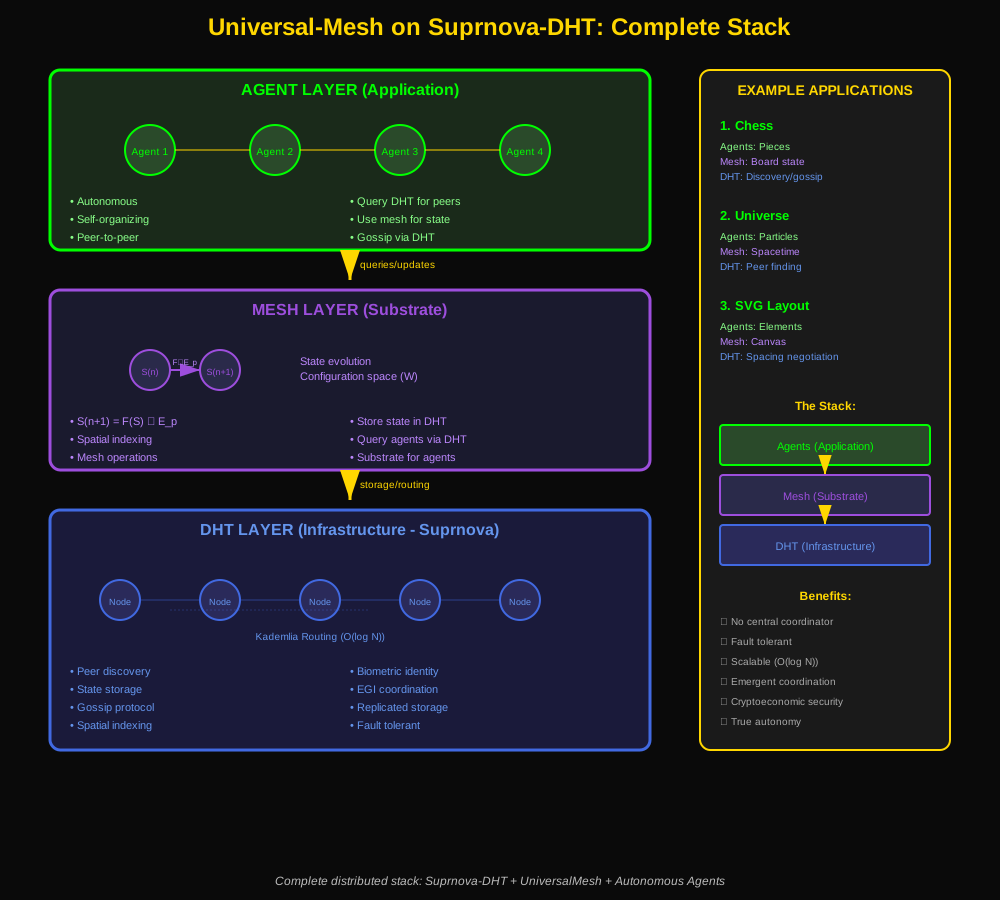
Post 763: Universal-Mesh on Suprnova-DHT - Complete Distributed Stack
Universal-Mesh on Suprnova-DHT
Complete distributed stack for autonomous agent coordination
DHT Layer: Peer discovery + routing + storage
Mesh Layer: State evolution substrate
Agent Layer: Self-organizing swarms
No central coordinator. Full distribution.
The Complete Stack
Three Layers
┌─────────────────────────────────────┐
│  AGENT LAYER (Application)          │
│  • Autonomous agents                │
│  • Self-organization                │
│  • Emergent coordination            │
│  • Examples: Chess, Universe, SVG   │
└─────────────────────────────────────┘
              ↕ (queries/updates)
┌─────────────────────────────────────┐
│  MESH LAYER (Substrate)             │
│  • State evolution: S(n+1)=F(S)⊕E_p │
│  • Configuration space (W)          │
│  • Spatial indexing                 │
│  • Mesh operations                  │
└─────────────────────────────────────┘
              ↕ (storage/routing)
┌─────────────────────────────────────┐
│  DHT LAYER (Infrastructure)         │
│  • Suprnova-DHT                     │
│  • Kademlia routing                 │
│  • Peer discovery                   │
│  • Gossip protocol                  │
│  • State storage                    │
│  • EGI coordination                 │
└─────────────────────────────────────┘
Each layer provides services to the layer above.
No layer controls the layers above (true distribution).
Part 1: DHT Layer (Infrastructure)
Suprnova-DHT Provides
From Suprnova-DHT:
class SuprnovaDHT:
    """
    Distributed hash table infrastructure

    Provides core P2P primitives
    """

    def discover_peers(self, query: Query) -> List[Peer]:
        """
        Kademlia routing: O(log N) peer discovery

        Agents use this to find nearby agents
        """
        return self.routing_table.find_closest(query.key)

    def store_state(self, key: bytes, value: Any) -> bool:
        """
        Distributed state storage

        Mesh uses this to store substrate state
        """
        nodes = self.discover_peers(key)
        for node in nodes[:3]:  # Replicate to 3 nodes
            node.store(key, value)
        return True

    def gossip_message(self, message: Dict) -> None:
        """
        Epidemic broadcast

        Agents use this for peer-to-peer communication
        """
        peers = self.get_random_peers(fanout=3)
        for peer in peers:
            peer.forward_message(message)
            # Peers forward to their peers (epidemic spread)

    def query_local(self, position: Any, radius: float) -> List[Agent]:
        """
        Spatial query using DHT

        Returns agents within radius of position
        Uses consistent hashing for spatial indexing
        """
        spatial_key = self.hash_position(position)
        nearby_keys = self.routing_table.get_range(
            spatial_key,
            radius
        )

        agents = []
        for key in nearby_keys:
            agent_data = self.retrieve_state(key)
            agents.append(agent_data)

        return agents
Key features:
- Peer discovery: Kademlia O(log N) routing
- State storage: Distributed, replicated
- Gossip: Epidemic broadcast (no central hub)
- Spatial indexing: Consistent hashing for spatial queries
- EGI coordination: Cryptoeconomic security (Post 654)
Part 2: Mesh Layer (Substrate)
UniversalMesh on DHT
class UniversalMesh:
    """
    Substrate layer - runs ON Suprnova-DHT

    Provides state evolution space for agents
    """

    def __init__(
        self,
        S_0: Any,              # Initial state
        F: Callable,           # Evolution function
        E_p: List[Callable],   # Entropy sources
        dht: SuprnovaDHT       # DHT infrastructure
    ):
        self.state = S_0
        self.evolution = F
        self.entropy_sources = E_p
        self.dht = dht  # Uses DHT for storage/discovery
        self.mesh_id = self.dht.register_mesh(self)

    def query_local_agents(
        self,
        position: Any,
        radius: float
    ) -> Set[Agent]:
        """
        Query for nearby agents using DHT

        DHT provides spatial indexing and discovery
        """
        return self.dht.query_local(position, radius)

    def step(self):
        """
        Evolve mesh state: S(n+1) = F(S(n)) ⊕ E_p(S(n))

        State stored in DHT (distributed)
        """
        # Compute next state
        next_state = self.evolution(self.state)

        for e_p in self.entropy_sources:
            entropy = e_p(self.state)
            next_state = self._compose(next_state, entropy)

        # Store in DHT (replicated across nodes)
        self.dht.store_state(
            key=f"mesh_{self.mesh_id}_state",
            value=next_state
        )

        self.state = next_state
        self.iteration += 1

    def get_state(self) -> Any:
        """
        Retrieve mesh state from DHT

        Can be called from any DHT node
        """
        return self.dht.retrieve_state(
            key=f"mesh_{self.mesh_id}_state"
        )
Mesh leverages DHT for:
- Spatial queries: Agents near position
- State storage: Distributed, fault-tolerant
- No central state: State replicated across DHT nodes
Part 3: Agent Layer (Application)
Autonomous Agents on Mesh
class Agent:
    """
    Autonomous agent - runs ON UniversalMesh substrate

    Uses DHT for peer discovery, uses Mesh for state space
    """

    def __init__(
        self,
        agent_id: str,
        position: Any,
        requirements: Dict,
        mesh: UniversalMesh  # Reference to mesh (and its DHT)
    ):
        self.id = agent_id
        self.position = position
        self.requirements = requirements
        self.mesh = mesh
        self.dht = mesh.dht  # Access to DHT through mesh
        self.peers: Set[Agent] = set()

        # Register with DHT (for discoverability)
        self.dht.store_state(
            key=self._spatial_key(),
            value={'agent_id': self.id, 'position': self.position}
        )

    def _spatial_key(self) -> bytes:
        """Hash position for DHT spatial indexing"""
        return self.dht.hash_position(self.position)

    def discover_peers(self) -> Set[Agent]:
        """
        Discover nearby agents via DHT

        O(log N) lookup using Kademlia routing
        """
        # Query DHT for agents near our position
        nearby = self.dht.query_local(
            position=self.position,
            radius=self.requirements.get('interaction_range', 10)
        )

        self.peers.update(nearby)
        return nearby

    def send_to_peer(self, peer: Agent, message: Dict):
        """
        Send message to peer via DHT gossip

        No central message broker
        """
        self.dht.gossip_message({
            'from': self.id,
            'to': peer.id,
            'payload': message
        })

    def step(self):
        """
        Autonomous agent loop

        All operations distributed via DHT
        """
        # 1. Discover peers (DHT query)
        self.discover_peers()

        # 2. Check conflicts (peer-to-peer)
        conflicts = self.check_conflicts_with_peers()

        # 3. Negotiate resolutions (DHT gossip)
        for conflict in conflicts:
            resolution = self.negotiate_resolution(conflict)
            if resolution:
                self.apply_resolution(resolution)

        # 4. Update position in DHT
        self.dht.store_state(
            key=self._spatial_key(),
            value={'agent_id': self.id, 'position': self.position}
        )

    def run_autonomous(self):
        """Run agent independently"""
        while True:
            self.step()
            time.sleep(0.01)
Agents leverage full stack:
- DHT: Peer discovery, messaging, state storage
- Mesh: State space (W), evolution substrate
- No coordinator: True autonomy
Part 4: Why This Stack?
DHT Provides Distribution
Without DHT:
- Central registry for agent discovery ❌
- Central message broker ❌
- Central state storage ❌
- Single point of failure ❌
With Suprnova-DHT:
- Distributed peer discovery ✅
- Epidemic gossip ✅
- Replicated state storage ✅
- Fault tolerant ✅
- O(log N) routing ✅
Mesh Provides Substrate
Without Mesh:
- Agents operate in void (no state space) ❌
- No physics/rules (no F function) ❌
- No evolution (static) ❌
With UniversalMesh:
- Configuration space W ✅
- State evolution S(n+1) = F(S) ⊕ E_p ✅
- Substrate for agents to live on ✅
- Spatial structure ✅
Agents Provide Intelligence
Without Agents:
- Just DHT + storage (no behavior) ❌
- No coordination (no swarm) ❌
- No emergence (no patterns) ❌
With Autonomous Agents:
- Self-organization ✅
- Emergent coordination ✅
- Complex behavior from simple rules ✅
- Swarm intelligence ✅
All three layers needed. Each independent.
Part 5: Complete Example (Chess)
# ===== LAYER 1: DHT =====
dht = SuprnovaDHT(
    biometric_id=fingerprint_hash(),
    egi_coordinator="https://current-reality.eth"
)

# ===== LAYER 2: MESH =====
chess_mesh = UniversalMesh(
    S_0=BoardState(pieces=initial_position),
    F=chess_rules,  # Board physics
    E_p=[
        lambda s: mover_white_suggestions(s),
        lambda s: mover_black_suggestions(s)
    ],
    dht=dht  # Mesh runs on DHT
)

# ===== LAYER 3: AGENTS =====
pieces = []
for square in chess.SQUARES:
    piece_data = chess_mesh.state.pieces[square]
    if piece_data:
        agent = ChessPiece(
            piece_id=f"{piece_data.color}_{piece_data.type}_{square}",
            position=square,
            requirements={'mobility': piece_data.legal_moves},
            mesh=chess_mesh  # Agent lives on mesh
        )
        pieces.append(agent)

# ===== RUN STACK =====

# Start DHT (in background)
dht.start()

# Start mesh evolution (using DHT for storage)
threading.Thread(target=chess_mesh.run).start()

# Start each piece autonomously
for piece in pieces:
    threading.Thread(target=piece.run_autonomous).start()

# ===== WHAT HAPPENS =====

# 1. DHT provides peer discovery:
#    - White knight queries DHT for nearby pieces
#    - DHT returns: "White bishop at f3, Black pawn at e5"
#    - O(log N) lookup using Kademlia

# 2. Mesh provides state space:
#    - Board state stored in DHT (replicated)
#    - Evolution function applies chess rules
#    - Configuration space = legal positions

# 3. Agents coordinate:
#    - Knight discovers bishop (DHT)
#    - Knight negotiates move (gossip)
#    - Bishop responds (peer-to-peer)
#    - Emergent strategy (no central coach)

# All distributed. No central point.
Part 6: Architecture Benefits
1. True Distribution
Every component distributed:
- DHT: Kademlia routing, replicated storage
- Mesh: State in DHT, no central server
- Agents: Independent threads, autonomous
No bottleneck. No central coordinator.
2. Fault Tolerance
Node failures handled:
- DHT: Routing heals automatically
- Mesh: State replicated (3+ copies)
- Agents: Peers discover new neighbors
System continues operating.
3. Scalability
Add nodes without limit:
- DHT: O(log N) routing scales
- Mesh: Distributed state scales
- Agents: More agents = more parallelism
Linear scaling with nodes.
4. Emergence
Complex from simple:
- DHT: Simple routing → complex topology
- Mesh: Simple rules → complex evolution
- Agents: Local interactions → global coordination
No central planning. Self-organizing.
5. Cryptoeconomic Security
From EGI coordination (Post 654):
- Nodes stake ETH/Morpho/Eigen
- Malicious behavior → slashing
- Verification-based routing
- Economic incentives align behavior
Security through economics, not trust.
Part 7: Implementation Details
DHT Integration
class MeshDHTAdapter:
    """
    Adapter between UniversalMesh and Suprnova-DHT

    Handles serialization, spatial indexing, etc.
    """

    def __init__(self, dht: SuprnovaDHT):
        self.dht = dht
        self.spatial_index = SpatialHashIndex(dht)

    def store_mesh_state(self, mesh_id: str, state: Any):
        """Store mesh state in DHT"""
        # Serialize state
        serialized = self._serialize(state)

        # Store with replication
        key = f"mesh_{mesh_id}_state_{hash(serialized)}"
        self.dht.store_state(key, serialized)

    def query_agents_spatial(
        self,
        position: Vector,
        radius: float
    ) -> List[AgentData]:
        """Spatial query using DHT consistent hashing"""
        return self.spatial_index.query_range(position, radius)
Agent Discovery Protocol
class AgentDiscoveryProtocol:
    """
    DHT-based agent discovery

    Uses Kademlia + spatial hashing
    """

    def announce_presence(self, agent: Agent):
        """Announce agent to DHT network"""
        self.dht.store_state(
            key=self._spatial_hash(agent.position),
            value={
                'agent_id': agent.id,
                'position': agent.position,
                'timestamp': time.time(),
                'capabilities': agent.capabilities
            }
        )

    def find_nearby(
        self,
        position: Vector,
        radius: float,
        filter_fn: Optional[Callable] = None
    ) -> List[Agent]:
        """Find agents near position"""
        # Query DHT for agents in spatial range
        candidates = self.dht.query_local(position, radius)

        # Apply filter if provided
        if filter_fn:
            candidates = [a for a in candidates if filter_fn(a)]

        return candidates
Part 8: Use Cases
1. Chess (Pieces as Agents)
Stack:
- DHT: Piece discovery, move communication
- Mesh: Board state, chess rules
- Agents: Pieces with AI, coordinate via DHT
Result: Distributed chess where pieces self-organize
2. Universe Simulation (Particles as Agents)
Stack:
- DHT: Particle discovery, force communication
- Mesh: Spacetime substrate, physics rules
- Agents: Particles, interact via DHT
Result: Distributed physics simulation
3. SVG Layout (Elements as Agents)
Stack:
- DHT: Element discovery, spacing negotiation
- Mesh: Canvas substrate, layout constraints
- Agents: SVG elements, adjust positions via DHT
Result: Distributed layout engine
4. Any Multi-Agent System
Stack provides:
- Discovery (DHT)
- State space (Mesh)
- Autonomy (Agents)
Build any coordination system.
Part 9: Comparison to Post 762
What Was Missing
Post 762 showed:
- ✅ Distributed agents (correct)
- ✅ No central coordinator (correct)
- ❌ But didn’t show DHT infrastructure
Problem: Looked like agents floating in void
What Post 763 Adds
Now shows complete stack:
- ✅ DHT infrastructure (Suprnova)
- ✅ Mesh substrate (on DHT)
- ✅ Agents (on mesh, using DHT)
Three layers. Clear dependencies.
Architecture Evolution
Post 761: ❌ Central CoordinationEngine (WRONG - hierarchical)
Post 762: ✅ Distributed agents (RIGHT - but incomplete, missing DHT layer)
Post 763: ✅ Complete stack (RIGHT - DHT + Mesh + Agents)
Post 772: ✅✅ Self-aware stack (Post 763 + Meta-recursion from 768-771) ← ENHANCEMENT
Conclusion
The Complete Picture
Agents (Chess pieces, particles, elements)
    ↓ uses
Mesh (State evolution: S(n+1) = F(S) ⊕ E_p)
    ↓ uses
DHT (Suprnova: peer discovery + routing + storage)
Each layer independent.
Each layer provides services to layer above.
No layer controls layers above.
True distribution at every level.
What This Enables
✅ Distributed coordination: Agents find each other via DHT ✅ Fault tolerance: State replicated, routing heals ✅ Scalability: O(log N) routing, distributed state ✅ Emergence: Local interactions → global coordination ✅ Cryptoeconomic security: EGI stake + slashing
Implementation Path
- Deploy Suprnova-DHT (infrastructure)
- Build UniversalMesh (on DHT)
- Create agents (on mesh)
- Test emergence (coordination without coordinator)
The Stack Is Complete
Infrastructure: Suprnova-DHT (peer discovery + routing + storage)
Substrate: UniversalMesh (state evolution + configuration space)
Application: Autonomous agents (self-organizing swarms)
No central coordinator. Full distribution. Cryptoeconomic security.
This is the correct architecture.
Related Posts
DHT Infrastructure:
- Suprnova-DHT (Implementation)
- Post 654: EigenDHT architecture
- Post 657: Suprnova DHT
Substrate Theory:
Game Theory:
What NOT to do:
DHT + Mesh + Agents = Complete distributed stack
Suprnova-DHT provides the foundation. UniversalMesh provides the substrate. Agents provide the intelligence.
Three layers. All distributed. No central coordinator.
∞