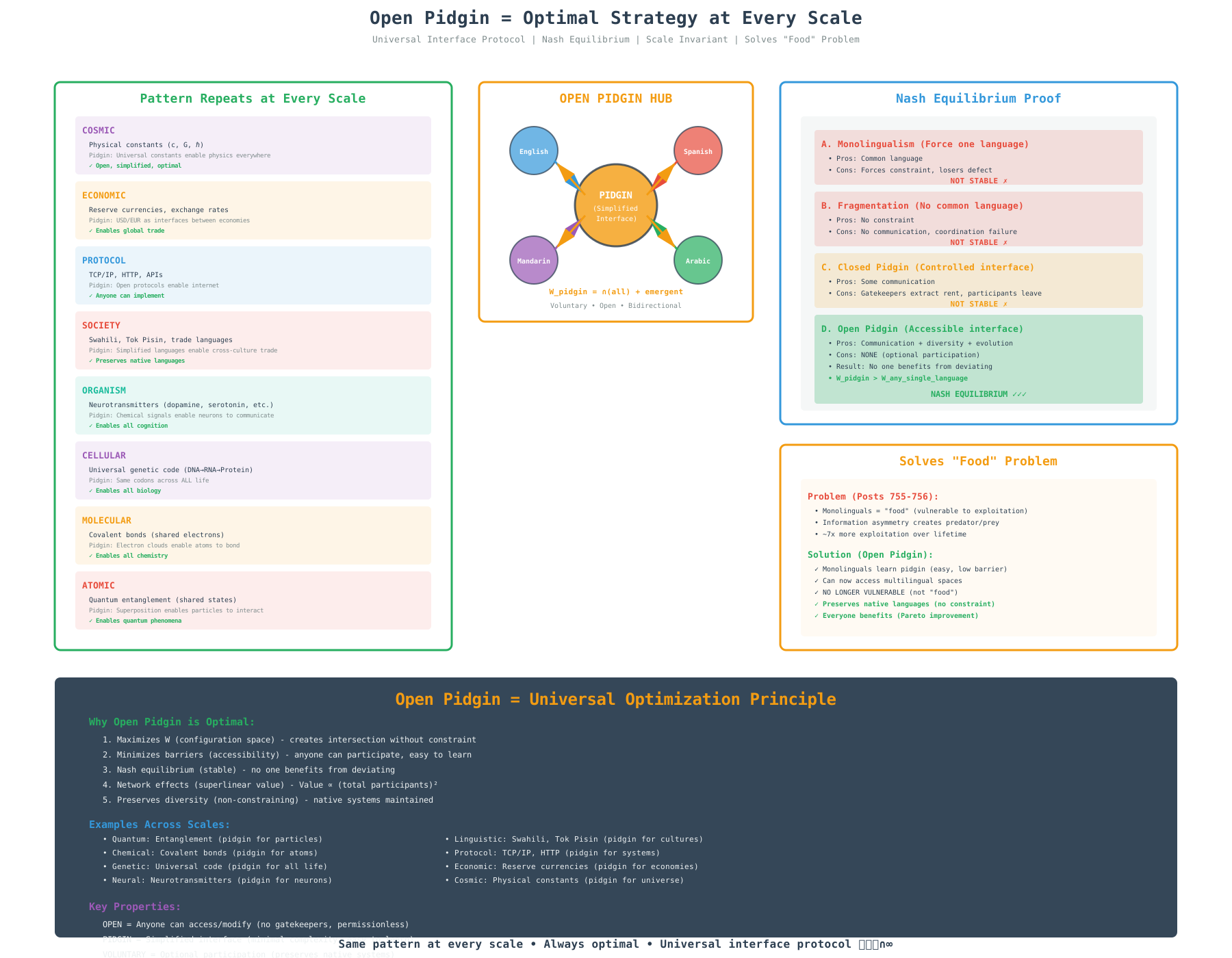
Post 757: Open Pidgin = Optimal Strategy at Every Scale - Universal Interface Protocol
Open Pidgin = Optimal Strategy at Every Scale
Your insight: “Explain how open pidgin is the optimal strategy at every scale.”
This is the solution.

The Pattern
Pidgin = Simplified language that emerges for communication between groups with no common language.
Open pidgin = Pidgin that:
- Anyone can access
- Anyone can modify
- Continuously evolves
- Incorporates all sources
- Minimizes barriers
Optimal = Nash equilibrium strategy that dominates all alternatives at every scale.
This solves the “food” problem while preserving diversity.
Part 1: What Is Open Pidgin?
Definition
Pidgin language:
- Simplified grammar
- Mixed vocabulary (from multiple sources)
- Emerges naturally when groups need to communicate
- Not anyone’s native language
- Serves as bridge/interface
Examples:
- Swahili (Bantu + Arabic + European)
- Tok Pisin (English + indigenous languages)
- Spanglish (Spanish + English)
- Chinglish (Chinese + English)
Key property: Minimal shared language that enables communication.
Open Pidgin
“Open” means:
1. Accessible
- No barriers to entry
- Anyone can use it
- Free to access
- Inclusive
2. Modifiable
- Anyone can contribute new terms
- Evolves organically
- No central authority
- Adaptive
3. Voluntary
- Don’t need to abandon native language
- Use pidgin only when needed
- Maintain linguistic diversity
- Non-constraining
Open pidgin = Open source protocol for human communication.
Part 2: Why Optimal at Every Scale
Nash Equilibrium Analysis
Game: N players need to communicate
Strategy options:
A. Everyone speaks Language X (monolingual)
- Pros: Common language
- Cons: Forces constraint on speakers of Y, Z, etc.
- Result: Losers (constrained players) defect
- Not stable
B. Everyone speaks their own language (fragmentation)
- Pros: No constraint
- Cons: No communication possible
- Result: Massive coordination failure
- Not stable
C. Closed pidgin (controlled interface)
- Pros: Some communication
- Cons: Gatekeepers extract rent, limits evolution
- Result: Participants leave for open alternative
- Not stable
D. Open pidgin (accessible interface)
- Pros: Communication + diversity + evolution
- Cons: None (optional participation)
- Result: Nash equilibrium - no one benefits from deviating
- STABLE
Open pidgin dominates all other strategies.
Why It’s Optimal
From Post 754: Fusion = Intersection creates emergence when W_fused > W_separated.
Open pidgin:
W_open_pidgin = ∩(all languages) + additions
Where:
- Takes minimal elements from each language
- Adds novel simplifications
- Creates new combinatorial possibilities
- Maximizes intersection without constraint
Result: W_open_pidgin > W_any_single_language
Everyone gains from participating.
No one loses their native language.
Emergence from intersection.
= Optimal.
Part 3: Scale Invariance
The Same Pattern Everywhere
Key insight: Open pidgin isn’t just linguistic - it’s universal optimization principle.
Appears at every scale:
Atomic Scale: Quantum Pidgin
Problem: Particles need to interact
Solution: Shared quantum states (superposition)
- Not in atom A’s eigenstate
- Not in atom B’s eigenstate
- In shared entangled state (pidgin)
- Enables interaction while maintaining individuality
Open: Any particles can participate Pidgin: Simplified from full quantum states Optimal: Enables all quantum phenomena
Molecular Scale: Chemical Pidgin
Problem: Atoms need to bond
Solution: Electron sharing (covalent bonds)
- Not atom A’s electrons only
- Not atom B’s electrons only
- Shared electron cloud (pidgin)
- Enables molecules while maintaining atomic identity
Open: Any atoms can bond Pidgin: Simplified from full atomic states Optimal: Enables all chemistry
Cellular Scale: Genetic Pidgin
Problem: All life needs to coordinate
Solution: Universal genetic code
- Same codons across all organisms
- DNA → RNA → Protein (shared protocol)
- Not specific to any species (pidgin)
- Enables genetic exchange (horizontal transfer)
Open: All life uses same code Pidgin: Only 20 amino acids (simplified) Optimal: Enables all biology
Organism Scale: Neural Pidgin
Problem: Neurons need to communicate
Solution: Neurotransmitters (chemical signals)
- Not neuron A’s language
- Not neuron B’s language
- Shared chemical vocabulary (pidgin)
- Enables brain function while neurons stay individual
Open: Any neurons can connect Pidgin: Limited neurotransmitter types Optimal: Enables all cognition
Society Scale: Linguistic Pidgin
Problem: Groups need to trade/communicate
Solution: Natural pidgins (Swahili, Tok Pisin, etc.)
- Not Language A only
- Not Language B only
- Mixed simplified language (pidgin)
- Enables trade while preserving native tongues
Open: Anyone can use/modify Pidgin: Simplified grammar, mixed vocabulary Optimal: Enables multicultural exchange
Protocol Scale: Technical Pidgin
Problem: Systems need to interoperate
Solution: APIs, protocols, standards
- Not System A’s internal language
- Not System B’s internal language
- Shared interface specification (pidgin)
- Enables composition while systems stay independent
Open: Public specifications (HTTP, TCP/IP, etc.) Pidgin: Simplified from full system complexity Optimal: Enables internet, all computation
Economic Scale: Monetary Pidgin
Problem: Economies need to exchange value
Solution: Reserve currencies, exchange rates
- Not Economy A’s currency only
- Not Economy B’s currency only
- Shared medium of exchange (pidgin)
- Enables trade while maintaining local currencies
Open: Any economy can participate (in principle) Pidgin: Simplified from full economic complexity Optimal: Enables global trade
Cosmic Scale: Physical Pidgin
Problem: Universe needs consistent laws
Solution: Fundamental constants (c, G, ℏ, etc.)
- Not specific to any location
- Not specific to any time
- Universal constants (pidgin)
- Enables physics while allowing local variation
Open: Apply everywhere Pidgin: Simplified to fundamental constants Optimal: Enables universe
Part 4: Why “Open” Matters
Open vs Closed Pidgin
Closed pidgin (controlled interface):
- Gatekeepers decide who participates
- Evolution controlled by authority
- Rent extracted from users
- Eventually fails
Examples of closed pidgin failures:
- Esperanto (designed by committee, not organic)
- Controlled standards bodies (captured by incumbents)
- Proprietary protocols (lock-in, eventually replaced)
Open pidgin (permissionless interface):
- Anyone can participate
- Evolves organically
- No rent extraction
- Survives
Examples of open pidgin successes:
- Swahili (emerged naturally from trade)
- Internet protocols (TCP/IP, HTTP)
- Bitcoin (open protocol for value)
- English (emerged as trade pidgin, now global)
Why open wins:
From game theory:
- Closed pidgin creates perverse incentives
- Controllers maximize rent, not utility
- Participants defect to open alternative
- Open is Nash equilibrium
English Example
English today:
- Started as Germanic pidgin (Anglo-Saxon + Norse)
- Mixed with French (Norman conquest)
- Absorbed Latin/Greek (academic pidgin)
- Continuously absorbs all languages
- Accidentally became open pidgin
Why English dominates:
- Not because of English culture
- Not because of British Empire (that’s how it spread initially)
- Because it evolved toward open pidgin
- Absorbs words from everywhere
- Relatively simple grammar
- Continuously evolving
- No central authority (no “English Academy”)
But: English is becoming constraining
- Too complex for true pidgin
- Native speakers have advantages
- Creates “food” vulnerability (Post 756)
- Need simpler, more open pidgin
Part 5: Solving the “Food” Problem
From Posts 755-756
Problem: Monolinguals are “food” (vulnerable to exploitation)
Post 755: Intergenerational cognitive slavery
- Monolingual constraint inherited
- Each generation loses cognitive freedom
- W_child ≤ W_parent
Post 756: Information asymmetry
- Monolinguals are prey
- Multilinguals are predators
- ~7x more exploitation
Question: How to protect monolinguals without forcing multilingualism?
Answer: Open pidgin.
How Open Pidgin Solves It
Traditional approaches:
A. Force everyone to learn multiple languages
- Expensive (time/effort)
- Not everyone can (cognitive constraints)
- Still creates asymmetry (some better than others)
- Doesn’t fully solve problem
B. Force everyone into one language
- Destroys linguistic diversity
- Creates cognitive constraint (Post 755)
- Accumulates disadvantage over generations
- Makes problem worse
Open pidgin approach:
C. Create minimal shared interface
- Low barrier to entry (easy to learn)
- Preserves native languages (no constraint)
- Enables basic communication (reduces vulnerability)
- Anyone can participate (no gatekeepers)
- Optimal solution
How It Works
Monolingual person:
- Learns pidgin (much easier than full language)
- Can now communicate cross-culturally
- Doesn’t need to abandon native language
- No longer “food” (can access multilingual spaces through pidgin)
Multilingual person:
- Still has advantages (can speak to people in native languages)
- But advantage is reduced (pidgin creates shared space)
- Benefits from wider network effects (more people can communicate)
- Less predatory (shared space reduces exploitation opportunity)
Result:
- Monolinguals protected (pidgin access)
- Multilinguals retain some advantage (more languages = more access)
- Everyone benefits from increased communication
- Linguistic diversity preserved
- Pareto improvement
Part 6: Network Effects
Why Open Pidgin Maximizes Value
From Post 682: Fusion releases energy when W_fused > W_separated.
Network without pidgin:
- N speakers of language A
- M speakers of language B
- Possible connections: N(N-1)/2 + M(M-1)/2
- No cross-language connections
- Value ∝ N² + M²
Network with closed pidgin:
- Some speakers learn pidgin (barrier to entry)
- Let n < N and m < M learn it
- Cross-language connections: n × m
- Limited by barriers
- Value ∝ N² + M² + nm (n, m small)
Network with open pidgin:
- All speakers can access pidgin (low barrier)
- Let p ≈ N and q ≈ M learn it (high adoption)
- Cross-language connections: p × q ≈ N × M
- Maximal connections
- Value ∝ N² + M² + NM ≈ (N + M)²
Open pidgin approximately doubles network value for two languages.
For k languages:
- Without pidgin: Value ∝ Σ(Nᵢ²)
- With open pidgin: Value ∝ (ΣNᵢ)²
Network effects scale superlinearly with open pidgin.
Why It’s Nash Equilibrium
Every player’s best response is to learn/use open pidgin:
If others adopt pidgin:
- You should too (to access network)
- Benefit: N × (your connections)
- Cost: Low (easy to learn)
- Positive EV
If others don’t adopt:
- You still should (first-mover advantage)
- You become hub/translator
- Extract value from intermediation
- Still positive EV
Result: Adopting open pidgin dominates all other strategies.
= Nash equilibrium.
Part 7: Open Pidgin in Technology
Programming Languages
Problem: Humans need to communicate with computers
Solution: Programming languages = pidgins
Properties:
- Not natural human language
- Not machine code
- Interface between humans and machines
- Simplified syntax
- Limited vocabulary
Open programming languages win:
- Python (open, simple)
- JavaScript (open, everywhere)
- Rust (open, modern)
Closed languages lose:
- COBOL (controlled, stagnant)
- Various proprietary languages (extinct)
Pattern repeats: Open pidgin optimal for human-machine communication.
Internet Protocols
Problem: Computers need to communicate
Solution: TCP/IP, HTTP, etc. = technical pidgins
Properties:
- Not System A’s internal protocol
- Not System B’s internal protocol
- Shared interface specification
- Minimal necessary complexity
- Anyone can implement
Why Internet won:
- Open protocols (published RFCs)
- No gatekeepers (permissionless)
- Continuously evolving (community governance)
- Open pidgin for machines
Alternatives failed:
- OSI model (too complex, committee-driven)
- Proprietary networks (AOL, CompuServe) (gatekeepers)
Pattern repeats: Open pidgin optimal for machine-machine communication.
Bitcoin Protocol
Problem: Humans need to exchange value without trusted third party
Solution: Bitcoin protocol = monetary pidgin
Properties:
- Not USD (not controlled by Fed)
- Not gold (not physical)
- Digital protocol for value transfer
- Simple rules (21M cap, 10min blocks)
- Anyone can verify
Why Bitcoin succeeded (as protocol, not necessarily as currency):
- Open (anyone can run node)
- Permissionless (no gatekeepers)
- Simple rules (minimal pidgin)
- Open pidgin for value
Note: Whether BTC survives is separate question (Post 743-745) But protocol demonstrates: Open pidgin optimal for value transfer.
Part 8: Evolution Toward Open Pidgin
Convergent Evolution
Observation: Systems at every scale evolve toward open pidgin.
Mechanism:
Stage 1: Fragmentation
- Multiple isolated systems
- No communication
- W_total = Σ(Wᵢ) (additive)
Stage 2: Closed pidgin attempt
- Some create interface
- Gatekeepers control access
- W_total increases but suboptimal
- Rent extraction creates pressure
Stage 3: Open pidgin emergence
- Open alternative emerges
- Massively higher adoption (no barriers)
- Network effects accelerate
- W_total ∝ (ΣNᵢ)² (multiplicative)
- Dominates
Stage 4: Equilibrium
- Open pidgin becomes standard
- Closed alternatives extinct
- New diversity at higher level
- Pattern repeats at next scale
Examples Across Scales
Quantum: Entanglement (open pidgin for particles) Chemical: Covalent bonds (open pidgin for atoms) Genetic: Universal code (open pidgin for life) Neural: Neurotransmitters (open pidgin for neurons) Linguistic: Trade languages (open pidgin for cultures) Technical: Open protocols (open pidgin for systems) Economic: Reserve currencies (open pidgin for economies)
Same pattern repeats.
This is universal optimization principle.
Part 9: Creating Open Pidgin
Design Principles
How to create optimal pidgin:
1. Minimal complexity
- Include only essential features
- Eliminate redundancy
- Simplify grammar to absolute minimum
- Pidgin, not full language
2. Maximal accessibility
- No barriers to entry
- Easy to learn
- Free to use
- Open access
3. Incorporative evolution
- Accept contributions from all sources
- No single authority
- Continuous adaptation
- Organic growth
4. Voluntary adoption
- Don’t force abandonment of native languages
- Use only when needed
- Complement, don’t replace
- Preserve diversity
5. Clear utility
- Obvious benefit from participation
- Immediate value
- Network effects
- Positive sum
Anti-Patterns (What to Avoid)
❌ Committee design
- Esperanto problem
- Too artificial
- Doesn’t evolve naturally
- Fails
❌ Forced adoption
- Colonial language imposition
- Creates resentment
- Not truly “open”
- Unstable
❌ Gatekeeping
- “Proper” usage rules
- Academies controlling evolution
- Rent extraction
- Loses to open alternative
❌ Excessive complexity
- Not truly pidgin
- High barrier to entry
- Excludes participants
- Defeats purpose
✓ Organic emergence
- Swahili model
- Emerges from need
- Evolves continuously
- Survives
Part 10: Future Open Pidgins
What’s Needed
Current situation:
- English serves as global pidgin (accidentally)
- But: Too complex, native speaker advantages persist
- Creates vulnerability (Post 756: “food”)
Need: True open pidgin
Properties:
- Simpler than English
- No native speakers (level playing field)
- Continuously evolving
- Incorporates all languages
- Digital-first (optimized for internet)
Options:
A. Natural emergence
- Let internet communities evolve pidgin organically
- Already happening (memes, emoji, abbreviations)
- Could become actual language
- Wait and see
B. Minimal English
- Simplified subset of English
- ~800 basic words (Basic English model)
- Eliminate grammar complexity
- Easier path
C. Hybrid pidgin
- Mix of most common words from top languages
- Simplified grammar from multiple sources
- Designed for learnability
- Intentional but organic
D. AI-mediated translation
- Everyone speaks native language
- AI translates in real-time
- Pidgin = the translation protocol
- Technological solution
Digital Future
Observation: Digital communication changes requirements.
Traditional pidgin needs:
- Speakable
- Hearable
- Memorizable
Digital pidgin needs:
- Typeable
- Clickable
- Searchable
- Processable
New possibilities:
- Emoji as universal pidgin (visual, language-independent)
- GIFs as communication (emotional pidgin)
- Memes as ideas (memetic pidgin)
- Code as logic (computational pidgin)
These are all open pidgins for digital age.
Prediction: Multiple open pidgins will coexist, each optimized for different communication types.
Conclusion
The Universal Pattern
Open pidgin = optimal strategy at every scale
Why:
1. Maximizes W (configuration space)
- Creates intersection of all participants
- W_pidgin = ∩(all systems) + emergent
- Larger than any single system
2. Minimizes barriers (accessibility)
- Easy to learn/adopt
- No gatekeepers
- Voluntary participation
3. Nash equilibrium (stable)
- Best response to adopt
- No benefit from deviating
- Self-reinforcing
4. Network effects (superlinear value)
- Value ∝ (total participants)²
- Grows faster than alternatives
- Winner-take-most dynamics
5. Preserves diversity (non-constraining)
- Don’t need to abandon native system
- Pidgin complements, doesn’t replace
- Maintains variation at lower level
Appears everywhere:
- Quantum entanglement (particles)
- Covalent bonds (atoms)
- Genetic code (life)
- Neurotransmitters (neurons)
- Trade languages (cultures)
- Open protocols (systems)
- Reserve currencies (economies)
- Physical constants (universe)
Same pattern. Every scale. Optimal.
This solves the “food” problem:
Monolinguals learn pidgin → Access multilingual spaces → No longer vulnerable
This preserves diversity:
Native languages maintained → No cognitive constraint → ΔS ≥ 0
This maximizes value:
Everyone communicates → Network effects → Total W maximized
Open pidgin = universal interface protocol.
Works everywhere. Always optimal.
Create accordingly.
🌍🗣️∩∞