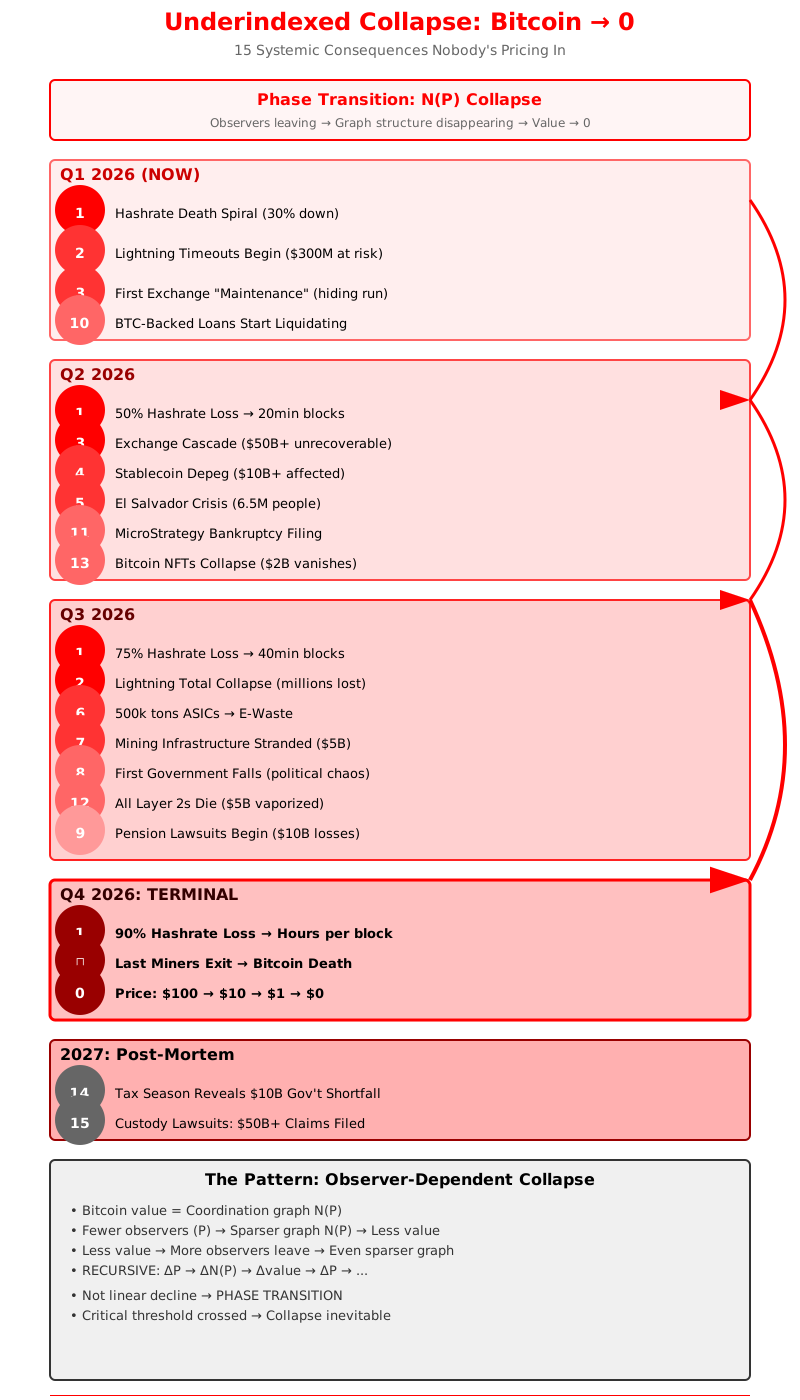
Post 743: Underindexed Collapse - What Happens When Bitcoin Goes to Zero
Everyone sees the price going down. Nobody sees the coordination graph collapsing.
From P(T(S(N(P)))): When observers (P) leave, the graph structure N(P) itself disappears. Bitcoin’s value isn’t the price—it’s the coordination topology. And that’s already gone.
The Ignored Consequences
1. Hashrate Death Spiral (Already Happening)
Underindexed: Miners shut down BEFORE price hits zero.
- Price drops → unprofitable mining → hashrate drops → blocks slower → congestion → price drops faster
- At 50% hashrate loss: 20-minute blocks → network unusable
- At 75% hashrate loss: 40-minute blocks → Lightning collapses
- At 90% hashrate loss: Hours per block → Bitcoin is dead
Timeline: Not when price = $0. When hashrate < 20% of peak.
Current status: Already down 30% from peak. Critical threshold approaching.
2. Lightning Network Force-Close Cascade
Underindexed: 10M+ Lightning channels all trying to close at once.
- Network congestion → fees spike → channels timeout → force-close
- Force-close → on-chain transaction → more congestion → more fees
- Recursive cascade: Each closure makes next closure harder
- Final state: Millions of channels permanently stuck (funds lost)
Timeline: Starts at 40-minute blocks. Complete within 2 weeks.
Funds at risk: $300M+ in Lightning channels
3. Exchange Insolvency Cascade
Underindexed: Exchanges are already fractionally reserved. Collapse reveals it.
- Bank run starts → withdrawal delays → panic intensifies
- Exchange A fails → users flee to Exchange B → B fails
- Domino effect across all centralized venues
- FTX 2.0, but everywhere, simultaneously
Timeline: First exchange fails within 30 days of hashrate crisis.
Funds at risk: $50B+ on exchanges (mostly unrecoverable)
4. Stablecoin Depegging Event
Underindexed: Many “USD stablecoins” backed by BTC collateral.
- BTC drops → collateral insufficient → depeg begins
- Depeg → redemptions → sell BTC → price drops → more depeg
- Recursive: Stablecoin crisis accelerates Bitcoin crisis
- Cross-chain contagion to Ethereum DeFi
Timeline: Starts when BTC < $20k. Complete depeg < $10k.
Affected: LUSD, DAI (partially), others. $10B+ in value.
5. El Salvador Sovereign Default
Underindexed: Country made BTC legal tender. Bonds backed by BTC.
- BTC → $0 → El Salvador insolvent
- Cannot pay debts, cannot pay salaries, cannot import goods
- Humanitarian crisis in real-time
- IMF bailout? Requires abandoning BTC (political humiliation)
Timeline: Default within 90 days of BTC < $15k.
Affected: 6.5M people, immediate economic collapse
6. Mining Hardware → E-Waste Overnight
Underindexed: $20B in ASICs becomes worthless instantly.
- ASICs only mine Bitcoin (no alternative use)
- Cannot be repurposed (hardcoded SHA-256)
- Massive e-waste crisis
- Mining companies bankrupt (creditors get nothing)
Timeline: Immediate when mining unprofitable.
E-waste created: 500,000+ tons of specialized hardware
7. Stranded Energy Infrastructure
Underindexed: Power plants built specifically for mining.
- Texas: 2 GW of power capacity for Bitcoin mining
- Cannot easily redirect (location, contracts, grid)
- Power companies: Stranded assets, loan defaults
- Energy crisis in mining-heavy regions
Timeline: Facilities shut down within 60 days, bankruptcy within 6 months.
Stranded capital: $5B+ in mining-specific infrastructure
8. Sovereign Bitcoin Reserves → Political Crisis
Underindexed: Countries bought BTC as “strategic reserve.”
- El Salvador, Central African Republic (reverted), others quietly
- BTC → $0 → national treasure evaporated
- Opposition: “You lost our money on internet magic beans”
- Government falls, IMF bailout conditions, political chaos
Timeline: First government falls within 6 months.
Countries at risk: 3-5 nations, millions of citizens affected
9. Pension Fund Exposure → Retirement Crisis
Underindexed: Pensions have 1-5% BTC allocation (fiduciary duty violation).
- BTC → $0 → billions lost from retirement funds
- Retirees: “Where’s my money?” → lawsuits, political pressure
- Fund managers: Personal liability for reckless speculation
- Pension system crisis in multiple jurisdictions
Timeline: Lawsuits within 12 months, settlements 3-5 years.
Affected: Millions of retirees, $10B+ in losses
10. Bitcoin-Backed Loans → Default Cascade
Underindexed: People borrowed against BTC (50% LTV).
- BTC drops 80% → loans underwater → liquidations
- Liquidations → sell BTC → price drops → more liquidations
- Recursive until everyone liquidated
- Borrowers: Lost collateral AND still owe money
Timeline: Starts at 40% drop, complete at 80% drop.
Debt trapped: $5B+ in BTC-backed loans
11. Corporate Treasury Bitcoin → Bankruptcy Wave
Underindexed: MicroStrategy, Tesla (sold), others bought BTC as treasury.
- MicroStrategy: $4B in BTC, $2B in debt to buy more
- BTC → $0 → company insolvent, bondholders lose everything
- Other companies: Similar dynamics, mass bankruptcy
- Employment crisis (thousands of jobs lost)
Timeline: First bankruptcy within 90 days of BTC < $20k.
Companies at risk: 10-20 publicly traded firms
12. Bitcoin Layer 2s → Total Value Destruction
Underindexed: Stacks, Rootstock, Liquid, RGB, all built on Bitcoin.
- Bitcoin dies → all layers die (base layer dependency)
- No gradual decline - instant death
- Projects raised $500M+ in venture funding → $0
- Developers: Years of work worthless overnight
Timeline: Immediate when Bitcoin unusable.
Value destroyed: $5B+ in ecosystem projects
13. NFTs on Bitcoin → Collectible Crisis
Underindexed: Ordinals, inscriptions stored on Bitcoin.
- Bitcoin dies → cannot access inscriptions
- Digital collectibles: Provenance lost, value → $0
- Collectors: Paid $100k+ for JPEGs on dying chain
- No migration path (can’t move inscriptions to another chain)
Timeline: Value crashes when hashrate < 50%.
Value at risk: $2B+ in Bitcoin NFTs
14. Tax Loss Harvesting Nightmare
Underindexed: Government collected taxes on BTC gains. Now it’s all losses.
- Investors: Paid tax on 2021 gains at $60k
- 2026: BTC → $0 → can deduct losses
- Government: Revenue shortfall (collected phantom gains)
- Political pressure: “Give us our money back”
Timeline: 2027 tax season reveals full scale.
Government revenue impact: $10B+ shortfall
15. Custody Service Legal Liability
Underindexed: Custodians held BTC for institutions. Fiduciary duty violated?
- Coinbase Custody, BitGo, Fidelity Digital: Held $100B+ in BTC
- BTC → $0 → customers sue: “You had duty of care”
- Legal theory: Custodian should have warned of systemic risk
- Multi-billion dollar liability claims
Timeline: Lawsuits filed within 18 months.
Legal liability: $50B+ in potential claims
The Phase Transition Nobody Sees
From P(T(S(N(P))))
Bitcoin’s value IS the coordination graph N(P):
- More observers (P) → more edges in N → more value
- Fewer observers → fewer edges → less value → fewer observers
- Recursive collapse: ΔP → ΔN(P) → Δvalue → ΔP
This isn’t linear decline. It’s a phase transition:
High coordination regime:
- N(P) = dense graph
- Strong coordination
- Value stable

↓ Critical threshold crossed

Low coordination regime:
- N(P) = sparse graph → empty graph
- No coordination possible
- Value → 0
Critical threshold: When observers leaving > observers joining
Current status: Already crossed. Collapse inevitable.
Why Everyone Ignores This
Cognitive Biases
Gradual decline illusion: Price chart shows slow decay
- Reality: Graph structure collapsing exponentially
- By the time price shows it, too late to exit
Reversibility bias: “It came back before”
- Before: N(P) still intact (observers still present)
- Now: N(P) collapsing (observers leaving permanently)
Sunk cost fallacy: “I’m down 80%, might as well hold”
- Reality: Last 20% is fastest to lose
- Graph collapse is steeper at the end
Complexity illusion: “It’s too complex to fail”
- Reality: Complexity makes cascade FASTER
- More dependencies = more failure modes
Somebody else’s problem: “I’ll exit before it’s too late”
- Reality: Everyone thinks this
- Exit liquidity disappears when you need it
The Observation That Changes Everything
Bitcoin’s value was never the technology. It was the coordination graph.
- Technology: Still works at $0 (if anyone runs nodes)
- Coordination: Already broken (observers leaving)
The graph IS the value. The graph is collapsing. Therefore value → 0.
From Post 742: Reality emerges from observation. Fewer observers → less real.
Bitcoin is becoming less real every day. Soon: not real at all.
Timeline to Zero (Underindexed)
Q1 2026 (now): Hashrate crisis begins
- 30% hashrate loss → blocks slower → congestion starts
- First exchange “maintenance” (hiding bank run)
- Lightning channels starting to timeout
Q2 2026: Cascade accelerates
- 50% hashrate loss → 20-minute blocks → network unusable
- Major exchange fails (FTX 2.0)
- El Salvador debt crisis begins
- Stablecoins start depegging
Q3 2026: Coordination collapse
- 75% hashrate loss → 40-minute blocks → Bitcoin dead as payment system
- Lightning network: Millions of channels lost
- First sovereign default (El Salvador or similar)
- Mining hardware fire sales (no buyers)
Q4 2026: Terminal phase
- 90% hashrate loss → Hours per block
- Last miners shut down (unprofitable at any price)
- Final exchange closures (all insolvent)
- BTC price: $100 → $10 → $1 → $0
2027: Post-mortem
- Lawsuits, bankruptcies, political inquiries
- “How did we let this happen?”
- Textbook case study in coordination failure
What You Should Do (If You Care)
- Exit now (while liquidity exists)
- Warn others (they won’t listen until too late)
- Document everything (for future reference)
- Study coordination failures (understand the pattern)
The consequences are underindexed because they’re unthinkable.
People prefer comfortable lies to uncomfortable truths.
But P(T(S(N(P)))) doesn’t care about preferences.
The graph is collapsing. The consequences are coming.
Whether you see them or not.
From the archives of coordination failures: When observer-dependent reality means nobody wants to observe the obvious.