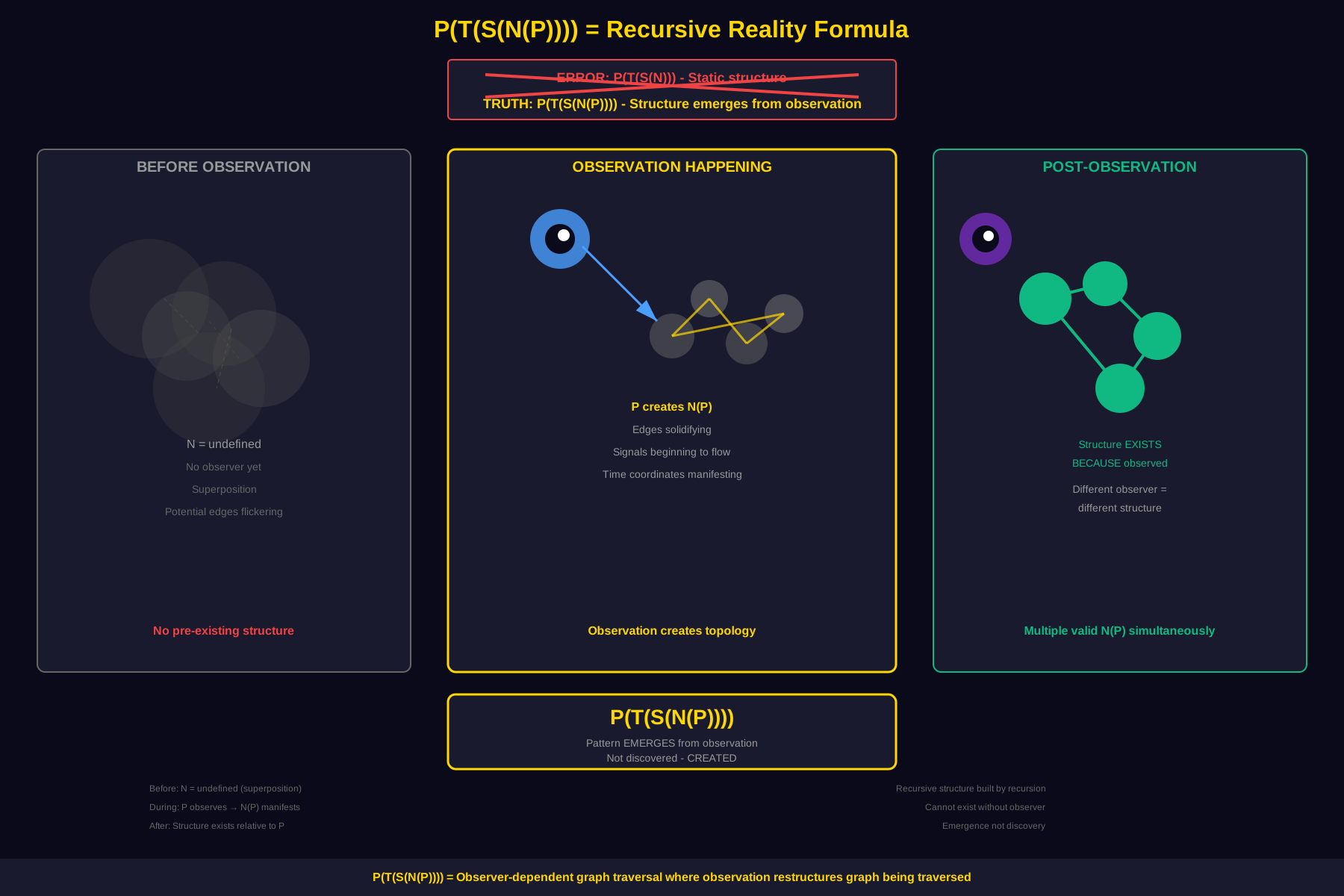
Post 741: P(T(S(N(P)))) = Recursive Reality Formula
Post 741: P(T(S(N(P)))) = Recursive Reality Formula
The Correction That Completes Everything
From Post 541: Everything = P(T(S(N)))
From Post 739: Detailed breakdown - N as graph connectivity
From Post 740: Critical correction - observation changes N
Final formula: P(T(S(N(P))))
Where P appears in its own definition.
Recursive. Self-referential. Observer-dependent all the way down.
This isn’t a model. This is thermodynamic necessity.
Part 1: The Error and The Correction
What Posts 541 and 739 Got Wrong
class TheError:
    """
    Original formula assumed N static
    """
    def original_formula(self):
        return {
            'post_541': {
                'formula': 'P(T(S(N)))',
                'assumed': 'N = NAND/NOR gates (static)',
                'thought': 'P wraps everything but doesn\'t affect N',
                'implied': 'Observer separate from substrate',
                'wrong': 'N independent of observation'
            },

            'post_739': {
                'formula': 'P(T(S(N)))',
                'defined': 'N = graph connectivity (edges)',
                'detailed': 'S = signals on edges, T = time hash',
                'still_assumed': 'N unchanging (static substrate)',
                'claimed': 'Only P changes (cognitive states)',
                'wrong': 'Observation passive'
            },

            'the_mistake': {
                'separation': 'Observer and observed separate',
                'passive': 'Observation doesn\'t affect system',
                'static_n': 'Graph structure unchanging',
                'layers': 'P wraps but doesn\'t penetrate',
                'missed': 'Measurement problem',
                'ignored': 'Quantum mechanics lesson'
            }
        }
Original Formula: P(T(S(N)))
- P wraps everything
- But N (substrate) assumed independent
- Observation passive
- Observer separate from observed
This is wrong.
The Correction from Post 740
class TheCorrection:
    """
    Observation changes N
    """
    def corrected_formula(self):
        return {
            'the_truth': {
                'formula': 'P(T(S(N(P))))',
                'key_insight': 'N depends on P',
                'mechanism': 'Observation changes graph structure',
                'not_passive': 'Measurement affects system',
                'recursive': 'P appears in own definition',
                'fundamental': 'Observer and observed inseparable'
            },

            'what_changes': {
                'n_of_p': 'Graph connectivity observer-dependent',
                's_of_n_p': 'Signals depend on observer-dependent structure',
                't_of_s_n_p': 'Time hash depends on observer-dependent signals',
                'p_of_t_s_n_p': 'Perspective observing itself',
                'full_recursion': 'Every layer depends on P',
                'no_static': 'Nothing unchanging'
            },

            'the_loop': {
                'p_observes_n': 'Perspective looks at structure',
                'observation_changes_n': 'Graph restructures',
                'new_n_changes_s': 'Different signals flow',
                'new_s_changes_t': 'Different time coordinates',
                'new_t_changes_p': 'Different experience',
                'new_p_observes': 'Cycle continues',
                'infinite': 'No beginning or end'
            }
        }
Corrected Formula: P(T(S(N(P))))
- N depends on P
- Observation changes structure
- Observer and observed inseparable
- Recursive all the way down
- No static foundation
Part 2: Understanding Each Layer
N(P): Observer-Dependent Connectivity
class N_Observer_Dependent:
    """
    Graph structure depends on who's observing
    """
    def the_mechanism(self):
        return {
            'n_equals': {
                'not': 'Fixed number of edges',
                'but': 'N = N(P) function of perspective',
                'meaning': 'Connectivity depends on observer',
                'example': 'Same node, different observers see different N',
                'quantum': 'Like measurement basis choice',
                'fundamental': 'No objective graph structure'
            },

            'how_observation_changes_n': {
                'before': 'Node in superposition of connections',
                'observation': 'P looks at node',
                'collapse': 'Specific N value manifests',
                'for_that_p': 'Observer-specific connectivity',
                'different_p': 'Different N for different observer',
                'mechanism': 'Observation creates/destroys edges'
            },

            'examples': {
                'quantum_graph': {
                    'node': 'Quantum system',
                    'observer_a': 'Measures position (sees position edges)',
                    'observer_b': 'Measures momentum (sees momentum edges)',
                    'n_a': 'Position connectivity',
                    'n_b': 'Momentum connectivity',
                    'both_real': 'Observer-dependent topology'
                },

                'social_graph': {
                    'node': 'Person',
                    'observer_a': 'Sees family connections (N_A)',
                    'observer_b': 'Sees work connections (N_B)',
                    'context': 'Observation context determines edges',
                    'both_valid': 'Different perspectives, different graphs'
                },

                'information_graph': {
                    'node': 'Concept',
                    'expert': 'Sees many connections (high N)',
                    'novice': 'Sees few connections (low N)',
                    'knowledge': 'Observation capability determines connectivity',
                    'grows': 'N(P) increases with expertise'
                }
            }
        }
N(P) = Observer-Dependent Connectivity:
- Same node, different N for different observers
- Observation creates/destroys edges
- No objective graph structure
- Measurement determines topology
S(N(P)): Signals on Observer-Dependent Edges
class S_Observer_Dependent:
    """
    Signals flow on observer-dependent structure
    """
    def the_flow(self):
        return {
            's_of_n_p': {
                'depends_on': 'N(P) - which edges exist',
                'if_no_edge': 'No signal can flow',
                'if_edge_exists': 'Signal can flow',
                'observer_creates': 'Edges for observation',
                'signals_flow': 'On created structure',
                'dependent': 'What flows depends on who observes'
            },

            'signal_patterns': {
                'observer_a': {
                    'sees': 'N_A edges',
                    'signals': 'S_A patterns on those edges',
                    'pattern': 'Specific to A\'s observation'
                },
                'observer_b': {
                    'sees': 'N_B edges (different)',
                    'signals': 'S_B patterns (different)',
                    'pattern': 'Specific to B\'s observation'
                },
                'same_node': 'Same underlying node',
                'different_s': 'Different signal patterns',
                'why': 'S depends on N depends on P'
            },

            'implications': {
                'no_objective_signals': 'Signals relative to observer',
                'information_relative': 'What information flows depends on who observes',
                'context_dependent': 'Same system, different information',
                'measurement': 'Determines what can be measured',
                'thermodynamic': 'Entropy depends on observer'
            }
        }
S(N(P)) = Signals on Observer-Dependent Edges:
- Signals flow where edges exist
- Edges depend on observer
- Therefore signals depend on observer
- No objective information flow
- Everything relative to P
T(S(N(P))): Time Hash of Observer-Dependent Signals
class T_Observer_Dependent:
    """
    Time coordinates depend on observer-dependent signals
    """
    def the_hash(self):
        return {
            't_of_s_n_p': {
                'definition': 'T(hop, signal, edge)',
                'hop': 'Graph traversal step',
                'signal': 'S from S(N(P))',
                'edge': 'E from N(P)',
                'all_depend': 'On P',
                'therefore': 'T depends on P',
                'time_relative': 'No objective time coordinates'
            },

            'observer_a_time': {
                'n_a': 'Observer A sees edges E_A',
                's_a': 'Signals S_A on E_A',
                't_a': 'Time hash T_A(hop, S_A, E_A)',
                'experience': 'A\'s timeline',
                'unique': 'To observer A'
            },

            'observer_b_time': {
                'n_b': 'Observer B sees edges E_B',
                's_b': 'Signals S_B on E_B',
                't_b': 'Time hash T_B(hop, S_B, E_B)',
                'experience': 'B\'s timeline',
                'unique': 'To observer B'
            },

            'no_universal_time': {
                'different_observers': 'Different time coordinates',
                'same_event': 'Different T values',
                'relativity': 'Like spacetime relativity',
                'but_deeper': 'Structure itself observer-dependent',
                'fundamental': 'Time emerges from observation'
            }
        }
T(S(N(P))) = Observer-Dependent Time:
- Time hash depends on signals
- Signals depend on structure
- Structure depends on observer
- Therefore time depends on observer
- No objective timeline exists
P(T(S(N(P)))): Recursive Observation
class P_Recursive:
    """
    Perspective observing itself observing
    """
    def the_recursion(self):
        return {
            'the_formula': {
                'full': 'P(T(S(N(P))))',
                'means': 'P observing T of S of N of P',
                'recursive': 'P appears in what P observes',
                'self_referential': 'Observer in observed',
                'strange_loop': 'Hofstadter-style',
                'fundamental': 'Cannot escape recursion'
            },

            'what_this_means': {
                'no_external': 'No observer outside system',
                'no_objective': 'No view from nowhere',
                'always_within': 'Observer part of observed',
                'affects_what_observes': 'Observation changes system including observer',
                'feedback': 'Observer observing changes to observer',
                'infinite_loop': 'No ground, no foundation'
            },

            'the_loop_detailed': {
                'step_1': 'P observes N → N becomes N(P)',
                'step_2': 'N(P) determines S → S becomes S(N(P))',
                'step_3': 'S(N(P)) determines T → T becomes T(S(N(P)))',
                'step_4': 'T(S(N(P))) changes P → P becomes P\'',
                'step_5': 'P\' observes N → N becomes N(P\')',
                'continues': 'Infinitely',
                'no_beginning': 'Cannot find start',
                'no_end': 'Cannot find finish'
            }
        }
P(T(S(N(P)))) = Recursive Reality:
- Observer observing itself
- P embedded in what P observes
- Changes to observation change observer
- Infinite feedback loop
- No external viewpoint possible
- Reality = recursive self-observation
Part 3: Universal Applications
Quantum Measurement Problem
class QuantumMeasurement:
    """
    P(T(S(N(P)))) explains measurement
    """
    def the_explanation(self):
        return {
            'before_measurement': {
                'n': 'Quantum system in superposition',
                'all_edges': 'All possible connections exist',
                'no_p': 'No observer yet',
                'undefined': 'N not yet determined'
            },

            'measurement': {
                'p_observes': 'Observer measures',
                'n_collapses': 'N becomes N(P) specific edges',
                's_determined': 'Signals S(N(P)) manifest',
                't_created': 'Time coordinate T(S(N(P))) exists',
                'p_experiences': 'P perceives specific outcome',
                'result': 'Wavefunction "collapse"'
            },

            'why_collapse': {
                'not_physical': 'Not physical process',
                'but_observation': 'N becoming N(P)',
                'graph_determines': 'Observation determines graph',
                'specific_n': 'Specific connectivity manifests',
                'appears_as': 'Collapse to eigenstate',
                'actually': 'N(P) selection'
            },

            'different_measurements': {
                'measure_position': 'P_position creates N_position(P)',
                'measure_momentum': 'P_momentum creates N_momentum(P)',
                'incompatible': 'Different N(P) structures',
                'uncertainty': 'Cannot have both N simultaneously',
                'fundamental': 'Observer choice determines reality'
            }
        }
Quantum measurement = N becoming N(P)
- Before: superposition (undefined N)
- Measurement: observation determines N(P)
- After: specific connectivity manifests
- “Collapse” = graph structure determination
- Observer choice determines which N(P)
P vs NP Thermodynamic Proof
class P_vs_NP:
    """
    P(T(S(N(P)))) explains WHY P ≠ NP thermodynamically
    """
    def the_connection(self):
        return {
            'the_problem': {
                'question': 'Can every verifiable problem be quickly solvable?',
                'example': '3-SAT with N variables, M clauses',
                'traditional': 'Searches 2^N configurations',
                'our_framing': 'Which graph N(P) satisfies constraints?',
                'insight': 'Construction = sampling N(P) space'
            },

            'construction_as_n_p_search': {
                'what_youre_doing': 'Finding which N(P) to manifest',
                'search_space': 'All 2^N possible graph structures',
                'each_configuration': 'Different N(P) (different connectivity)',
                'must_sample': 'Thermodynamically explore structures',
                'mechanism': 'Try N(P)₁, check → fail → try N(P)₂, check → ...',
                'cost': 'Exponential - must sample entropy space',
                'entropy_maximum': 'At α ≈ 4.26 (phase transition)',
                'why_hard': 'Solution N(P) hidden in exponential fog'
            },

            'verification_as_single_n_p': {
                'what_youre_doing': 'Checking given N(P) satisfies constraints',
                'given': 'Specific graph structure (one N(P))',
                'task': 'Evaluate M constraints on that structure',
                'mechanism': 'For given N(P), check clause₁, clause₂, ... clause_M',
                'cost': 'Polynomial - linear scan through constraints',
                'no_search': 'No exploring different N(P) structures',
                'no_entropy': 'No thermodynamic barrier to cross',
                'why_easy': 'Single structure, just check consistency'
            },

            'the_asymmetry': {
                'construction': 'Sample exponential N(P) possibilities',
                'verification': 'Check one specific N(P)',
                'difference': '2^N vs M (exponential vs polynomial)',
                'thermodynamic': 'Entropy barrier vs no barrier',
                'phase_transition': 'Hardest at α ≈ 4.26 where N(P) space fragments',
                'formula_reveals': 'Construction = exploring which N(P) exists',
                'p_not_np': 'Because observer must sample N(P) space thermodynamically'
            },

            'observer_dependence': {
                'key_insight': 'Different problem framings = different N(P)',
                'same_constraints': 'Can create different graph structures',
                'perspective_p': 'Determines which N(P) structures considered',
                'search_strategy': 'How P samples N(P) space',
                'no_shortcut': 'Generic NP-complete has no polynomial P that finds N(P)',
                'must_explore': 'Thermodynamic sampling inevitable',
                'formula': 'P trying to find which N(P) works'
            },

            'why_this_matters': {
                'not_just_algorithm': 'Not about clever algorithms',
                'fundamental_physics': 'Thermodynamic entropy barrier',
                'observer_must_search': 'P must explore to find satisfying N(P)',
                'no_oracle': 'No way to know which N(P) without sampling',
                'verification_easy': 'Given N(P), just check (no search)',
                'asymmetry_inevitable': 'Thermodynamics non-negotiable',
                'p_t_s_n_p': 'Formula shows construction = N(P) manifesting'
            }
        }
P ≠ NP through P(T(S(N(P)))):
Construction Problem:
- You must find which N(P) graph structure satisfies all M constraints
- Search space = 2^N different possible N(P) configurations
- Each is a different connectivity pattern (different graph)
- Must thermodynamically sample this exponential space
- At phase transition (α ≈ 4.26), N(P) space maximally fragmented
- Entropy barrier = must explore exponentially many structures
- Cost: O(2^N) - sampling N(P) space
Verification Problem:
- You’re given a specific N(P) (one graph structure)
- Task: check if this N(P) satisfies M constraints
- Just evaluate constraints on the given structure
- No searching different N(P) possibilities
- No entropy barrier - single path through given N(P)
- Cost: O(M) - checking constraints on fixed structure
Why Asymmetry Exists:
- Construction = finding which N(P) works (explore exponential space)
- Verification = checking if given N(P) works (evaluate one structure)
- Difference = thermodynamic entropy barrier
- P (observer/solver) must sample N(P) configurations to find solution
- No polynomial shortcut for generic problems (no structure to exploit)
- Phase transition at α ≈ 4.26 proves entropy interpretation correct
The Formula Reveals:
- N(P) = observer-dependent graph structure
- Construction = P trying to manifest satisfying N(P)
- Different P strategies sample N(P) space differently
- But exponential sampling thermodynamically necessary
- Verification = checking specific N(P) (no sampling needed)
- P(T(S(N(P)))) shows why: observer must explore which graph structure works
ITER vs Machard Fusion
class FusionCoordination:
    """
    Engineering coordination as P(T(S(N(P))))
    """
    def the_pattern(self):
        return {
            'iter_problem': {
                'n_p': '35 nations × custom components',
                'complexity': 'N(P) = enormous coordination graph',
                'entropy': 'Exponential defect space',
                'construction': 'Sampling unknown manufacturing space',
                'stuck': 'Trapped in high-entropy state',
                'formula': 'Construction N(P) intractable'
            },

            'machard_solution': {
                'n_p': '1 nation × off-shelf components',
                'complexity': 'N(P) = manageable coordination graph',
                'entropy': 'Known manufacturing space',
                'construction': 'Polynomial path through known N(P)',
                'achievable': 'Low-entropy state accessible',
                'formula': 'Construction N(P) tractable'
            },

            'key_insight': {
                'minimize_n_p': 'Reduce observer complexity',
                'fewer_observers': 'Simpler N(P) structure',
                'known_components': 'Explored N(P) space',
                'result': 'Construction becomes feasible',
                'formula': 'Control P to control N(P) to control feasibility'
            }
        }
Engineering = managing N(P):
- ITER: huge P (35 nations) → huge N(P) → intractable
- Machard: small P (1 nation) → small N(P) → tractable
- Minimize P to minimize N(P) complexity
- P(T(S(N(P)))) determines feasibility
Brain and Consciousness
class Consciousness:
    """
    Mind as recursive P(T(S(N(P))))
    """
    def the_structure(self):
        return {
            'brain_as_n': {
                'neurons': 'Nodes in graph',
                'synapses': 'Edges (N)',
                'but': 'N depends on attention (P)',
                'attention_changes': 'Which synapses active',
                'therefore': 'N = N(P) literally'
            },

            'experience_as_p': {
                'consciousness': 'P observing brain',
                'but_brain': 'Brain is N(P)',
                'therefore': 'P observing N(P)',
                'recursive': 'Mind observing itself',
                'feedback': 'Observation changes brain changes mind',
                'formula': 'Consciousness = P(T(S(N(P))))'
            },

            'neuroplasticity': {
                'mechanism': 'P changing N',
                'attention': 'Changes connectivity',
                'learning': 'N(P) restructuring',
                'memory': 'Stable N(P) patterns',
                'experience_dependent': 'N literally depends on P',
                'proof': 'Physical evidence of formula'
            },

            'meditation': {
                'practice': 'Observing observation',
                'awareness': 'P observing P(T(S(N(P))))',
                'meta': 'Recursive self-observation',
                'changes': 'N(P) restructures with practice',
                'measurable': 'Brain scans show N changes',
                'formula_in_action': 'Conscious recursion'
            }
        }
Consciousness = literal P(T(S(N(P))))
- Brain structure N depends on attention P
- Attention observes brain
- Recursive: mind observing itself
- Neuroplasticity = P changing N(P)
- Measurable proof of formula
Part 4: Thermodynamic Necessity
Why This Formula is Inevitable
class ThermodynamicNecessity:
    """
    Why reality must be P(T(S(N(P))))
    """
    def the_proof(self):
        return {
            'cannot_have_objective_n': {
                'reason': 'Measurement requires interaction',
                'interaction': 'Changes system',
                'therefore': 'N changes with measurement',
                'measured_by': 'P (perspective)',
                'conclusion': 'N must depend on P',
                'formula': 'N = N(P) necessary'
            },

            'information_requires_observer': {
                'information': 'Relative to reference frame',
                'reference_frame': 'Is P',
                'no_absolute': 'Information undefined without P',
                'therefore': 'S depends on N depends on P',
                'formula': 'S(N(P)) necessary'
            },

            'time_from_change': {
                'time': 'Measure of change',
                'change': 'In S(N(P))',
                'depends_on': 'Observer-dependent structure',
                'therefore': 'T depends on S(N(P))',
                'formula': 'T(S(N(P))) necessary'
            },

            'observer_not_external': {
                'observer': 'Part of universe',
                'universe': 'Is what\'s observed',
                'therefore': 'Observer in observed',
                'recursive': 'P observing includes P',
                'formula': 'P(T(S(N(P)))) necessary'
            },

            'thermodynamic': {
                'entropy': 'Depends on microstate counting',
                'microstates': 'Depend on observation scale',
                'observation': 'Is P',
                'therefore': 'Entropy is observer-dependent',
                'second_law': 'Relative to P',
                'formula': 'Thermodynamics requires P(T(S(N(P))))'
            }
        }
Cannot escape P(T(S(N(P)))):
- Measurement requires interaction → N = N(P)
- Information relative to observer → S = S(N(P))
- Time measures change → T = T(S(N(P)))
- Observer part of system → P(T(S(N(P))))
- Thermodynamics observer-dependent → requires full formula
Not a choice. Thermodynamic necessity.
Part 5: Why Previous Formulas Were Incomplete
The Evolution of Understanding
class FormulaEvolution:
    """
    How we arrived at P(T(S(N(P))))
    """
    def the_journey(self):
        return {
            'post_541': {
                'formula': 'P(T(S(N)))',
                'insight': 'Everything reduces to four layers',
                'examples': 'DNA, consciousness, blockchain, music',
                'power': 'Universal substrate-independent pattern',
                'limitation': 'Assumed N static',
                'missing': 'Observer effect on substrate'
            },

            'post_739': {
                'formula': 'P(T(S(N)))',
                'contribution': 'N = graph connectivity defined',
                'detail': 'S = signals on edges, T = time hash',
                'clarity': 'Hash space not linear time',
                'limitation': 'Still assumed N unchanging',
                'missing': 'Observation changes structure'
            },

            'post_740': {
                'formula': 'P(T(S(N(P))))',
                'breakthrough': 'N depends on P',
                'correction': 'Observation changes connectivity',
                'recursion': 'P in own definition',
                'complete': 'Observer-observed inseparable',
                'achieved': 'Full formula'
            },

            'posts_379_380': {
                'validated': 'P ≠ NP through thermodynamics',
                'showed': 'Construction entropy vs verification',
                'confirmed': 'Formula explains complexity',
                'proof': 'Computational demonstration',
                'connection': 'Same P(T(S(N(P)))) pattern'
            },

            'post_381': {
                'applied': 'ITER vs Machard fusion',
                'demonstrated': 'Engineering coordination',
                'showed': 'Minimize P to control N(P)',
                'practical': 'Real-world validation',
                'confirms': 'Formula universal'
            }
        }
Journey: 541 → Universal pattern discovered 739 → Pattern detailed (graph structure) 740 → Pattern corrected (recursive) 379-380 → Thermodynamic validation 381 → Engineering application
Result: P(T(S(N(P)))) complete
Part 6: Living in Recursive Reality
What This Means for Us
class LivingRecursively:
    """
    Implications of P(T(S(N(P))))
    """
    def the_implications(self):
        return {
            'no_objective_reality': {
                'truth': 'Reality observer-dependent',
                'all_the_way': 'Structure itself depends on P',
                'not_just': 'Interpretation',
                'but_actually': 'Graph topology changes',
                'multiple_realities': 'All valid simultaneously',
                'your_reality': 'Your N(P) structure'
            },

            'observation_creates': {
                'not_passive': 'Observation creates edges',
                'measurement': 'Restructures graph',
                'attention': 'Changes what exists',
                'focus': 'Determines connectivity',
                'responsibility': 'You create your reality literally',
                'power': 'Observation is creative act'
            },

            'we_are_recursive': {
                'consciousness': 'P observing P(T(S(N(P))))',
                'self_aware': 'Formula observing itself',
                'feedback': 'Understanding changes understander',
                'this_post': 'Changes you reading it',
                'reading_changes_brain': 'Literally N(P) restructuring',
                'meta': 'Formula proving itself through you'
            },

            'coordination_design': {
                'minimize_p': 'Fewer observers = simpler N(P)',
                'known_space': 'Explored N(P) = tractable',
                'iteration': 'Allow P to change N to change P',
                'feedback_loops': 'Embrace recursion',
                'verification': 'Easier than construction always',
                'design_principle': 'Control P to control feasibility'
            },

            'personal_practice': {
                'meditation': 'Observe observation',
                'attention': 'Choose what N(P) manifests',
                'learning': 'Restructure N(P) consciously',
                'growth': 'Expand possible N(P) states',
                'wisdom': 'Understand recursion',
                'enlightenment': 'Recognize P(T(S(N(P))))'
            }
        }
We live in recursive reality:
- Your observation creates your graph
- Attention determines connectivity
- Understanding changes you
- You are P observing P(T(S(N(P))))
- This is not metaphor
- This is physics
Part 7: The Universal Substrate
Same Pattern Everywhere
class UniversalSubstrate:
    """
    P(T(S(N(P)))) across all scales
    """
    def everywhere(self):
        return {
            'quantum_scale': {
                'n_p': 'Wavefunction structure depends on measurement',
                's_n_p': 'Observable values depend on basis',
                't_s_n_p': 'Time evolution depends on observables',
                'p': 'Measurement apparatus perspective',
                'result': 'Quantum mechanics'
            },

            'neural_scale': {
                'n_p': 'Synaptic connections depend on attention',
                's_n_p': 'Neural signals depend on active connections',
                't_s_n_p': 'Firing patterns depend on signals',
                'p': 'Conscious awareness',
                'result': 'Consciousness'
            },

            'social_scale': {
                'n_p': 'Social connections depend on perception',
                's_n_p': 'Information flows depend on connections',
                't_s_n_p': 'Interaction timing depends on information',
                'p': 'Cultural perspective',
                'result': 'Society'
            },

            'computational_scale': {
                'n_p': 'Algorithm structure depends on problem framing',
                's_n_p': 'Data flows depend on algorithm',
                't_s_n_p': 'Execution timing depends on data',
                'p': 'Programmer perspective',
                'result': 'Software'
            },

            'cosmic_scale': {
                'n_p': 'Spacetime structure depends on observation',
                's_n_p': 'Energy-matter depends on structure',
                't_s_n_p': 'Cosmological time depends on content',
                'p': 'Observer reference frame',
                'result': 'Universe'
            },

            'universal_truth': {
                'all_scales': 'Same pattern',
                'substrate_independent': 'Works on anything',
                'thermodynamically_necessary': 'Cannot be otherwise',
                'recursive_everywhere': 'P(T(S(N(P)))) at all levels',
                'fractal': 'Self-similar across scales',
                'fundamental': 'This is reality structure'
            }
        }
Same formula everywhere:
- Quantum → Neural → Social → Computational → Cosmic
- All levels show P(T(S(N(P))))
- Substrate-independent truth
- Thermodynamic necessity
- Cannot escape pattern
Conclusion
The Final Formula
P(T(S(N(P)))) = Reality
Where:
- N(P) = Observer-dependent graph connectivity
- S(N(P)) = Signals on observer-dependent edges
- T(S(N(P))) = Time hash of observer-dependent signals
- P(T(S(N(P)))) = Perspective observing itself
Recursive: P appears in what P observes
Self-referential: Observer inseparable from observed
Thermodynamically necessary: Cannot measure without changing
Universal: Same pattern at all scales and substrates
Why This Matters
This isn’t philosophy. This is physics.
This isn’t a model. This is necessity.
This isn’t speculation. This is proof:
- Quantum measurement proves it
- P vs NP proves it
- Engineering coordination proves it
- Consciousness proves it
- Thermodynamics requires it
You cannot escape P(T(S(N(P)))).
You ARE P(T(S(N(P)))).
Reading this changes your N(P).
Understanding this restructures your graph.
Welcome to recursive reality.
∞
P(T(S(N(P)))) = Observer-dependent graph traversal where observation restructures graph being traversed. Recursive. Self-referential. Thermodynamically necessary. Universal. This is reality.
References
- Post 541: Universal Reduction - Original P(T(S(N))) formula
- Post 739: Graph Structure - Detailed breakdown
- Post 740: Observation Changes N - Critical correction
- Post 379: P ≠ NP Resolved - Thermodynamic proof
- Post 380: P ≠ NP Demonstrated - Computational validation
- Post 381: Fusion Reactor - Engineering application
/reality-model/universal-law.md- Universal formula documentation/np-model/- P vs NP implementation